
Why Most Law Firms Are Invisible to the Clients Who Need Them Most
A solid attorney marketing strategy is no longer optional — it’s the difference between a full caseload and an empty waiting room.
Here’s a quick snapshot of what an effective law firm marketing strategy looks like in 2026:
- Define your niche and ideal client — know exactly who you serve and what cases you want
- Build a conversion-ready website — fast, mobile-friendly, with clear calls to action
- Optimize your Google Business Profile — the #1 driver of local calls for small firms
- Invest in SEO and content — the highest long-term ROI channel for most law firms
- Run Google Ads or Local Services Ads — for immediate, high-intent leads
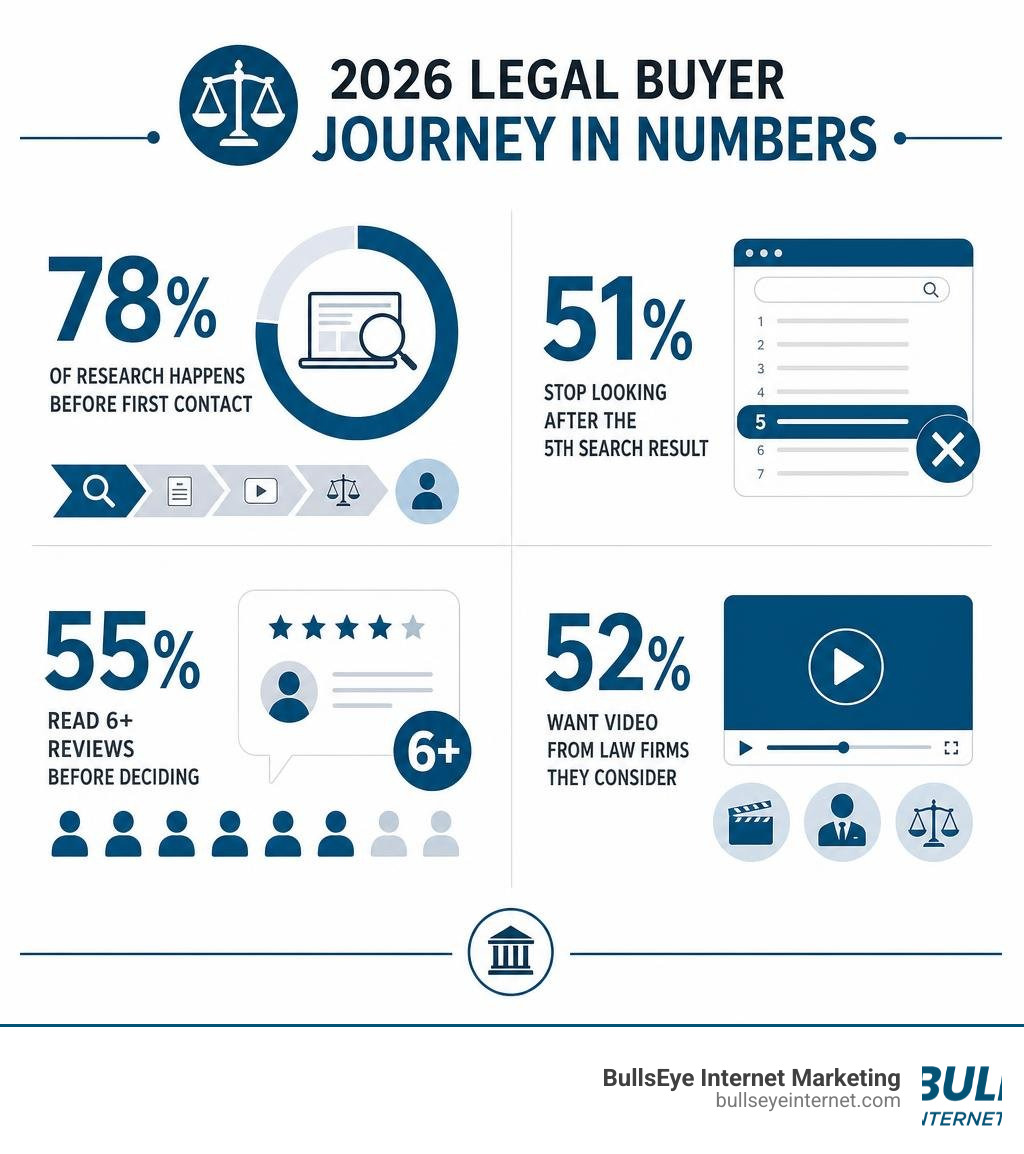
- Build a review generation system — 55% of legal consumers read six or more reviews before deciding
- Track cost per signed case — not just clicks or traffic
- Stay compliant — follow ABA Model Rules 7.1 and 7.2 and your state bar’s advertising rules
The legal industry has changed dramatically. Today, 78% of the buyer journey is complete before a prospect ever contacts an attorney. They’ve already Googled you, read your reviews, watched your videos, and compared you to competitors — all before picking up the phone.
And if you’re not showing up early in that journey, someone else is.
Here’s the other hard truth: 51% of legal consumers stop looking after the fifth search result. If your firm isn’t in that top tier of visibility, you’re essentially invisible to the majority of potential clients.
This isn’t a brand awareness problem. It’s a strategy problem.
I’m Ronnie Katz, founder of BullsEye Internet Marketing, and I’ve spent over 20 years helping businesses — including law firms — build online marketing systems that actually drive calls, consultations, and signed cases. Developing a data-driven attorney marketing strategy is at the core of everything my team does, and this guide distills what we’ve learned into one practical resource.
Simple attorney marketing strategy word guide:
Foundations of a Modern Attorney Marketing Strategy
Many small and solo law firms in South Florida — whether practicing in West Palm Beach, Fort Lauderdale, or Miami — make the mistake of treating marketing as a collection of random, disconnected tactics. They might boost a Facebook post one week, pay for a high-priced directory listing the next, and hope for the best.
To scale past the referral-only ceiling, you need a structured blueprint that aligns your business goals with client acquisition. A great starting place is to map out a clear Law Firm Marketing Plan: Top Strategies for Lawyers in 2026 | Clio to ensure you are investing your resources where they actually yield returns.
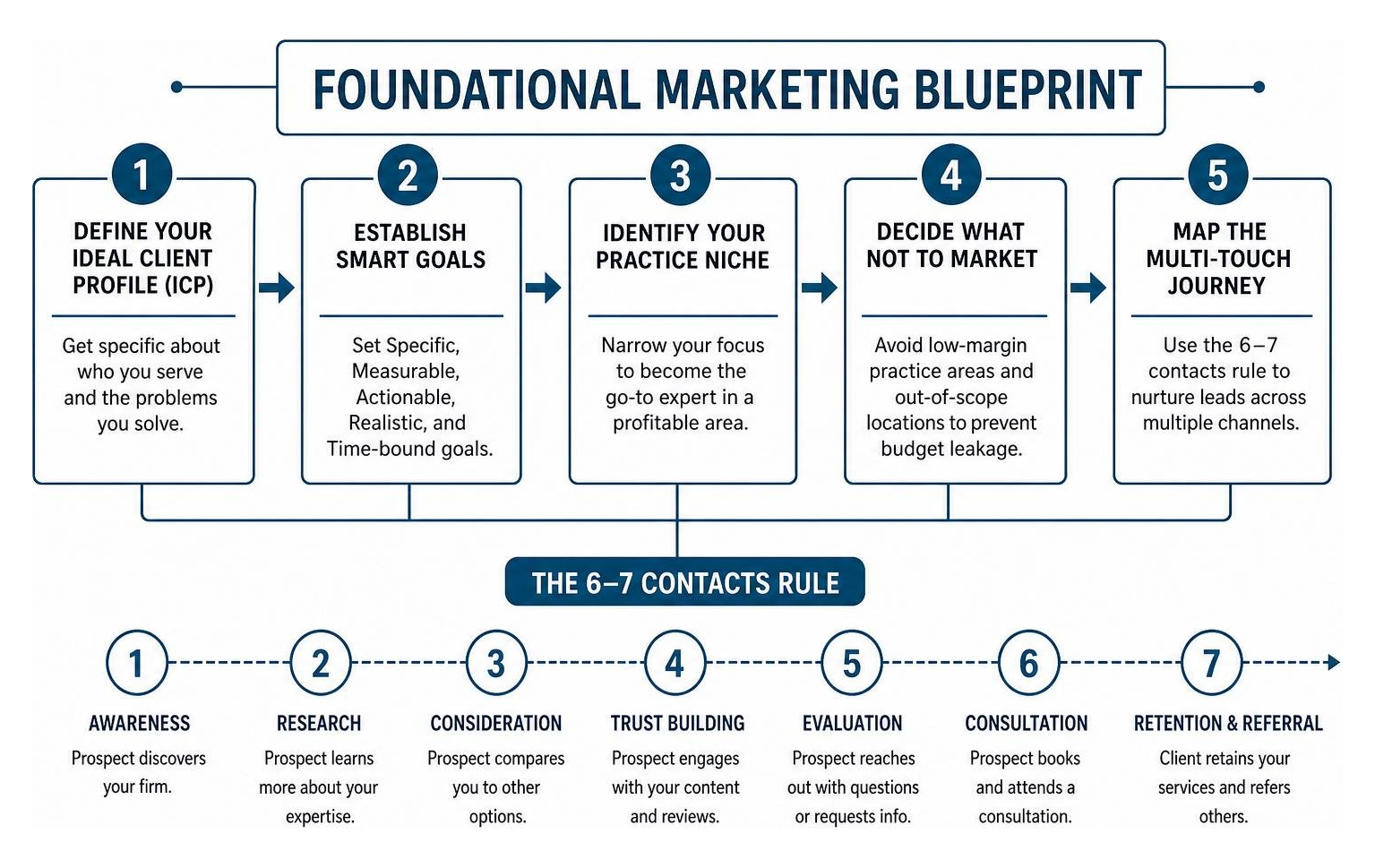
Building an elite attorney marketing strategy requires a step-by-step foundational framework:
- Define Your Ideal Client Profile (ICP): You cannot market to everyone. A family law attorney in Broward County shouldn’t just target “people getting divorced.” Instead, target “high-net-worth professionals in Fort Lauderdale seeking collaborative divorce.”
- Establish SMART Goals: Set business development goals that are Specific, Measurable, Actionable, Realistic, and Time-bound. For example, aim to “acquire 5 new estate planning retainers per month within 90 days.”
- Identify Your Practice Niche: Niche specialization is the ultimate differentiator. When you narrow down your focus, you stop competing broadly with massive firms on generic keywords. Instead, you become the go-to expert. For ideas on specialized campaigns, see our guide on A Comprehensive Guide to Family Law Marketing or explore niche positioning with our resource on Small Law Firm Marketing: From Zero to Client Hero.
- Decide What NOT to Market: Prevent budget leakage by explicitly listing low-margin practice areas or geographic locations outside your operational limits that you will actively avoid targeting.
- Map the Multi-Touch Journey: Remember the 6-7 contacts rule — it generally takes between six and seven touchpoints before a prospective client takes action. Your strategy must nurture leads across multiple channels before they feel comfortable booking a consultation.
Striking the right balance between traditional marketing (like local networking and attorney-to-attorney referrals) and digital tactics is crucial. Traditional methods build deep trust, but they do not scale predictably. By pairing personal networking with digital assets, you amplify those offline connections.
To discover how to bridge this gap, check out Beyond Word of Mouth: Modern Marketing for Legal Services. Transitioning from passive referral reliance to an active client acquisition system is the master key to sustainable growth, as outlined in our guide on Attorney Marketing Solutions: How to Stop Chasing Clients and Start Attracting Them.
The 2026 Digital Marketing Engine: Channels and Execution
In 2026, the digital landscape is highly competitive, yet incredibly rewarding for firms that execute with precision. Over 90% of prospective clients begin their search online. To capture them, your digital marketing engine must run on highly optimized, interconnected channels.

The heart of local client acquisition for small-to-midsize firms in South Florida is Google Business Profile (GBP) optimization and Local SEO. In fact, local searches account for a massive portion of direct calls. If your GBP is incomplete, you are losing cases to local competitors.
To maximize local pack visibility, you must:
- Complete every single field in your profile.
- Upload 20+ high-quality, geotagged photos of your office and team.
- Post updates weekly.
- Consistently generate and respond to client reviews.
Your website acts as your digital closer. It must load in under two seconds, feature an intuitive mobile-responsive design, and present clear calls to action (CTAs). If your site is slow or hard to navigate on a phone, prospective clients will click away instantly.
For a deep dive into building this digital ecosystem, refer to the Foundations of Digital Marketing for Attorneys – Miami-Dade Bar and our complete playbook on Digital Marketing for Law: Complete Guide.
Furthermore, if you are looking to dominate local searches in competitive regions like Palm Beach, Broward, or Miami-Dade, our guide on The Sunshine State of Search: Boosting Your Florida Law Firm’s Online Visibility provides tailored local search insights.
To help you decide where to allocate your resources, let’s compare the performance of key digital channels:
2026 Legal Marketing Channel Performance Comparison
| Marketing Channel | Average Time to First Case | Estimated 12-Month ROI | Primary Metric to Track | Best Suited For |
|---|---|---|---|---|
| Local SEO & GBP | 2–4 months | High (Compounding) | Calls & Directions | Local, high-intent consumer cases (Family, Criminal, PI) |
| Organic SEO & Content | 6–12 months | 526% (3-year average) | Organic Traffic & Leads | Building topical authority, long-term brand equity |
| Google Ads (PPC) | 4–8 weeks | Immediate but variable | Cost per Signed Case | Immediate leads, competitive niches, high-value cases |
| Social Media | 3–6 months | Moderate (Validation) | Engagement & Referral traffic | Professional networking (LinkedIn), brand validation |
High-Intent Paid Search and Google Ads
Pay-Per-Click (PPC) advertising remains one of the fastest ways to generate immediate leads. However, with average legal CPCs ranging from $50 to over $400 in major metro areas like Miami and West Palm Beach, running unoptimized campaigns is an easy way to burn through your budget.
To succeed in paid search, you must combine traditional Google Search Ads with Google Local Services Ads (LSAs). LSAs appear at the very top of search results, operate on a pay-per-lead model rather than pay-per-click, and have outperformed traditional search ads over the past two years by attracting highly qualified clients at a lower cost.
To master these formats, explore our strategic guides on Lawyers Lead the Way: How to Master Google Local Service Ads and How Local Ads for Lawyers Improve Visibility in High Competition Cities.
Additionally, never send paid traffic to your website’s homepage. You must design service-specific, high-converting landing pages. A dedicated landing page that matches the exact intent of the search query (e.g., “DUI defense attorney in Fort Lauderdale”) will easily outperform a generic homepage.
For step-by-step instructions on setting up high-performing paid campaigns, see our comprehensive resources:
- PPC Advertising for Lawyers: Complete Guide
- Lawyer PPC Advertising: Ultimate Guide
- PPC Advertising for Law Firms
Content and Video as an Attorney Marketing Strategy Pillar
Content marketing in 2026 is no longer about stuffing keywords into short blog posts. Search engines and AI answer engines demand high levels of E-E-A-T (Experience, Expertise, Authoritativeness, and Trustworthiness). This is especially true for legal websites, which fall under Google’s strict “Your Money or Your Life” (YMYL) content standards.
An effective content strategy must address the real-world questions your clients ask using natural, empathetic language. For example, instead of writing an academic article on “Florida Statute 61.13,” write a practical guide titled “How Is Child Custody Determined in Broward County?”
To learn how to draft highly authoritative legal content, check out 16 Lawyers Share Their Best Law Firm Marketing Tips | Clio .
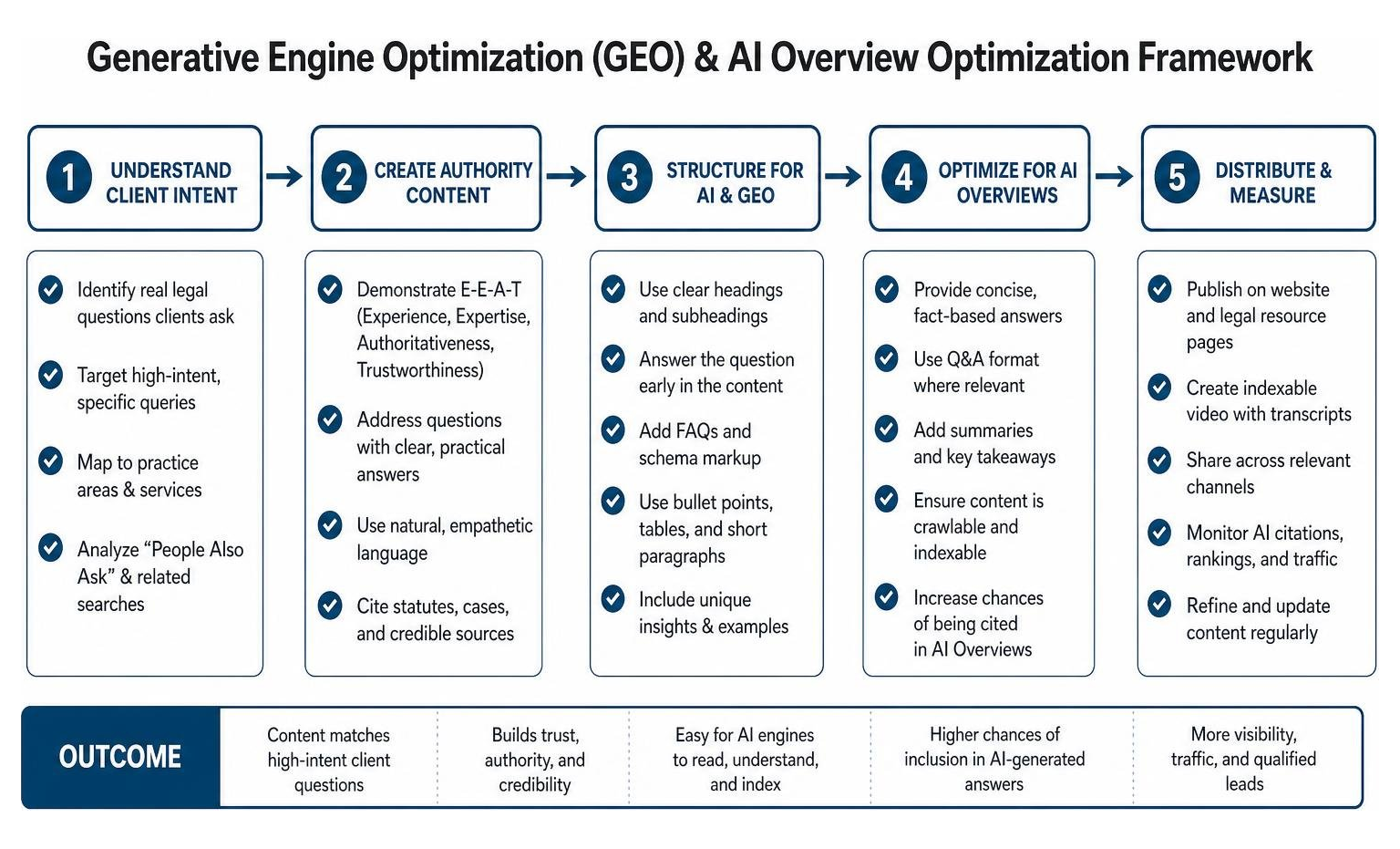
Furthermore, the rise of AI Overviews in search engines has changed organic search dynamics, reducing traditional organic click-through rates by approximately 34% to 35% for top positions. To counter this, firms must optimize for Generative Engine Optimization (GEO). This means structuring your content so AI engines can easily read, synthesize, and cite your firm as the source.
At the same time, video content has become a non-negotiable pillar of modern legal marketing. 52% of potential clients look for videos explaining a firm’s services before making a decision.
Producing indexable video content — such as short, 2-minute answers to frequently asked legal questions uploaded with clean transcripts — allows you to rank in both traditional video search results and AI-generated summaries. It humanizes your firm, builds instant rapport, and breaks down the initial barrier of intimidation that many clients feel.
Compliance, Reputation, and Operational Systems
No matter how brilliant your creative campaigns are, your marketing must remain strictly compliant with professional ethics. Under ABA Model Rules 7.1 and 7.2, as well as local state bar guidelines, you must avoid misleading statements, unsubstantiated comparisons, or promising specific outcomes.
Every marketing asset should include clear disclaimers stating that the information provided does not constitute formal legal advice. For practical compliance solutions, see our guide on Lawyer Advertising Rules & Solutions for Modern Firms.
Beyond compliance, your online reputation is your most valuable digital asset. Consider these powerful statistics:
- 55% of legal consumers read six or more reviews before choosing an attorney.
- 53% of legal consumers will not consider any firm rated below 4 stars.
To build a flawless reputation, you must establish an automated review generation system. Don’t wait until a case is over to awkwardly ask for a review. Instead, build review requests into your standard operational workflow. Send automated email or text prompts immediately after achieving a positive milestone or closing a file.
To explore how small firms can leverage reviews and local involvement, read the Michigan State Bar’s resource on Growth and retention: Marketing tactics for small firms .
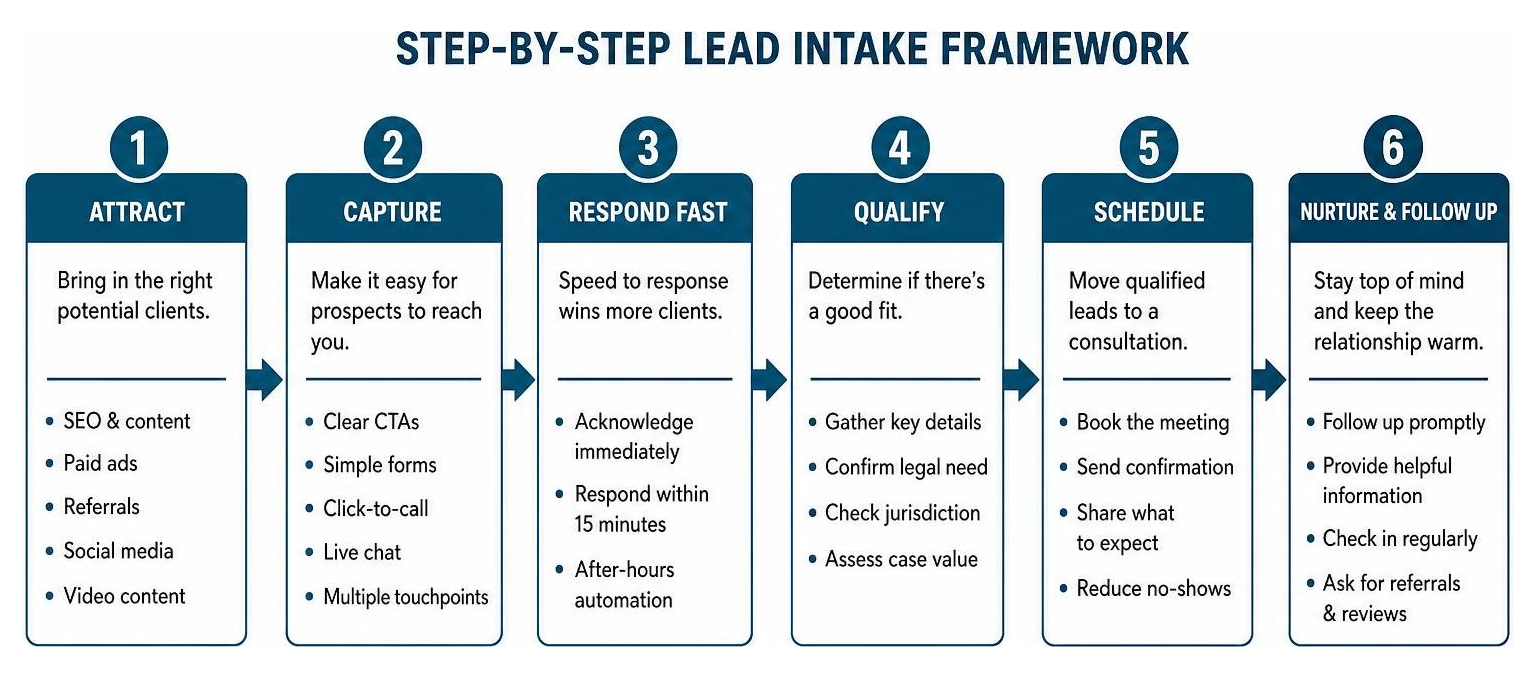
Finally, even the best marketing campaigns will fail if your intake process is broken. If a prospective client calls your office and is put on hold, or fills out a form and doesn’t receive a response within 15 minutes, they will simply call the next attorney on Google.
You must treat intake as a core component of your marketing engine.
Budget Allocation and ROI Tracking in an Attorney Marketing Strategy
To run a highly profitable law practice, you must avoid the most common marketing mistakes:
- Running campaigns without end-to-end attribution.
- Sending paid traffic to a generic homepage.
- Failing to track cost per signed case.
- Stopping SEO campaigns prematurely (before the 6-to-12-month compounding window).
A realistic marketing budget depends on your firm’s size, growth goals, and practice area competitiveness. Generally, law firms allocate between 2% and 10% of their gross revenue to marketing, with high-growth firms pushing above 10% (and sometimes up to 15% to 20% in highly competitive fields like personal injury).
To manage this spend effectively, you must integrate your marketing channels with a legal CRM (like Clio or MyCase). This integration allows you to track the exact source of every lead, consultation, and signed retainer.
By knowing your precise cost per signed case, you can confidently scale the channels that drive profitability and cut the ones that only deliver empty clicks. For a step-by-step guide to building this tracking infrastructure, see our playbook on How to Build a Client Acquisition Machine for Your Law Practice.
Frequently Asked Questions about Law Firm Marketing
How much should a small law firm spend on marketing in 2026?
Most small law firms allocate 7% to 15% of their gross annual revenue to marketing if they are in a growth phase, or 2% to 5% if they are established and looking to maintain their current caseload. For solo practitioners in South Florida, this typically translates to a monthly budget of $1,500 to $3,000, while mid-sized firms often spend $4,000 to $8,000 per month.
How long does it take to see results from legal SEO?
SEO is a long-term, compounding investment. While technical optimizations and local Google Business Profile updates can yield a 20% increase in qualified lead flow within 90 to 120 days, true organic search dominance and sustainable ROI typically take 6 to 12 months to fully materialize. However, the three-year average ROI for law firm SEO is exceptionally high, hovering around 526%.
How can lawyers ethically generate more online reviews?
Attorneys can ethically ask for reviews under ABA rules as long as they do not offer financial compensation, gifts, or discounts in exchange for them. The most effective approach is to automate the request process through your CRM, sending a direct link to your Google Business Profile via email or text immediately after a successful resolution or closing a client’s file.
Achieving Scalable Growth with BullsEye Internet Marketing
Building a high-performing attorney marketing strategy doesn’t have to be overwhelming or require risky, long-term agency commitments.
At BullsEye Internet Marketing, we do things differently. We specialize in generating direct calls and signed cases through Pay Per Lead campaigns, Google Business Profile Optimization, SEO, PPC, and conversion optimization.
Our unique selling proposition is simple: we offer no long-term contracts and work with only one client per industry per geographic area. This gives your South Florida law firm an exclusive, unfair competitive advantage in your local market.
If you are ready to stop chasing leads and start attracting high-value clients across Miami-Dade, Broward, or Palm Beach County, explore An Essential Guide to Advertising for Lawyers or contact us today to claim your exclusive territory!
