
Why Paid Ad Management Is Your Key to Measurable Digital Results
Paid ad management is the strategic process of planning, executing, and optimizing campaigns across platforms like Google, Facebook, LinkedIn, and others to drive measurable business results. Here’s what effective management delivers:
- Targeted Reach – Connect with high-intent audiences actively searching for your products or services
- Measurable ROI – Track every dollar spent and understand exactly what drives conversions
- Cost Control – Optimize campaigns in real-time to eliminate wasted spend
- Faster Results – Generate leads and sales immediately, unlike organic marketing that takes months
- Strategic Scaling – Grow campaigns based on proven performance data
If you’ve been frustrated by high ad costs, low-quality leads, or campaigns that don’t move the needle, you’re not alone. More than half of all marketing budgets (51%) are now dedicated to paid media, yet many businesses struggle to see returns. The challenge isn’t the platforms themselves—it’s the lack of strategic management.
The good news? Visitors who arrive via PPC ads are 50% more likely to convert than those from organic search. When managed correctly, paid advertising becomes a predictable revenue engine, not a money pit.
But here’s the reality: with ad budgets growing and more platforms to consider, it’s easy to lose sight of what’s working. Google’s average cost per click now sits at $5.26, and costs have been rising year over year for the last five years. Without proper management, campaigns quickly become chaotic—generating volume but not value, overwhelming your team, and draining your budget.
I’m Ronnie Katz, founder and Principal CEO of BullsEye Internet Marketing. Since 2006, I’ve helped businesses transform their paid ad management from costly experiments into systematic revenue generators through data-driven strategies and transparent reporting. My approach combines over 20 years of experience with cutting-edge techniques to ensure your campaigns drive actual phone calls and sales, not just clicks.
The Core Components of a Winning Paid Media Strategy
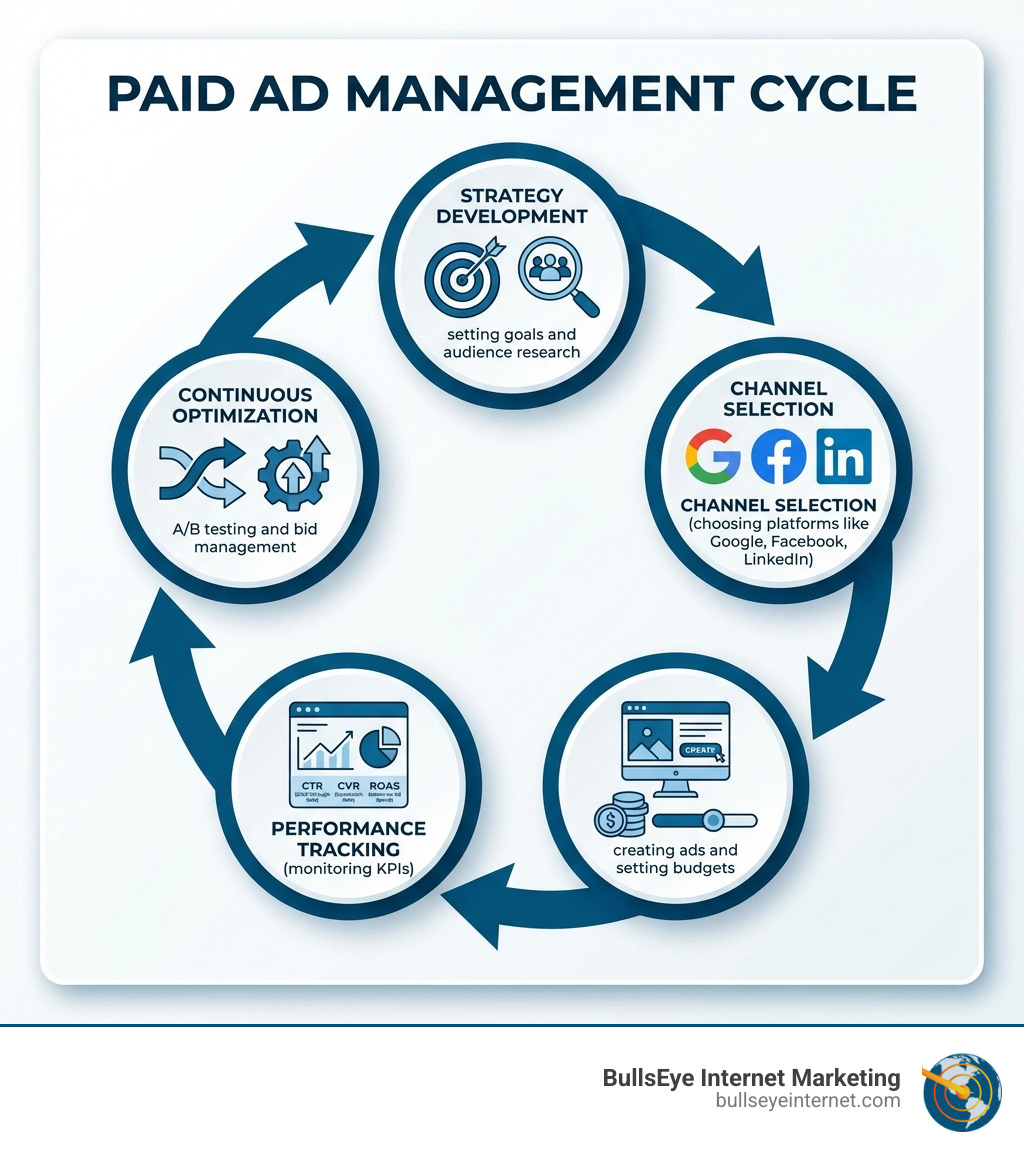
At BullsEye Internet Marketing, we believe that paid ad management isn’t just about spending money; it’s about investing wisely. A winning paid media strategy is a carefully constructed blueprint that aligns every dollar spent with your overarching business objectives. It’s a continuous cycle, much like tending a garden – you plant the seeds, nurture them, prune what isn’t working, and harvest the fruits of your labor.

This strategic process starts with setting crystal-clear marketing goals. We don’t just aim for “more sales”; we define SMART (Specific, Measurable, Achievable, Relevant, Time-bound) objectives. Do we need to boost brand awareness in Broward County, generate leads for a new product in Toronto, or drive direct sales in the UK? Each goal dictates a different approach, channel selection, and budget allocation.
Once goals are set, deep audience research becomes paramount. Who are we trying to reach? What are their pain points, their desires, their online habits? We develop detailed buyer personas, painting a vivid picture of our ideal customer. This isn’t guesswork; it’s data-driven decision-making, increasingly leveraging first-party data (information we collect directly from our customers) to ensure we’re targeting the right people with the right message at the right time. After all, if you’re selling snowshoes in Miami, you might get some clicks, but probably not many conversions!
Finally, strategic budget allocation ensures every penny works hard. We plan budgets with intent, building a strategy that aligns spend with goals across all platforms. This isn’t a “set it and forget it” approach; it’s dynamic, constantly adapting to performance and market shifts.
Aligning Paid Media with Your Business Goals
Defining success in paid ad management goes beyond surface-level metrics. It’s about connecting ad performance directly to your revenue goals. A low cost per click (CPC) is great, but if those clicks don’t convert into calls or sales, they’re just expensive window shopping. Our focus is always on cost per lead (CPL) or cost per acquisition (CPA), which directly indicates how effective our campaigns are at delivering marketing ROI.
However, a crucial aspect often overlooked is aligning your paid media strategy with your operational capacity. Imagine a perfectly optimized campaign that generates 200 high-quality leads in a week, but your sales team can only handle 50. That’s 150 missed opportunities, wasted ad spend, and potentially frustrated prospects. As experts in driving calls and sales, we’ve seen how “too much” growth can lead to overwhelmed internal staff, declining morale, and a drop in efficiency. If your current paid campaigns are generating volume but not value, or worse, creating chaos for your internal teams, it’s time to rethink how they’re managed. We ensure our campaigns are paced to your business’s ability to convert, focusing on lead quality over sheer quantity to prevent team burnout and ensure sustainable growth.
The Critical Role of Data in Paid Ad Management
Data is the lifeblood of effective paid ad management. Without it, we’re flying blind, relying on intuition rather than insight. Our foundation is built on robust analytics, starting with the meticulous implementation of tracking pixels and comprehensive conversion tracking. This allows us to see exactly what happens after someone clicks your ad – whether they fill out a form, make a purchase, or, crucially for many of our clients, make a phone call.
We leverage this data to continually refine targeting and ad messaging. By understanding the customer journey, we can identify where prospects drop off, what resonates with them, and how to guide them more effectively towards conversion. This includes developing a sophisticated first-party data strategy, using the information we gather directly to create highly personalized and effective campaigns. We know that machine learning models are only as good as the data they’re fed, and we’re meticulous about feeding them quality, relevant information. This data-driven approach allows us to make better decisions, stay focused, and get more from every dollar spent.
Choosing the Right Paid Media Channels for Your Objectives
Selecting the right channels for your paid campaigns is like choosing the right tools for a job – you wouldn’t use a hammer to drive a screw! Each platform offers unique strengths, and a well-rounded paid ad management strategy often involves a strategic channel mix to reach your audience wherever they spend their time. We help you diversify your approach, ensuring maximum impact.
| Channel Type | Primary Objectives | Typical Cost Model | Best Use Cases |
|---|---|---|---|
| Search Engine Marketing (SEM) | Awareness, Consideration, Conversion | PPC (Pay-per-Click) | When users have high intent, actively searching for products/services. Ideal for lead generation & sales. |
| Social Media Advertising | Awareness, Consideration, Lead Generation | CPM (Cost-per-Mille), CPC, CPA | Targeting specific demographics, interests, behaviors. Building communities, brand awareness, lead generation (especially B2B on LinkedIn). |
| Display & Video Advertising | Awareness, Consideration, Retargeting | CPM, CPC, CPV (Cost-per-View) | Broad reach for brand visibility, retargeting website visitors, storytelling, product demonstrations. |
Search Engine Marketing (SEM) for High-Intent Audiences
When customers are actively searching for solutions, products, or services that you offer, that’s your golden opportunity. This is where Search Engine Marketing (SEM) shines. As a Google Premier Partner, we help businesses connect with potential customers at the right time on the world’s largest advertising network. This includes Google Ads, where we harness the power of Pay-Per-Click (PPC) to capture high-intent searchers. You only pay when someone clicks your ad, making it an incredibly efficient way to spend your marketing budget.
But don’t stop at Google! Many searchers are not on Google. Did you know you can also connect with millions of searchers that Google can’t reach with targeted Microsoft Ads (formerly known as Bing Ads)? Often, we can replicate your Google Ads success on Microsoft Ads for typically a lower cost. This diversification ensures broader reach and often better ROI.
Effective SEM hinges on meticulous keyword research. We identify the exact terms your target audience is using, ensuring your ads appear for the most relevant searches. Then, we craft compelling ad copy that speaks directly to their needs, enticing them to click. For those who want to dive deeper into how bidding works, understanding the mechanics of About Manual CPC bidding is crucial, though we often use automated strategies to optimize for conversions.
Social Media Advertising for Targeted Reach
While SEM captures demand, social media advertising creates demand and nurtures audiences. These platforms allow for unparalleled targeting capabilities, letting us reach specific demographics, interests, and behaviors.
- Facebook & Instagram Ads: As a Facebook Business Partner, we help businesses get in front of highly targeted audiences with enticing ads. These platforms are fantastic for B2C brand awareness, lead generation, and direct sales, using rich visuals and engaging content.
- LinkedIn Ads: For B2B businesses, LinkedIn is a powerhouse. Did you know LinkedIn members have twice the buying power of average web audiences? LinkedIn is the #1 platform for B2B lead generation, allowing us to target by job title, function, industry, and more. We’ve seen how the lead quality from Sponsored Content on LinkedIn is often higher than any other social platform.
- TikTok Ads: Want to reach a highly engaged, often younger audience? We help businesses get in front of them on the fast-growing social media platform with TikTok Ads. It’s a fantastic channel for brand awareness and driving viral engagement.
Whether it’s B2B targeting on LinkedIn for our clients in Canada or B2C campaigns on Facebook for a local business in Miami, we tailor our approach to ensure your ads resonate with the right people.
Display, Video, and Programmatic Advertising
Beyond search and social, other channels play a vital role in a comprehensive paid ad management strategy.
- Display Advertising: Think of these as banner ads that appear across millions of websites. They’re excellent for brand visibility and keeping your brand top-of-mind. We also leverage retargeting campaigns here, showing ads to people who have previously visited your website, gently nudging them back towards conversion.
- Video Advertising: Platforms like YouTube and Connected TV (CTV) offer powerful ways to tell your brand’s story. We combine the impact of video with the ease and intent of search, engaging audiences with compelling content. Advertising on streaming platforms like Netflix, Max, Hulu, Roku, and findy+ can place your message front and center, reaching users while they’re relaxed and receptive.
- Programmatic Advertising: This is the automated, real-time buying and selling of ad inventory. It allows for incredibly precise targeting and efficiency, ensuring your ads are shown to the most relevant users across the web at the optimal time. It’s like having a super-smart robot bidding on your behalf, maximizing your budget.
Measuring and Optimizing for Maximum ROI
The beauty of paid ad management is its measurability. Unlike traditional advertising, we don’t just hope for results; we track, analyze, and optimize every step of the way. This is where the magic happens – turning raw data into actionable insights that drive real business growth. Our optimization cycle is relentless, constantly striving for continuous improvement.

Key Performance Indicators (KPIs) You Must Track
To truly understand campaign performance, we obsess over Key Performance Indicators (KPIs). These metrics tell us what’s working, what’s not, and where to adjust our strategy.
- Click-Through Rate (CTR): The percentage of people who see your ad and click on it. A higher CTR often indicates a more relevant and engaging ad. The average CTR in Google Ads for 2025 is 6.66%.
- Cost Per Click (CPC): How much you pay each time someone clicks your ad. The average CPC in Google Ads for 2025 is $5.26, and these costs have been increasing year over year for the last five years. Our goal is to always get the most value for your clicks.
- Conversion Rate (CVR): The percentage of people who click your ad and then complete a desired action (like filling out a form or making a purchase). The average CVR in Google Ads for 2025 is 7.52%. A high conversion rate indicates your ads are showing to interested potential customers with compelling ad copy, and your landing page is optimized for the buyer’s journey.
- Cost Per Lead (CPL): The total cost divided by the number of leads generated. This is a critical metric for our clients focused on lead generation. The average CPL in Google Ads for 2025 is $70.11. We constantly work to lower this for you.
- Return on Ad Spend (ROAS): The revenue generated for every dollar spent on advertising. This is the ultimate measure of direct profitability. For example, some businesses see a 267% increase in ROAS by leveraging Shopping ads.
- Customer Acquisition Cost (CAC): The total cost of acquiring a new customer. This helps us understand the long-term value of our campaigns.
These Google Ads benchmarks provide a valuable reference point, but our focus is always on your specific business goals and improving your unique performance metrics.
Best Practices for Effective Paid Ad Management
Effective paid ad management is an art and a science, combining strategic thinking with meticulous execution. Here are some of our core best practices:
- A/B Testing Ad Creative: We constantly test different headlines, ad copy, images, and video creatives to see what resonates best with your audience. What works in Florida might be different from what works in the UK!
- Landing Page Optimization: Your ad is only half the battle. The landing page it leads to must be equally compelling and aligned with the ad’s message. We design landing pages that captivate audiences and guide them towards desired actions, ensuring a seamless user journey.
- Keyword Refinement & Negative Keyword Lists: We continuously review and refine our keyword lists to target high-intent, transactional terms. Equally important is building negative keyword lists to prevent your ads from showing for irrelevant searches, which can quickly eat into your budget (e.g., if you sell luxury watches, we’d add “free” or “replica” to your negative list).
- Bid Management Strategies: Whether it’s Manual CPC bidding for fine-tuned control or advanced automated strategies, we manage your bids to ensure optimal placement and cost-efficiency. Our goal is to get you the most bang for your buck, always.
Common Challenges and How to Overcome Them
Even with the best intentions, paid ad management comes with its share of problems. We’ve steerd these challenges for countless businesses, turning obstacles into opportunities.
- Wasted Ad Spend: On average, we find that 68% of ad spend is wasted. This can stem from poor targeting, irrelevant keywords, or unoptimized campaigns. Our solution? Relentless optimization, data-driven decisions, and transparent reporting to ensure every dollar is accounted for and working towards your goals.
- Rising Ad Costs: Search advertising costs have been increasing year over year, and the average CPC in Google Ads is now $5.26. This trend isn’t going away. We overcome this by improving Quality Scores, refining targeting to reach more receptive audiences, and ensuring conversion rates are as high as possible so that even if the click costs more, the lead is more valuable.
- Ad Fatigue: Even the best ad can get stale. Users see the same ad too many times and stop noticing it, or worse, get annoyed. We combat ad fatigue with continuous A/B testing, fresh creative, and dynamic ad formats to keep your message engaging and effective.
- Tracking Issues in a Privacy-Focused World: With increasing privacy regulations and browser restrictions, tracking conversions can get tricky. Cross-device usage and varying consent choices create measurement gaps. We leverage advanced tracking solutions and first-party data strategies to maintain accurate measurement and feed machine learning models with quality data, ensuring we stay compliant while still optimizing for results.
- Scaling Campaigns Effectively: Growing too fast without the operational capacity to handle new leads can be detrimental. We work closely with our clients to align ad spend with their sales and service capabilities, ensuring that increased lead volume translates into sustainable business growth, not just chaos.
Conclusion: Achieve Sustainable Growth with Expert Management
Paid ad management is not a one-time setup; it’s a dynamic, strategic cycle that requires constant attention, data analysis, and optimization. It’s about leveraging data to build the most effective ad campaigns possible, making better decisions, and getting more from every dollar spent. Data is truly the cornerstone of success, guiding every decision we make to ensure continuous improvement and maximum ROI.
At BullsEye Internet Marketing, we understand the nuances of this complex landscape. We specialize in generating calls and sales through expert PPC management, Google Business Profile Optimization, SEO, and conversion optimization. Our unique approach means we offer no long-term contracts, because we believe our results should speak for themselves. Furthermore, we work with only one client per industry per geographic area, ensuring you have a competitive advantage in your local market, whether that’s Miami, Toronto, or London. This exclusivity means we’re fully invested in your success, not just running generic campaigns.
If you’re ready to transform your paid advertising from a cost center into a predictable revenue engine, we’re here to help. Let us apply our expertise to your business, driving the calls and sales you need for sustainable growth.
