
Why Pay Per Call Marketing is Revolutionizing Lead Generation
A pay per call company connects businesses with high-intent customers who are ready to make a purchase decision. Here’s what you need to know:
What Pay Per Call Companies Do:
- For Advertisers: Generate qualified phone leads where you only pay when potential customers call your business
- For Publishers/Affiliates: Earn high commissions (often $50-$1700+ per lead) by driving phone calls to advertisers
- Core Model: Performance-based marketing where payment occurs only for qualified calls that meet specific criteria (duration, caller intent, location)
Types of Pay Per Call Companies:
- Affiliate Networks – Connect publishers with pay per call offers (Marketcall, PALO, RingPartner)
- Call Tracking Platforms – Provide technology for tracking and attribution (Invoca, Ringba)
- Full-Service Agencies – Manage complete pay per call campaigns from strategy to execution
Unlike traditional pay-per-click advertising where you pay for every click regardless of quality, pay per call ensures you’re only investing in leads with genuine purchase intent. The model has proven particularly effective in high-value industries like home services, insurance, legal, and healthcare—where a single qualified call can generate hundreds or even thousands of dollars in revenue.
The shift from clicks to conversations represents a fundamental change in performance marketing. When customers pick up the phone, they’re typically further along in the buying journey and more likely to convert. Research shows contact centers see conversion rates increase by over 110% when implementing proper pay per call strategies, with some businesses reporting ROAS growth of 1500% after optimizing their call tracking and routing.
I’m Ronnie Katz, founder and Principal CEO of BullsEye Internet Marketing, and since 2006 I’ve helped businesses leverage pay per call company strategies to generate qualified leads and measurable ROI. My expertise in performance marketing and call tracking has enabled clients across multiple industries to transform their phone lines into profit centers while maintaining complete transparency and control over their marketing investment.
How to Identify a Top-Tier Pay Per Call Company
When we’re looking for a pay per call company to partner with, or when we help our clients evaluate their options, we focus on several critical features that ensure a successful, transparent, and profitable relationship. It’s not just about getting calls; it’s about getting the right calls that turn into real business.

First and foremost, transparent pricing models are non-negotiable. We believe you should know exactly what you’re paying for and what you’re getting in return. This includes clear agreements on cost per call, billable duration, and what constitutes a “qualified” call. Our philosophy at BullsEye Internet Marketing is built on this transparency, offering no long-term contracts and working with only one client per industry per geographic area to ensure a competitive advantage. This means if you’re a plumber in Miami, we’re not working with another plumber down the street.
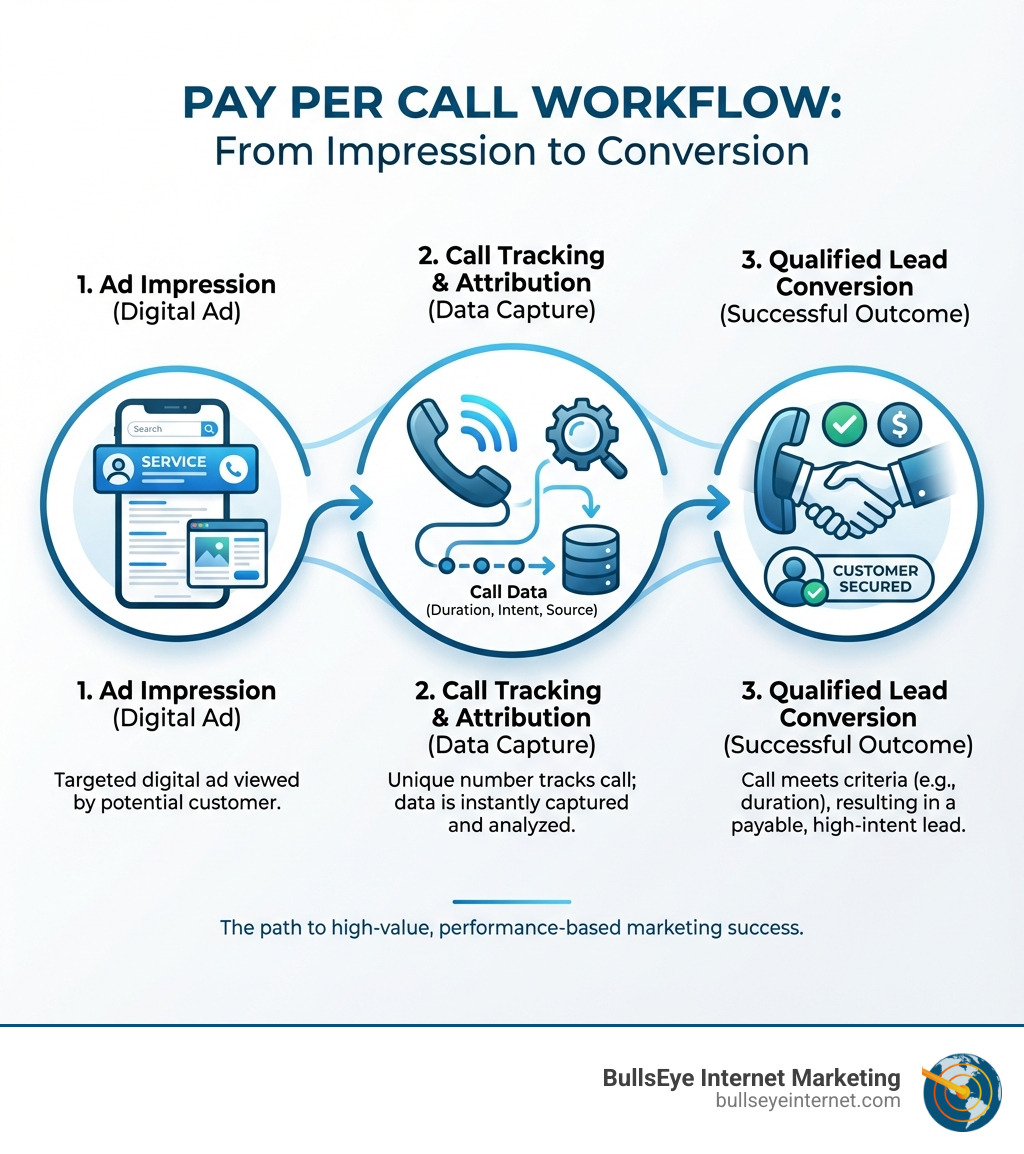
Advanced call tracking is the backbone of any effective pay per call strategy. This isn’t just about knowing how many calls you received; it’s about understanding their origin, quality, and outcome. Companies like Marketcall, for instance, are known for their in-house call tracking technology, while Aragon Advertising leverages proprietary call routing and ping/post technology. For us, it’s about ensuring every call is traceable to its source, allowing for precise attribution and optimization.
Real-time analytics go hand-in-hand with advanced tracking. Imagine having an online control panel with real-time reporting, giving you immediate insights into your campaign’s performance. This kind of detailed statistics and analytics, as offered by platforms like Invoca, provides full visibility and attribution for valuable call conversions. It helps us make quick, informed decisions to adjust campaigns for maximum efficiency.
Industry specialization can also be a significant advantage. Some pay per call company providers excel in specific verticals, understanding the unique nuances of lead generation for those industries. Whether it’s home services, legal, or insurance, a company with deep industry knowledge can often deliver higher-quality leads.
Finally, fraud prevention technology is an often-overlooked but crucial aspect. In performance marketing, ensuring that the calls you’re paying for are legitimate and high-quality is paramount. Reputable networks and agencies integrate mechanisms to prevent fraudulent calls, protecting your investment. And of course, dedicated support from account managers, like those emphasized by PALO, ensures you always have someone to turn to for assistance and optimization advice.
Essential Technology and Tools to Look For
When diving deeper into the technological capabilities of a pay per call company, we look for a suite of tools that empower us to not just track, but truly optimize and understand every customer interaction.
AI-powered analytics are rapidly changing the industry. Invoca, for example, highlights its AI-powered call tracking & analytics, which goes beyond basic reporting to provide deeper insights into conversations. This allows for more sophisticated campaign optimization and even AI-powered lead-to-call automation, as seen with platforms like CallX. This kind of intelligence helps us understand caller intent, identify trends, and fine-tune our targeting.
Robust call routing technology is essential, especially for businesses with multiple locations across Florida, such as our clients in Miami-Dade, Broward, and Palm Beach Counties. Proprietary call routing solutions, like those from Aragon, ensure that calls are directed to the most appropriate location or department in real-time. This dynamic call distribution to buyers ensures that every lead reaches the right person, maximizing conversion potential.
CRM integration capabilities are vital for a seamless sales and marketing funnel. Being able to connect call data directly into your customer relationship management system allows for better lead nurturing, follow-up, and a holistic view of the customer journey. Invoca offers dozens of no-code and low-code integrations, making it easier for businesses to leverage their first-party customer data.
Dynamic number insertion is another powerful tool. This technology displays different phone numbers on your website or landing pages based on how a visitor arrived (e.g., from a specific ad, a particular keyword, or a different geographic area). This allows for incredibly granular tracking, helping us attribute calls to the exact marketing source that drove them.
Finally, comprehensive reporting dashboards are critical. We need clear, actionable data. Monthly call detail reports, like those provided by Hibu, give us insights into caller information, call duration, and even voice links to listen to calls. An online control panel with real-time reports ensures we always have our finger on the pulse of your campaigns.
Vetting a Potential Pay Per Call Company Partner
Choosing the right pay per call company is a pivotal decision. We approach this vetting process with meticulous attention to detail, ensuring that our partners align with our commitment to quality and results, especially for our clients located across Florida, from Jacksonville to the Florida Keys.
First, we arm ourselves with a set of crucial questions to ask:
- How do you define a “qualified call,” and what are your specific criteria for billing? (This is perhaps the most important question!)
- What call tracking and analytics technology do you use? Can we see a demo of your reporting dashboard?
- What kind of fraud prevention measures are in place?
- Do you offer geo-targeting capabilities down to the city level, which is critical for our clients in places like Miami, Fort Lauderdale, or West Palm Beach?
- What are your payment terms and methods?
- Can you provide case studies relevant to our industry and geographic area?
Reviewing case studies is invaluable. We look for tangible results, like the 1500% ROAS growth achieved by Matterport or the 34% increase in new customers with a 17% drop in cost per acquisition that some businesses have seen. These examples provide concrete evidence of a company’s ability to deliver.
Understanding their definition of a qualified lead is paramount. We want to ensure that we’re only paying for calls that genuinely represent a potential customer, not just someone who dialed for a few seconds by mistake. Companies like Marketcall and Hibu emphasize paying only for qualified calls, which protects your budget.
At BullsEye Internet Marketing, our business model stands out with its commitment to no long-term contracts. This flexibility ensures that our clients are always satisfied with our performance, as we continuously strive to deliver exceptional results without locking them into lengthy agreements.
Furthermore, we offer geographic exclusivity. This means we work with only one client per industry per geographic area. For example, if you’re an HVAC company serving Broward County, we won’t work with another HVAC company in the same county. This ensures you have a unique competitive advantage in your local market, whether that’s Miami, Fort Lauderdale, or any of the numerous cities we serve across Florida. This customizable offering allows us to organize traffic funneling to specific cities, counties, and states, providing a vast yet incredibly detailed reach for your business.
The Dual Advantage: Why Advertisers and Publishers Win
The beauty of the pay per call company model lies in its synergistic relationship, creating a win-win scenario for both advertisers (businesses seeking leads) and publishers (affiliates generating calls). It’s a performance-based model where everyone’s success is directly tied to tangible results – qualified phone calls. This allows for effective monetization of traffic for publishers and efficient customer acquisition for advertisers.

Benefits for Advertisers
For advertisers, partnering with a reliable pay per call company is like having a secret weapon for customer acquisition. We’ve seen how this model can transform marketing budgets into predictable revenue streams for our clients across Florida.
One of the biggest advantages is access to higher quality leads. When someone picks up the phone, they’re typically further down the buying funnel, often with an immediate need or strong intent to purchase. This contrasts sharply with many online forms or clicks. As Hibu points out, they deliver “high-quality, purchase-ready leads” by paying only for qualified calls.
This focus on quality translates directly into improved ROI. Forget vanity metrics; we’re talking about real results. Invoca’s data highlights impressive gains: a +110% higher contact center close rate, a +47% increase in appointments booked, a +45% increase in marketing-driven leads, and a +50% increase in sales from paid search. Some businesses have even reported a staggering 1500% ROAS growth and a 34% increase in new customers with a 17% drop in cost per acquisition by leveraging these strategies.
The core principle here is paying for results. With a pay per call company, you only invest when a qualified call comes in. This minimizes wasted ad spend, allowing you to cut efforts on ineffective campaigns and focus your budget where it truly counts. This model ensures better sales conversion rates because you’re engaging with customers who are genuinely interested and ready to convert.
Furthermore, advertisers gain access to granular campaign data. Platforms like Marketcall provide detailed statistics and analytics, offering full visibility and attribution for every call. This data allows for continuous optimization, ensuring that your campaigns are always performing at their peak. We can pinpoint hidden inefficiencies in your funnel, refine targeting for our clients in specific Florida cities like Coral Springs or Doral, and align ad spend with actual revenue impact.
Benefits for Publishers (Affiliates)
For publishers and affiliates, the pay per call company model offers an incredibly lucrative opportunity to monetize their traffic, often with significantly higher payouts than traditional affiliate marketing.
One of the most attractive aspects is the potential for high commission payouts. We’re not talking about pennies here; some payouts offer several hundred dollars for a single lead, and some networks provide offers in the region of $1700 for a single lead. Even niches like dating can pay $50–$100 alone per call, with a starting commission of $15 per fixed lead being common across various industries.
This model is particularly effective for monetizing mobile traffic. With the vast majority of consumers now accessing the internet via mobile devices, pay-per-call offers high-growth revenue streams from mobile that are best by other methods. Goojibear’s specialization in mobile optimization underscores how well-positioned these companies are to capture the growing trend of consumer behavior shifting towards mobile.
Publishers also benefit from a diverse range of offers available. Whether your audience is interested in auto insurance, payday loans, online college degrees, legal services, or home improvement, there are ready-to-go offers in popular niches. This variety allows publishers to select campaigns that best align with their audience, maximizing relevance and conversion potential.
The model also offers significant passive income potential. Once a campaign is set up and optimized, it can continue to generate calls and commissions with ongoing monitoring and fine-tuning.
Finally, prompt payment schedules are a huge plus for publishers. Many networks, including Marketcall and WeCall Media, offer weekly payouts, while others have timely payment structures like Net 15. This consistent cash flow is vital for affiliates to reinvest and scale their operations.
Pay Per Call vs. Other Models: A Comparative Look
When we talk about digital marketing, there are many avenues to generate leads and sales. Pay Per Call (PPC), Pay Per Click (PPC), and Cost Per Acquisition (CPA) are three common models, but they each serve different purposes and offer distinct advantages. Understanding these differences is key to choosing the right strategy for your business, especially if you’re targeting specific markets in Florida, from Palm Beach County to Miami-Dade.
| Metric | Pay Per Call (PPC) | Pay Per Click (PPC) | Cost Per Acquisition (CPA) |
|---|---|---|---|
| Lead Quality | High (customers often have immediate intent) | Variable (depends on keyword/ad relevance) | High (payment for specific conversion event) |
| Cost | Generally higher per lead (but higher value) | Lower per click (but many clicks may not convert) | Variable (cost per sale, form fill, etc.) |
| Tracking Complexity | Moderate to High (requires call tracking software) | Low (standard web analytics) | Moderate (requires conversion tracking setup) |
| Typical ROI | High (due to high conversion rates) | Variable (can be optimized for good ROI) | High (direct correlation to desired outcome) |
| Search Intent | Very high (phone calls often indicate urgency) | High (if keywords are specific) | High (user completes a desired action) |
| Interaction Type | Direct voice conversation | Website visit | Website visit leading to specific action |
Pros of Pay Per Call:
- High Intent: As we mentioned, when someone calls, they usually have an immediate need or high intent to purchase. This makes them warmer leads.
- Higher Conversion Rates: These high-intent leads generally convert at a much higher rate than clicks or form fills. Contact centers often see significantly higher close rates.
- Personalized Interaction: A phone call allows for immediate, personalized engagement, which can build trust and address specific customer needs.
- Reduced Wasted Spend: You only pay for qualified calls, meaning your budget is allocated to actual potential customers, not just curious browsers. This aligns perfectly with our goal of turning marketing into measurable growth.
Cons of Pay Per Call:
- Higher Cost Per Lead: The cost per qualified call can be higher than a simple click, but the value and conversion rate often justify this.
- Requires Robust Tracking: Implementing advanced call tracking software is essential to ensure proper attribution and qualification of calls.
- More Effort for Publishers: While lucrative, generating calls can require more strategic effort than simply driving clicks.
When to Choose Each Model:
- Pay Per Click (PPC): Excellent for generating brand awareness, driving traffic to informational content, or for products with a lower price point where the sales cycle is shorter and conversion can happen quickly online. It’s about casting a wider net.
- Cost Per Acquisition (CPA): Ideal when your primary goal is a specific online action, like a form submission, app download, or direct online sale. You only pay when that specific acquisition occurs.
- Pay Per Call: Our preferred model for high-value services and products, especially those with a longer sales cycle or requiring complex consultations. Think home services (HVAC, plumbing), legal, insurance, or financial services. These are the industries where a direct conversation is often the most effective path to conversion.
The choice depends on your business goals and the nature of your service. For our clients across Florida, we often find that the direct engagement and high intent of a phone call make pay per call an incredibly effective strategy for driving revenue.
Launching Your First Campaign: A Strategic Guide
Starting on your first pay per call campaign can feel like navigating a new galaxy, but with a strategic approach, we can ensure your efforts hit the bullseye. It’s about setting up for success, budgeting intelligently, and continuously optimizing for conversions.
Campaign setup involves defining your target audience, selecting the right offers, and configuring your tracking systems. For our clients in specific Florida locations like Hollywood, Kendall, or Tallahassee, this means hyper-local targeting and tailoring ad copy to resonate with local needs.
Budgeting for performance is where pay per call truly shines. Instead of blindly spending, you’re investing in potential customer interactions. This aligns with our agency’s focus on aligning ad spend with actual revenue impact, ensuring that every dollar spent is working towards a conversion.
Optimizing for conversions is an ongoing process. We constantly analyze call data, refine our targeting, and adjust our strategies to improve the quality and quantity of calls. This continuous feedback loop is crucial for maximizing your return on investment.
Finding Your Niche: Top Verticals for Pay Per Call
Not all industries are created equal when it comes to pay per call. Some verticals naturally lend themselves to phone-based conversions due to the nature of the service, urgency, or complexity. For our clients across Florida, we’ve identified several key areas where pay per call thrives:
- Home Services: This is a huge one for us. When a pipe bursts in Fort Lauderdale or an AC unit breaks down in Miami, people don’t usually fill out a form; they call! Lead Smart Inc. focuses specifically on lead generation for local services, particularly for home improvement and contractors. Industries like HVAC, plumbers, and appliance repair, as highlighted by Hibu, are perfectly suited.
- Legal Services: Whether it’s a personal injury case in Orlando or a family law matter in Tampa, legal issues often require immediate, confidential, and detailed conversations. People call lawyers, they don’t typically click “buy now.”
- Insurance: Auto, home, or health insurance often involves comparing quotes, discussing coverage, and asking specific questions. Calls convert well here, with auto insurance being a popular pay per call offer.
- Finance & Loans: For services like payday loans or mortgage inquiries, customers frequently prefer to speak directly with an agent to discuss sensitive financial details and options. Marketcall, for example, focuses on verticals like finance.
- Healthcare: From scheduling appointments with a specialist in Gainesville to discussing medical procedures, many healthcare decisions are made over the phone.
- Travel: While online booking is common, complex travel arrangements, group bookings, or urgent changes often lead to a phone call. Marketcall also includes travel in its focused verticals.
- Auto Services: When your car breaks down near Naples or you need a specific repair, a direct call to a mechanic or dealership is the fastest route to a solution.
These industries share common characteristics: a sense of urgency, high-value transactions, or the need for personalized consultation, all of which make a phone call the preferred method of communication for potential customers.
Understanding Payouts from a Pay Per Call Company
Navigating the financial side of pay per call involves understanding commission structures, payout methods, and, crucially, what defines a “qualified call.”
Commission structures in pay per call are generally performance-based. This means payment is usually made per each call, though it can also include per-customer conversion or lead. For publishers, this can be a lucrative model, with some offers providing hundreds of dollars for a single lead. For advertisers, it means you’re only paying when a genuine potential customer connects with your business.
Payout methods vary among different pay per call company providers and networks. Weekly payouts are common, offered by companies like Marketcall and WeCall Media. Other typical methods include ACH Transfer, PayPal, and Wire Transfer, with payout terms ranging from Net 15 to Net 30, meaning payment within 15 or 30 days after the end of the billing period.
Duration-based payouts are a key aspect of many pay per call campaigns. With this model, you might only pay for calls that last a certain minimum duration (e.g., 60 seconds). This “billable duration,” as Hibu describes it, is a critical component of defining a qualified call. It filters out hang-ups or accidental dials, ensuring you pay only for meaningful conversations.
Some models also incorporate revenue share models, where the affiliate earns a percentage of the revenue generated from the call. However, the most common and transparent approach is the flat fee per qualified call.
The most important factor is what defines a ‘qualified call’. This is the bedrock of the entire pay per call model. A qualified call is not just any call; it’s a call that meets specific, pre-agreed-upon criteria. These criteria often include:
- Call Duration: As mentioned, a minimum talk time is usually required.
- Caller Intent: The caller must express a genuine interest in your service or product.
- Geo-targeting: The caller must be located within your specified service area. For our clients, this is precisely targeted to cities like Naples, Gainesville, or the broader South Florida region.
- Specific Actions Taken: Sometimes, a call is qualified only if the caller reaches a specific department, requests a quote, or completes an IVR (Interactive Voice Response) qualification process.
By clearly establishing these qualifications upfront, both advertisers and the pay per call company ensure that payments are fair and that the leads generated are genuinely valuable.
Frequently Asked Questions about Pay Per Call Marketing
We often get a lot of questions about how pay per call works, especially from businesses looking to optimize their marketing budget and truly understand their return on investment. Let’s tackle some of the most common ones.
How much can you earn with pay per call?
The earning potential in pay per call is quite impressive, both for advertisers (in terms of ROI) and for publishers (in commissions). It really depends on the industry, the value of the lead, and the specific campaign.
For publishers, payouts can vary significantly:
- Some offers might be as low as $10 per lead, while others can go as high as $900 per lead, as seen with companies like Service Direct.
- We’ve seen reports of some networks providing offers in the region of $1700 for a single lead in certain high-value verticals.
- Even specific niches, like dating, can pay $50–$100 alone per call.
- More general offers might range from $2-$20 per lead, or between $11.50 and $400 per call, depending on the service.
- Averages often hover around $20 per lead but can reach up to $80 per lead, with a starting commission of $15 per fixed lead being a good benchmark.
The key factors influencing these earnings are:
- Niche: High-value services like legal, insurance, home services, and finance tend to have higher payouts. Even offers in areas like auto insurance, payday loans, online college degrees, and lawyers are known for strong commissions.
- Call Quality: Higher quality, more qualified calls naturally command better rates.
- Network/Agency: Different pay per call company providers and networks will have varying commission structures.
- Geo-targeting: Specific, highly targeted geographic areas, like the populous cities and counties of Florida, can sometimes yield higher payouts due to increased demand and competition among advertisers.
For advertisers, the “earning” is in the ROI. By paying only for qualified calls that convert at a high rate, businesses significantly reduce wasted ad spend and see a much stronger return on their marketing investment.
What makes a call “qualified” in pay per call?
This is perhaps the most crucial question in the entire pay per call model. A “qualified” call is not just any incoming call; it’s a call that meets specific, predefined criteria set by the advertiser and the pay per call company. These criteria are designed to ensure that the call represents a genuine sales opportunity, making it worth the investment.
Here are the common elements that define a qualified call:
- Call Duration: Often, a minimum call duration is required for a call to be considered qualified. For instance, a call might need to last at least 30, 60, or 90 seconds. This “billable duration,” as mentioned by Hibu, helps filter out accidental dials or calls from people who quickly realize they’ve reached the wrong number.
- Caller Intent: The caller must express a genuine interest in the specific product or service being advertised. This can be determined by the conversation’s content (often analyzed by AI or human review) or by specific prompts within an IVR system.
- Geo-targeting: For local businesses, the caller must be located within a specific geographic service area. For our clients, this could mean ensuring the caller is in Miami, Fort Lauderdale, West Palm Beach, or any of the cities and counties we target across Florida. Our customizable offerings organize traffic funneling to specific states, counties, and cities to ensure this precision.
- Specific Actions Taken: In some cases, a call is only qualified if the caller takes a particular action, such as requesting a quote, scheduling an appointment, or reaching a specific department within your business.
- IVR Qualification: An Interactive Voice Response (IVR) system can be used to pre-qualify calls. For example, a caller might be asked to press ‘1’ for sales or ‘2’ for customer service, or to enter their zip code to confirm their location. This helps ensure that only relevant calls are routed to the advertiser and billed.
By clearly defining these parameters, both the advertiser and the pay per call company have a transparent understanding of what constitutes a valuable lead, ensuring fair compensation and effective lead generation.
How is technology like AI changing the pay per call industry?
Technology, particularly Artificial Intelligence (AI) and advanced call tracking software, is revolutionizing the pay per call industry, making it more efficient, precise, and profitable than ever before. This is especially true for companies like Invoca, which leads the charge in this area.
Here’s how AI is impacting the pay per call space:
- Predictive Analytics: AI can analyze vast amounts of data to predict which marketing channels, keywords, or demographics are most likely to generate high-converting calls. This allows for proactive campaign optimization, ensuring ad spend is directed towards the most promising leads.
- Conversation Intelligence: AI-powered call tracking and analytics platforms, often referred to as “conversation intelligence,” can transcribe and analyze call recordings. Invoca’s Signal AI, for instance, can identify keywords, sentiment, and outcomes within calls, providing deep insights into caller intent, agent performance, and what makes a call qualified. This helps businesses like ours understand the value of every call from search and digital advertising.
- Automated Call Scoring: AI can automatically score calls based on predefined criteria, such as call duration, keywords spoken, and whether a sales-related event occurred. This “AI-powered lead-to-call automation,” as seen with CallX, streamlines the qualification process, reducing manual effort and improving accuracy.
- Fraud Detection: AI algorithms are highly effective at identifying patterns indicative of fraudulent calls. This helps pay per call company providers and advertisers protect their budgets by ensuring they only pay for legitimate leads. Marketcall, for example, emphasizes its fraud prevention mechanisms.
- Campaign Optimization: With AI-driven insights, campaigns can be optimized in real-time. This means adjusting bids, pausing underperforming ads, or shifting budget to top-performing sources to maximize ROI. As one B2C marketing agency noted, AI helps “refine your targeting, and align your ad spend with actual revenue impact.” This leads to more efficient spending and better results, as seen in cases where businesses achieve a 1500% ROAS growth.
These technological advancements are changing calls from a notoriously difficult-to-track conversion into a fully measurable, optimizable, and highly valuable lead source, ensuring that every customer interaction contributes to revenue growth.
Conclusion: The Future of Performance Marketing is a Phone Call
The landscape of digital marketing is always evolving, and the future trends clearly point towards a continued surge in the importance of direct, high-intent customer interactions. For us, the future of performance marketing is undeniably intertwined with the phone call. Even though pay per call is still at an early stage of development, its potential for generating high-value leads is undeniable.
AI and automation will continue to play an increasingly central role, refining everything from call tracking and routing to conversation intelligence and fraud prevention. This means campaigns will become even more precise, efficient, and capable of delivering truly qualified leads. We anticipate further advancements in predictive analytics and automated call scoring, making the process of connecting businesses with their ideal customers smoother than ever before.
In this dynamic environment, the importance of a strategic partner cannot be overstated. You need a pay per call company that understands these trends, leverages cutting-edge technology, and, most importantly, prioritizes your success. At BullsEye Internet Marketing, we pride ourselves on being that partner. Our expertise in generating calls and sales through Pay Per Lead, Google Business Profile Optimization, SEO, PPC, and conversion optimization is specifically designed to help businesses like yours thrive.
We stand by our unique selling proposition: no long-term contracts, giving you the flexibility and confidence to grow your business on your terms. And our commitment to working with only one client per industry per geographic area ensures that you maintain a distinct competitive advantage in your local market, whether you’re serving the busy areas of Miami-Dade County, the vibrant communities of Broward County, or the sprawling landscapes of Palm Beach County and beyond, across all 50 USA States, including our home state of Florida.
The journey from a click to a conversation is where real business happens. Let us help you turn those conversations into conversions and tangible growth.
