
Why Getting More Patients as a Plastic Surgeon Is Harder Than It Looks
Plastic surgeon lead generation is one of the most competitive and complex challenges in all of digital marketing — and if you’re running a cosmetic surgery practice, you already know this firsthand.
Here’s a quick look at what actually works:
Top strategies for generating plastic surgery leads:
- SEO with local + procedure keywords — e.g., “tummy tuck Miami” converts at 21.4% lead-to-consultation
- Google Ads (PPC) — delivers fast results; 10.7% lead-to-consultation conversion rate
- Meta Ads — best for top-of-funnel awareness; 6.2% conversion rate
- Automated lead nurturing — email and SMS sequences that follow up until a patient books
- Exclusive leads — leads sent only to your practice, not shared with 10 competitors
- Answer Engine Optimization (AEO) — getting your practice cited by AI tools like ChatGPT and Perplexity
- Before-and-after galleries + trust content — the single biggest driver of consultation requests
What makes plastic surgery different from most medical marketing? The stakes are high on both sides. Patients are spending $10,000–$15,000+ on elective procedures. They’re not impulse-buying. They research for weeks or months, compare surgeons, read reviews, and look at dozens of before-and-after photos before they ever pick up the phone.
That means a generic “fill out this form” approach simply doesn’t work here. You need a system built around how cosmetic patients actually make decisions.
I’m Ronnie Katz, founder of BullsEye Internet Marketing, and since 2006 I’ve helped practices across competitive markets build plastic surgeon lead generation systems that bring in consistent, high-quality patient inquiries — not just clicks. In this guide, I’ll walk you through exactly what’s working right now, from SEO and paid ads to AI search optimization and lead nurturing.
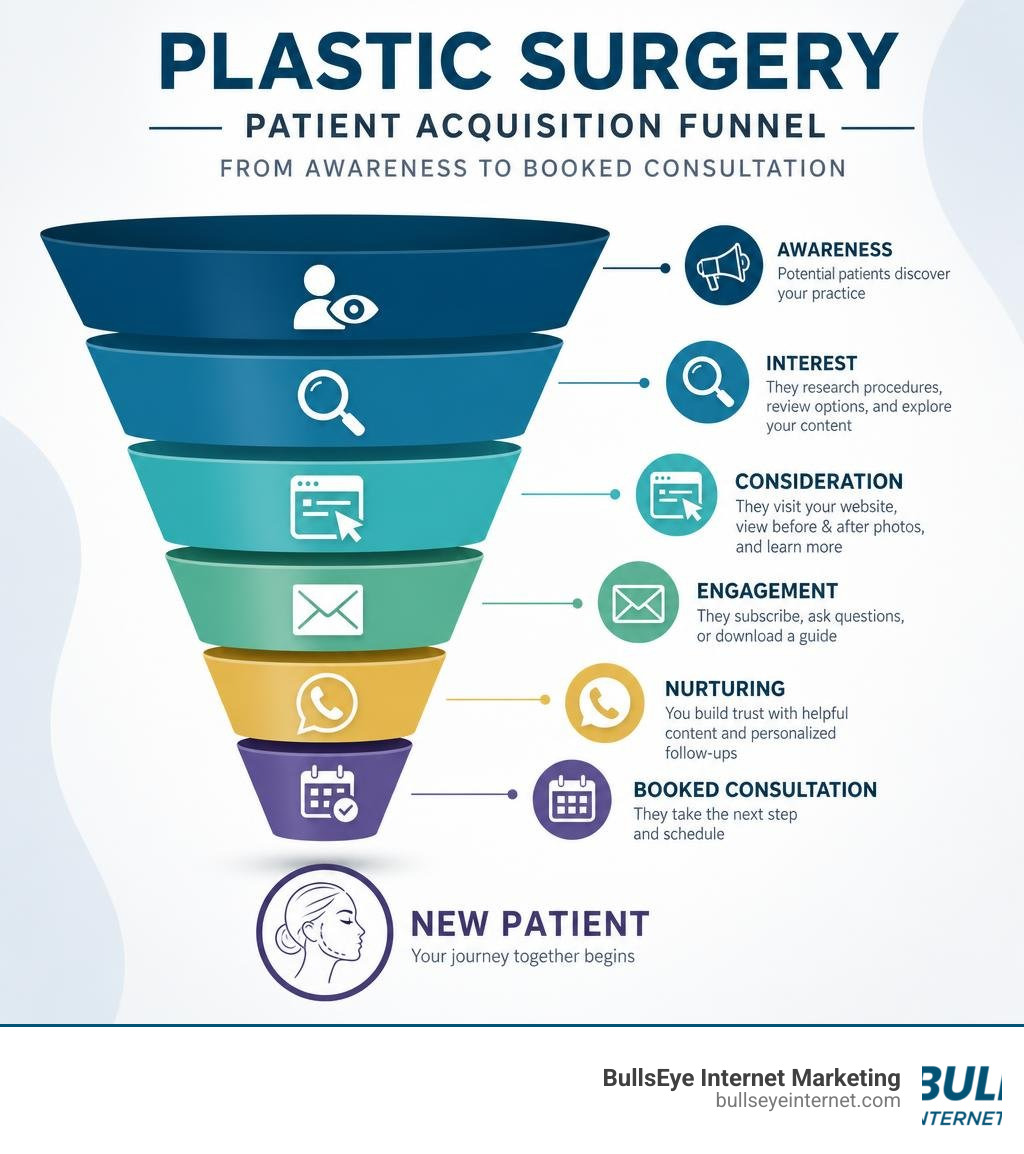
Simple guide to plastic surgeon lead generation:
Why Plastic Surgeon Lead Generation Demands a Specialized Approach
Many general marketing agencies treat plastic surgery like any other local service. They run a few basic ads, set up a generic contact form, and expect high-value patients to start booking. But aesthetic medicine is completely different from a standard dental cleaning or emergency medical service.
To build a reliable system, you must design your strategy around the specialized nature of cosmetic surgery lead generation.
The Psychology of High-Ticket Elective Procedures
Unlike reconstructive procedures covered by insurance, cosmetic surgery is entirely elective and paid out-of-pocket. Because patients are investing significant disposable income—often between $8,500 and $25,000+ depending on the procedure—their decision-making process is highly emotional, deliberate, and research-heavy.
The typical patient journey involves several distinct psychological phases:
- The Awareness Phase: Driven by personal motivations or self-improvement goals, the prospect begins researching general solutions (e.g., “how to get rid of loose skin after weight loss”).
- The Consideration Phase: The prospect looks at specific procedures (e.g., “tummy tuck vs. liposuction”) and begins reviewing credentials, board certifications, and educational content.
- The Decision Phase: The prospect compares local surgeons, scrutinizes before-and-after galleries, reads patient reviews, and seeks out trusted recommendations.
To capture these prospects, your marketing must project absolute authority, surgical artistry, and medical safety. If you want to learn more about setting up these high-trust campaigns, you can explore our guide on advertising for plastic surgeons.
Why Exclusive Leads Outperform Shared Leads
Many plastic surgeons rely on third-party lead aggregators or directories to fill their consultation calendars. However, these platforms typically sell the exact same lead to three, four, or even five competing practices in your local area.
This creates a race to the bottom where you are forced to compete on price, and your team must waste hours chasing down prospects who are already being bombarded by other clinics.
By focusing on exclusive leads generated through your own digital assets, you ensure that when a prospect reaches out, they are interested in your expertise, your results, and your clinic. This drastically improves your patient conversion rates and lowers your overall acquisition costs. For a deeper dive into how this model works, read our breakdown of pay per lead marketing agency strategies.
The Core Channels for High-Quality Patient Acquisition
A successful patient acquisition system does not rely on a single marketing channel. Instead, it leverages multi-channel synergy to build brand authority and capture high-intent prospects at different stages of their search journey.
To maximize your local presence, we recommend integrating several key channels as outlined in our local lead generation services complete guide.
Search Engine Optimization (SEO) for Plastic Surgeon Lead Generation
Organic search remains the absolute foundation of sustainable, long-term lead generation for plastic surgery. When someone searches for a local specialist, they are showing immediate, high-intent interest.
Our approach to SEO focuses on three primary pillars:
- Procedure-Specific Keyword Targeting: General terms like “plastic surgeon” are highly competitive and often attract top-of-funnel researchers. Instead, we target high-intent, long-tail search terms combined with local modifiers (e.g., “facelift surgeon Fort Lauderdale” or “breast augmentation Miami”). Statistics show that procedure + location keywords convert at an incredible 21.4% lead-to-consultation rate, nearly double that of generic search terms.
- Local SEO & Google Business Profile (GBP) Optimization: For local practices, your GBP is your digital storefront. Optimizing your profile with accurate business data, procedure lists, and a steady stream of patient reviews helps you dominate the Google Local Map Pack.
- High-Value Content Creation: Producing detailed, medically accurate articles that answer common patient questions—such as recovery timelines, scarring, and financing options—builds immediate trust and captures users during their research phase.
Developing these organic assets pays massive dividends over time. In fact, organic search delivers the lowest overall patient acquisition cost (PAC) across all cosmetic specialties, with average costs ranging from $276 for liposuction to $361 for a facelift. You can learn more about structuring your site for these terms in our dedicated guide to cosmetic surgery lead generation.
The Role of Paid Ads in Plastic Surgeon Lead Generation
While SEO builds a compounding asset for long-term growth, Pay-Per-Click (PPC) advertising provides an immediate faucet of highly targeted leads. By leveraging platforms like Google Ads and Meta (Facebook & Instagram), we can place your practice in front of patients the moment they decide to take action.
- Google Ads: This platform is unmatched for capturing high-intent searchers. By bidding on commercial keywords like “best rhinoplasty surgeon near me,” you can drive immediate traffic to dedicated landing pages.
- Meta Ads (Facebook & Instagram): Because plastic surgery is highly visual, visual social media platforms are perfect for top-of-funnel awareness. Using high-quality video walkthroughs, educational content, and compliant before-and-after showcases allows you to build demand among local demographics.
To prevent wasted ad spend, it is critical to send paid traffic to highly optimized, distraction-free landing pages rather than your website’s homepage. To master this channel, read our comprehensive guide on mastering PPC for lead generation.
Channel Comparison: SEO vs. PPC vs. Meta Ads
To help you understand how to allocate your marketing budget, here is a detailed breakdown of how these channels perform side-by-side in a typical cosmetic surgery campaign:
| Performance Metric | Search Engine Optimization (SEO) | Google Ads (PPC) | Meta Ads (Facebook/Instagram) |
|---|---|---|---|
| Lead-to-Consultation Rate | 18.9% (Highest digital channel) | 10.7% | 6.2% |
| Patient Acquisition Cost (PAC) | Low ($276 – $361 on average) | Medium to High ($400 – $800+) | Medium ($350 – $600) |
| Time to See Results | 4 to 6 Months (Compounding) | 24 to 48 Hours (Immediate) | 3 to 7 Days |
| Primary User Intent | Informational & Transactional | High Transactional | Awareness & Consideration |
| Long-Term Asset Value | Permanent owned asset | Temporary (Stops when budget ends) | Temporary (Stops when budget ends) |
Note: While personal referrals still hold the highest overall conversion rate at 36.8%, SEO remains the top-performing digital marketing channel for direct patient acquisition.
Optimizing Your Website and Funnel for Maximum Conversions
Generating traffic to your website is only half the battle. If your digital presence feels outdated, confusing, or difficult to navigate, prospective patients will quickly leave and book with a competitor.
Conversion rate optimization (CRO) ensures that your website acts as a 24/7 patient booking engine.
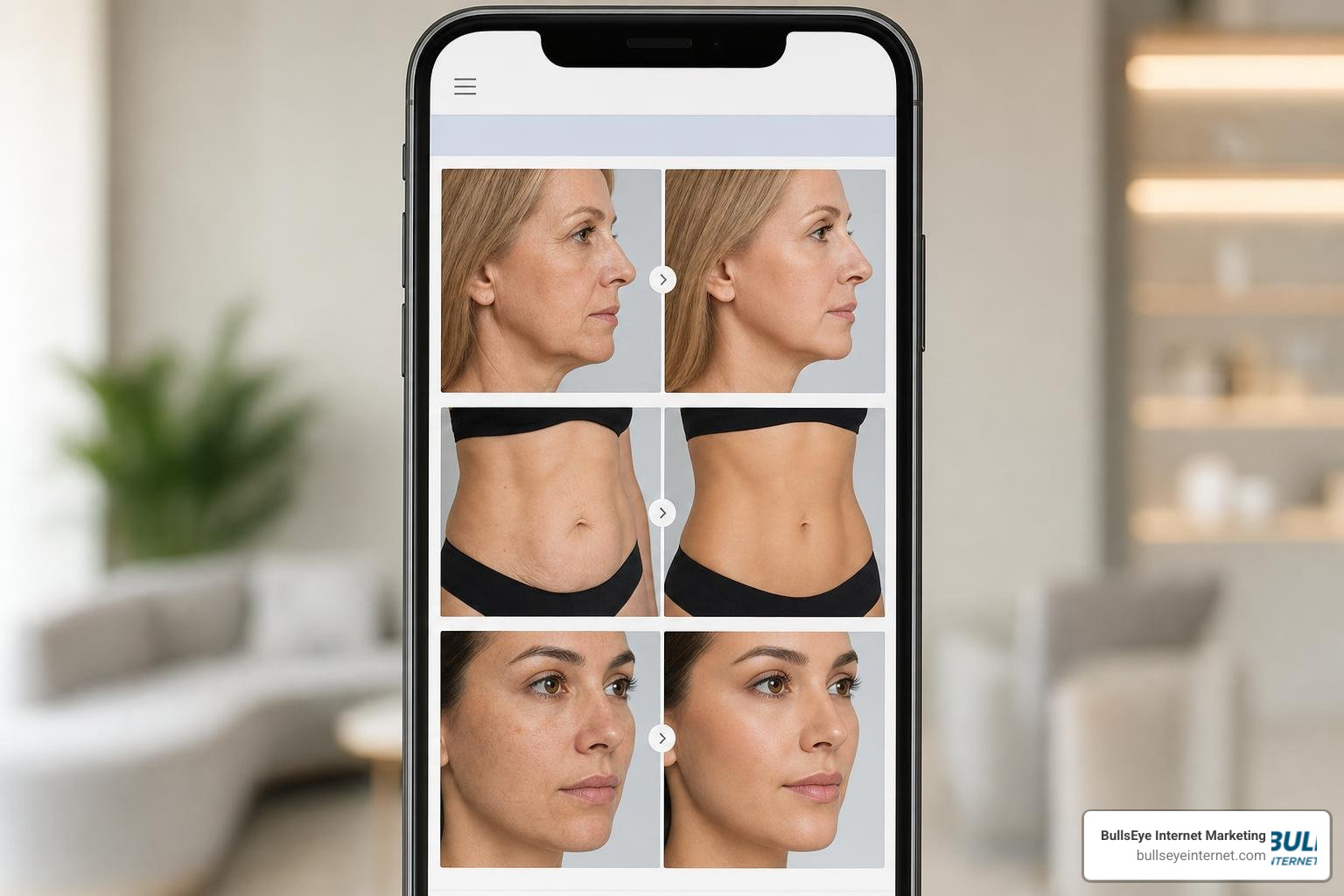
Before-and-After Galleries and Compliance
Your before-and-after gallery is the single most visited section of your website. Patients want to see real, undeniable visual proof of your surgical artistry. However, displaying these photos requires strict adherence to ethical and legal guidelines:
- HIPAA Compliance: You must obtain explicit, written patient consent before publishing any clinical photos or case details online. Ensure your forms clearly outline where and how the images will be used.
- FTC Guidelines: Avoid editing, filtering, or altering clinical photos in any way. Lighting, angles, and patient positioning should remain as consistent as possible between the “before” and “after” shots to avoid misleading prospects.
- Clear Categorization: Organize your gallery by procedure, body type, and age so prospects can easily find results that match their unique starting point.
Automated Nurturing and Lead Pre-Screening
A common issue in plastic surgery marketing is the “leaky funnel.” On average, 27% of leads do not attend the first consultation they schedule. Furthermore, it takes an average of 7.2 touchpoints before a team can successfully reach a new digital inquiry.
To solve this, we implement automated nurturing and pre-screening tools directly into your website:
- Instant SMS & Email Follow-Ups: When a prospect submits an inquiry, our system triggers an automated, personalized text message within 2 minutes. This immediate response drastically improves booking rates.
- Interactive Chatbots: Implementing smart, HIPAA-compliant chatbots allows you to capture leads 24/7. Since 63% of people prefer online scheduling, giving them an interactive way to book instantly satisfies modern consumer preferences.
- Financial and Medical Pre-Screening: To protect your surgeon’s valuable time, our multi-step booking forms pre-screen leads based on their budget, procedure timeline, and medical history. This filters out “tire-kickers” and ensures your staff only spends time calling highly qualified, cash-ready prospects.
Essential Website Conversion Elements Checklist:
- [ ] Clear, visible phone number and “Book Consultation” buttons in the header.
- [ ] Mobile-responsive navigation with fast page-load speeds.
- [ ] Well-organized, high-resolution before-and-after galleries.
- [ ] Embedded, HIPAA-compliant self-scheduling software.
- [ ] Visible credentials, board certifications, and professional associations.
- [ ] Live text-chat options for instant communication.
- [ ] Financing information and integrated calculators (e.g., CareCredit or Alphaeon).
Future-Proofing Your Practice with AI Search and Answer Engine Optimization
The digital landscape is undergoing its largest shift in decades. Traditional search engines are no longer the only way patients discover plastic surgeons. Today, prospects are increasingly turning to AI-powered platforms like ChatGPT, Perplexity, and Google Gemini to find recommendations.
Navigating the Shift to Generative Engine Optimization (GEO)
Instead of searching “best facelift surgeon Miami” on Google and clicking through organic listings, a patient might ask ChatGPT: “Who is a board-certified plastic surgeon in South Florida specializing in natural-looking deep plane facelifts with excellent patient reviews?”
To remain visible, practices must optimize for Generative Engine Optimization (GEO) and Answer Engine Optimization (AEO). The impact of this shift is massive: early adopters of GEO strategies have seen a 19% decline in patient acquisition costs within just 6 months, highlighting how rapidly this channel is growing.
Structuring Content for LLM Retrieval
AI models do not crawl websites the same way traditional search engines do. They rely on pulling clear, structured data and highly authoritative, cited information. To ensure your practice is recommended by large language models (LLMs), we implement several advanced technical strategies:
- Schema Markup & Structured Data: We embed detailed, custom schema code (such as
MedicalBusiness,Physician, andMedicalProceduremarkups) directly into your website. This tells AI engines exactly who you are, what procedures you perform, and where you are located. - Modular, Atomic Content Blocks: LLMs prefer direct, clear answers to specific user questions. We structure our content into clear, Q&A-style blocks that can easily be parsed, extracted, and cited by AI engines.
- Unassailable Digital Footprint: AI models verify information by cross-referencing multiple sources. Maintaining consistent Name, Address, and Phone (NAP) data across your website, Google Business Profile, local directories, and medical associations builds a strong knowledge graph that AI systems trust.
Key Metrics to Measure Lead Generation Success
If you aren’t tracking your data, you are marketing in the dark. To ensure your campaigns are profitable, you must monitor key performance indicators (KPIs) through a unified tracking dashboard.
When analyzing your marketing performance, focus on these essential metrics:
- Cost Per Lead (CPL): The total marketing spend divided by the number of inquiries generated. While CPL varies by procedure, a healthy campaign typically generates exclusive consultation leads for $95 to $145.
- Lead-to-Consultation Rate: The percentage of raw leads that successfully book and attend a consultation.
- Patient Acquisition Cost (PAC): The total amount spent to acquire a single paying surgery patient. As noted, organic SEO consistently delivers the lowest PAC, often staying under $360 for major surgical procedures.
- Consultation-to-Surgery Conversion Rate: The percentage of consultations that close into scheduled surgeries. A highly qualified, pre-screened pipeline should yield a conversion rate of 40% to 60%.
- Return on Investment (ROI): The total revenue generated compared to your overall marketing spend.
Frequently Asked Questions About Plastic Surgeon Lead Generation
How much should a practice budget for plastic surgeon lead generation?
Marketing budgets typically depend on your practice’s size, location, and growth goals. Smaller, established practices looking to maintain their local presence generally budget $4,000 to $8,000 per month. Medium to large clinics aiming for aggressive growth or expanding into new locations typically invest $8,000 to $15,000+ per month.
Because high-ticket surgeries carry significant patient values ($8,500 to $15,000+), securing just one or two additional surgeries per month easily covers the entire marketing investment.
What is the average cost per lead for cosmetic surgery?
When purchasing shared leads from third-party aggregators, practices often pay $250 to $450+ per lead for prospects that are simultaneously sold to your direct competitors.
By building your own digital marketing assets through SEO, local optimization, and targeted paid ads, you can generate exclusive, high-intent leads directly to your practice for $95 to $145 per lead on average.
How long does it take to see results from plastic surgery SEO?
While paid advertising campaigns (PPC) can start generating consultation requests within 24 to 48 hours of launch, organic SEO is a long-term compounding asset.
Most practices begin seeing noticeable improvements in organic search visibility and local map rankings within 4 to 6 months, with maximum ROI and lowest patient acquisition costs realized in year two and beyond.
Conclusion: Dominate Your Local Market with BullsEye Internet Marketing
Building a highly profitable plastic surgeon lead generation system requires a specialized, high-trust approach that aligns with how cosmetic patients think, research, and make decisions. From dominating local search results and Google Maps to optimizing your website for AI search engines, every element of your digital footprint must work together.
At BullsEye Internet Marketing, we don’t believe in cookie-cutter solutions or lock-in contracts. We specialize in generating high-quality calls and direct sales through custom Pay Per Lead models, Google Business Profile optimization, advanced SEO, targeted PPC, and conversion rate optimization.
Best of all, we offer a powerful competitive advantage: we work with only one client per industry per geographic area, and we operate with no long-term contracts. This means we dedicate our entire local expertise to helping your practice win.
Are you ready to stop paying for shared, low-quality leads and start building a premium, owned patient acquisition engine? Schedule a consultation with our advertising experts today, and let’s discuss how we can fill your consultation calendar.
