
Understanding VEO: How Voice Engine Optimization Differs from SEO and AEO
AI voice search optimization is the practice of refining website architecture, structured data, and content to ensure conversational AI assistants and voice engines select and read your brand’s answers aloud. Businesses optimize for voice discovery by structuring concise direct answer blocks, embedding conversational question-and-answer schemas, maintaining fast server-rendered pages, and optimizing local business listings for single-answer and multi-turn voice queries.
Search behavior has experienced a massive shift. In 2026, roughly 50% of searches now involve voice in some form. Spoken search volume grew 31.4% year over year, while traditional typed search grew by only 4.2%. Understanding the mechanics behind this shift requires breaking down the differences between traditional SEO, Answer Engine Optimization (AEO), and Voice Engine Optimization (VEO).
Traditional SEO focuses on optimizing web pages to rank in search engine results pages (SERPs) across a list of ten blue links. It emphasizes keywords, backlink profiles, and page-level metadata.
Answer Engine Optimization expands on this by structuring data and text so generative engines can extract and synthesize information. If you explore what is AEO?, you will find it centers on delivering direct, authoritative passages that large language models cite in synthesized overviews.
Voice Engine Optimization (VEO) represents the specialized audio layer of this ecosystem. As detailed in the voice search AEO framework, VEO is essentially AEO with an audio interface attached. While traditional search displays choices and AEO provides multi-source generative answers on a screen, voice search frequently reduces the outcome to a single spoken response.
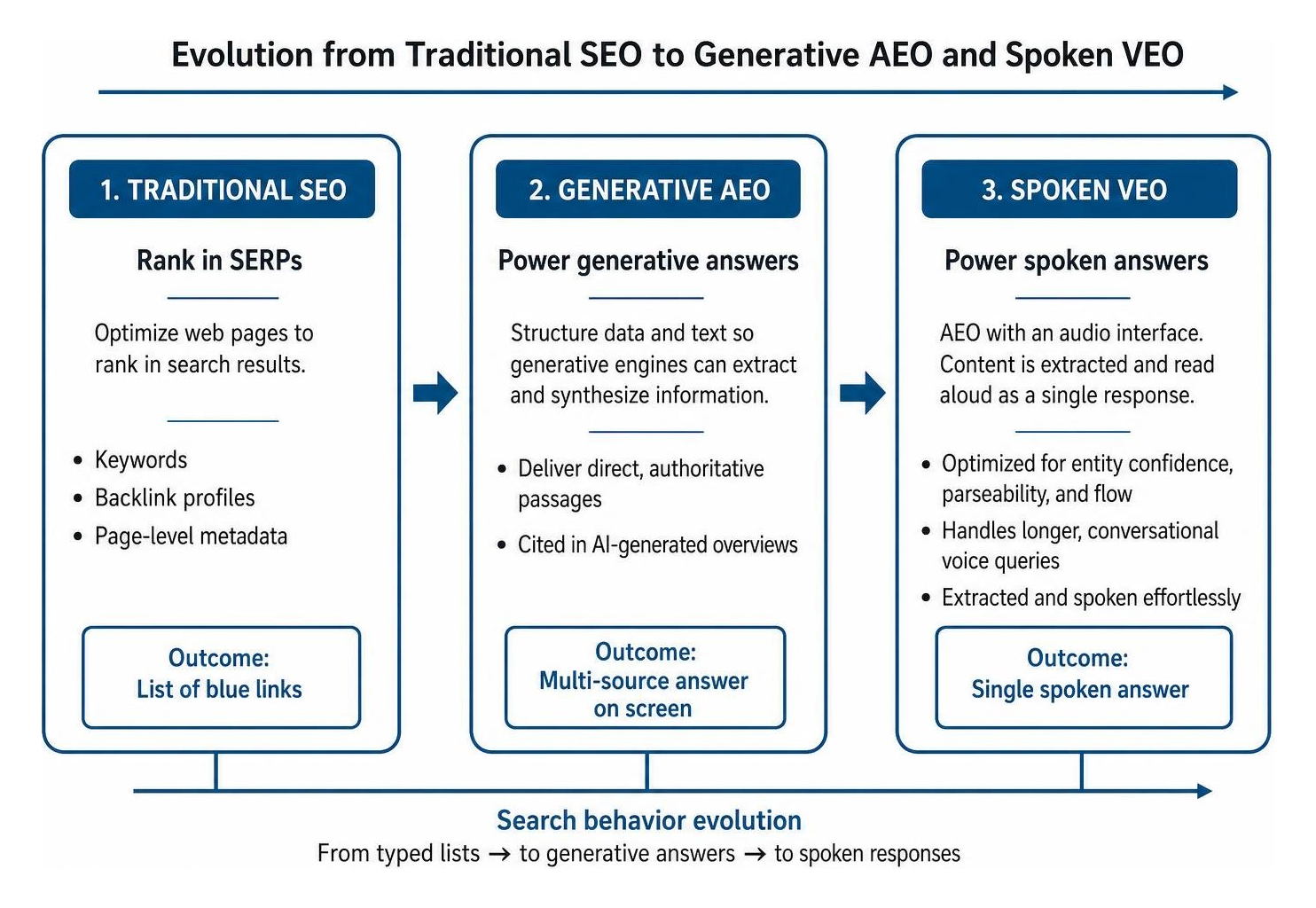
When an AI assistant speaks an answer aloud, natural language processing models evaluate entity confidence, parseability, and grammatical flow. Spoken queries average 7.2 words in length compared to 3.8 words for typed searches, and 71% of voice queries are phrased conversationally with full subject-verb sentence structures. VEO ensures that an engine does not just index your text, but can extract and read your content aloud effortlessly.
Single-Answer Assistants vs. Conversational Voice Models
The modern voice ecosystem splits into two retrieval and delivery architectures: single-answer traditional assistants and multi-turn conversational AI voice models.
Single-answer assistants—such as classic configurations of Apple Siri, Amazon Alexa, and Google Assistant—primarily solve immediate, factual, or local problems. Across all platforms, 78% of factual voice queries return a single definitive answer extracted from position-zero featured snippets or localized knowledge graphs.
Conversational voice platforms—such as ChatGPT Advanced Voice Mode, Google Gemini Live, Perplexity Voice, and Claude-powered voice layers—engage in multi-turn dialogues. Instead of reciting a static snippet, these models ingest server-rendered content, cross-reference entity facts across domains, and synthesize responses that average 89 words in length (compared to the 38-word average of legacy assistants).
| Dimension | Single-Answer Assistants (Siri, Alexa, Google Assistant) | Conversational Voice Models (ChatGPT, Gemini Live, Perplexity Voice) |
|---|---|---|
| Output Format | Single, direct spoken passage | Synthesized multi-sentence conversational summary |
| Average Answer Length | ~38 words | ~89 words |
| Primary Data Source | Featured Snippets, Knowledge Graph, Business Profiles | Multi-source LLM synthesis, live search citations |
| Query Structure | Direct interrogative (“Where is…”, “Who makes…”) | Exploratory, contextual, multi-turn dialogue |
| Citation Style | “According to [Domain]…” or direct read | Natural inline attribution, audio readbacks, or screen citations |
| Primary Success Metric | Position Zero capture, Local 3-Pack presence | Brand mention rate, citation frequency, entity salience |
Optimizing for both models requires clean passage structuring: factual directness for single-answer extractions, and deep topical context for conversational synthesis.
Core Technical Ranking Factors in AI Voice Search Optimization
Winning spoken search visibility requires technical excellence. Voice engines prioritize platforms that deliver data instantly, cleanly, and reliably.
Assistants must parse and return information in fractions of a second. If a page stalls, the assistant moves to an alternate source. Voice assistants strongly prefer pages that load in under 3 seconds, with field data confirming that pages loading under 1.5 seconds capture the highest share of voice extractions. Meeting Core Web Vitals thresholds—specifically keeping Largest Contentful Paint (LCP) under 2.5 seconds—is essential for eligibility.
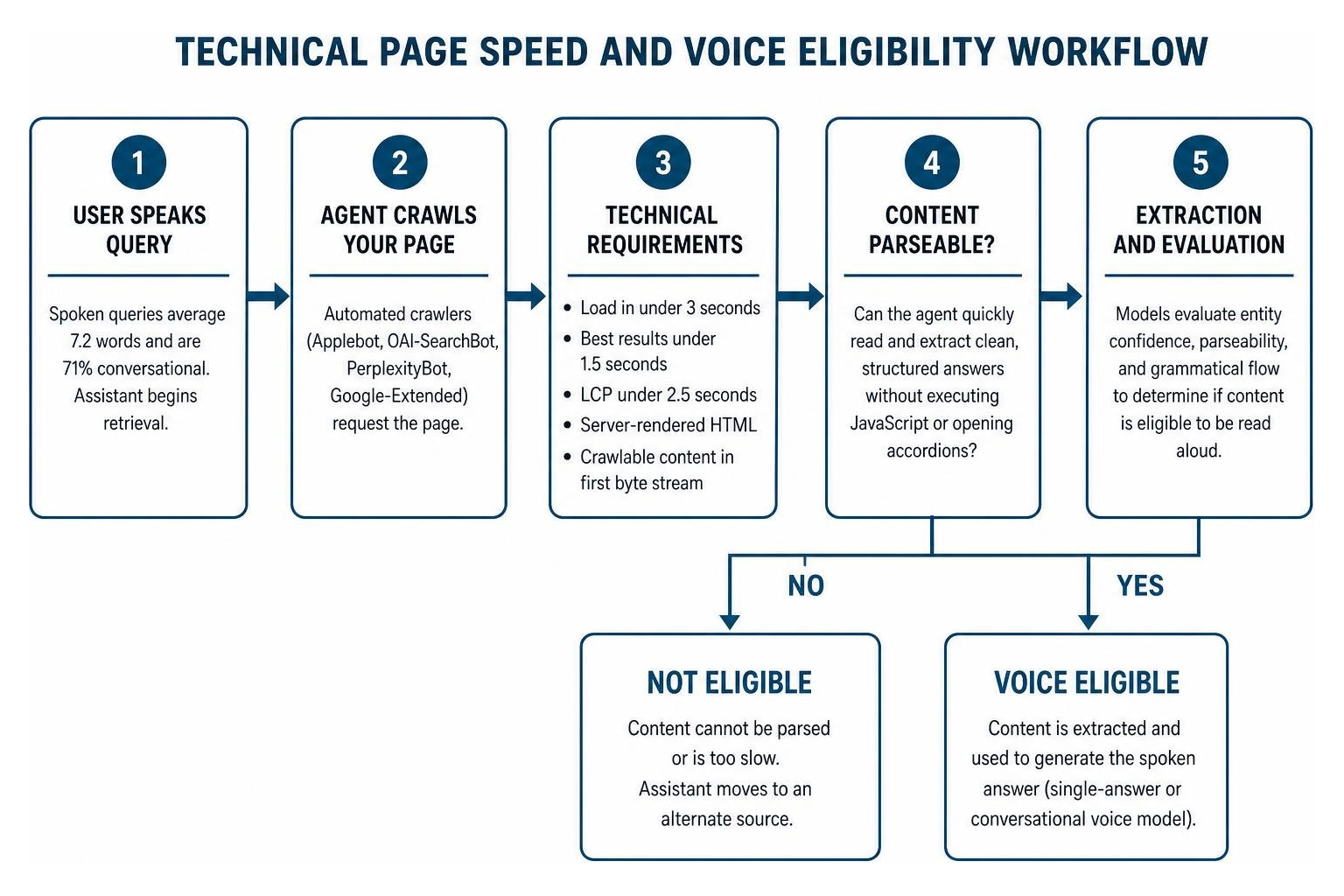
Beyond speed, crawl accessibility and server-side rendering govern whether an AI agent can read your text. Voice search models rely on automated crawlers (such as Applebot, OAI-SearchBot, PerplexityBot, and Google-Extended). If critical answers are hidden behind client-side JavaScript execution or complex accordions, voice engines cannot parse the content during fast retrieval passes. Ensure all core answer blocks are embedded in server-rendered HTML within the first byte stream of the document. Reviewing the core AI search ranking factors helps ensure your infrastructure meets modern machine-retrieval standards.
Implementing Schema Markup for AI Voice Search Optimization
Structured data acts as a translator between your website and voice synthesis engines. Implementing comprehensive schema markup removes ambiguity, allowing algorithms to map entity relationships quickly.
The most critical schema types for voice discovery include:
- Speakable Specification (
@type: SpeakableSpecification): Highlights specific CSS selectors (such as article summaries or concise answer paragraphs) designed specifically for audio readback via text-to-speech (TTS). - FAQPage (
@type: FAQPage): Identifies natural question-and-answer pairings directly within the code, making direct answer extraction effortless for AI bots. - LocalBusiness (
@type: LocalBusiness): Explicitly defines Name, Address, Phone (NAP), operational hours, geographic coordinates, and service categories.
Applying structured schema allows search engines to identify the exact sentences suitable for audio delivery. Pairing these schema elements with comprehensive semantic SEO services guarantees that your pages convey unambiguous entity meaning across all voice discovery channels.
Content Structuring and the 25-50 Word Direct Answer Pattern
Search queries delivered by voice are fundamentally interrogative. In fact, 64% of voice queries use explicit question stems (who, what, where, when, why, how), compared to only 18% of typed searches.
To capture these spoken questions, structure your content hierarchy around the Question-and-Immediate-Answer Pattern:
- Format Headings as Spoken Questions: Use H2 and H3 tags that mirror the natural language phrasing people use when speaking to their devices.
- Provide a 25-50 Word Direct Answer Block: Immediately below the heading, write a concise, authoritative answer of 25 to 50 words that directly answers the question without preamble.
- Expand with Context Below: Follow the concise answer block with deeper analysis, data points, bulleted lists, and supporting context.
Content structured this way allows search bots to extract the lead paragraph for direct TTS playback, while indexing the remaining text for topical authority. Pages with a conversational tone score above 70 capture 38% of priority featured snippets. Mastering these concise answer blocks is a proven strategy for mastering Google answer box optimization and dominating voice outputs.
Winning Local and Conversational AI Voice Discovery
Voice search is deeply intertwined with local intent: 41% of all voice queries embed local proximity parameters (such as “near me” or specific city names).
When a user asks a smart device for a local recommendation in South Florida—whether in Fort Lauderdale, Miami, West Palm Beach, Coral Gables, or Boca Raton—the voice assistant relies on local business directories and maps data.
Two primary directories power modern local voice queries:
- Google Business Profile (GBP): Powers local voice answers across Google Assistant, Android auto systems, and Gemini Live. Businesses with consistent NAP data, accurate operating hours, and active review management dominate local voice results.
- Apple Business Connect: Directly feeds Apple Maps, Siri, and Apple Intelligence. Claiming and optimizing Apple Business Connect listings allows businesses to appear 3.8 times more frequently in Apple Intelligence voice answers for local commercial intent.
Recent voice search behavioral data demonstrates that consumer review velocity is a primary local ranking filter. Businesses that generate at least one verified customer review per month appear 2.3 times more frequently in “near me” spoken search results compared to inactive profiles.
Optimizing Brand Mention Rates across ChatGPT and Perplexity Voice
In conversational AI platforms like ChatGPT, Perplexity Voice, and Claude, voice discovery extends beyond local map pins. These engines function as reasoning systems that evaluate brand authority and cross-domain consensus.
To maximize your brand mention rate in conversational AI platforms:
- Build Digital Consensus: AI models verify claims across multiple sources. Ensure your brand’s core services, leadership, and location details are consistently cited across industry directories, news releases, and trade associations.
- Establish Entity Salience: Clearly associate your brand name with specific topical categories and geographic service regions in your body copy.
- Target Spoken Citation Playback: Perplexity Voice reads citations aloud in 48% of its voice responses—higher than any other assistant. Publishing original research, proprietary survey metrics, and definitive definitions increases the likelihood that these reasoning engines will quote your brand as the primary source.
Focusing on conversational AI SEO ensures that when prospective clients ask conversational agents for vendor comparisons, your business is cited as the market benchmark.
Auditing, Measuring, and Avoiding Critical Voice Search Pitfalls
Optimizing for voice search requires identifying and eliminating friction points that prevent AI systems from parsing your content. Implementing a multi-assistant voice search framework helps you systematically audit your web assets.
High-Impact Voice Search Mistakes to Avoid
- Burying the Answer: Hiding the core answer deep within long paragraphs or complex narratives makes passage extraction difficult for automated crawlers.
- Relying on Client-Side Rendering for Key Data: Using JavaScript frameworks that do not prerender critical text prevents search bots from accessing answer blocks on initial crawl passes.
- Blocking AI Crawlers in robots.txt: Inadvertently restricting user agents like Applebot, OAI-SearchBot, or PerplexityBot removes your site from conversational AI indices.
- NAP Inconsistencies: Discrepancies in business name, address, or phone formatting across directories confuse entity matching algorithms.
- Missing Structured Data: Failing to implement Speakable, FAQPage, and LocalBusiness schema strips away structural context that assists TTS synthesis.
Measuring ROI and Tracking AI Voice Search Optimization
Traditional web analytics platforms like Google Analytics 4 (GA4) cannot directly tag incoming visits as “voice search” because voice assistants rarely pass unique referrer strings. Measuring voice search performance requires tracking reliable proxy metrics:
- Featured Snippet Capture Rate: Monitor Search Console and rank tracking tools for ownership of Position Zero across conversational, interrogative queries.
- Impression Growth on Question Queries: Track organic impressions on long-tail question queries (queries beginning with how, what, where, can I).
- Direct Local Conversions: Measure call volume, driving direction requests, and “Open Now” click actions originating from Google Business Profile and Apple Maps.
- AI Engine Brand Mentions: Track brand citation frequency across ChatGPT, Perplexity, and Gemini using targeted conversational prompt audits.
Implementing structured tracking aligns with broader strategies for generative engine optimization and AI search visibility, turning uninstrumented voice interactions into measurable commercial growth.
Frequently Asked Questions about AI Voice Search
How do voice assistants decide which website to read aloud?
Voice assistants select content from top-ranking pages that display high entity confidence, clear structured schema (such as Speakable or FAQPage markup), and fast server response times. The engine extracts concise passages (typically 25 to 50 words) that directly match the user’s spoken intent without requiring conversational editing.
Why are question-style headings essential for voice engine optimization?
Because 64% of voice queries are spoken as complete interrogative sentences, matching your H2 and H3 headings directly to these spoken questions creates an exact semantic match. This structure allows search engine parsing algorithms to easily map the query to your answer block.
Can traditional Google Analytics track voice search traffic directly?
No. Traditional web analytics platforms do not isolate spoken voice queries from typed desktop or mobile searches. Performance is measured through proxy indicators, including featured snippet ownership, question-based search impressions in Google Search Console, local profile call actions, and citation tracking across AI platforms.
Conclusion
The rapid growth of spoken queries, smart devices, and conversational reasoning engines has transformed how consumers discover local businesses and professional services. Securing voice search visibility is no longer optional—it is a direct commercial advantage.
At BullsEye Internet Marketing, we help businesses establish market authority through advanced search strategies, Local SEO, and AI engine optimization. Our model provides a unique competitive edge: we operate without long-term contracts and work with only one client per industry per geographic area.
Position your brand to capture the next wave of spoken search. Explore our specialized AI visibility optimization services and secure your exclusive market position today.
