
Why Your PPC Campaigns May Be Bleeding Budget (And How to Find Out)
PPC audit methodology is a systematic approach to evaluating your pay-per-click campaigns to identify what’s working, what’s wasting money, and where you can improve performance. Here’s what it involves:
Key Components of a PPC Audit Methodology:
- Account Structure Review – Verify campaign settings, naming conventions, and organization
- Keyword Analysis – Assess keyword performance, match types, and negative keyword lists
- Ad Copy Evaluation – Review ad relevance, messaging, and asset utilization
- Conversion Tracking – Confirm accurate tracking setup and goal measurement
- Landing Page Assessment – Ensure message match and optimize user experience
- Budget & Bid Analysis – Identify wasted spend and optimize bid strategies
- Performance Metrics – Analyze CTR, Quality Score, conversion rates, and ROAS
If you’ve ever looked at your PPC spending and wondered where all that money went, you’re not alone. Research shows that on average, 68% of ad spend is wasted. That’s not a typo. More than two-thirds of what businesses spend on paid advertising goes down the drain due to poorly optimized campaigns.
The problem is simple: most PPC accounts don’t get the attention they need. Studies reveal that only 10% of advertisers consistently work on their accounts every week, and about 20% don’t touch their campaigns monthly at all. Without regular, systematic auditing, even well-intentioned campaigns develop expensive blind spots—worthless keywords, broken tracking, irrelevant placements, and landing pages that kill conversions.
A proper PPC audit methodology cuts through the noise. It’s your diagnostic tool for identifying exactly where your campaigns are hemorrhaging money and, more importantly, how to stop it. Think of it as a financial health check for your advertising—one that can reveal opportunities to reduce cost-per-lead by 42% or uncover $147,000 spent on search terms that produced zero leads (yes, that’s from a real audit).
The good news? You don’t need a crystal ball to find these issues. You need a systematic approach that looks at the right data, asks the right questions, and follows a proven process. Whether you’re spending $1,000 or $100,000 per month, the methodology stays the same—and the potential savings are substantial.
I’m Ronnie Katz, founder and Principal CEO of BullsEye Internet Marketing, and I’ve been helping businesses optimize their online advertising since 2006. Over nearly two decades, I’ve seen how a proper ppc audit methodology can transform struggling campaigns into profitable growth engines—and I’ve developed a systematic approach that consistently uncovers opportunities others miss.
Let’s walk through exactly how to conduct a thorough PPC audit that actually saves you money and drives real results.
Must-know ppc audit methodology terms:
Why a Systematic PPC Audit is Your Most Powerful Optimization Tool
In the world of digital advertising, simply launching campaigns isn’t enough. To truly succeed and get the most out of your investment, a systematic PPC audit methodology is indispensable. It’s our secret weapon for turning good campaigns into great ones. As Mitch Cartwright aptly puts it, “Audits serve as a diagnostic tool, allowing you to get under the hood of your campaigns to assess what is working and what is costing your business money.”
For small and mid-sized businesses, who spend an average of $9,000 – $10,000 per month on PPC campaigns, every dollar counts. A thorough audit helps us:
- Reduce wasted spend: By identifying inefficiencies and irrelevant traffic.
- Maximize ROI: Aiming for that sweet spot of 25-50% ROI and a 2.87:1 ROAS.
- Improve advertising strategy: Ensuring campaigns align with your overarching business goals.
- Identify strengths and weaknesses: Pinpointing what’s performing well and what needs attention.
- Adapt to market changes: Staying agile in a constantly evolving digital landscape.
Strategic advertising doesn’t just drive sales; it can also significantly increase brand awareness, with studies showing up to an 80% lift. Our goal at BullsEye Internet Marketing is to leverage this potential for your business, whether you’re in Miami, Broward County, or anywhere across Florida and the United States. We believe that with a proper PPC audit methodology, we can help your campaigns not just perform, but thrive.

Uncovering Hidden Costs and Inefficiencies
One of the most immediate benefits of a PPC audit is shining a light on where your budget might be leaking. That alarming statistic of 68% wasted ad spend isn’t just a number; it represents concrete issues within campaigns that an audit can fix.
Think about it: are your ads appearing on websites or apps that deliver irrelevant traffic or poor user engagement? Our audits help us pinpoint these low-quality placements that drain your budget without delivering value.
Poor targeting is another common culprit. If your keywords and match types are too broad, your ads might show up for searches that have little to do with what you offer. This leads to irrelevant clicks, which not only cost money but also signal to the ad platforms that your ads aren’t relevant, impacting your Quality Score. As the experts say, low search term relevance kills your quality score, making those non-converting clicks even more expensive. We often find good click-through rates on mobile devices associated with poor conversion rates, indicating landing pages that aren’t optimized for mobile users. Identifying and rectifying these issues is a cornerstone of our PPC audit methodology.
Aligning Campaigns with Business Goals
A PPC audit isn’t just about cutting costs; it’s about ensuring your campaigns are working towards your larger business objectives. We dig into your Key Performance Indicators (KPIs) to confirm that every click, every impression, and every conversion is contributing to your bottom line. Are we driving valuable leads, increasing sales, or boosting brand awareness in areas like Palm Beach County or Miami Dade County?
The importance of accurate marketing ROI cannot be overstated. Without robust conversion tracking, it’s impossible to tell if your hard work is paying off! Neglecting to track conversions is one of the biggest mistakes a PPC manager can make. Our audits ensure that your tracking is flawless, giving us the data needed to make informed decisions and optimize for higher conversion value and lead quality.
Gaining a Competitive Advantage
Understanding your market positioning is critical. A comprehensive PPC audit methodology includes a deep dive into your competitive landscape. By analyzing what your rivals are doing, we can identify gaps in your strategy, uncover new keyword opportunities, and even get inspiration for ad copy that stands out.
We often look at the Google Ads Transparency Center to see active ads from competitors. This helps us understand their messaging, offers, and overall approach. Furthermore, we review your ads against Google’s ad policies to ensure compliance and avoid any penalties that could hinder your campaign performance. This competitive insight allows us to refine your strategy, ensuring your ads are not just running, but truly competing and winning in your specific market.
The Core Components of a Comprehensive PPC Audit Methodology
At BullsEye Internet Marketing, our PPC audit methodology is built on a foundation of several core components. Each element is carefully examined to ensure your campaigns are optimized from every angle.

Account & Campaign Structure: The Foundation of Your PPC Audit Methodology
The structure of your PPC account is like the blueprint of a building—if it’s flawed, everything else will suffer. Our audit begins by scrutinizing your campaign settings. Are your naming conventions consistent, specific, and descriptive? Clear naming helps us understand what each campaign, ad group, and label is for, especially crucial when managing diverse campaigns across Florida.
We check:
- Device preferences and bid adjustments: Are we optimizing for mobile users in Miami, given the high usage in our service areas?
- Ad scheduling: Are your ads running when your target audience in Broward County is most active and likely to convert?
- Location targeting: Is it precise enough to reach your ideal customers in specific areas like Boynton Beach or Fort Lauderdale, while excluding irrelevant regions?
- Budget pacing: Is your budget being spent effectively throughout the month, or are you running out too early or underspending?
We look for tight theming within your ad groups—ideally, 5-10 highly relevant keywords per group. This granular approach ensures your ads are hyper-specific, leading to better relevance and higher Quality Scores.
Keyword & Targeting Analysis
Keywords are the lifeblood of PPC, and our audit dives deep into their performance. We assess:
- Keyword research: Identifying high-performing keywords, underperforming ones, and opportunities for new, relevant terms. A well-run Google Ads account typically includes a variety of match types.
- Match types: Ensuring a strategic mix of broad, phrase, and exact match keywords to balance reach and relevance.
- Negative keywords: These are your best defense against impressions and clicks from unqualified searchers. We carefully review your negative keyword lists, adding terms that are irrelevant to your business in areas like Palm Beach County to prevent wasted spend.
- Search Terms Report: This report is a treasure trove of insights. We analyze it to uncover new negative keyword opportunities and identify valuable search queries that could be added as positive keywords.
- Quality Score: A crucial metric! A Quality Score of 7 or higher is generally considered good. We evaluate your Quality Score for each keyword, ad, and landing page. Low scores indicate issues with ad relevance, expected click-through rate, or landing page experience, all of which we address to improve your ad position and reduce costs.
- Audience segmentation: Beyond keywords, we examine your audience targeting—demographics, interests, and remarketing lists—to ensure your ads are reaching the right people in the right places.
Ad Copy & Creative Assessment
Your ad copy is often the first impression potential customers have of your business. Our PPC audit methodology includes a thorough assessment of your ad copy and creative elements. We look for:
- Ad relevance: Does your ad copy perfectly match the keywords and the user’s search intent?
- A/B testing: Are you running at least two different ad variations per ad group to identify what resonates best with your audience? Without testing, you’re missing out on vital insights.
- Call-to-Action (CTA): Is your CTA clear, compelling, and guiding users to the next step?
- Ad assets (formerly ad extensions): These expand your ad’s real estate and provide additional information. We ensure you’re utilizing relevant ad extensions like sitelinks, callouts, structured snippets, and location assets (especially important for businesses in South Florida). We also check for banner sizes in display campaigns.
- Ad policy compliance: We review your ads against Google’s guidelines to prevent disapprovals and ensure your campaigns run smoothly.
Post-Click Experience: Landing Pages & Conversion Tracking
The journey doesn’t end with a click. What happens next on your landing page is critical for conversions. Our audit thoroughly examines the post-click experience:
- Landing page relevance: Does the landing page deliver on the promise of the ad? A mismatch here leads to high bounce rates and wasted spend.
- Mobile-friendliness: With a significant portion of searches on mobile devices, your landing pages must be optimized for mobile to prevent poor conversion rates.
- Page speed: Slow-loading pages frustrate users and negatively impact Quality Score.
- Conversion tracking setup: This is non-negotiable. We carefully check your tracking statuses to ensure all desired actions (form submissions, calls, purchases) are accurately recorded. We also verify that Google Analytics 4 (GA4) is Google’s new measurement solution and properly integrated, as it replaced Universal Analytics in 2023.
- Goal verification: We use tools like Google’s Tag Assistant to debug tracking issues and confirm that your conversion goals are accurately firing.
A Step-by-Step Guide to Executing Your PPC Audit
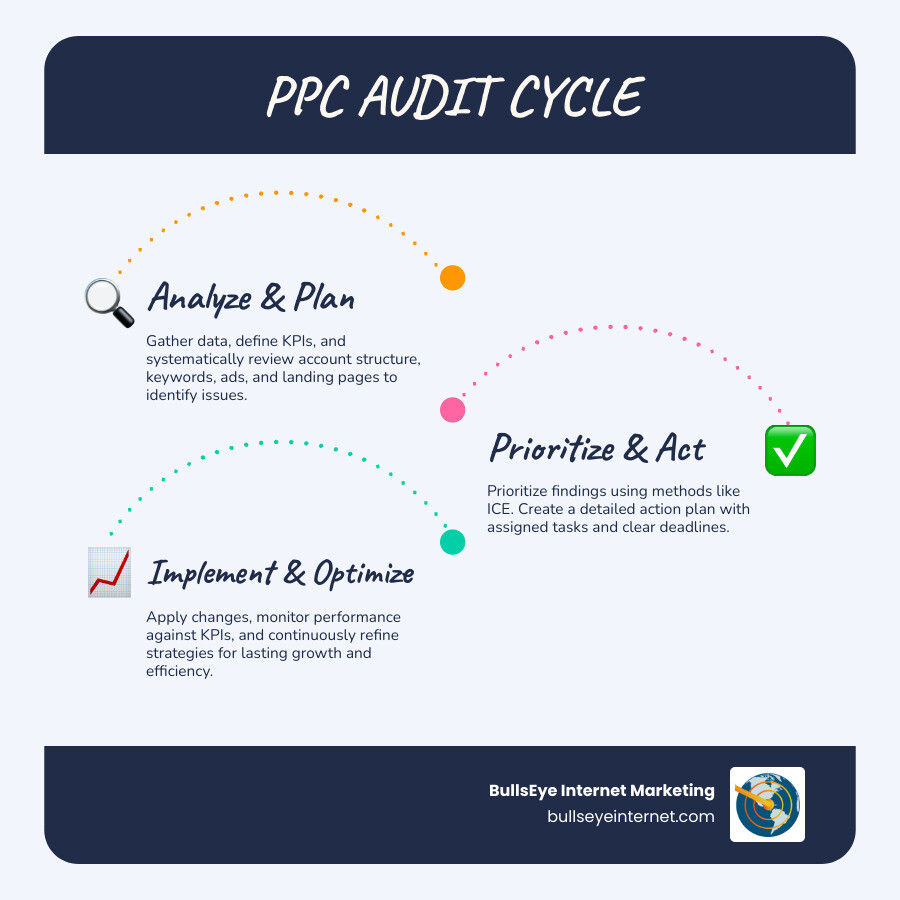
Conducting an effective PPC audit might seem like a daunting task, but with a structured approach, it becomes manageable and highly rewarding. Our PPC audit methodology breaks it down into clear, actionable phases.
Phase 1: Preparation and Data Gathering
Before we dive into the nitty-gritty, proper preparation sets the stage for a successful audit.
- Define KPIs: What are your campaign goals? Is it leads, sales, brand awareness, or something else? Clear KPIs provide the framework for our analysis.
- Select date range: We typically look at a minimum of three months of data, but six months is ideal to capture seasonal trends and understand long-term performance.
- Gather tools: We rely on Google Ads, Google Analytics, and robust spreadsheet software.
- Export data: Export your data directly from your Google Ads account. You can export all PPC account data or limit it to specific campaigns or date ranges. This allows us to perform in-depth analysis outside the platform.
Phase 2: The Deep-Dive Analysis (Your PPC audit methodology checklist)
This is where the real detective work begins. We systematically go through each component of your campaigns, documenting our findings. Using a structured checklist ensures no stone is left unturned.
Many experts have shared valuable resources, such as PPC Google Ads audit templates and checklists. These templates provide a fantastic starting point for a systematic review. We use similar checklists to guide our process, carefully documenting our observations and identifying patterns of success or areas for improvement across campaigns in your specific Florida markets.
Phase 3: Synthesis and Action Planning
Once the analysis is complete, we synthesize the findings and create a clear, actionable roadmap.
- Prioritizing fixes: Not all issues are created equal. We use methods like the ICE (Impact, Confidence, Ease) framework to prioritize optimizations that will yield the biggest results with the least effort.
- Creating a roadmap: We develop a detailed action plan outlining specific changes, their expected impact, and the steps required for implementation.
- Assigning tasks and setting deadlines: Clarity is key. We ensure everyone knows their role and when tasks need to be completed, fostering accountability and driving progress.
Frequently Asked Questions about PPC Audits
How often should I conduct a PPC audit?
The frequency of your PPC audits depends on several factors, but consistency is key. We generally recommend:
- Quarterly audits: A great rhythm for most businesses. This allows us to catch issues before they escalate, capitalize on new opportunities, and adjust for seasonal trends relevant to our clients in Florida.
- Annual reviews: At a minimum, a comprehensive audit should be performed once a year to ensure overall account health.
- Trigger events: Specific situations warrant an immediate audit:
- When taking on a new client or account.
- Before launching a major new campaign.
- When there’s a significant change in business goals or market conditions.
- Before peak seasons (e.g., holiday shopping in the United States).
- After major platform updates from Google Ads.
As industry experts emphasize, maintaining the health of your PPC account by running regular audits is crucial.
What are the best tools for a PPC audit?
While expertise and a keen eye are invaluable, several tools can significantly aid your PPC audit methodology:
- Native platform tools: Google Ads provides built-in tools for basic account health checks and performance insights.
- Analytics platforms: Google Analytics offers deeper insights into user behavior and conversion paths.
- Research tools: Third-party platforms can provide competitive analysis, keyword research, and ad copy insights.
- Audit checklists and templates: Many industry blogs and resources offer structured templates to guide your audit.
- PPC setup checklist: Google provides its own checklist to review your account setup.
What are common mistakes to avoid during a PPC audit?
Even with a solid PPC audit methodology, pitfalls exist. Here are some common mistakes we help our clients avoid:
- Neglecting conversion tracking: As we’ve emphasized, without accurate conversion data, you’re flying blind. This is one of the biggest mistakes a PPC manager can make.
- Ignoring negative keywords: Failing to add negative keywords is a surefire way to waste budget on irrelevant searches.
- Disregarding Quality Score: A low Quality Score impacts your ad position and increases your cost-per-click. It’s a critical metric that must be addressed.
- Failing to segment data: Looking at aggregate data can hide crucial insights. Always segment by device, location, time of day, and other relevant factors to uncover specific performance trends, especially valuable across diverse areas like South Florida.
- Not setting clear goals: An audit without defined objectives is like a ship without a rudder—it might look busy, but it’s not going anywhere productive.
- Over-reliance on automated recommendations: While platforms offer automated suggestions, they often prioritize spending more, not necessarily optimizing for your specific ROI.
- Ignoring real-world conditions: Seasonal shifts, economic changes, or local events in places like Miami can significantly impact campaign performance. An audit should consider these external factors.
Conclusion: Turning Your Audit Insights into Lasting Growth
A comprehensive PPC audit methodology is not a one-time fix; it’s an ongoing commitment to excellence. It’s how we ensure your advertising budget works harder and smarter for your business, translating insights into tangible growth. By systematically reviewing your campaigns, identifying inefficiencies, and capitalizing on opportunities, we move beyond simply running ads to strategically optimizing your entire advertising ecosystem.
At BullsEye Internet Marketing, we specialize in generating calls and sales through expertly managed PPC campaigns. Our approach is rooted in data-driven decisions and continuous improvement, ensuring your campaigns are always aligned with your business goals. We offer no long-term contracts and work with only one client per industry per geographic area, ensuring you a competitive advantage in your local Florida market and across the United States.
Ready to transform your PPC performance? Let us help you steer the complexities of paid advertising and turn your audit insights into lasting growth.
