
Why PPC is a Growth Engine for Small Businesses
PPC management for small business is the process of planning, executing, and optimizing pay-per-click advertising campaigns to drive targeted traffic and qualified leads—all within a controlled budget.
What PPC Management Includes:
- Keyword Research – Finding the right search terms your customers use
- Campaign Setup – Structuring accounts, ad groups, and targeting options
- Ad Copywriting – Creating compelling ads that get clicks
- Bid Management – Controlling costs while maximizing visibility
- Performance Tracking – Monitoring metrics like CTR, conversions, and ROI
- Continuous Optimization – Testing, refining, and improving campaigns over time
Competing with larger companies online is tough. SEO takes months, and social media reach is shrinking. PPC management offers an immediate solution, placing your business at the top of search results when customers are actively looking for you.
The beauty of PPC is that you only pay when someone clicks your ad. You control your budget, target your ideal audience, and track every dollar. In fact, businesses make an average of $2 in revenue for every $1 they spend on Google Ads. Well-optimized campaigns can see returns as high as 800%.
But PPC isn’t “set it and forget it.” Over 7 out of 10 companies haven’t reviewed their campaigns in over a month—and that’s where budgets get wasted. Successful PPC requires ongoing management and data-driven decisions.
I’m Ronnie Katz, founder of BullsEye Internet Marketing. Since 2006, my team and I have specialized in PPC campaigns that make your phone ring, delivering measurable ROI without locking you into long-term contracts.
Explore more about ppc management for small business:
What is PPC and How Does it Work?
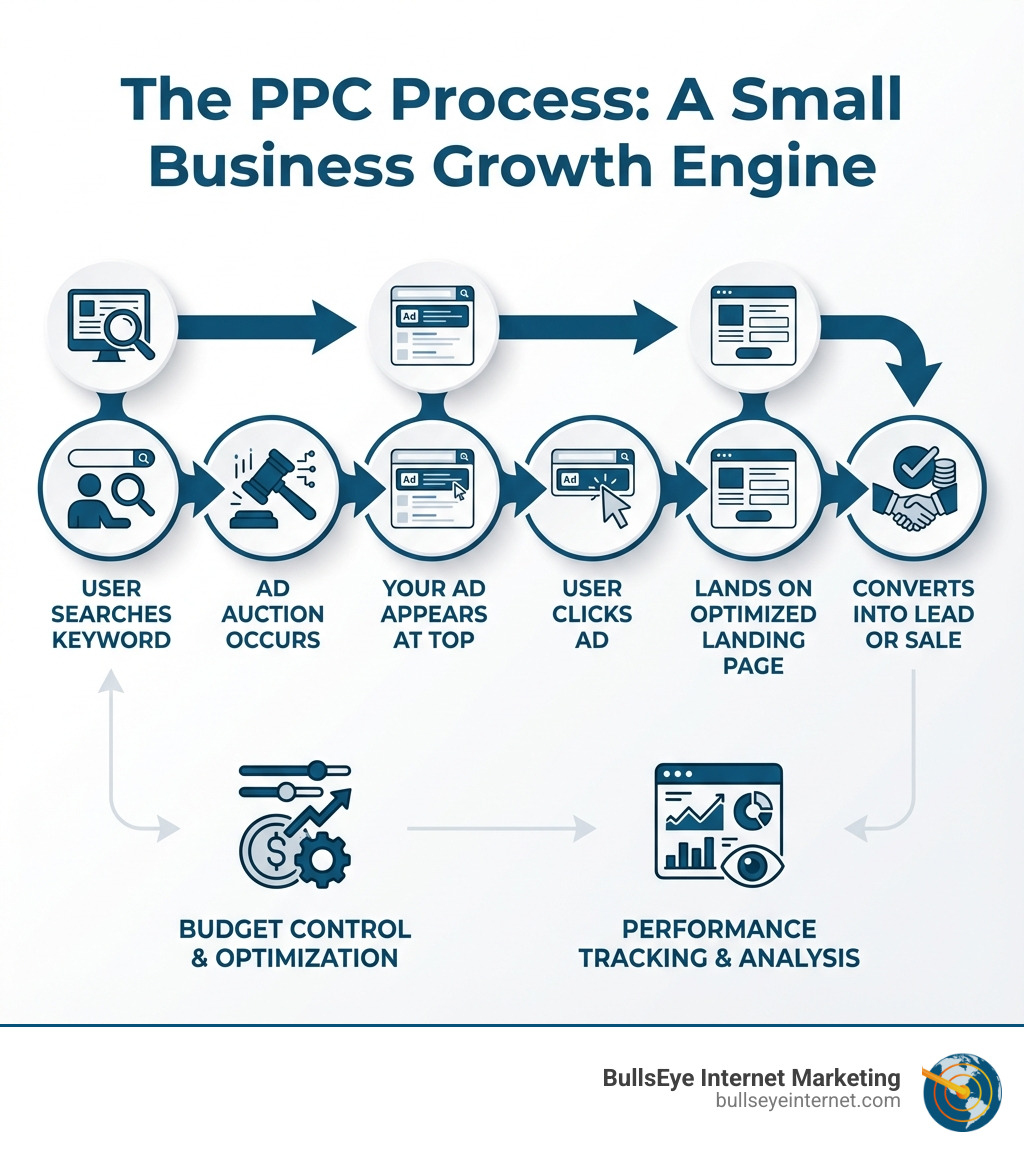
Pay-Per-Click (PPC) is an advertising model where you pay a fee each time someone clicks your ad. It works like a digital auction on platforms like Google, Bing, Facebook, and LinkedIn. Your ads can appear at the top of search results when users search for relevant keywords, or on social media feeds based on user demographics and interests.
The most common model is pay-per-click (PPC), but some platforms use pay-per-impression (PPM), where you pay per thousand views. For small businesses, the PPC model is often preferred because you only pay when a user shows direct interest by clicking.
For more detailed insights, explore our comprehensive guide to PPC Advertising.
The Key Benefits for Small Companies
PPC is a strategic tool that levels the playing field against larger competitors. Here’s why it’s so important:
- Cost-Effectiveness and Budget Control: You set a maximum daily budget and only pay when someone clicks your ad. This ensures you avoid wasting money on impressions that don’t lead to engagement and maintain a positive return on investment.
- Reaching Ideal Customers with Targeted Precision: PPC allows you to hyper-target your audience by demographics, location (like specific Florida zip codes), interests, and search behavior. This is why PPC ads convert 50% better than other forms of advertising.
- Quick, Measurable Results: Unlike SEO, PPC offers immediate visibility. You can see traffic almost instantly and use conversion tracking to measure impressions, clicks, and ROI, allowing for data-driven budget decisions.
- Competing with Larger Companies: PPC empowers small businesses to compete with bigger brands on a tight budget. By focusing on niche audiences and local targeting (e.g., “emergency dental implant specialist West Palm Beach”), you can capture highly qualified leads that larger companies might overlook.
- Gaining Immediate Online Visibility: PPC helps you cut through the noise and get your brand in front of potential customers quickly. This immediate exposure is a game-changer for new businesses or product launches.
The Essential Components of a Winning PPC Campaign

Crafting a successful PPC campaign requires the right ingredients. Here are the essential components we focus on to build winning campaigns for small businesses.
Keywords: The Foundation of Your Campaign
Keywords are the words and phrases potential customers use in search engines, acting as triggers for your ads. Our goal is to bid on relevant keywords to reach the right audience.
- User Search Intent: Understanding the why behind a search is crucial. We target keywords that show a user is ready to buy or take action, ensuring our website is the solution they need.
- High-Intent Keywords: These are specific phrases indicating a user is ready to act. For example, “emergency plumber West Palm Beach” shows more urgency than just “plumber.”
- Long-Tail vs. Broad Keywords:
- Long-tail keywords are longer, specific phrases (e.g., “24-hour AC repair Boynton Beach”). They have lower search volume but much higher conversion rates, making them ideal for small businesses.
- Broad keywords are general terms (e.g., “AC repair”). They have high search volume but can be expensive and attract less qualified traffic.
- Negative Keywords: These are terms we tell the ad platform not to show our ads for. For an AC sales company, adding “free” or “DIY” as negative keywords prevents wasted ad spend on irrelevant searches.
- Using Tools like Google’s Keyword Planner: We brainstorm keywords from the customer’s perspective, then use tools like Google’s Keyword Planner to expand our list, get search volume data, and gauge competition.
For a deeper dive, explore our guide on how we Master Keyword Research and Strategy with PPC Management Services.
Ad Copy, Landing Pages, and Quality Score
Once we’ve identified keywords, we craft a message and user journey that converts.
- Writing Compelling Ads: Your ad copy must convince searchers to click. We focus on:
- Relevance: Directly addressing the user’s search query.
- Unique Selling Proposition (USP): Highlighting what makes you different (e.g., “No long-term contracts”).
- Clear Call-to-Action (CTA): Telling the user what to do next (e.g., “Call Now,” “Get a Free Quote”).
- Ad Extensions: Using sitelinks, callouts, and location extensions to provide more information and take up more space.
- Matching Ad Message to Landing Page: The user journey must be seamless. If your ad promises “Emergency Plumbing in Miami,” the landing page must reflect that exact offer and location. Consistency prevents confusion and improves lead generation. Learn more about creating effective landing page experiences.
- Optimizing Landing Pages: The landing page is where success is won or lost. We ensure pages are:
- Fast-loading and Mobile-Friendly: Over 50% of internet traffic is mobile, especially for local searches.
- Clear and Concise: With a compelling headline that echoes the ad copy.
- Conversion-Focused: Featuring a prominent lead form or phone number and a strong CTA.
- Trust Signals: Including testimonials, reviews, or accreditations.
- How Google Determines Quality Scores: Google’s Quality Score (1-10) measures the relevance of your ads and landing pages. A higher score means lower costs and better ad positions. It’s based on:
- Expected Click-Through Rate (CTR): The likelihood your ad will be clicked.
- Ad Relevance: How well your ad matches the search intent.
- Landing Page Experience: The relevance and usability of your landing page.
Essential PPC Management Tools We Use:
- Google Ads Editor: For bulk campaign management.
- Google Analytics: To track conversions and user behavior.
- Google Tag Manager: To implement tracking tags efficiently.
- SEMrush: For competitor analysis and keyword research.
- Optmyzr: For automated bid management and reporting.
- WordStream: For campaign optimization and performance grading.
Building and Launching Your First Campaign: A Step-by-Step Guide
Launching a PPC campaign is about making a few smart choices upfront. Here’s our framework for building a high-performing campaign for your small business.
Step 1: Set Realistic Goals and Budgets
First, define what success means for your business: more phone calls, online sales, or form submissions? Your objectives should focus on actions that generate revenue.
- Calculating Target Cost Per Acquisition (CPA): This is crucial. If your average customer is worth $2,000 and you can spend 20% on acquisition, your target CPA is $400. This helps determine what you can realistically pay per lead.
- Setting a Daily/Monthly Budget: Start with a daily budget you’re comfortable with, treating the first month as a data-gathering mission. While the average small to mid-sized business might spend $9,000-$10,000 per month on PPC, we tailor initial budgets to our client’s needs and scale up as we see results.
For more guidance, refer to our Ultimate Google PPC Management Guide.
Step 2: Structure Your Account for Success
A well-structured account is vital for efficiency and relevance. It acts like an organized library for your ads.
- Campaigns for Different Services/Locations: Create separate campaigns for distinct business lines or service areas. For example, a Florida home services business might have separate campaigns for “AC Repair West Palm Beach” and “Plumbing Services Fort Lauderdale.”
- Tightly Themed Ad Groups: Within each campaign, create ad groups containing a small set of highly related keywords and corresponding ads. For instance, an “AC Repair” campaign might have ad groups for “Emergency AC Repair” and “New AC Installation.”
- Granular Structure for Relevance: This granular approach allows us to deliver hyper-relevant ads and landing pages, leading to higher click-through and conversion rates. This is why we believe in Why You Need Custom Pay Per Click Management Solutions.
Step 3: Launch, Monitor, and Begin A/B Testing
Launching your campaign is the start of an ongoing optimization process, not a one-time task.
- Starting with a Conservative Budget: We launch with a smaller budget and a limited keyword set to prevent costly mistakes while gathering performance data. The goal of the first month is data collection, not massive ROI.
- Monitoring Initial Performance: We closely monitor key metrics like impressions, clicks, click-through rate (CTR), and conversions. Daily checks are smart early on to catch cost spikes or declining lead quality.
- A/B Testing Headlines and Descriptions: We create multiple versions of ad headlines and descriptions and run them simultaneously to see which performs better. This continuous testing refines our messaging over time.
- Using Data to Make Decisions, Not Assumptions: Every click and conversion provides valuable data. We rely on analytics, not assumptions, to iterate and improve campaigns for more profitable results.
Effective PPC Management for Small Business: Strategies for Success
PPC isn’t a one-and-done deal; it’s a dynamic process. To succeed with PPC management for small business, we employ strategies that ensure continuous improvement and maximize every dollar.
Refining Your Strategy with Continuous Monitoring
The digital landscape changes constantly, so continuous monitoring and optimization are essential.
- Regularly Reviewing Performance: We recommend weekly campaign reviews to catch performance issues quickly. We dive into search term reports to see what people are actually searching for when our ads appear.
- The Danger of “Set It and Forget It”: This is where many businesses falter. Neglecting campaigns leads to wasted ad spend and missed opportunities. A well-tuned campaign is a constantly monitored one.
- Adjusting Bids: Based on performance, we adjust bids. If a keyword converts well at a low cost, we might increase its bid. If a keyword spends without converting, we’ll lower its bid or pause it.
- Pruning Underperforming Keywords: We regularly review long-term keyword performance to identify and prune costly, weak keywords. These are then added to our negative keyword lists to prevent future wasted spend.
These refinements are part of the Top 10 PPC Strategies That Are Driving Leads in 2025.
Leveraging Local Targeting and Advanced Tactics
For local businesses, especially those in Florida, advanced targeting is key.
- Using geotargeting for Service Areas: We use geotargeting to show your ads only to searchers in your service areas, whether it’s specific cities, zip codes, or a radius around your location. This ensures you don’t waste money on clicks from outside your service area.
- Ad Scheduling (Dayparting): We can schedule ads to show only during specific days or hours when customers are most likely searching or when your business is open. For example, a restaurant might increase bids during lunch hours.
- Audience Segmentation: We can segment audiences based on demographics, interests, and past interactions with your website. This allows for more precise targeting, like a music school targeting parents of toddlers.
- Remarketing to Past Visitors: Remarketing shows targeted ads to people who visited your website but didn’t convert. It’s a highly effective way to re-engage warm leads and encourage them to return.
Our expertise in these areas allows us to provide highly effective PPC Services Near Me for businesses across our service areas.
Common PPC Mistakes Small Businesses Must Avoid
Avoid these common PPC traps that drain budgets and deliver poor results:
- Bidding on Irrelevant Keywords: Bidding on broad terms without proper negative keywords leads to clicks from people who aren’t looking for your specific services.
- Sending Traffic to the Homepage: Always send ad traffic to a dedicated landing page that matches the ad’s promise, not your general homepage.
- Ignoring Mobile Optimization: With over 50% of internet traffic coming from mobile, non-mobile-friendly ads and landing pages lead to high bounce rates and poor results.
- Not Tracking Conversions: Without tracking conversions (calls, form fills), you’re flying blind. You won’t know which campaigns are generating value, making optimization impossible.
- Neglecting Negative Keywords: Failing to continuously add irrelevant search terms to your negative keyword lists means you’re paying for clicks that will never convert.
Measuring Success and Making Smart Decisions
Mastering PPC management for small business requires knowing how to measure your efforts and make informed decisions. This includes understanding key metrics and deciding when to hire an expert.
Key Metrics to Track for PPC Success
We focus on KPIs that directly relate to business goals:
- Click-Through Rate (CTR): The percentage of impressions that result in a click. A high CTR (above the average of 3.17% for search) indicates a relevant ad.
- Conversion Rate: The percentage of clicks that result in a desired action (e.g., a sale or lead). A low rate may indicate a problem with your landing page.
- Cost Per Conversion (CPA): The average cost to acquire one conversion. Aim to keep this well below the revenue generated by that conversion.
- Return On Ad Spend (ROAS): The revenue generated for every dollar spent on ads. A 5:1 ROAS means you earned $5 for every $1 spent. While the average is 2:1, well-tuned campaigns can achieve 8:1 or higher.
Our Google Ads Management Services are built around this data-driven approach.
The DIY vs. Agency Decision for PPC Management for Small Business
Should you manage PPC in-house or hire an agency? Here’s the breakdown:
- DIY (Do-It-Yourself): This saves on agency fees but requires a significant time commitment for learning, management, and staying current. Most business owners lack the bandwidth to become PPC experts.
- Hiring an Agency: This incurs a management fee but frees up your time and provides immediate access to certified professionals, advanced tools, and years of experience. An agency can often get better results faster and prevent costly mistakes.
If you’re swamped, find ad platforms complex, or want better results, hiring a professional PPC Management Consultant is often the smarter choice.
PPC vs. SEO: When to Prioritize Each Channel
PPC and SEO are both vital for a complete Search Engine Marketing strategy, but they serve different purposes.
| Feature | PPC (Pay-Per-Click) | SEO (Search Engine Optimization) |
|---|---|---|
| Speed of Results | Immediate traffic and visibility (minutes to days) | Long-term results (months to years) |
| Cost | Pay per click; direct budget control | “Free” clicks, but requires investment in content, time, and tools |
| Placement | Top of search results, designated ad sections | Organic search results, below paid ads |
| Control | High control over messaging, targeting, and budget | Less direct control; relies on algorithm changes |
| Longevity | Stops when you stop paying | Results are more durable and cumulative over time |
| Brand Awareness | Can quickly boost brand awareness | Builds long-term brand authority and trust |
| Targeting | Highly specific audience, location, and intent | Broader reach, but less precise targeting |
- Use PPC for immediate results: It’s ideal for driving traffic fast, generating leads quickly, or promoting time-sensitive offers.
- Use SEO for long-term growth: It builds sustainable organic visibility and authority, providing a consistent stream of “free” traffic over time.
- Use both for an integrated strategy: The best approach is to combine them. PPC provides quick wins and data that can inform your SEO strategy, while strong SEO supports PPC by improving credibility and Quality Scores.
Frequently Asked Questions about PPC for Small Businesses
How long does it take to see results from PPC?
You’ll see traffic and clicks almost immediately. However, expect a 1-3 month learning phase to gather data and optimize. Consistent, profitable results in terms of lead generation often take three to six months of refinement. It’s a process of systematic, patient optimization.
How much should a small business spend on PPC?
There’s no single answer, but a good starting point for many small businesses is $500 to $2,000 per month. This allows for enough data collection to see what works. As you prove your Return on Ad Spend (ROAS), you can scale your budget. The focus should always be on profitability, not just total spend.
Can PPC help my small business compete against big brands?
Yes. PPC levels the playing field. A smart, focused strategy can outperform a large, scattered budget. You can win by:
- Targeting Niche Audiences: Focus on specific, long-tail keywords that big brands often ignore.
- Local Focus: Hyper-target specific cities (e.g., West Palm Beach, Miami) or even neighborhoods to reach customers actively seeking local services.
- Precision and Relevance: A high Quality Score can earn you better ad positions at a lower cost, maximizing your budget’s efficiency and allowing you to connect with the right people at the right moment.
Get Expert Help with Your PPC Campaigns
PPC is a powerful growth engine for small businesses, offering immediate visibility and measurable results. However, its complexity requires active, expert management to ensure profitability and avoid wasted spend.
At BullsEye Internet Marketing, we use data-driven decisions and continuous optimization to manage your campaigns. This frees you to run your business while we focus on making your phone ring.
Our commitment to your success is reflected in our unique approach: we offer no long-term contracts, giving you the flexibility and confidence that we’re always earning your business. Furthermore, we work with only one client per industry per geographic area, ensuring you have a competitive advantage and our undivided focus in your market.
If you’re ready to transform your marketing from an expense into a strategic investment, let us put our experience to work for you. For expert guidance and a custom strategy custom to your business needs, explore our PPC Pay Per Click Management services today. Let’s make your phone ring!
