
Boost Leads with Professional Service Ads BullsEye Internet Marketing
Professional service ads are specialized advertising formats designed to help service providers connect directly with potential clients who are actively searching for their expertise. Here’s what you need to know:
Three Proven Methods to Create Effective Professional Service Ads:
- Local Service Ads – Pay only when customers contact you; appear at the very top of search results with a verified badge
- Professional Service Search Ads – Feed-based campaigns that show your business details without traditional keywords; 60% higher conversion rates than standard search ads
- Traditional PPC Campaigns – Complement your strategy with keyword-targeted text ads across multiple search engines
Key Benefits:
- Connect with customers at the exact moment they need your services
- Build immediate trust through verification badges and reviews
- Pay for actual leads (calls and messages) instead of just clicks
- Stand out from competitors in crowded local markets
Tired of ads that don’t bring in calls? You’re not alone. Many professionals struggle against bigger brands dominating search results. The good news is these three methods level the playing field, putting you in front of people ready to hire right now.
According to industry research, 39% of consumers have used professional services in the past year. That’s a massive market actively searching for providers like you. The challenge is making sure they find your business instead of your competitor’s.
I’m Ronnie Katz of BullsEye Internet Marketing. With over 20 years of experience, I’ve seen how the right professional service ads strategy transforms a business. The techniques I’ll share are the same ones we use to generate qualified leads for attorneys, accountants, real estate agents, and home service providers daily.
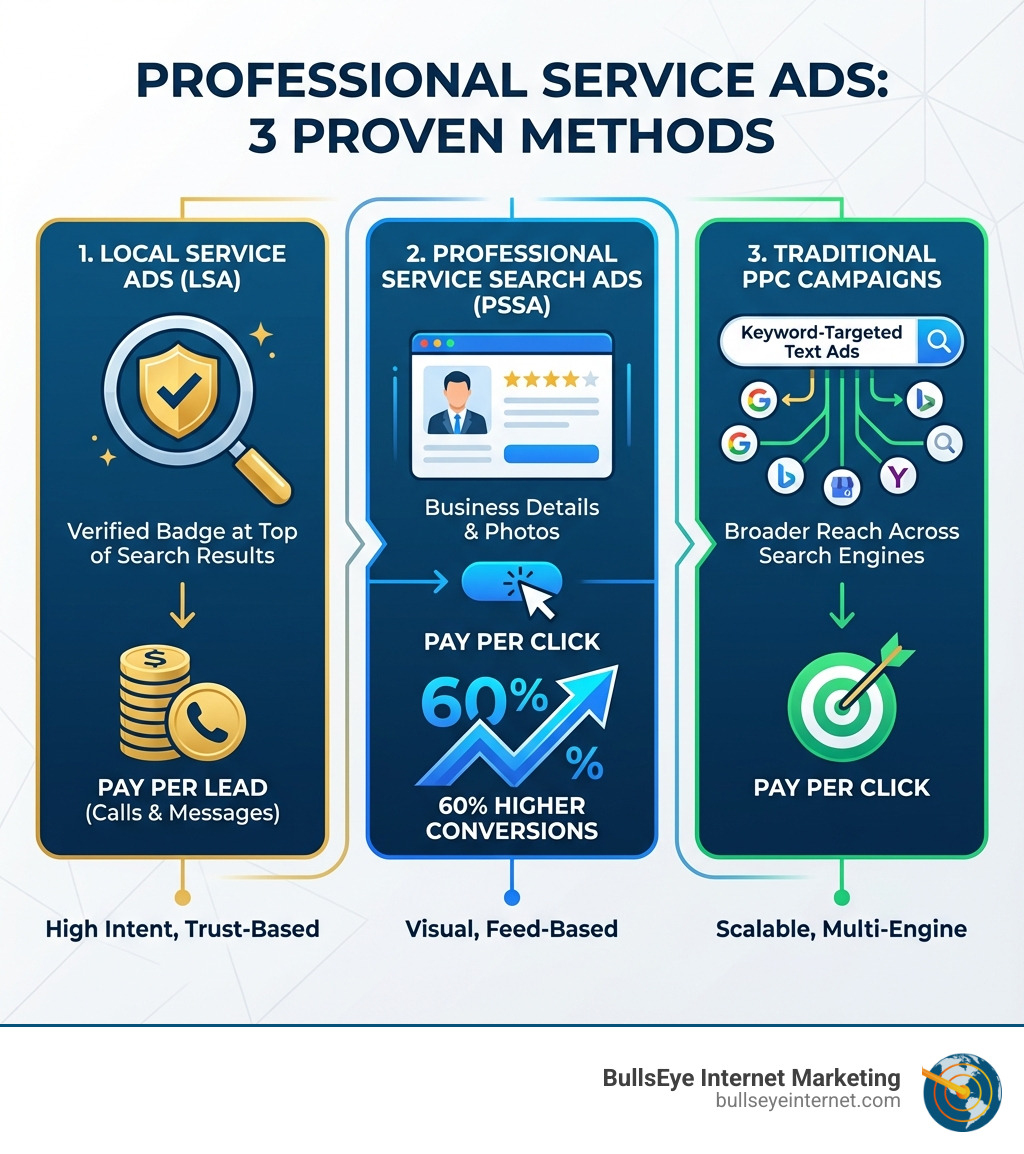
Quick look at professional service ads:
Method 1: Dominate Local Search with Verified Local Service Ads
Google Local Services Ads (LSAs) are a game-changer for connecting with high-intent customers in areas like South Florida. These professional service ads appear at the very top of Google search results, above traditional ads and organic listings. This prime placement ensures your business is the first thing potential clients see.
LSAs use a pay-per-lead model, a key differentiator from traditional Pay-Per-Click (PPC). You only pay when a valid customer contacts you via a call, message, or booking request. This makes budgeting predictable and ensures you’re paying for results, not just clicks.
Another significant advantage is the “Google Guaranteed” or “Google Screened” badge that accompanies these ads. This badge is Google’s stamp of approval, signifying that your business has undergone a thorough vetting process. This builds immense consumer trust, a critical factor when people are looking for professional services. Customers are more likely to choose a verified provider, knowing that Google stands behind the service.
LSAs are designed to help local businesses connect with local customers. If you’re wondering about the specifics of how they work, you can learn more by visiting the Getting started with Local Service Ads help page.

Eligibility and Verification
Not every business can run LSAs. There are specific eligibility requirements and a rigorous verification process to ensure quality and trust for consumers.
Eligible Industries: LSAs cater to a wide range of service businesses. For our clients in Florida, this includes many essential local services. The categories typically covered include:
- Home services: Such as plumbing, HVAC, electrical, roofing, landscaping, and appliance repair.
- Professional services: Including legal services (lawyers), financial advisors, real estate agents, accounting, and tax services.
- Health, Learning, Care, Wellness, and Beauty services: Such as dentists, optometrists, tutors, childcare providers, massage therapists, and hair stylists.
The verification process is comprehensive and designed to protect both consumers and reputable businesses. It involves several key steps:
- Background Checks: This often applies to the business owner and sometimes employees who will be entering customers’ homes or interacting directly with clients.
- License Verification: Google checks that your business holds all necessary state and local licenses for the services you provide in your operating areas.
- Insurance Checks: You’ll need to provide proof of general liability insurance to cover potential damages or issues.
- Professional Qualification Checks: For professional services like legal or financial advice, Google may verify professional qualifications and conduct checks for malpractice.
The verification process can take a few weeks, but it’s a worthwhile investment. Once approved, your business earns that coveted Google badge, instantly boosting your credibility.
Optimizing Your Local Service Ad Performance
Getting your LSA up and running is just the first step. To truly maximize your results and ensure your professional service ads are performing their best, ongoing optimization is key.
- Managing Reviews: Reviews are paramount for LSAs. They directly impact your ad’s ranking and how prominently it appears. The more positive reviews you have, and the higher your average rating, the better your chances of standing out. We always encourage our clients to actively solicit reviews after every completed job. Responding to all reviews, both positive and negative, also shows you’re engaged and care about customer feedback.
- Responding to Leads Quickly: Responsiveness is another crucial ranking factor. Google tracks how quickly you respond to calls and messages received through your LSA. Prompt replies not only improve your ad’s performance but also increase your chances of converting a lead into a paying client. These customers are often looking for immediate help!
- Lead Tracking and Disputing Invalid Leads: LSAs operate on a pay-per-lead model, but what if you receive a lead that isn’t relevant? You can dispute leads that are outside your service area, for services you don’t offer, or that are clearly spam. This helps ensure you’re only paying for legitimate, high-quality inquiries. We help our clients track these leads diligently to optimize their ad spend.
- Setting Budgets: You have control over your weekly budget, allowing you to choose how many new leads you want to receive. You can adjust this monthly budget as needed, scaling up during busy seasons or scaling down during slower periods.
- Scheduling: LSAs also allow you to set your business hours, so ads only appear when you’re available to respond to leads. This prevents missed calls and ensures you’re not paying for leads when your office is closed.
Key LSA Ranking Factors:
- Proximity: How close your business is to the searcher’s location.
- Reviews: Your average rating and the total number of reviews.
- Responsiveness: How quickly you answer calls and reply to messages.
- Budget: Your chosen weekly budget and cost-per-lead bid.
Method 2: Capture High-Intent Users with Professional Service Search Ads
Beyond Local Service Ads, another powerful method for reaching clients is through Professional Service Search Ads. These ads, offered on platforms like Microsoft Advertising, differ significantly from traditional keyword-based search ads. Instead of a complex keyword strategy, they are often feed-based. You provide details about your services and business through a data feed, and the platform matches your services with relevant user searches.
The beauty of this approach is that it often doesn’t require managing keywords or crafting text ads manually. The system intelligently pulls information from your feed to generate compelling ad creatives. This streamlined process can lead to impressive results. For instance, Professional Service Ad campaigns on some networks have shown a 60% higher conversion rate and a 67% lower Cost Per Acquisition (CPA) compared to traditional search ads. This means more clients for less money.
Getting Started with Professional Service Search Ads
Setting up Professional Service Search Ads involves a slightly different process than traditional PPC, primarily due to their feed-based nature.
Supported Industries: These ads are designed for a range of service industries. For our clients across South Florida, these categories are highly relevant:
- Insurance Services
- Real Estate Services
- Tax Services
- Home Services
- Doctor & Clinic Ads
Future expansions are also planned for Lawyer & Legal Service Ads and Financial Advisor Ads, making this an evolving and increasingly valuable ad type for professionals.
Creating a Data Feed or Keyword List:
For these feed-based ads, the core of your campaign is a data feed. This is typically a spreadsheet (like a CSV or XLSX file) containing essential information about your business and services, including:
- Your business name and contact information
- Specific services you provide (e.g., “estate planning lawyer,” “HVAC repair,” “residential real estate agent”)
- Service areas
- Descriptions of your expertise
- Any special offers or unique selling points
For individual practitioners, a simple spreadsheet might suffice. Larger organizations may need a more automated approach to feed management. We recommend starting with a template provided by the ad platform, as it outlines all required attributes.
To understand how these ads perform and how they stack up against other formats, you can Download our search ads benchmarks. This will give you a clearer picture of the potential ROI.
Uploading the Feed and Campaign Setup:
Once your data feed is ready, you’ll upload it into your advertising account. After the feed is processed, you’ll create a corresponding search campaign and ad group. It’s crucial that the names you use for your campaigns and ad groups match the attributes in your data feed. This ensures the system correctly associates your feed data with your ad campaigns, allowing your professional service ads to be served effectively.
Best Practices for Professional Service Search Ads
To get the most out of your professional service ads, especially the feed-based search ads, follow best practices for budgeting, bidding, and optimization.
Recommended Budget Ranges:
The ideal budget for professional service ads varies based on your industry, service area, and goals.
- For local businesses in competitive South Florida markets, we recommend starting with a daily budget that allows for sufficient visibility. A good rule of thumb is to allocate around 20% of your current PPC budget to these ads, or start with a range like $100-$500 per day for broader visibility.
- The key is to start with a budget that allows you to gather enough data to make informed optimization decisions.
Bidding Strategies:
Effective bidding is crucial for controlling costs and maximizing lead generation.
- Manual CPC (Cost-Per-Click): This gives you direct control over how much you’re willing to pay for each click. We often recommend starting with manual CPC, perhaps in the range of $3-$5 per click, and then adjusting based on performance.
- Improved CPC (Improved CPC): This semi-automated strategy lets the platform adjust your manual bids in real-time to help you get more conversions. It’s a good middle ground between full automation and manual control.
- For more advanced optimization, consider automated bidding strategies. These can manage your bids to achieve specific goals like maximizing conversions or targeting a specific CPA. You can explore how Let automated bidding strategies manage your bids can benefit your campaigns.
Reviewing Search Terms and Using Negative Keywords:
Even with feed-based ads, understanding what people are searching for is vital. Regularly review your search term reports to see the actual queries that triggered your ads. This allows you to:
- Identify new, relevant services or keywords to potentially add to your feed or traditional campaigns.
- Add negative keywords to prevent your ads from showing for irrelevant searches. For example, a real estate agent might add “rental” as a negative keyword if they only deal with property sales. This prevents wasted ad spend and ensures your ads reach high-intent customers.
Audience Targeting:
Don’t underestimate the power of audience targeting. Layering audience segments on top of your feed-based ads can significantly refine your reach:
- Remarketing lists: Target users who have previously visited your website.
- In-market audiences: Reach individuals who are actively researching services similar to yours.
- Custom audiences: Create audiences based on specific customer lists or behaviors.
- LinkedIn profile targeting: For B2B professional services, this can be incredibly powerful, allowing you to target by job title, industry, or company size.
By combining these strategies, you can ensure your professional service ads are seen by the right people, at the right time, leading to higher quality leads and better ROI.
Comparing Local Service Ads and Search Ads
It’s helpful to understand the differences between Local Service Ads (LSAs) and feed-based Professional Service Search Ads (PSAs). Both offer unique advantages, and the most effective strategy often uses both.
Here’s a comparison to help you weigh your options:
| Feature | Google Local Service Ads (LSAs) | Professional Service Search Ads (PSAs) (e.g., Microsoft Advertising) |
|---|---|---|
| Setup Process | More complex, outside Google Ads interface, requires extensive verification. | Simpler, managed within existing ad account, relies on a data feed. |
| Management | Limited optimization options, relies heavily on reviews and responsiveness. | More flexible, offers bid adjustments, search term review, negative keywords, audience targeting. |
| Pricing Model | Pay-per-lead (you pay when a customer contacts you). | Pay-per-click (you pay when someone clicks your ad). |
| Verification Req. | Strict, mandatory Google Guaranteed/Screened badge process (background checks, licenses, insurance). | Varies by platform; typically less stringent than LSA, but still requires business details. |
| Ad Appearance | Top of SERP, prominent “Google Guaranteed” badge, basic business info. | Appears on SERP, features business details, image, specific services. |
| Keyword Usage | No explicit keyword targeting; Google matches based on service categories. | No keywords required; system matches from data feed. |
| Optimization Control | Less control over ad copy, bidding, and targeting beyond service area. | More control over ad display, bidding, and refined audience targeting. |
Simpler Setup: The setup for feed-based Professional Service Search Ads is often quicker. You work within your existing advertising account and upload a data feed, rather than navigating a separate portal and undergoing a multi-week verification process.
Flexible Optimization: Professional Service Search Ads offer control similar to traditional search campaigns. You can apply bid adjustments, review search terms, add negative keywords, and leverage audience targeting to fine-tune performance. LSAs have more limited options for granular optimization.
Pay-per-Click vs. Pay-per-Lead: This is a fundamental difference. LSAs use a cost-effective pay-per-lead model. PSAs use a pay-per-click model, but their reported higher conversion rates and lower CPAs often make them an efficient use of budget, especially with strong audience targeting.
Both types of professional service ads are powerful tools. LSAs are excellent for capturing immediate, local, high-trust leads, while feed-based Professional Service Search Ads offer more control and can complement your LSA strategy by providing broader reach and deeper optimization capabilities.
Method 3: Complement Your Strategy with Traditional PPC Campaigns
Specialized professional service ads are most effective within a broader digital marketing strategy that includes traditional PPC (Pay-Per-Click) campaigns. Standard PPC ads let you cast a wider net, build brand awareness, and capture users across various search engines.
Think of it this way: LSAs put you at the top for specific, local searches with a trust badge. Professional Service Search Ads use your service data to generate ads. Traditional PPC lets you actively target keywords, write your own ad copy, and reach customers on Google, Bing, and other search engines, complementing your other efforts.
The roles of SEO (Search Engine Optimization) and PPC are not mutually exclusive; they work together. SEO builds long-term organic visibility, while PPC provides immediate visibility and traffic. For businesses in competitive markets like South Florida, leveraging both ensures you’re visible at every stage of the customer journey.
Keyword and Bidding Strategies
Traditional PPC campaigns for professional service ads require a robust keyword strategy and smart bidding to ensure your ads are seen by the right audience without overspending.
Targeting Keywords:
With traditional PPC, we carefully research and select keywords that potential clients are using to find your services. This could range from broad terms like “Miami personal injury lawyer” to more specific phrases like “estate planning attorney Fort Lauderdale” or “HVAC repair Boynton Beach.” The goal is to match your services to user intent.
Broad Match Modifier Changes:
It’s important to stay updated with changes in keyword match types. Historically, broad match modifier (BMM) keywords allowed for more control. However, platforms like Microsoft Advertising have deprecated BMM, treating them more like broad match. This means we need to be more diligent with negative keywords and phrase match to maintain precision. Understanding What are keyword match types, and how do I use them? is crucial for effective campaign management.
Improved CPC and Target Bid Value:
For bidding, Improved CPC is often a good starting point. It allows the ad platform to automatically adjust your manual bids in real-time to help you get more conversions. For more advanced control with automated bidding strategies like Target CPA or Target ROAS, a “Target bid value” column has been introduced in some ad platforms. This column facilitates easier optimization, allowing us to view and edit the current target bid value directly. This helps ensure our bids align with our desired cost-per-acquisition or return on ad spend.
Building Brand Awareness and Generating Leads:
Traditional PPC isn’t just about immediate leads; it’s also excellent for building brand awareness. Even if someone doesn’t click your ad, seeing your business at the top of search results repeatedly builds familiarity and trust. When combined with a strong strategy for Generating leads, traditional PPC becomes an indispensable part of your digital marketing arsenal. We focus on crafting compelling ad copy that highlights your unique value proposition, encouraging clicks and driving conversions.
Frequently Asked Questions about Professional Service Ads
We often get asked common questions about professional service ads and how they fit into a broader marketing strategy. Here are some of the most frequent inquiries:
Do professional service ads replace the need for SEO?
No. Professional service ads and SEO are complementary, not mutually exclusive. Think of it this way:
- Professional service ads (especially LSAs and targeted search ads) are fantastic for capturing immediate, high-intent leads. When someone in Palm Beach County needs an emergency plumber, they’re searching right now, and ads put you at the top.
- SEO, on the other hand, builds your long-term online authority, organic visibility, and brand reputation. It ensures your website ranks highly for relevant keywords over time, bringing in a steady stream of “free” traffic and establishing you as an industry leader.
A holistic digital marketing strategy leverages both. Ads give you instant visibility and leads, while SEO ensures sustainable growth and a strong online foundation. We always recommend a combined approach for maximum visibility and long-term success.
What is the main advantage of a pay-per-lead model?
The main advantage of a pay-per-lead model (used by Local Service Ads) is that you only pay for results: direct contacts from potential customers. Here’s why that’s a game-changer:
- Predictable ROI: You know exactly what you’re paying for each potential client inquiry, making it easier to track your return on investment.
- Less Wasted Ad Spend: Unlike pay-per-click, you’re only charged when a customer actively reaches out. If a lead is irrelevant (e.g., outside your service area or for a service you don’t offer), you can often dispute it and avoid being charged.
- High-Quality Leads: The nature of these ads (top of search, verified badge) often attracts customers who are serious about hiring a service provider, leading to higher conversion rates.
This model makes professional service ads incredibly efficient for service providers looking to generate tangible leads.
How important are reviews for these ad types?
Reviews are extremely important, especially for Local Service Ads, but they play a significant role in all forms of professional service ads. Here’s why:
- Direct Impact on Ranking and Visibility (LSAs): For Local Service Ads, your review rating and the volume of reviews are direct ranking factors. Higher ratings and more recent reviews mean your ad is more likely to appear prominently at the top of search results.
- Building Trust and Social Proof: In the service industry, trust is paramount. Reviews act as powerful social proof, reassuring potential clients that your business is reputable and provides quality service. When someone in Miami-Dade County is looking for a new doctor, seeing positive reviews is a major decision-making factor.
- Differentiation: In a crowded market, strong reviews help you stand out from competitors. They highlight your expertise and customer satisfaction, giving potential clients a compelling reason to choose you.
- Feedback and Improvement: Reviews also provide valuable feedback, allowing you to understand customer needs and continuously improve your services.
We actively work with our clients to implement strategies for soliciting and managing reviews, understanding that they are a cornerstone of successful professional service ads.
Boost Leads with Professional Service Ads BullsEye Internet Marketing
We’ve explored three powerful methods for creating effective professional service ads that connect your business with high-intent customers actively searching for your expertise.
By leveraging Local Service Ads, you can dominate local search results in areas like Broward County, building immediate trust with a verified badge and paying only for qualified leads. Professional Service Search Ads offer a streamlined, feed-based approach, delivering higher conversion rates by intelligently matching your services to user searches. Finally, Traditional PPC Campaigns provide a flexible, keyword-driven strategy that complements your other efforts, expanding your reach and building brand awareness.
The common thread among all these methods is their ability to help you highlight your expertise and build trust. Whether through Google’s verification process, detailed service descriptions, or glowing customer reviews, these advertising avenues provide the platform for your business to shine.
At BullsEye Internet Marketing, we specialize in generating calls and sales for professional service providers. We understand the nuances of these platforms and craft custom strategies to ensure your professional service ads deliver consistent, high-quality leads. We provide a competitive advantage by working with only one client per industry per geographic area and offering no long-term contracts—because your success is our success.
Ready to connect with more clients and grow your business? Learn more about our professional service ads management.
