
Choose a White Label AdWords Management Partner That Can Scale With You
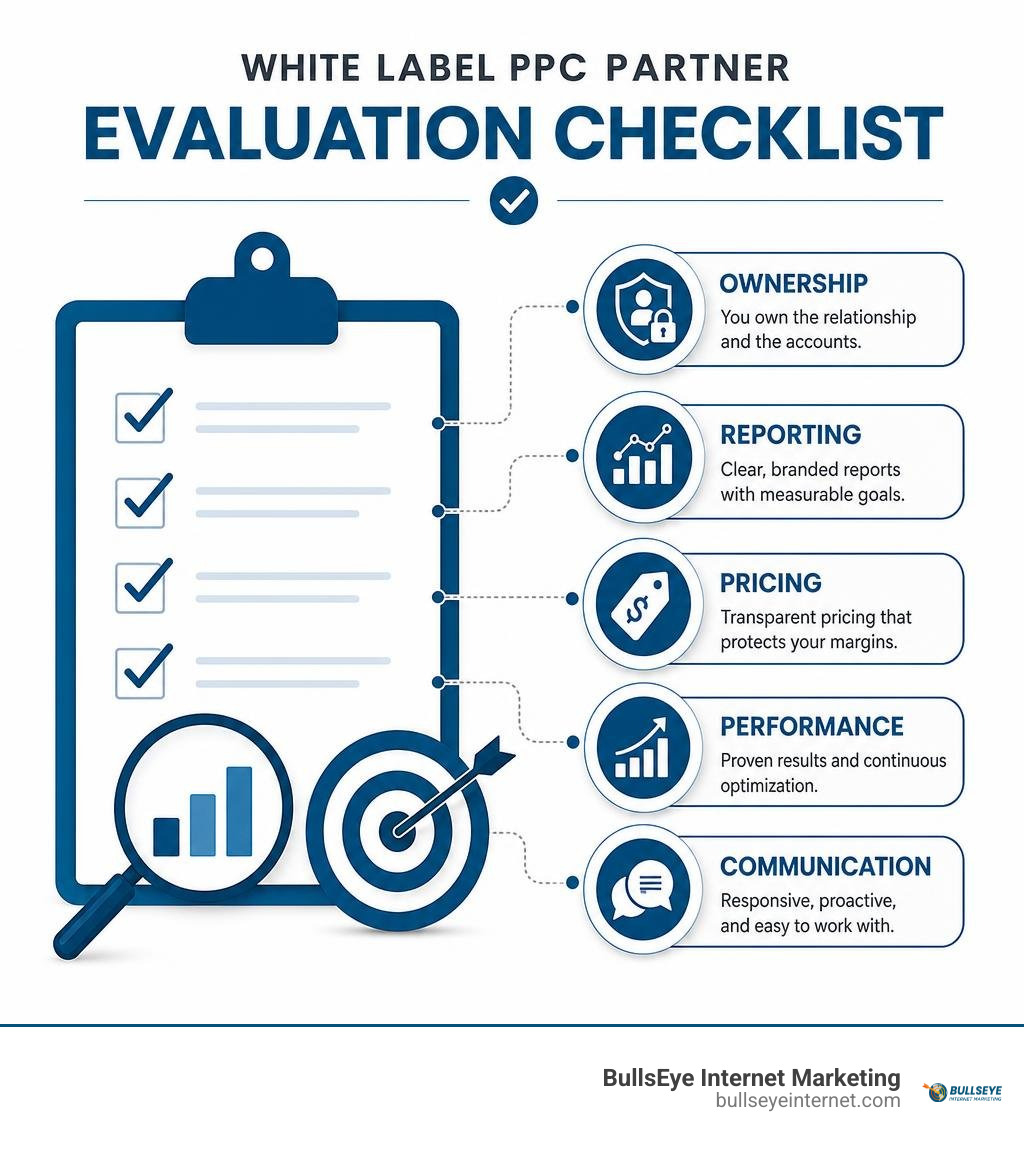
A white label AdWords management company lets your agency sell Google Ads services under your own brand while a specialist team handles campaign setup, optimization, tracking, and reporting behind the scenes. To choose the right partner, look for three things:
- Clear ownership and communication rules so your client relationship stays protected.
- Transparent reporting and measurable goals such as leads, cost per acquisition, and return on ad spend.
- A pricing model that leaves room for profit without locking you into work you cannot support.
This model can help agencies add paid search capacity without recruiting, training, and managing an in-house PPC team. That matters when clients need faster results: new ecommerce sites and local businesses often cannot wait for organic visibility to build. Well-managed Google Ads can put offers in front of people already searching for a product or service.
The tradeoff is real, though. A weak fulfillment partner can create reporting gaps, inconsistent work, compliance risks, and unhappy clients. The right one works as an extension of your team, follows Google Ads policies, protects account access, and gives you timely, branded information you can confidently share.
I am Ronnie Katz, founder and Principal CEO of BullsEye Internet Marketing, with more than 20 years of experience helping businesses improve visibility, traffic, leads, and conversions through PPC and other digital marketing. In this guide, I will show you how to evaluate a white label AdWords management company based on service quality, communication, pricing, performance, and client-fit.
White label adwords management company word guide:
What Is a White Label AdWords Management Company and How Does It Work?
A white label AdWords partner operates as an invisible fulfillment engine for your agency. You manage the client relationship, sign the contracts, and maintain the account ownership, while your wholesale partner handles the technical architecture, execution, and day-to-day bidding.
To the end client, all campaign deliverables, optimization notes, and performance dashboards come directly from your agency. You present the strategies, send the monthly updates under your agency’s logo, and invoice the client at retail rates.
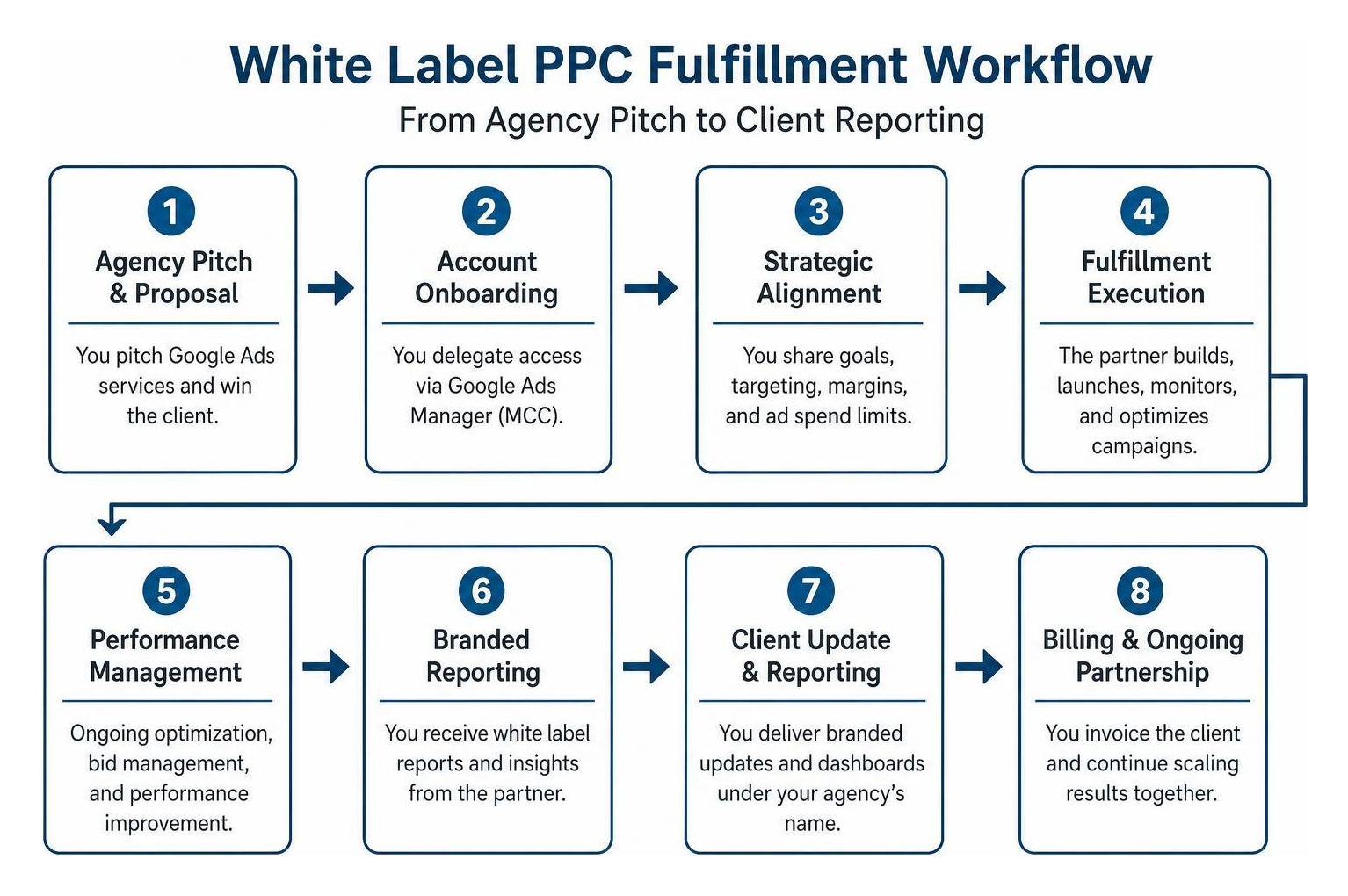
The operational structure typically follows a streamlined flow:
- Account Onboarding: Your agency delegates administrative or standard access through Google Ads Manager (MCC) accounts.
- Strategic Alignment: You share client objectives, target geography, target margins, and monthly ad spend limits.
- Fulfillment Execution: The partner builds, launches, monitors, and optimizes search, display, shopping, or Performance Max campaigns.
- Unbranded Deliverables: You receive comprehensive performance data packaged in unbranded or custom-branded templates ready for client review.
This structure allows you to offer high-level White Label PPC Management Company solutions without taking on operational friction.
Core Services Delivered by a White Label AdWords Management Company
A dedicated fulfillment partner handles every stage of the campaign lifecycle. Paid search demands constant technical maintenance and ongoing refinement.
Standard white label fulfillment includes:
- Audience & Keyword Research: Identifying high-intent search terms, negative keyword lists, competitor brand variations, and long-tail commercial queries.
- Ad Creative & Copywriting: Crafting responsive search ads (RSAs), callouts, sitelinks, structured snippets, and image extensions designed to maximize Quality Scores.
- Bid Optimization & Budget Pacing: Managing manual CPC strategies, Target CPA, Target ROAS, and automated smart bidding algorithms to protect return on investment.
- Conversion Tracking Integration: Implementing Google Tag Manager containers, server-side tracking, Google Analytics 4 event tags, and phone call tracking numbers.
- Negative Keyword Sculpting: Continuously auditing search terms reports to prune non-converting queries and eliminate wasted spend.
When paired with comprehensive PPC Ad Campaign Management, your agency can confidently pitch complex enterprise setups and high-velocity ecommerce stores alike.
Scaling Agency Fulfillment Without In-House Hiring
Hiring an in-house PPC team introduces substantial fixed overhead. Between competitive senior salaries, recruitment fees, health benefits, software licenses, and ongoing training, bringing talent into your office eats away at agency operating margins before your clients even launch their first campaigns.
If an in-house media buyer leaves, your agency faces immediate fulfillment bottlenecks, account instability, and potential client churn. Working with reliable Managed PPC Services transforms fixed labor costs into a variable expense that scales strictly when you bring in new revenue. You pay for execution only when an active client is paying you.
Key Benefits of Partnering with an Outsourced Paid Search Provider
Partnering with an established backend team unlocks rapid operational advantages. Instead of spending months building out standard operating procedures (SOPs) and testing software stacks, your agency gets instant access to enterprise-grade infrastructure.
Key benefits include:
- Immediate Bandwidth: Accept new clients immediately without worrying about internal team capacity.
- Specialized Industry Expertise: Leverage historical campaign data across diverse verticals, from local home services to complex B2B niches.
- Quality Assurance Protocols: Benefit from multi-tiered account reviews that catch campaign errors before ads go live.
- Cross-Platform Scalability: Deploy multi-channel strategies across Google Search, Display, YouTube, and Performance Max without retraining internal staff.
For a deeper look at agency-level campaign operations, explore our PPC Management Agency Complete Guide.
Why Hire a Dedicated White Label AdWords Management Company for Client Retention
Client churn is often the silent killer of agency growth. In paid search, clients leave when campaigns underperform, budgets get mismanaged, or communication fails during volatility.
A dedicated backend team focuses entirely on core performance levers: increasing impression share on profitable search terms, cutting underperforming placements, and optimizing cost per acquisition (CPA). For small businesses with conservative budgets, this surgical focus is essential.
Delivering solid results through experienced PPC Management for Small Business translates directly into longer client retention, predictable monthly recurring revenue, and more referral opportunities for your agency.
Brand Consistency, Whitelabel Reporting, and Client Communication
Maintaining your agency’s reputation requires clean, cohesive reporting. A professional white label provider delivers unbranded or custom-styled reports matching your visual identity:
- Custom-Branded Dashboards: Live Looker Studio (formerly Google Data Studio) dashboards displaying client metrics under your agency’s domain and logo.
- Automated PDF Performance Summaries: Monthly and weekly summaries highlighting lead volume, conversion rates, and spend efficiency.
- Communication Protocols: Fulfillment partners operate either completely behind the scenes (submitting notes directly to your account managers) or via ghostwritten updates sent from your branded email aliases.
Evaluating and Choosing the Right White Label PPC Partner
Not every provider delivers the same technical rigor. When evaluating prospective backend partners, look beyond sales pitches and audit their technical processes, SLA response times, and account governance.

Ensure your prospective partner uses standard industry frameworks. Review our PPC Management Complete Guide to verify that your partner’s methodologies align with proven best practices.
Pricing Models and Profit Margins: Flat Fee vs. Percentage of Ad Spend
Selecting the right pricing model ensures your agency maintains healthy gross margins (ideally 40% to 60%) while offering competitive rates to your end clients.
| Pricing Model | How It Works | Agency Pros | Agency Cons |
|---|---|---|---|
| Flat Monthly Fee | A set wholesale dollar fee per account based on spend tiers (e.g., $500/mo for accounts spending up to $5,000). | Highly predictable costs; maximum profit upside as client budgets scale within the tier. | Can cut into margins on very small-budget accounts if base rates are high. |
| Percentage of Ad Spend | Wholesale provider charges a fixed percentage (e.g., 8–12%) of the client’s monthly ad spend. | Directly aligns costs with campaign size; easy to calculate for high-spend enterprise clients. | Margin shrinkage on large accounts if your retail pricing isn’t marked up appropriately. |
| Tiered Retainer | Base fee covering core management, plus small variable percentage after exceeding spend thresholds. | Balanced risk profile; ensures provider is compensated for complex, large-scale accounts. | Requires careful tracking during client billing cycles to avoid margin discrepancies. |
Assessing Track Records, Compliance, and Technical Competence
Before handing over client accounts, ensure your white label partner meets strict technical and regulatory standards:
- Google Ads Policy Compliance: The team must adhere strictly to Google’s advertising policies, avoiding deceptive practices or black-hat tactics that risk account suspensions.
- Conversion API & First-Party Data Setup: In the modern privacy landscape, your partner must know how to implement Enhanced Conversions and server-side tracking.
- Landing Page & Funnel Alignment: Effective campaign managers don’t stop at ad copy; they evaluate whether landing pages convert incoming paid traffic.
Consulting an experienced PPC Management Consultant can help your agency set internal performance benchmarks before finalizing your partner contracts.
Measuring ROI and Navigating Potential Risks in White Label Partnerships
Outsourcing fulfillment carries real operational risks if expectations are misaligned. Agencies must establish clear Service Level Agreements (SLAs), tracking mechanisms, and governance protocols from day one.

Key Performance Metrics for Client Campaigns
To evaluate both campaign health and partner execution, monitor these core performance metrics:
- Cost Per Acquisition (CPA): Are client acquisition costs declining or stabilizing over time?
- Return On Ad Spend (ROAS): For ecommerce accounts, is total revenue exceeding targeted ad spend multipliers?
- Search Impression Share: Is the client capturing available search volume for their highest-value commercial keywords?
- Quality Score & Click-Through Rate (CTR): Are ad relevance and expected CTR scores high enough to lower average cost per click?
Mitigating Operational Bottlenecks and Quality Risks
Protect your agency from potential pitfalls by establishing strict operational boundaries:
- Maintain Direct Account Ownership: Never allow an external provider to create client accounts under their proprietary MCC where you cannot revoke access. Your agency or your client must always own the administrative credentials.
- Set Turnaround SLAs: Define firm response windows for campaign build requests, ad copy updates, and emergency troubleshooting (e.g., 24-48 business hours).
- Protect Intellectual Property & Non-Competes: Secure explicit, signed non-compete and non-disclosure agreements ensuring the wholesale provider will never solicit your clients directly.
Frequently Asked Questions About White Label PPC
How do white label AdWords management providers handle direct client communication?
Most white label providers offer two distinct communication setups:
- Behind-the-Scenes (Ghost Fulfillment): The provider communicates exclusively with your internal account managers via Slack, email, or project management software. Your team relays all recommendations to the client.
- Front-Facing Agency Representation: The provider attends client strategy calls or responds to emails using an
@youragency.comemail alias, acting entirely as a member of your in-house team.
What pricing model delivers the most predictable agency profit margins?
A flat-fee tiered model generally provides the most stable agency margins. It allows you to package PPC management alongside SEO, web design, or social media services as a predictable recurring retainer while securing your target gross margin on every account.
How quickly can an agency onboard a partner for active Google Ads accounts?
Onboarding typically takes between 3 to 7 business days. This window allows the fulfillment team to conduct a comprehensive historical account audit, configure tracking tags, verify conversion actions, align negative keyword lists, and present a strategic optimization roadmap.
Conclusion
Scaling an agency requires smart leverage. Partnering with a dedicated fulfillment specialist gives you the technical horsepower to launch high-performing paid campaigns, protect client retention, and unlock predictable recurring revenue—without adding substantial payroll overhead.
At BullsEye Internet Marketing, we deliver transparent, results-driven campaign fulfillment across South Florida—including Palm Beach County, Broward County, and Miami-Dade County—as well as across all 50 U.S. states. We provide a genuine competitive advantage by offering no long-term contracts and working with only one client per industry per geographic market.
Ready to expand your agency’s fulfillment capabilities? Explore our dedicated pay-per-click management services and discover how our team can help drive profitable growth for your agency.
