
Why Understanding Semantic SEO Matters for Your Business
Semantic SEO services help your website rank higher by optimizing content for meaning and user intent, not just keywords. Here’s what you need to know:
What Semantic SEO Services Include:
- Topic clusters and pillar pages that establish your expertise
- Entity optimization using structured data (Schema markup)
- Natural language content that answers real user questions
- Internal linking strategies that connect related topics
- Contextual keyword research beyond exact-match phrases
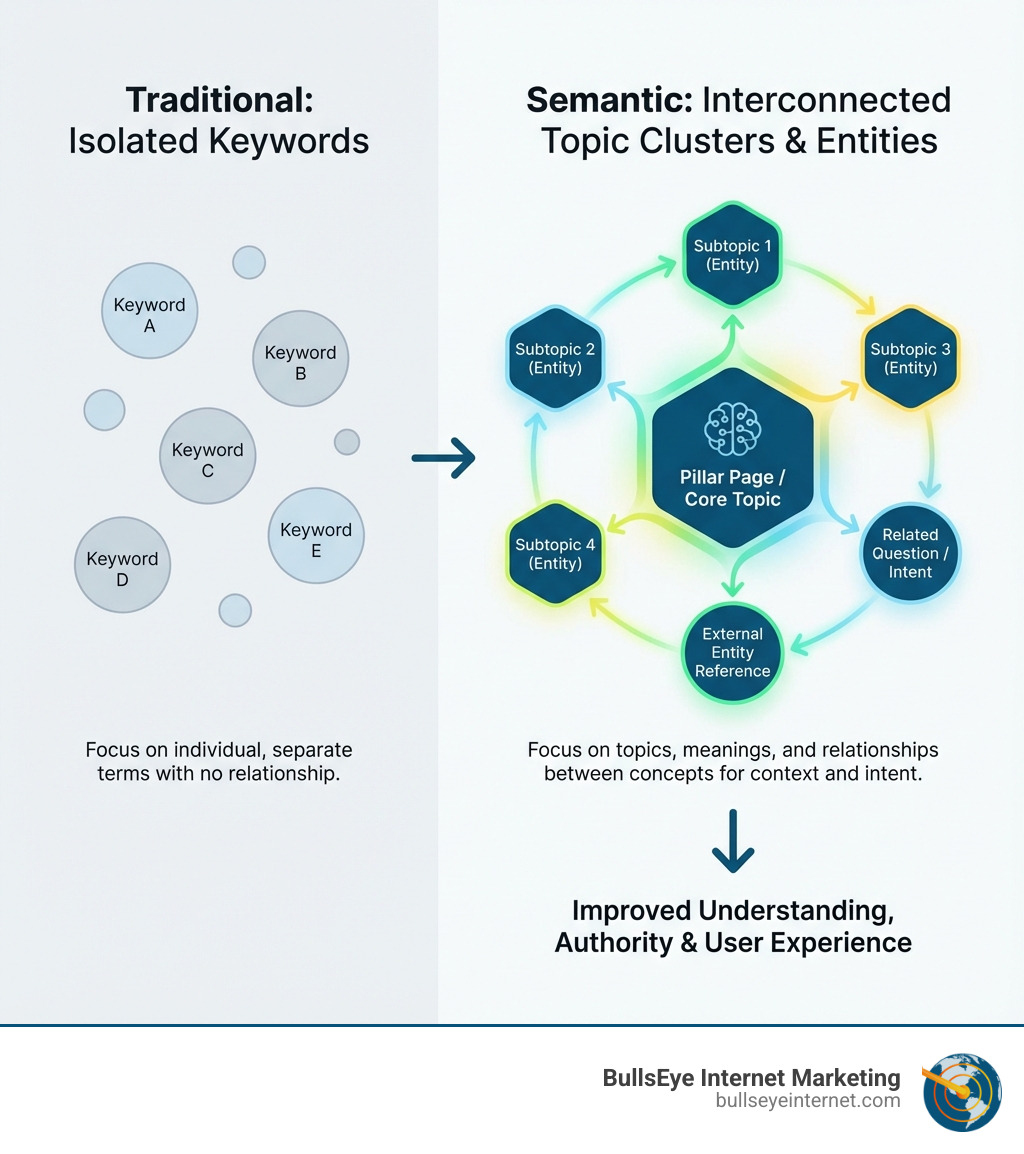
Key Difference: Traditional SEO targets specific keywords. Semantic SEO targets topics and the relationships between concepts—the way people actually search and ask questions.
If you’ve been frustrated watching competitors rank higher despite your best SEO efforts, you’re not alone. The search landscape has changed dramatically. Google now processes over 3.5 billion searches daily, and most of these require understanding context and intent—not just matching keywords.
Search engines have evolved from simple keyword matching to understanding what users really mean when they search. Google’s algorithms like Hummingbird, RankBrain, and BERT now interpret language the way humans do. They recognize entities (people, places, concepts), understand relationships between topics, and reward content that provides comprehensive answers.
This shift means keyword stuffing is dead. What works now is building topical authority—creating interconnected content that demonstrates deep expertise on subjects your customers care about. Websites using semantic SEO strategies see up to 20% increases in organic traffic by ranking for broader sets of related search terms.
As Ronnie Katz, founder of BullsEye Internet Marketing with over 20 years of experience in online marketing, I’ve helped businesses adapt their strategies to align with how search engines understand content today, including implementing cutting-edge Semantic SEO services that drive measurable results. Let me show you how semantic SEO can transform your visibility and bring qualified traffic to your business.
Easy Semantic SEO services glossary:
What is Semantic SEO and Why Does It Matter?
The digital world is constantly evolving, and so are search engines. Remember the good old days when stuffing your content with keywords was the ticket to the top? Well, those days are long gone. Search engines, particularly Google, have become incredibly sophisticated, moving beyond simple keyword matching to genuinely understanding the meaning and intent behind a user’s query. This evolution is precisely why Semantic SEO services are not just a trend, but a necessity for any business aiming to thrive online.
Google’s mission is “to organize the world’s information and make it universally accessible and useful.” To achieve this, their algorithms have undergone significant changes. It all started with major updates like Google’s Hummingbird algorithm changes made in 2013, which shifted focus from individual keywords to understanding the meaning and context of entire phrases. This was followed by RankBrain in 2015, a machine learning algorithm that further improved Google’s ability to interpret search intent, and then BERT in 2019, which greatly improved the understanding of conversational search by analyzing the nuances of language.
The rise of AI-driven search, with features like AI Overviews and generative AI models, has pushed this even further. Now, search engines aren’t just looking for words; they’re looking for answers, context, and comprehensive understanding. With over 3.5 billion searches processed daily, a large number of these require semantic interpretation. This means Google has to analyze the context and intent behind the words, not just the exact terms used. For businesses like ours in Florida, from Miami to West Palm Beach, understanding this shift is crucial to connecting with our local customers.
How Search Engines Understand Meaning
So, how do these digital brains actually “understand” what we mean? It’s largely thanks to Natural Language Processing (NLP), a field of AI that helps computers interpret, understand, and generate human language. NLP plays a significant role in helping Google rank websites, drastically improving Google’s understanding of web content and user queries.
At the heart of this understanding are “entities.” Think of entities as “things”—people, places, concepts, or objects—that are unique, singular, distinguishable, and well-defined. For example, “Apple” could be a company or a fruit. Search engines use context and relationships to figure out which “Apple” you mean. This is where Google’s Knowledge Graph comes in. Since 2012, Google has used this large and sophisticated knowledge base to organize information and improve its understanding of the relationships between various entities and concepts. It’s how Google knows that “Steve Jobs” is related to “Apple Inc.” and “iPhone.”
This process is about turning “strings” (like a jumble of letters) into “things” (identifiable entities). As Google explains, if “bestgihrtie” means nothing, it won’t mean anything to a search engine. But if we declare it as the name of our new album, snack food, or generative AI tool, it becomes an identifiable entity. Google understands entities and topics by linking them to its vast Knowledge Graph, creating a web of contextual relevance that helps it serve the most accurate results.
The Shift to ‘People-First’ Content
With this advanced understanding, Google now prioritizes what it calls “people-first” content. This isn’t just a catchy phrase; it’s a fundamental shift in how content is evaluated. Search engines now consider content depth, meaning (aka semantics), and how it answers user questions by providing the desired information.
What does this mean for your business? It means your content needs to be genuinely helpful, comprehensive, and user-focused. It’s no longer enough to just include keywords; you need to anticipate user questions and provide thorough, well-structured answers. Google’s helpful content update indicates that sites with a high amount of unhelpful content are less likely to perform well. This aligns perfectly with the principles of Semantic SEO services: creating content that truly serves the user. Our goal is to ensure your content provides such value that it becomes a go-to resource, not just another page on the web. You can learn more about this approach directly from Google’s ‘people-first’ content guide.
The Impact on Voice Search and AI Overviews
The evolution of search isn’t stopping there. Voice search and AI-driven search results are rapidly changing how users interact with information. When people use voice search, they tend to ask longer, more conversational questions, much like they would speak to another person. Our content needs to align with this natural language to capture this growing segment of traffic.
Semantic SEO helps your content match the conversational nature of voice search queries. By aligning your content with the way people naturally speak, you can capture more traffic from voice searches and improve your rankings in voice search results.
And then there’s the exciting, and sometimes challenging, world of AI Overviews (formerly Search Generative Experience or SGE). The emergence of powerful generative AI search engines, like Google’s Search Generative Experience, has propelled semantic technology to unprecedented heights. These AI overviews synthesize information from multiple sources to provide direct answers. What’s fascinating is that 82.5% of AI Overview citations point to “deep pages” with URLs located two or more clicks from the homepage, not surface-level content. This highlights the importance of comprehensive, semantically rich content that thoroughly covers a topic—exactly what our Semantic SEO services aim to achieve.
Core Components of a Winning Semantic SEO Strategy
Building a successful semantic SEO strategy is like constructing a magnificent house. You need a strong foundation, well-designed rooms, and interconnected pathways. Our approach focuses on establishing topical authority, creating robust content ecosystems, and ensuring semantic depth across your entire website.
Here are the core components we leverage to lift your online presence:
- Building Topic Clusters and Pillar Pages: Organizing your content logically.
- The Role of Entities and Structured Data: Helping search engines understand the “things” on your site.
- Creating Contextually Rich Content: Crafting content that answers user intent thoroughly.
Building Topic Clusters and Pillar Pages
Imagine your website as a library. In traditional SEO, each book might stand alone. In semantic SEO, we organize books into interconnected sections and shelves. This is the concept of topic clusters and pillar pages. A pillar page is a comprehensive, broad piece of content about a core topic (e.g., “Digital Marketing Strategies”). Cluster content then digs into specific subtopics related to that pillar (e.g., “SEO Best Practices,” “PPC Campaign Setup,” “Social Media Advertising”).
This model establishes you as an authority on a subject. When Google sees a well-organized cluster, it understands that your site offers in-depth knowledge, making it more likely to rank for a wider range of related queries. An effective internal linking strategy connects these pillar and cluster pages, reinforcing the semantic relationships and guiding both users and search engine crawlers through your content ecosystem. HubSpot, for example, has famously demonstrated how HubSpot uses topic clusters to drive massive SEO growth.

The Role of Entities and Structured Data
We’ve talked about entities—the “things” Google understands. But how do we explicitly tell Google what our “things” are and how they relate? That’s where structured data, specifically Schema markup, comes in. Schema (as it’s often shortened) is a rigorous way of marking up entity-attribute-value relationships. It uses vocabulary developed by Schema.org, a collaborative project between Google, Microsoft, Yahoo!, and Yandex.
Structured data, commonly implemented using JSON-LD, provides search engines with explicit details about your content. It’s like adding labels to everything in your library, telling the librarian exactly what each book is about, its author, genre, and even who might be interested in it. This helps search engines categorize entities and explicitly relate them to each other, giving them helpful contextual information about your content.
For example, if you have a recipe page, structured data can tell Google it’s a “Recipe,” what the ingredients are, cooking time, and even user ratings. This can lead to rich snippets in search results, which stand out and often lead to higher click-through rates. Using structured data is one of the most powerful ways to improve your semantic signals.
Consider the impact of structured data on a recipe page:
| Feature | Without Schema Markup | With Schema Markup (JSON-LD) |
|---|---|---|
| Search Result | Standard title, URL, description | Rich snippet with star rating, cook time, image |
| Understanding | Google infers content from text | Google explicitly understands it’s a recipe, ingredients, etc. |
| Visibility | Blends in with other results | Stands out, higher click-through potential |
| AI Answers | Less likely to be cited for specific details | More likely to be sourced for recipe instructions |
This table illustrates how structured data helps Google understand your content better and presents it more appealingly to users.
Creating Contextually Rich Content
The final piece of the puzzle is creating content that is rich in context and meaning. This goes beyond traditional keyword research. We perform semantic keyword research, looking not just for exact phrases but for synonyms, related terms, questions, and subtopics that a user might search for. This includes Latent Semantic Indexing (LSI) keywords, which are words and phrases related to your main keyword that help search engines understand the context and relevance of your content. For example, if you’re writing about “athletic footwear,” LSI keywords might include “running shoes,” “sneakers,” “sports shoes,” or “training gear.”
A fantastic way to find these contextual gems is by looking at Google’s “People also ask” feature, which appears for 48.4% of all search queries. These are real questions users are asking. By addressing these questions directly in your content, you improve your semantic signals and boost your chances of ranking higher, potentially even in the top of the SERPs.
Contextually rich content is about anticipating user intent and providing comprehensive, natural language answers. It means writing content that isn’t just for bots, but for the humans who will read it, covering topics from multiple angles and addressing various stages of the user journey.
Benefits, Measurement, and Finding the Right Semantic SEO Services
Investing in Semantic SEO services isn’t just about technical tweaks; it’s about fundamentally improving how your business connects with its audience online. The benefits are far-reaching, from higher rankings and increased organic traffic to building lasting brand trust.
Key Benefits for Your Business
When we implement a robust semantic SEO strategy, our clients often see a noticeable boost in visibility and rankings for a wider range of search terms. For example, a business selling running shoes in Coral Gables might also optimize for terms like “athletic footwear” or “exercise shoes,” capturing a broader audience. This strategy has been shown to increase organic traffic by up to 20%, according to case studies in industries like fashion and electronics.
Here are some key benefits our clients experience:
- Improved User Engagement: By answering user intent more accurately, your content becomes more relevant and satisfying, leading to longer time on page and lower bounce rates.
- Lower Bounce Rates: When users find exactly what they’re looking for, they’re less likely to immediately leave your site.
- Building Brand Trust and Authority: Consistently providing comprehensive, helpful content establishes your business as a knowledgeable and trustworthy resource in your industry, whether you’re in Miami or Fort Lauderdale.
- Future-Proofing Your Website: As search engines continue to evolve with AI, a semantic approach ensures your content remains relevant and findable, adapting to new search behaviors and technologies.
How to Measure the Success of Your Semantic SEO Services
Measuring the success of your Semantic SEO services is crucial to understanding your return on investment and refining your strategy. We don’t just set it and forget it; we constantly monitor and adapt. Here are some key metrics we track:
- Organic Traffic Growth: This is the most straightforward indicator. We look for sustained increases in visitors coming from organic search.
- Topic-Level Visibility: Beyond individual keywords, we analyze your visibility for entire topics and clusters, ensuring you’re dominating your niche.
- Unique Queries Per Page: Semantic content often ranks for hundreds, if not thousands, of unique search queries, indicating its broad relevance.
- Engagement Metrics: We dig into data like time on page, scroll depth, and next-page clicks to understand how users are interacting with your content. High engagement signals content quality to search engines.
- AI Citation Frequency: With the rise of AI Overviews, we monitor how often your content is cited as a source in generative AI answers, a key indicator of its semantic strength and authority.
The Future of Search: Preparing for What’s Next
The future of search is undeniably semantic and increasingly AI-driven. This means SEO is evolving into what some call Generative Engine Optimization (GEO) or AI Optimization (AIO). These terms highlight the need to optimize content not just for traditional search results, but for inclusion in AI-generated answers and summaries.
Google’s experimental breakthrough in 2023, where they announced the integration of generative AI with search, marked a new era. Now, with features like Google’s AI Overviews, your content’s ability to be understood semantically and contribute to these AI-powered summaries is paramount.
The importance of E-E-A-T (Experience, Expertise, Authoritativeness, and Trustworthiness) will only continue to grow. AI models need to trust the sources they draw from. By consistently providing high-quality, semantically rich content that demonstrates your expertise, you’re building a foundation for long-term success in this AI-first world. This is where our Semantic SEO services truly shine—positioning your business for today’s search landscape and tomorrow’s AI revolution.
Frequently Asked Questions about Semantic SEO Services
How is Semantic SEO different from traditional SEO?
The biggest difference between Traditional SEO and Semantic SEO is their focus. Traditional SEO primarily focuses on individual keywords and phrases, aiming to rank for those exact terms. It often involved analyzing keyword density and placing keywords strategically throughout the content.
Semantic SEO, on the other hand, focuses on the meaning and intent behind search queries, as well as the relationships between entities and concepts. It’s about optimizing your content for a topic rather than a single keyword. WeDevs states that “Semantic SEO is the bridge between your content and users’ intent. This is the biggest difference between Traditional SEO and Semantic SEO.” This approach considers synonyms, related concepts, and the overall context to ensure your content provides the most relevant and comprehensive answer to a user’s underlying need. It’s about understanding why someone is searching, not just what they typed.
How long does it take to see results from professional semantic SEO services?
The timeline for seeing results from Semantic SEO services can vary depending on several factors, including the competitiveness of your industry, the current state of your website, and the comprehensiveness of the strategy implemented. However, you can typically expect to see improvements in search rankings and organic traffic within a few months.
For example, case studies have shown significant lifts in organic traffic within 6 to 18 months of implementing strategic SEO initiatives. Some businesses have seen noticeable boosts in visibility and rankings within three months. We emphasize patience and consistent effort, as Google’s algorithms need time to crawl, index, and recognize the improved relevance and authority of your semantically optimized content. We commit to transparent reporting, detailing improvements and performance metrics so you always know where you stand.
Can small businesses benefit from semantic SEO?
Absolutely! Semantic SEO services are beneficial for businesses of all sizes, including small local businesses across Florida, from St. Lucie County to Indian River County. While large enterprises might have extensive resources, semantic SEO levels the playing field by rewarding quality, relevance, and comprehensive content over sheer volume or link profiles alone.
For a small business, semantic SEO means you can:
- Compete on relevance: By deeply understanding your local customers’ needs and providing genuinely helpful content, you can outrank larger competitors who might have more generic content.
- Capture niche queries: Optimize for long-tail, conversational queries that your specific audience is asking, driving highly qualified traffic to your site.
- Build local authority: Establish yourself as the go-to expert for your services in your specific geographic area, whether you’re an HVAC company in Vero Beach South or a boutique in Delray Beach.
For example, an HVAC company that rewrote service pages using natural phrasing, FAQs, and entity optimization ranked in Google Assistant voice queries and saw mobile leads rise by 61%. This demonstrates that a focused semantic approach can yield significant results for local businesses.
Semantic SEO: Key to Sustainable Growth – BullsEye Internet Marketing
The digital landscape is a dynamic place, constantly reshaped by evolving search engine algorithms and the increasing sophistication of artificial intelligence. We’ve explored how Semantic SEO services are no longer a luxury but a fundamental necessity for any business aiming for sustainable online growth.
The shift from a keyword-centric approach to one that prioritizes meaning, user intent, and contextual relevance is profound. By building topic clusters, leveraging entities and structured data, and crafting content that genuinely answers user questions, you’re not just optimizing for today’s search engines; you’re future-proofing your online presence against the inevitable advancements in AI.
At BullsEye Internet Marketing, we understand this evolution deeply. Our expertise in implementing cutting-edge Semantic SEO services is designed to help businesses like yours generate more calls and sales by ensuring your content speaks directly to your audience and to the advanced algorithms that connect them. We believe in building long-term strategies that deliver measurable results, helping you gain a competitive advantage in your industry and geographic area, without the burden of long-term contracts.
Ready to transform your online visibility and connect with your customers more effectively? Learn more about our Answer Engine Optimization services and let us help your business thrive in this exciting new era of search.
