
Why Senior care leads Are Harder to Win Than Ever — and What to Do About It
Senior care leads are inquiries from families or individuals actively seeking home care, assisted living, memory care, or related services for an aging loved one. If you’re trying to grow a senior care agency, here’s what you need to know upfront:
Quick Answer: The Most Effective Sources of Senior Care Leads
| Lead Source | Lead Type | Speed to Results | Cost Level |
|---|---|---|---|
| National directories (A Place for Mom, Caring.com) | Shared | Fast | Medium |
| Exclusive pay-per-lead agencies | Exclusive | Fast | Medium–High |
| Google Ads (PPC) | Intent-based | Fast | Medium–High |
| Local SEO / Google Map Pack | Organic | Slow | Low (time investment) |
| Referral networks (doctors, discharge planners) | Warm | Medium | Low |
| Interactive quizzes / AI lead capture | Mixed | Medium | Low–Medium |
Finding new clients is one of the hardest parts of running a senior care business. The market is growing fast — over 52 million Google searches happen every year related to senior care, and the industry is projected to hit $500 billion by 2030. But more demand doesn’t mean easier growth.
Here’s the problem most agencies run into:
- Purchased leads from big directories are shared with multiple competitors
- Slow follow-up means losing families to whoever calls first
- Organic strategies take months to show results
- It’s hard to know which lead sources actually deliver ROI
The agencies that win are the ones that combine the right lead sources with fast response systems and a clear conversion process.
I’m Ronnie Katz, founder of BullsEye Internet Marketing, and with over 20 years helping businesses generate senior care leads through SEO, pay-per-lead, Google Ads, and local search optimization, I’ve seen what works and what wastes budget. In this guide, I’ll break down exactly how to evaluate your options and build a lead strategy that actually converts.
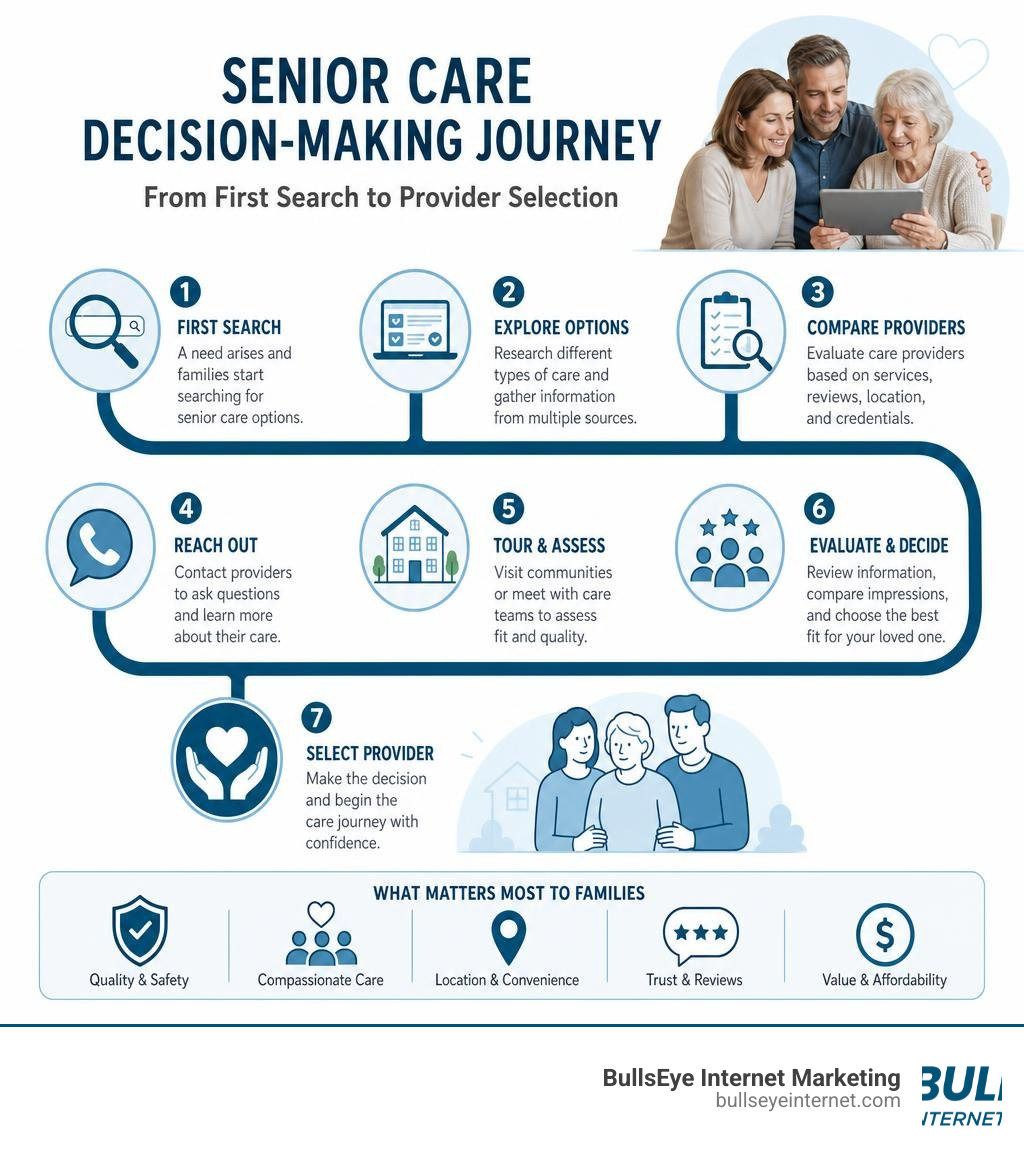
Quick look at Senior care leads:
Understanding the Market for Senior Care Leads

The landscape of senior care is undergoing a massive transformation. As we navigate July 2026, we are witnessing the peak of the baby boomer generation crossing the age thresholds that require structured care. By 2030, all baby boomers will be 65 or older, representing a staggering 20% of the United States population.
This demographic shift has triggered a surge in demand, particularly for non-medical home care and specialized memory support. Families are increasingly looking for ways to keep their loved ones safe, happy, and independent in their own homes. In fact, 76% of seniors express a strong preference for aging in place rather than transitioning to institutional care facilities.
When evaluating where to establish or expand your care services, understanding regional dynamics is critical. Various states offer differing levels of infrastructure and support for the aging population. For a comprehensive look at how different regions stack up, you can review the Center for Retirement Research guide on the best states for growing old. Here in Florida, particularly in South Florida counties like Broward, Miami-Dade, and Palm Beach, the concentration of retirees makes the local search landscape exceptionally competitive.
Why High-Quality Senior Care Leads Matter for Agency Growth
For any home care or senior living provider, senior care leads are the lifeblood of business development. However, not all leads are created equal. A “lead” can range from a highly motivated family member looking for immediate 24-hour care to a casual browser who clicked an ad by accident.
Chasing low-quality, unverified inquiries drains your administrative resources and burns out your sales team. High-quality leads—those that are pre-qualified for care level, geographic location, and financial capacity—convert at a 32% higher rate than traditional, unvetted referral sources. When you focus your marketing resources on capturing high-intent prospects, you experience:
- Faster move-in velocities and care start times
- Higher conversion rates from initial inquiry to signed contract
- Predictable revenue growth that allows you to confidently recruit and retain caregivers
To understand how to position your agency to capture these premium prospects, check out our comprehensive guide on local lead generation services.
The Role of Adult Children in Senior Care Decisions
When building a marketing campaign for senior care leads, many agencies make the mistake of targeting the seniors themselves. In reality, seniors use the internet less than any other demographic. The true buyer persona you must target is the adult child.
Adult children make approximately 78% of senior care purchasing decisions. Typically, these are busy professionals in their 40s, 50s, or 60s who are suddenly thrust into the role of care coordinator due to a sudden health decline or hospitalization of their aging parent.
These family decision-makers do not make hasty choices without research. On average, families research senior care options online for 47 days before making a final decision. Furthermore, 68% of these decision-makers state that a provider’s digital presence (including website design, ease of navigation, and online reviews) significantly impacts their ultimate choice.
Comparing National Lead Networks vs. Exclusive Regional Providers
To build a sustainable pipeline, you need to understand the structural differences between national lead networks and exclusive regional lead generation agencies.
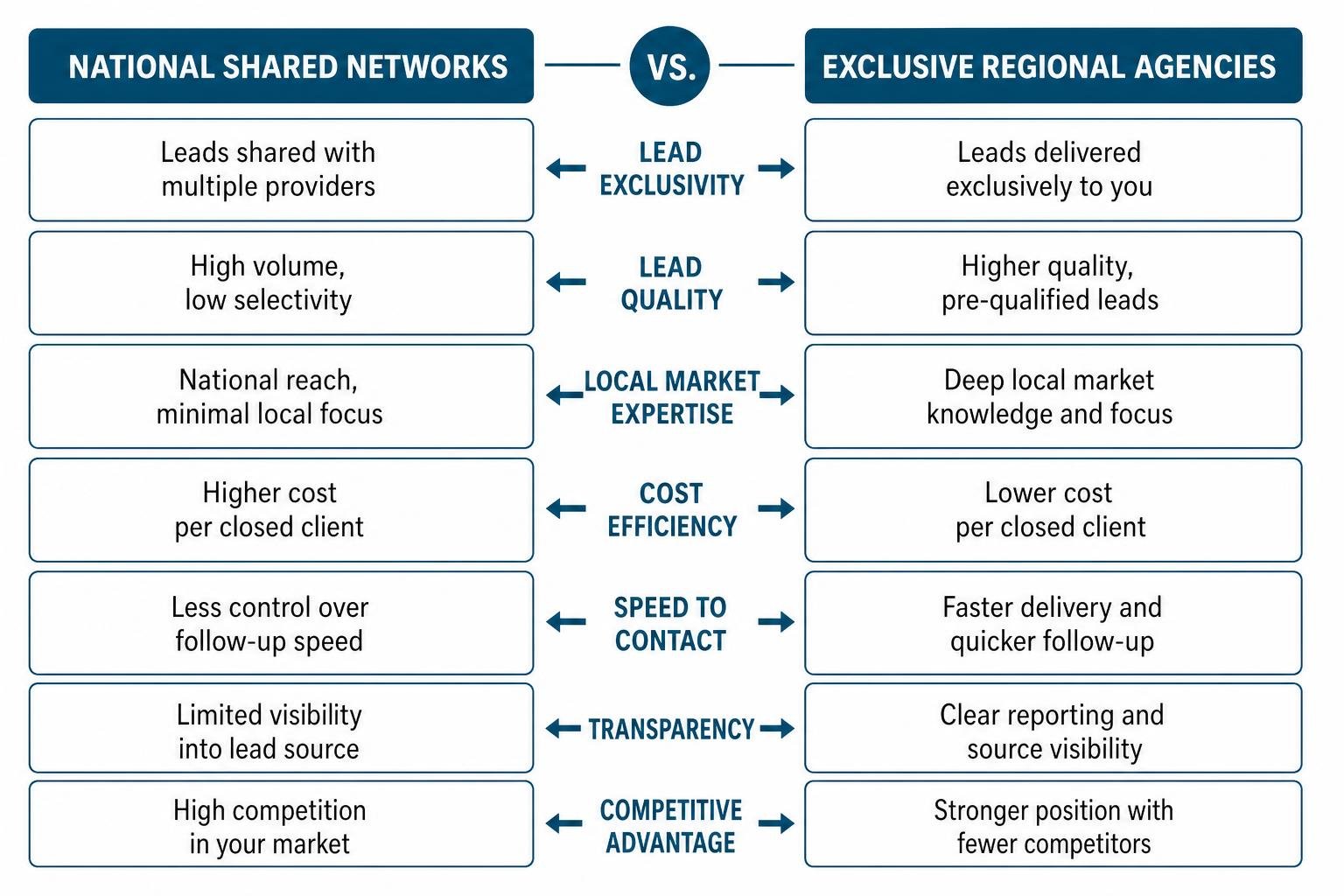
The Pros and Cons of National Shared Lead Directories
National directories operate on a massive scale, leveraging heavy search engine marketing budgets to capture top-of-funnel search traffic.
The Pros:
- High Lead Volume: They can deliver a steady stream of inquiries due to their massive national footprint.
- Brand Recognition: Families often trust these large directories initially because they present themselves as neutral advisory services.
- Free for Families: Because the service is free to the consumer, the barrier to entry for a family to submit their information is very low.
The Cons:
- Shared Lead Distribution: The biggest drawback is that these directories typically sell the exact same lead to 3 to 5 local competitors simultaneously. This creates an intense, high-stress race to the phone.
- Competition Fatigue: Because multiple agencies are calling the family within minutes, the family often feels harassed and may stop answering their phone altogether.
- Commission Fees: Some national networks charge hefty placement fees—often equivalent to 50% to 100% of the first month’s care revenue or a permanent percentage of the contract value.
How to Evaluate Providers of Senior Care Leads
If you decide to purchase senior care leads, you must vet the provider with extreme scrutiny. Look for providers that offer transparency in how they acquire their traffic and verify their prospects.
When evaluating a pay-per-lead provider, ask the following questions:
- Is the lead exclusive? Exclusive leads are routed to your agency and your agency alone, completely eliminating direct inbox competition.
- What is the verification process? Top-tier providers verify key details such as geographic location, care level requirements (e.g., companion care vs. specialized dementia care), timeline, and financial capacity before routing the lead to you.
- What is the contract flexibility? Avoid providers that lock you into long-term contracts. At BullsEye Internet Marketing, we believe that if a lead campaign isn’t performing, you shouldn’t be trapped in a multi-month commitment.
- How are duplicate leads handled? Ensure there is a clear dispute window (typically 5 business days) to flag and receive credit for duplicate inquiries.
To learn more about how to structure these performance-based partnerships, read our complete pay-per-lead agency guide.
Multi-Channel Strategies for Generating Senior Care Leads
Relying on a single source of leads is a risky business model. If a third-party directory changes its pricing structure or algorithm, your lead flow can dry up overnight. The most successful agencies combine purchased leads with robust, organic multi-channel marketing.
In South Florida, local agencies like Visiting Angels of West Palm Beach establish a balanced approach by combining digital visibility with deep local community connections. They often work alongside regional resources like the Area Agency on Aging of Broward County, the Miami-Dade County Elderly Services, and the Council on Aging of Martin County to build credibility both online and offline.
Leveraging Local SEO and Online Reviews
Local SEO is the single most cost-effective way to generate high-intent senior care leads over the long term. When an adult child searches for “home care near me” or “assisted living in [City],” Google displays the Local 3-Pack (the Map Pack) at the very top of the organic search results.
- The Power of the Map Pack: 44% of all clicks in local search results go directly to the Google Map Pack. If your agency is not ranking in these top three positions, you are missing out on nearly half of your local market.
- The Impact of Reviews: 89% of healthcare consumers read online reviews, and 87% believe they are highly important when choosing a provider. In fact, 79% of consumers trust online reviews as much as personal recommendations from friends or family.
- Directory Amplification: Listings on local directories that have active, positive reviews can generate up to 14 times more leads than listings with zero reviews.
To maximize your local search footprint, we highly recommend utilizing Google Local Services Ads. These pay-per-lead ads appear at the absolute top of the Google search page, even above traditional PPC ads. Read our guides on Google Local Services Ads for wellness services and why healthcare Google Local Ads are a game changer to see how this can work for your agency.
Paid Search and Google Ads for High-Intent Traffic
While organic SEO is a long-term play, Google Ads (PPC) offers an immediate way to get in front of families in crisis. When a senior is being discharged from a rehabilitation facility in Fort Lauderdale or West Palm Beach and cannot return home safely without support, the family needs care today. They search with high-urgency keywords like “urgent home care agency” or “24/7 senior care.”
To run a profitable Google Ads campaign:
- Focus on Quality Score: Google rewards highly relevant ads and landing pages with higher Quality Scores (ranging from 1 to 10). A higher Quality Score lowers your cost-per-click (CPC), allowing you to outrank competitors who may have larger budgets but poorer ad relevance.
- Avoid Broad Keywords: Bidding on broad terms like “senior help” or “aging” will waste your budget on non-commercial informational searches. Instead, bid on high-intent phrases like “licensed home care agency near me.”
- Use Negative Keywords: Actively exclude search terms related to employment (e.g., “caregiver jobs”) to prevent wasting budget on job seekers rather than care seekers.
Interactive Quizzes and AI-Powered Lead Capture
Modern digital marketing is shifting away from static “Contact Us” forms. Families navigating the senior care space for the first time are often confused, overwhelmed, and hesitant to commit to a sales call.
Interactive quizzes offer a low-pressure, highly engaging way to capture top-of-funnel leads. For example, a quiz titled “Does My Parent Need Home Care? Take the 2-Minute Assessment” provides immediate, personalized value to the user while capturing essential care and contact details for your agency. Platforms like Your Senior Leads and Acquiring Leads AI specialize in automating these front-end interactions.
Furthermore, integrating GPT-powered AI voice and text agents allows you to follow up with these leads within 60 seconds of form submission. This immediate touchpoint keeps the prospect engaged before they navigate to a competitor’s website.
Maximizing Conversion Rates and Avoiding Common Pitfalls
Generating a lead is only half the battle. If your internal intake processes are broken, even the highest-quality leads will fail to convert into active clients.
Streamlining Intake and CRM Integration
In the senior care industry, “speed to lead” is the single most critical factor determining conversion success.
- The 5-Minute Rule: If you do not contact a new lead within the first 5 minutes of inquiry, your chances of converting them drop by over 80%. Families in crisis make decisions rapidly; the first agency to pick up the phone and show genuine compassion almost always wins the contract.
- CRM Automation: To achieve this rapid response, your lead generation channels must integrate directly with your Customer Relationship Management (CRM) system. Platforms like PeakIntent offer real-time delivery formats that push verified lead details directly to your phone or CRM within 3 to 5 minutes of generation.
- Automated Workflows: Set up automated SMS and email sequences that trigger immediately upon lead capture. An automated text saying, “Hi Sarah, we received your inquiry about home care for your mom. Would you like to schedule a quick 10-minute call with our care coordinator today?” can secure the prospect’s attention in seconds.
For deeper insights on modernizing your digital intake process, explore our guide on how to fill your waiting room using modern lead generation.
Common Pitfalls in Senior Care Lead Generation
Avoid these frequent mistakes to protect your marketing ROI:
- Chasing Unqualified Leads: Do not waste time on leads that do not match your service area, budget requirements, or care capabilities. Implement strict pre-qualification filters on all lead capture forms.
- Failing to Track ROI: Many agencies monitor raw lead volume rather than customer lifetime value (LTV) and acquisition cost. Track every lead back to its original source to identify your most profitable channels.
- Neglecting Lead Nurturing: Because the average family research window is 47 days, a lead that isn’t ready to start care today may be ready next month. Maintain a gentle, educational email nurturing campaign to keep your agency top-of-mind.
- Ignoring Local Partners: Digital marketing should complement, not replace, local networking. Ensure your team maintains close relationships with local care coordinators, such as the professionals listed on the Senior Care Solutions FL team page or representatives at the Florida Department of Elder Affairs Elder Affairs Florida portal.
Frequently Asked Questions about Senior Care Leads
What is the average cost per lead in the senior care industry?
The cost per lead (CPL) varies widely depending on the lead type, geographic location, and competition. Shared directory leads typically range from $40 to $90 per lead, though they require high administrative effort to close. Exclusive, pre-qualified phone leads or live transfers generally cost between $150 and $300+ per lead, but they carry a significantly higher conversion rate. PPC-generated leads via Google Ads can range from $100 to $250 depending on local market competitiveness.
How can agencies verify the quality of purchased leads?
Agencies should partner with lead generation providers that implement multi-step verification. A high-quality provider will verify:
- Identity and Intent: Confirming the person submitting the form is a family decision-maker with a genuine need.
- Financial Capacity: Vetting for private pay capability, long-term care insurance, or specific government waiver programs.
- Care Specifics: Determining the exact level of care needed (companion, personal, memory, or 24-hour care) and the desired start date.
Why is speed-to-lead so critical for shared leads?
Because national directories distribute the same lead to multiple local agencies simultaneously, the family is often overwhelmed by incoming calls. The “first responder advantage” is incredibly real; the first agency to connect with the family, offer professional guidance, and schedule an in-person assessment is highly likely to secure the contract before competitors even make their first call.
Conclusion
Generating a consistent stream of high-quality senior care leads requires a diversified, strategic approach. While national shared networks can offer initial volume, the ultimate path to sustainable, high-ROI growth lies in building your own organic local presence and partnering with exclusive, territory-protected lead providers.
At BullsEye Internet Marketing, we do things differently. We specialize in generating exclusive calls and sales for our clients through tailored SEO, Google Business Profile optimization, PPC, and pay-per-lead campaigns.
Our unique advantage? We offer no long-term contracts and work with only one client per industry per geographic area. This means when we partner with your agency in Broward, Miami-Dade, or Palm Beach County, we focus 100% of our local search expertise on giving you the ultimate competitive advantage—never your local competitors.
Are you ready to stop chasing shared, low-quality inquiries and start receiving exclusive, high-intent phone calls? Get started with our pay-per-call advertising agency services today and let us help you grow your census with confidence.
