
Why Most Electricians Are Invisible Online (And How to Fix It)
A solid electrician marketing plan is the difference between a fully booked schedule and waiting for the phone to ring. Here’s what one looks like at a glance:
The Essential Components of an Electrician Marketing Plan:
- Google Business Profile — Optimize for local map visibility and reviews
- Local SEO — Rank for “electrician near me” and city-specific searches
- Google Local Services Ads (LSAs) — Pay per lead, not per click, with the Google Guaranteed badge
- High-Converting Website — Mobile-friendly, fast-loading, with click-to-call and trust signals
- Review Generation — Consistent, recent reviews that build trust and boost rankings
- Content Marketing — Service pages and blogs that attract high-intent organic traffic
- SMS and Email Follow-Up — Automated sequences to convert quotes into booked jobs
- Customer Retention — Maintenance reminders and referral programs to drive repeat business
You’re great at electrical work. But here’s the hard truth: 97% of consumers now go online to find local businesses. If your marketing isn’t working, your competitors are getting those calls instead.
The old model — build a reputation, let word-of-mouth do the work — used to be enough. It isn’t anymore. Consumer behavior has shifted almost entirely online. When a homeowner’s breaker trips at 9pm, they’re not asking a neighbor. They’re searching Google. And whoever shows up first, with the most reviews and the clearest trust signals, gets the job.
That’s what this guide is about: building a marketing system that makes you the obvious choice.
I’m Ronnie Katz, founder of BullsEye Internet Marketing, and since 2006 I’ve helped electrical contractors and other local service businesses build electrician marketing plans that generate consistent, high-quality leads. In the sections below, I’ll walk you through exactly what works in 2026 — no guesswork, no fluff.
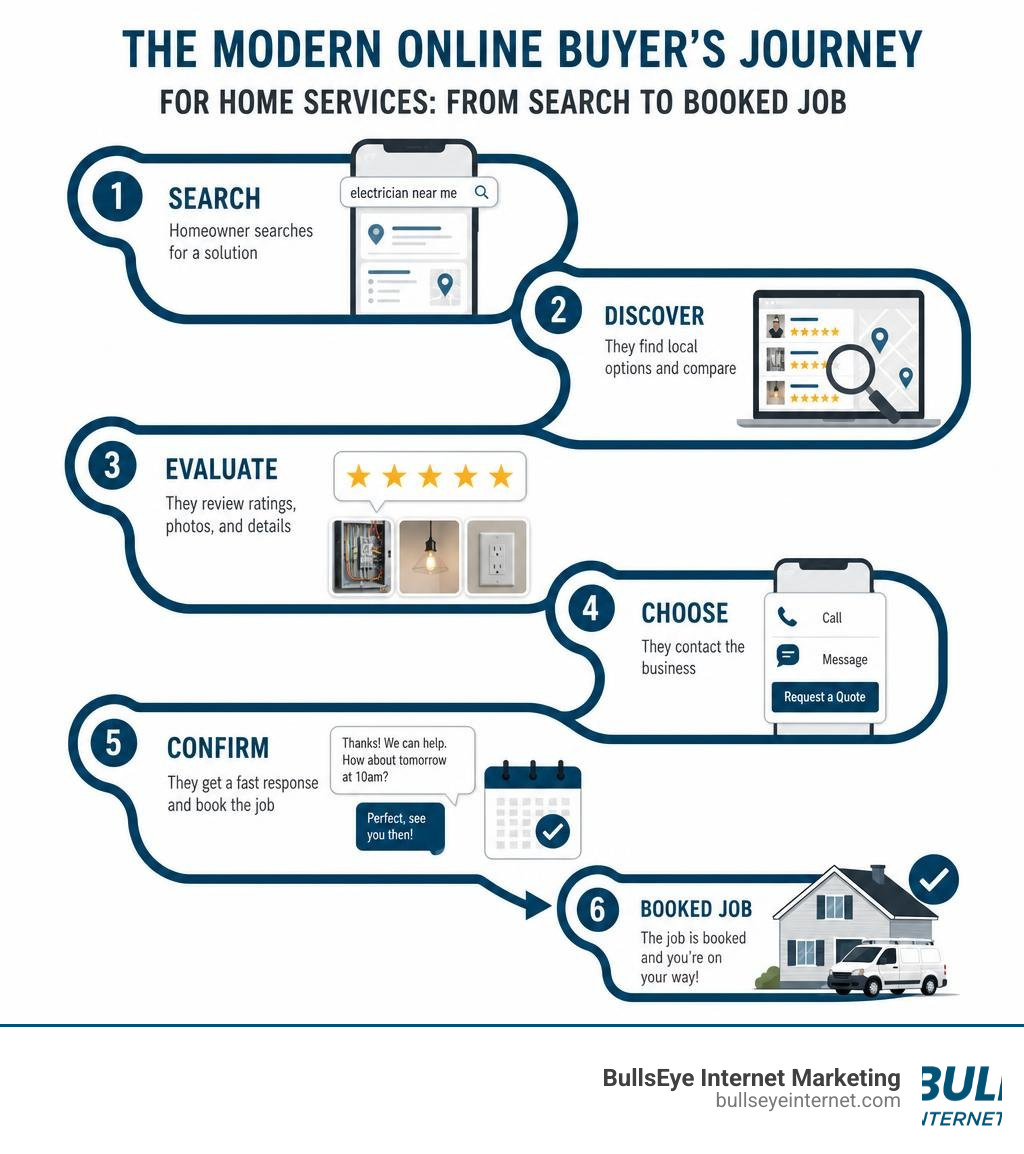
Electrician marketing plan word roundup:
The Core Pillars of a Modern Electrician Marketing Plan
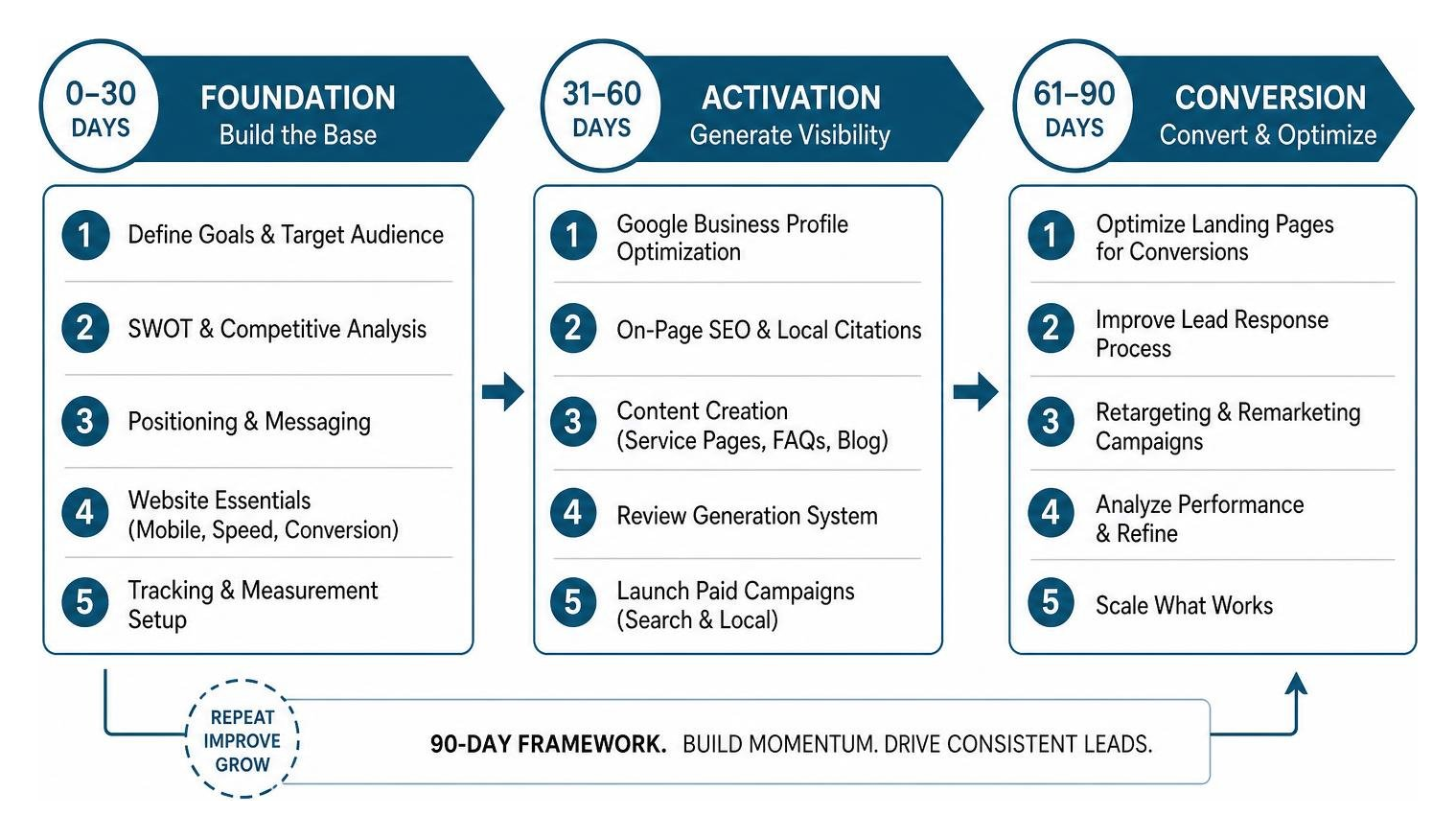
Before you spend a single dollar on advertising, you need a blueprint. Treating marketing as a collection of random, disconnected activities — like boosting a Facebook post here or buying a shared lead there — is the fastest way to burn through your hard-earned cash. A successful electrician marketing plan is a complete, interconnected system.
To build this foundation, we start with a simple SWOT analysis:
- Strengths: What makes your team stand out? (e.g., emergency response times, residential panel specialization, neat wiring work).
- Weaknesses: Where do you struggle? (e.g., zero search engine visibility, high rate of missed calls, lack of historical customer data).
- Opportunities: Where is the untapped market? (e.g., the massive surge in EV charger installations in South Florida).
- Threats: What external challenges do you face? (e.g., large-budget corporate electrical franchises dominating local search).
Next, we establish SMART goals. Instead of saying, “We want more leads,” a SMART goal is: “We want to book 15 new electrical panel upgrades per month in Fort Lauderdale by the end of Q3 2026.”
From there, we define our target audience. In our service areas — spanning Miami-Dade, Broward, Palm Beach, Martin, St. Lucie, and Indian River counties — this includes residential homeowners, property managers, and local general contractors. Your brand identity must speak directly to these groups, positioning your business as licensed, insured, highly professional, and responsive.
Aligning Your Electrician Marketing Plan with High-Margin Services
Not all electrical service calls are created equal. While replacing a broken light switch keeps the lights on, high-margin projects are what scale your business. Your marketing plan should prioritize high-value offerings:
- EV Charger Installations: With electric vehicle adoption accelerating rapidly, home charging station installation searches have grown by over 340% in recent years. This is a critical window to establish local dominance.
- Electrical Panel Upgrades: Older homes throughout South Florida — from historic properties in West Palm Beach to established neighborhoods in Coral Gables — frequently require panel upgrades to support modern appliances and EV chargers.
- Whole-Home Backup Generators: Given our regional vulnerability to major storm events and power grid fluctuations, standby generator installations represent massive, high-ticket opportunities.
By focusing your marketing assets on these premium services, you increase your average ticket size and improve your overall profitability. To learn more about structuring these offerings, check out our comprehensive Electrician Marketing Services Guide.
Budget Allocation and ROI Benchmarks for Your Electrician Marketing Plan
How much should you invest to see real growth? If you are simply looking to maintain your current business volume, a budget of 5% of your gross sales is standard. However, if your goal is aggressive growth and market scaling, you should allocate 10% to 15% of your gross revenue to marketing.
For example, a contractor doing $500,000 in annual revenue seeking steady expansion should invest roughly $25,000 to $50,000 annually ($2,000 to $4,000 monthly).
When distributing this budget across channels, we recommend a balanced approach:
- Local SEO & Website Optimization: 30% (Long-term, highest overall ROI)
- Paid Search (Google Ads & LSAs): 50% (Immediate high-intent lead generation)
- Review & SMS Automation Software: 10% (Operational conversion booster)
- Email & Past Customer Marketing: 10% (Low-cost customer retention)
Your ultimate goal is to keep your cost-per-booked-job under 15% of your average job ticket. To dive deeper into budget optimization, read our guide on Electrician Marketing Strategies.
Dominating Local Search and Google Business Profile
When a homeowner experiences a sudden electrical failure, they do not browse social media; they search Google for “emergency electrician near me.” To capture these highly motivated buyers, your business must dominate local search engine optimization (SEO) and the Google Maps Pack.
Local SEO is the process of optimizing your online presence so that search engines understand exactly which geographic areas you serve. This relies heavily on Name, Address, and Phone number (NAP) consistency across the web. If your business address is listed differently on your website, Google Business Profile, and local directories, search engines will view your business as less reliable, hurting your rankings.
For a step-by-step breakdown of how to structure your local search presence, explore our Local SEO Complete Guide.
Optimizing Your Google Business Profile for Maximum Visibility
Your Google Business Profile (GBP) is your single most valuable free marketing tool. It drives between 30% and 45% of all organic inbound phone calls for local contractors. To fully optimize your profile:
- Primary Category: Set your primary category to “Electrician.”
- Secondary Categories: Add relevant secondary categories like “Electric Vehicle Charging Station Contractor” or “Electrical Engineer” to capture specific search queries.
- Service Areas: List the exact cities you serve across Broward, Miami-Dade, or Palm Beach counties. Avoid listing P.O. Boxes, as Google requires a legitimate physical address or a clearly defined service boundary to prevent profile suspension.
- Visual Proof: Upload high-quality, real photos weekly. Show clean panel wiring, neatly wrapped service trucks, and professional technicians. Avoid generic stock photos; real images build authentic trust.
Review Generation and Managing Online Reputation
Online reviews are the digital equivalent of a personal recommendation. In fact, 88% of consumers trust online reviews as much as a personal referral, and 95% of customers read reviews before making a purchase.
However, total review volume is only half the battle. Google’s local algorithm heavily prioritizes review velocity (how frequently you receive new reviews). A competitor with 40 reviews who receives 3 to 5 new ones every week will easily outrank an older business with 150 reviews that hasn’t received a new one in six months.
To build a continuous stream of fresh, positive feedback, implement an automated post-job text request. Send a message within two hours of completing a service call while the positive experience is fresh in the client’s mind.
High-Converting Post-Job Text Template:
“Hi [Customer Name], thank you for choosing [Business Name] for your electrical service today! We hope our technician resolved your issue perfectly. Could you take 30 seconds to share your experience with us on Google? Your feedback helps us serve our local community better: [Insert Link]”
If you receive a negative review, respond professionally within 24 hours. Avoid getting defensive. State clearly that you take customer satisfaction seriously and provide a direct phone number to resolve the issue offline. This demonstrates to prospective customers that you are accountable and professional.
High-Intent Paid Advertising and Lead Generation
Organic SEO is a powerful long-term asset, but it takes time to build momentum. If you need to generate high-value leads immediately, paid advertising is the solution. For home service contractors, the most effective paid channels are Google Search Ads and Google Local Services Ads (LSAs).
LSAs are particularly attractive because they sit at the very top of the Google search results page, even above traditional paid search ads. They feature the “Google Guaranteed” badge, which certifies that your business is licensed, insured, and background-checked. Best of all, LSAs operate on a pay-per-lead model rather than pay-per-click. You only pay when a customer actually calls or messages your business.
To understand how to leverage these campaigns for your trade, read our guide on Google Local Services Ads for Home Services.
Pay-Per-Click (PPC) Strategies for Emergency vs. Planned Work
Traditional Google Search Ads allow you to target specific keywords with high precision. However, because electrician keywords are highly competitive — with average costs-per-click (CPCs) ranging from $18 to $42 in South Florida markets like Boynton Beach or Delray Beach — your campaigns must be tightly structured to avoid wasted spend.
The key is separating your campaigns into two distinct categories: Emergency Work and Planned Projects.
| Strategy Element | Emergency Campaigns (e.g., “power outage repair”) | Planned Project Campaigns (e.g., “panel upgrade cost”) |
|---|---|---|
| User Intent | Immediate crisis, low price sensitivity, rapid decision. | Research-driven, high price sensitivity, multiple quotes. |
| Bidding Strategy | Maximize clicks/conversions to secure top ad positions. | Target CPA (Cost-Per-Acquisition) to control lead costs. |
| Ad Copy Focus | 24/7 availability, 60-minute response, licensed pros. | Free estimates, financing options, lifetime warranties. |
| Landing Page | Click-to-call button above the fold, simple contact form. | Detailed service breakdown, customer reviews, booking calendar. |
To protect your budget, you must aggressively use negative keywords. Build a list of terms you do not want to pay for, such as “DIY,” “jobs,” “salary,” “wiring diagram,” or “cheap.” Additionally, avoid using broad match keywords, which allow Google to show your ads for loosely related, low-intent searches. Stick to phrase match and exact match keywords.
For professional management of these complex campaigns, refer to our PPC Management Agency Complete Guide.
Capturing High-Value Niche Leads
To maximize your advertising ROI, target specific seasonal and regulatory opportunities. For instance, during the South Florida storm season, standby generator searches spike by 150% to 300%. Pre-build your generator ad campaigns in the spring so they are ready to launch the moment a tropical storm or hurricane threatens our local counties.
Additionally, use regulatory compliance as a trust-building marketing asset. Emphasize that your work strictly adheres to the National Electrical Code (NEC) and that you handle all local municipal permitting, such as Miami-Dade County Electrical Permits. This positions your business as a highly professional, legitimate contractor, filtering out low-budget clients looking for unlicensed handymen.
Building a High-Converting Website and Content Engine
Your website is the digital hub of your entire electrician marketing plan. Every ad click, search result, and social media recommendation will ultimately lead prospects back to your site. If your website is slow, confusing, or poorly designed, you are throwing away valuable leads.
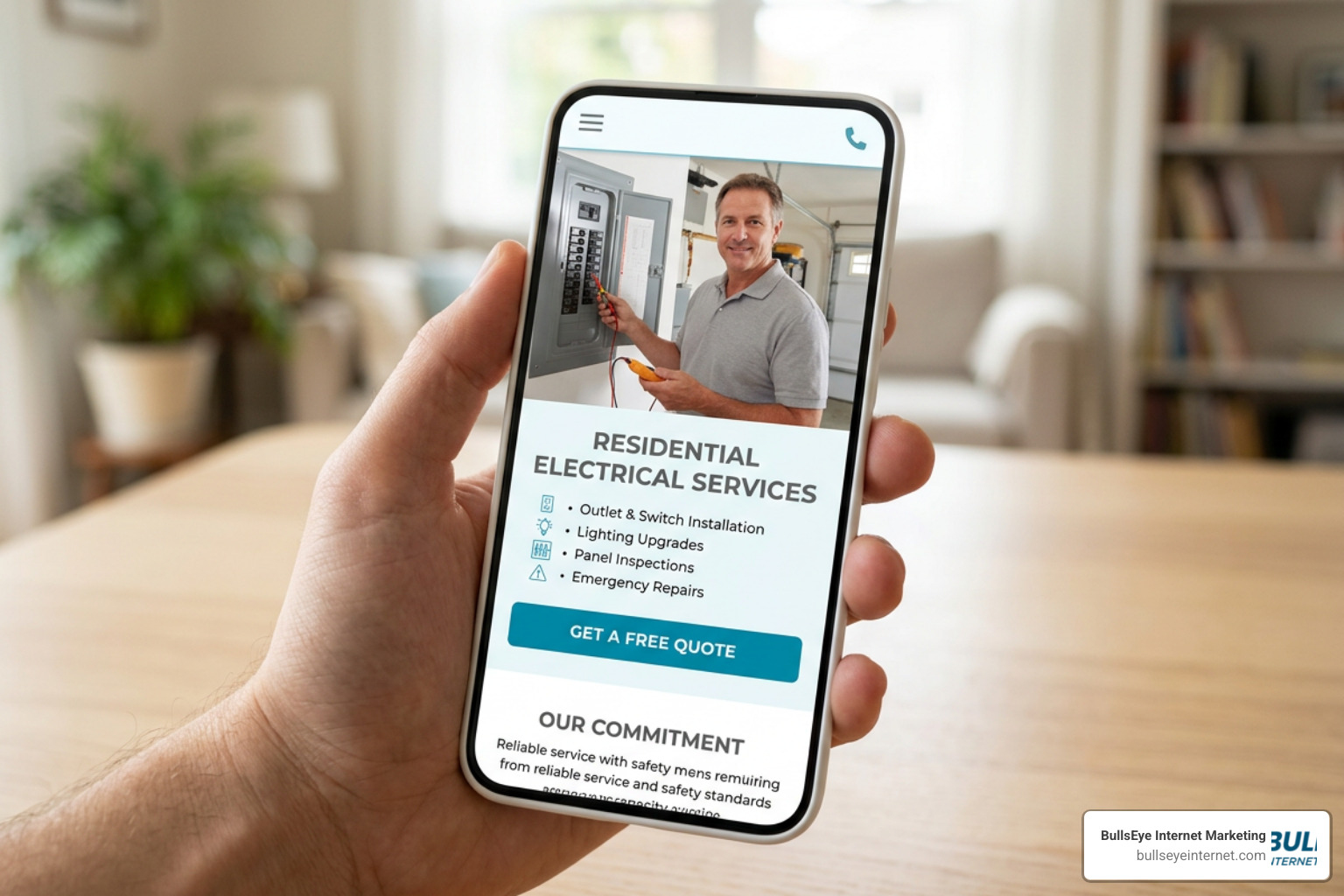
A high-performing website must meet several strict technical standards:
- Mobile Responsiveness: Over 61% of all local search queries for electricians are conducted on mobile devices. Your site must adapt perfectly to any screen size.
- Page Speed: 40% of website visitors will leave a page if it takes more than three seconds to load. Optimize images and clean up code to keep load times lightning-fast.
- Security (HTTPS): A secure website is non-negotiable. If a user sees a “Not Secure” warning in their browser, 88% of them will immediately leave and visit a competitor.
Conversion Rate Optimization (CRO) for Electrical Contractors
Conversion Rate Optimization (CRO) is the practice of turning passive website visitors into actively booked jobs. To maximize your conversion rates:
- Click-to-Call Buttons: Place a prominent, clickable phone number at the very top of every page on mobile viewports.
- Simple Booking Forms: Keep contact forms short. Ask only for essential information: Name, Phone, Email, and a brief description of the issue.
- Trust Signals: Display your state license number, proof of insurance, and industry certifications clearly on your homepage.
To design a highly optimized conversion path, explore our Contractors Blueprint How to Generate Leads and Land More Jobs.
Essential Website Trust Signals Checklist:
- [ ] Active state electrical contractor license number clearly visible in the footer
- [ ] “Fully Licensed and Insured” badge prominently displayed above the fold
- [ ] Real photos of your local team and wrapped service vehicles
- [ ] Embedded, real-time Google reviews from local clients
- [ ] Clear, upfront warranty and satisfaction guarantees
Content Marketing and Blogging to Establish Authority
Blogging isn’t just about writing articles; it’s about building topical authority. When you publish helpful, informative content that answers common electrical questions, search engines recognize your business as an industry expert, which boosts your overall organic search rankings.
Write educational blog posts targeting local, high-intent questions. For example:
- Why Does My Circuit Breaker Keep Tripping in Broward County?
- How to Prepare Your Home’s Electrical Panel for a South Florida Hurricane
- The Homeowner’s Guide to EV Charger Installation Costs in West Palm Beach
This content answers immediate consumer concerns, builds early trust, and positions your business as the logical choice when they decide to hire a professional. To see how content marketing works as a system for home service trades, read our guide on Content Marketing for Plumbers.
Lead Conversion, SMS Marketing, and Customer Retention
Generating leads is only half the battle. If your operational follow-up is slow, you are wasting your marketing budget. In local home services, speed-to-lead is everything: the first responder wins 78% of all jobs.

If a prospect calls your office and you do not answer within the first five minutes, they will hang up and call the next electrician on the Google search results page. To prevent these missed opportunities, you must build robust lead-capture and automation systems behind your marketing campaigns.
SMS Marketing and Automated Follow-Up Sequences
SMS messages have an incredible 95% open rate within three minutes of delivery. This makes text-based automation one of the most powerful tools in your marketing arsenal.
To capture missed calls and convert silent leads, implement these key automations:
- Missed-Call Text-Back: If a call goes unanswered during busy hours or after-hours, an automated system should instantly send a text to the caller: “Hi! We’re sorry we missed your call. We’re currently helping another customer, but we want to assist you right away. How can we help you tonight?” This immediately pauses their search and keeps them from calling a competitor.
- Multi-Step Quote Follow-Up: When you send an estimate for a larger project, like a panel upgrade or generator installation, do not wait for the customer to call you back. Implement a structured SMS follow-up sequence:
- Day 1: “Hi [Customer Name], just checking in to see if you had any questions about the electrical estimate we sent over yesterday!”
- Day 3: “Hi [Customer Name], our schedule is filling up for next week. Would you like to secure your spot for the panel upgrade?”
- Day 7: “Hi [Customer Name], this is our final follow-up regarding your estimate. Let us know if you’re ready to move forward!”
Customer Retention and Maximizing Lifetime Value
Acquiring a new customer is significantly more expensive than keeping an existing one. Because homeowners typically require electrical services every 18 to 24 months, customer retention is critical to long-term profitability.
To maximize customer lifetime value:
- Residential Maintenance Programs: Offer an annual electrical safety inspection program. For a small annual fee, customers receive a comprehensive home safety check, panel inspection, and priority scheduling. This generates predictable recurring revenue and keeps your brand top-of-mind.
- Value-Driven Email Newsletters: Send quarterly emails with seasonal safety tips, surge protection advice, and exclusive customer discounts.
- Structured Referral Incentives: Reward your loyal customers for spreading the word. Offer a referral program where both the existing customer and the referred friend receive a discount on their next service call.
To learn more about building a strong local brand that drives repeat business, explore Build Your Brand Essential Digital Marketing for Contractors.
Frequently Asked Questions about Electrician Marketing
How much should an electrician spend on marketing?
We recommend allocating 5% of your gross annual revenue to marketing if you simply want to maintain your current volume. If you are looking to actively grow and scale your electrical business, you should invest 10% to 15% of your gross sales into highly targeted, trackable digital marketing channels.
What is the fastest way to get more electrical leads in 30 days?
The fastest way to generate immediate leads is to launch Google Local Services Ads (LSAs) and run highly optimized Google Search Ads targeting high-intent, emergency keywords. Simultaneously, request Google reviews from all your past clients to quickly boost your local Map Pack visibility.
Why is my electrical business not showing up on Google Maps?
This is typically caused by a lack of geographic authority, inconsistent NAP citations across the web, or a poorly optimized Google Business Profile. Ensure your profile is fully complete, verify your service area, and consistently gather fresh, keyword-rich reviews from customers in your target cities.
Conclusion
Building a shockingly effective electrician marketing plan requires a systematic, multi-channel approach. From optimizing your Google Business Profile to running high-intent paid search ads and implementing automated SMS follow-ups, every component of your marketing stack must work together to turn local searchers into booked, high-margin jobs.
At BullsEye Internet Marketing, we specialize in helping home service contractors dominate their local markets. We offer a highly competitive advantage: we work with only one client per industry per geographic area, ensuring your competitors never benefit from our strategies. Plus, we build trust by offering no long-term contracts, letting the quality of our results retain your business month after month.
Ready to power up your lead flow and dominate your local area? Let us build your custom growth engine. To learn how we deliver predictable, high-quality results, explore How We Guarantee Quality Leads for Home Service Contractors and secure your territory today!
