
Understanding Google Local Service Ads Cost: The Quick Facts
Google local service ads cost operates on a pay-per-lead model, where you only pay when potential customers contact you directly through phone calls, messages, or booking requests. Here’s what you need to know:
Quick Answer: Google Local Service Ads Pricing
- Average cost per lead: $5 to $130+ (varies by industry and location)
- Overall average: Around $60 per lead
- High-cost industries: Legal services ($150-$600 per lead), Real estate, Financial services
- Mid-range industries: HVAC, Plumbing, Home repair ($30-$80 per lead)
- Messages cost less: Typically 50% of phone call leads
- You pay for: Phone calls, text messages, voicemails, and booking requests
- You don’t pay for: Ad clicks or impressions
If you’re frustrated with pay-per-click campaigns that generate traffic but not customers, Google Local Service Ads offers a different approach. You’re charged only when someone reaches out to hire you—not when they simply click your ad.
The catch? Understanding what drives these costs and how to control your spending while maximizing results.
The core difference between Local Service Ads and traditional Google Ads is simple: one charges per click, the other charges per actual lead. This means you’re paying for potential customers who are ready to talk, not just browse.
I’m Ronnie Katz, and I founded BullsEye Internet Marketing in 2006 to help businesses with online advertising. Over nearly two decades, I’ve seen how understanding google local service ads cost upfront helps businesses budget effectively and achieve a measurable ROI.
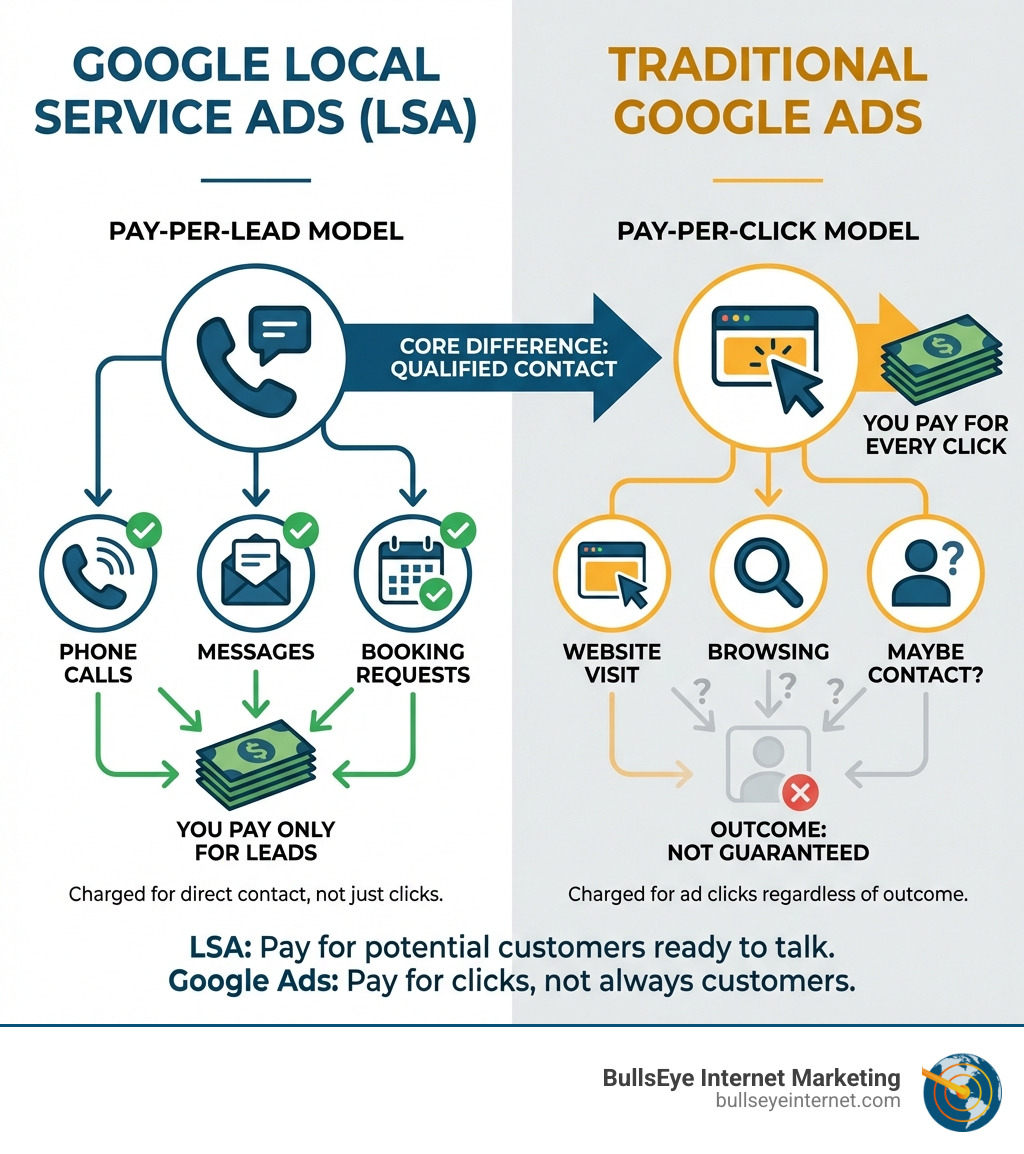
Know your google local service ads cost terms:
The LSA Pricing Model: Paying for Results, Not Clicks
When discussing google local service ads cost, the first thing to know is its unique Pay-Per-Lead (PPL) model. Unlike traditional ads where you pay for impressions or clicks, with LSAs, you only pay when a potential customer contacts you. This contact, or ‘lead,’ must be valid and related to the services you offer.
This model is a game-changer for local service businesses in places like South Florida, from Miami to Palm Beach County, because it aligns spending directly with potential client interactions. We’re not just buying visibility; we’re buying conversations.
Leads can be phone calls, text messages, or booking requests. Google’s system assesses lead validity, and if a lead is fraudulent, spam, or a poor match, we can dispute the charge. This protection ensures we only pay for genuine opportunities.
Furthermore, LSAs feature the prominent Google Verified badge. This badge isn’t just for show; it’s a powerful trust signal for consumers. It tells potential customers that Google has screened and verified our business, adding an extra layer of credibility. For us, it means that the leads we pay for are coming from customers who already have a higher level of confidence in our services.

What Is a Billable Lead?
Understanding what constitutes a billable lead is crucial for managing your google local service ads cost. Google defines a valid lead as one that genuinely connects a potential customer with your business for a service you provide.
Here’s what typically counts as a billable lead:
- Phone calls: When a customer calls your business directly through the LSA. Even if you miss the call, but return it and engage in a conversation or leave a voicemail, it can be considered a valid lead.
- Text messages: If a customer sends a message request through your ad and you respond, leading to a conversation.
- Voicemails: If a customer leaves a voicemail related to your services.
- Booking requests: In regions where it’s available, if a customer schedules a booking directly through your LSA.
You pay for these leads, not just clicks. This means a customer could click on your ad multiple times, but you’re only charged if they take one of these specific actions to contact you.
However, not all contacts are billable. Google has a system for identifying invalid leads, and we can also dispute charges for leads that don’t meet the criteria. Leads won’t be credited if they are:
- Received outside your specified business hours.
- From customers only seeking advice without intent to hire.
- Canceled bookings.
- Research inquiries without a clear service need.
- Unreturned calls where no contact was made.
- For services you don’t offer or are temporarily unable to provide.
We encourage our clients to actively review their leads and dispute any that are clearly invalid. This helps us ensure your budget is spent efficiently and effectively. You can learn more about how leads work directly from Google’s support pages.
LSA vs. Traditional Google Ads
It’s easy to confuse Local Service Ads with traditional Google Ads, but they operate on fundamentally different principles, especially when it comes to google local service ads cost. Understanding these differences is key to choosing the right advertising strategy for your local business in areas like Broward County or Miami Dade County.
Here’s a quick comparison:
| Feature | Google Local Service Ads (LSA) | Traditional Google Ads (PPC) |
|---|---|---|
| Pricing Model | Pay-Per-Lead (PPL) – you pay for valid customer contacts. | Pay-Per-Click (PPC) – you pay every time someone clicks your ad. |
| Ad Placement | Top of search results, above all other organic and paid listings. | Below LSAs, or on the side/bottom of the page, depending on competition. |
| Management Effort | Low – Google manages keywords; focus on profile & lead response. | High – requires continuous keyword research, bid management, ad copy optimization. |
| Primary Goal | Direct leads (calls, messages, bookings) from high-intent local users. | Website traffic, brand awareness, conversions (which may require further action on your site). |
| Trust Factor | Features Google Verified badge, signaling pre-screening and credibility. | No inherent trust badge; trust is built through ad copy, landing page, and brand reputation. |
| Targeting | Service-based businesses targeting specific local service areas. | Any business type, targeting broad or narrow audiences based on keywords, demographics, etc. |
The main takeaway for us is that with LSAs, we’re investing directly in tangible customer interactions. With traditional Google Ads, we’re investing in the opportunity for those interactions, which requires more active management and optimization to convert clicks into leads. Both have their place, but for immediate, high-intent local leads, LSAs offer a streamlined path.
The Real Google Local Service Ads Cost: Averages and Ranges
So, what’s the actual google local service ads cost? While it varies, Google LSA leads generally cost from $5 to $130 or more. The U.S. average is about $60 per lead, which is competitive compared to the search ad benchmark average of around $70.
This wide range isn’t arbitrary; it’s influenced by your industry, geographic location (e.g., a competitive market like Miami vs. a smaller town), and overall service demand. We analyze these details to help our clients understand what to expect.

Average Google Local Service Ads Cost by Industry
The industry we operate in plays a significant role in determining our google local service ads cost. Some industries inherently have higher-value leads, and thus, the cost per lead reflects that.
Here’s a breakdown of what we’ve observed:
- High-Cost Examples: Legal services often see the highest costs. For instance, we’ve seen a minimum bid of $150 per lead for Attorney – Bankruptcy services. In some cases, phone leads for attorneys were charged around $600, and message leads at $300, averaging out to about $225 per lead. A social security disability lawyer client, for example, was charged $131 for a single lead. Other high-value industries like real estate and financial services can also command higher lead costs due to the significant potential revenue from each client.
- Mid-Range Examples: Home services like HVAC, plumbing, electrical, and roofing typically fall into a mid-range. While competitive, their lead costs are generally lower than legal services, often in the $30-$80 range. These are essential services with consistent demand across our service areas in Florida.
- Lower-Cost Examples: Less urgent or lower-ticket services might see costs on the lower end of the spectrum, sometimes as low as $5-$20 per lead.
The market competition within each industry also heavily impacts these costs. If there are many businesses vying for the same leads in a dense area like Fort Lauderdale or West Palm Beach, the cost per lead will naturally be higher. Google’s system is moving towards an auction model for LSAs, meaning that our bid, along with other factors, will influence our lead cost.
Why Messages Cost Less Than Phone Calls
An interesting aspect of google local service ads cost is the pricing difference between various lead types. Specifically, message leads almost always cost less than phone call leads. In fact, Google states that message leads are typically priced at 50% of the corresponding phone lead price. Booking leads, on the other hand, are generally charged at the same rate as phone leads.
Why the difference? It often comes down to user intent and immediacy. A phone call usually signifies a more urgent need or a customer who is ready to engage in a direct conversation to solve a problem. Think of someone with a burst pipe in their home in Davie – they’re calling, not messaging. This higher level of intent often translates to a more valuable lead for businesses, hence the higher cost.
Message leads, while still valuable, might indicate a customer who is in an earlier stage of research, gathering quotes, or has a less urgent inquiry. This doesn’t make them less important, but the perceived immediate value to the service provider is slightly lower, which Google reflects in the pricing.
For us, this means we can strategically optimize our campaigns. If we’re looking to maximize the volume of leads and are comfortable engaging through text, focusing on message-friendly services could help manage our overall google local service ads cost while still filling our pipeline.
Key Factors That Influence Your LSA Spend
Understanding the average google local service ads cost is just the beginning. Several dynamic factors constantly influence how much we pay per lead and how often our ads appear. These factors contribute to what Google calls “Ad Rank” for LSAs, which determines our visibility. It’s not just about money; it’s about overall profile quality and responsiveness.
Your Industry, Location, and Competition
As we discussed, our industry plays a major role in google local service ads cost. The average job value in our service niche directly correlates with how much a lead is worth, and thus, how much Google charges. For instance, a lead for a major home renovation in Boca Raton will likely cost more than a lead for a routine lawn care service in Greenacres.
Our geographic location is another critical factor. Advertising in highly populated and competitive metro areas like Miami or Fort Lauderdale will generally result in higher lead costs compared to less dense regions. The sheer volume of businesses and searchers creates a more competitive environment.
Finally, the number and activity of our competitors significantly impact our spend. If many businesses in our area are actively running LSAs, it can drive up the lead cost. We’ve seen that while some businesses might be charged the same as their competitors, others might have a higher bid, leading to a varied cost per lead. Google is evolving towards an auction model for LSAs, which means our bid amount and mode will increasingly influence our ad’s appearance and cost. This is why we always monitor the competitive landscape for our clients.
Your Profile Quality and Ad Rank
Beyond industry and location, the quality of our LSA profile and how we manage it directly affects our Ad Rank and, by extension, our google local service ads cost and lead volume. Google wants to show searchers the best, most reliable businesses, and it uses several signals to determine this:
- Proximity to customer: Google prioritizes businesses closest to the searcher. While we can’t change our physical location, we ensure our service areas are accurately defined to capture relevant local searches.
- Review score and quantity: This is huge! The more positive reviews we have, and the higher our average star rating, the better our chances of ranking well. Google emphasizes businesses with a strong reputation.
- Responsiveness to inquiries: How quickly and consistently we respond to phone calls and messages from potential customers impacts our Ad Rank. If we’re slow to respond, Google might show our ads less often.
- Business hours: Keeping our business hours accurate and ensuring we’re available to take leads during those times is important. Leads received outside business hours might not be billable, but consistent availability helps our ranking.
- Profile completeness: A fully filled-out LSA profile, including services offered, business photos, and a compelling bio, makes our ad more appealing to customers and signals to Google that we’re a professional operation.
By actively managing these aspects, we can improve our Ad Rank, potentially getting more leads for the same or even lower cost, optimizing our overall google local service ads cost efficiency.
Budgeting and Optimizing Your LSA Campaigns
Effectively managing our google local service ads cost requires smart budgeting and continuous optimization. With LSAs, we have a unique level of control over spending because we’re paying for results, not just exposure, allowing for direct ROI tracking.
We treat LSA campaigns as dynamic, constantly monitoring lead flow, quality, and performance. Our goal is to maximize high-quality leads for our clients while keeping costs profitable.
How to Determine Your Initial Google Local Service Ads Cost and Budget
Setting an initial LSA budget can feel like a guessing game, but we approach it strategically by aligning the budget with lead goals.
Here’s how we typically guide our clients:
- Define Lead Goals: How many new customers or jobs do we want each week or month? This is our starting point.
- Use Google’s Cost Calculator: Google provides a tool that helps estimate lead costs based on our service type and geographic area. This gives us a ballpark figure for the cost per lead in our specific market, whether it’s in Palm Beach County or Martin County.
- Work Backward from Revenue: We consider the average value of a new customer. If one new customer generates $500 in revenue and our profit margin is 50%, we know we can afford to spend up to $250 to acquire that customer. If the average lead cost is $60, we can see how many leads we might need to convert to hit our targets.
- Start with a Realistic Minimum: Google recommends setting a budget for a minimum of 10 leads a week to see the best results. For businesses just starting, we sometimes suggest budgeting for at least 20 leads per week to gather enough data quickly. This might mean an initial weekly budget of $600-$1200 if the average lead cost is $60.
- Set a Weekly Budget Cap: We choose a weekly budget based on our lead goals and estimated costs. We can adjust this monthly budget whenever needed. While we might spend slightly more than our average weekly budget in a given week, we’ll never exceed our monthly maximum (weekly budget multiplied by the average number of weeks in a month).
This approach helps us set a budget that makes sense for our business goals, rather than just throwing money at ads hoping for the best.
Top Tips for Optimizing Your Campaign
Once our LSA campaign is live, the work doesn’t stop. Continuous optimization is key to getting the most out of our google local service ads cost. Based on our experience with clients across Florida, here are our top tips:
- Improve Response Time: This is critical! Google tracks how quickly we answer calls and respond to messages. Faster response times often lead to higher conversion rates and can positively impact our Ad Rank. We train our clients to respond as promptly as possible.
- Actively Request Reviews: Positive reviews are gold for LSAs. They build trust with potential customers and are a major factor in Google’s ranking algorithm. We encourage our clients to actively ask satisfied customers for reviews, especially on their Google Business Profile, as these reviews often appear on LSAs.
- Refine Service Areas and Job Types: We continuously review and refine the specific services we offer and the geographic areas we target. If we’re getting leads for services we don’t provide, or from areas too far to serve efficiently, we adjust our profile to avoid wasted spend.
- Optimize Business Hours: We ensure our listed business hours accurately reflect when we’re available to take leads. This prevents us from being charged for leads that come in when we’re closed and can’t respond.
- Add Photos and a Business Bio: A complete and appealing profile with high-quality photos and a well-written business bio helps us stand out. It makes our ad more trustworthy and engaging, encouraging more potential customers to contact us.
- Mark Leads as “Booked”: Inside the LSA dashboard, we can mark leads as “booked.” This isn’t just for organization; it helps us track our overall ROI and can provide valuable data back to Google about which leads are most successful for us.
By staying on top of these optimization strategies, we can ensure our google local service ads cost is always working hard to bring in the best possible leads.
Getting Started with Google Local Services Ads
Getting started with Google Local Services Ads can feel like a big step, but the process is straightforward. For Florida businesses, it means understanding eligibility and following a clear onboarding path.
Are You Eligible? Industries and Requirements
Google Local Services Ads are for specific service-based businesses. While Google supports over 70 industries across the United States, we must confirm eligibility for our specific niche and location, whether in Miami-Dade or St. Lucie County.
Here’s a general list of eligible categories, though specific services within these may vary:
- Home Services: Appliance repair, carpentry, carpet cleaning, electricians, HVAC, plumbing, roofing, garage door repair, house cleaning, landscaping, pest control, tree services, and more.
- Business Services: Various legal specializations (e.g., bankruptcy, personal injury, estate planning), real estate agents, financial planners, tax specialists.
- Health Services: Dentists, chiropractors, dermatologists, physical therapists.
- Learning Services: Preschools, tutors, driving instructors.
- Care Services: Child care, pet training, veterinary services.
- Wellness Services: Personal trainers, yoga studios.
- Beauty Services: Hair salons, nail salons.
- Automotive Services: Auto repair shops, car washes, towing services.
Beyond our industry, Google has specific requirements to ensure customer safety and trust. These include:
- License Requirements: We’ll need to provide proof of relevant business licenses for our industry and state.
- Insurance Proof: Valid business insurance is typically a must-have.
- Google Business Profile: An active and optimized Google Business Profile is a prerequisite.
We can easily check our eligibility for Google Local Services Ads on Google’s dedicated page. This is always our first step when exploring LSAs for a client.
The 4-Step Onboarding Process
Once eligibility is confirmed, the onboarding process is a structured, four-step journey to get ads live. This ensures our business is properly vetted and our profile is optimized.
- Create Your Profile: This is where we tell Google about our business. We’ll provide essential information like our business name, contact details, service types, and the specific service areas we cover (e.g., all of South Florida, or just specific cities like Coral Springs or Doral). This profile is distinct from our Google Business Profile, though it draws some information from it. We also add compelling business photos and a detailed bio to make our profile shine.
- Set Your Budget and Bid: Next, we define our google local service ads cost strategy. We set an average weekly budget based on our desired number of leads and determine our bidding mode, which influences how much we’re willing to pay per lead. Google offers options to maximize leads or target a specific cost per lead. We work with our clients to choose the most effective approach for their goals.
- Complete the Background Check and Verification: This is a crucial step that sets LSAs apart and builds consumer trust. All businesses and their fieldworkers must pass Google’s screening and verification process, which includes a background check. This rigorous vetting helps Google ensure that only reputable businesses appear in LSAs, building confidence with potential customers.
- Go Live and Manage Leads: Once our profile is complete, our budget is set, and verification is approved, our ads go live! We then manage incoming leads directly from the LSA dashboard. This involves responding to calls and messages, tracking bookings, and providing feedback on lead quality. We continually monitor performance to ensure we’re maximizing our lead generation while managing our google local service ads cost effectively.
This structured process ensures that our clients are well-prepared to leverage LSAs for consistent lead generation.
Conclusion: Is the LSA Investment Right for You?
Understanding google local service ads cost is more than just crunching numbers; it’s about evaluating a powerful marketing opportunity. For local service businesses, especially in competitive Florida markets, LSAs offer a unique and effective way to connect with customers actively seeking your services.
Let’s recap the significant benefits:
- High-Quality Leads: With LSAs, you pay for actual contacts—phone calls, messages, or booking requests—from high-intent customers ready to hire. This contrasts with paying for clicks that may not convert.
- Top-of-Page Visibility: Your ads appear at the very top of Google search results, above traditional paid ads and organic listings. This prime real estate significantly increases your visibility and credibility.
- Controllable Costs: The pay-per-lead model, weekly budget settings, and the ability to dispute invalid leads give you remarkable control over your spending. You know exactly what you’re paying for.
- Building Customer Trust: The Google Verified badge is a powerful endorsement. It assures potential customers that your business has been screened and vetted by Google, instilling confidence before they even contact you.
At BullsEye Internet Marketing, we’ve seen how LSAs can transform lead generation for our clients. From HVAC companies in Cooper City to legal practices in Coral Gables, the ability to directly connect with pre-qualified local customers is invaluable. We specialize in helping businesses like yours steer the complexities of online advertising, ensuring your marketing dollars generate tangible results. Our commitment to no long-term contracts and working with only one client per industry per geographic area means our success is directly tied to yours.
If you’re ready to stop paying for clicks and start paying for conversations, it’s time to explore what Google Local Services Ads can do for your business.
