
Local Search: A Competitive Priority by BullsEye Internet Marketing
To dominate local search means showing up when a nearby customer is ready to buy — and that window is short.
Here is a quick breakdown of how to do it:
- Optimize your Google Business Profile (GBP) — complete every field, add photos, and post weekly
- Build NAP consistency — match your Name, Address, and Phone number exactly across all directories
- Generate reviews consistently — aim for a steady stream, not a one-time burst
- Create hyperlocal content — use neighborhood names, landmarks, and city-specific pages on your website
- Earn local backlinks — sponsorships, local press, and community partnerships outperform generic directories
- Track with geo-grid tools — see where you rank block by block, not just city-wide
Think about what happens when someone searches “HVAC repair near me” or “best dentist in [your city].” Google serves up three businesses in the Map Pack — and those three get the lion’s share of clicks. According to research, the Map Pack captures roughly 80% of local-intent clicks, with only three spots available.
If your business isn’t one of them, you’re invisible to the most motivated buyers in your area.
The good news? Local search levels the playing field. A well-optimized small business can outrank a national chain in its own backyard. Google’s local algorithm weighs relevance, distance, and proximity — not just budget size. That means execution beats spending power here.
But the rules are changing fast. In 2026, AI Overviews, voice search, and generative engines like ChatGPT are reshaping how people find local businesses. About 46% of all Google searches have local intent, yet AI Overviews now appear above the Map Pack on roughly 7.9% of local queries. Businesses that ignore these shifts will fall behind the ones that adapt.
I’m Ronnie Katz, founder of BullsEye Internet Marketing, and I’ve spent over 20 years helping businesses dominate local search through SEO, GBP optimization, reputation management, and paid lead generation. In this guide, I’ll walk you through exactly what works in 2026 — no fluff, no guesswork.
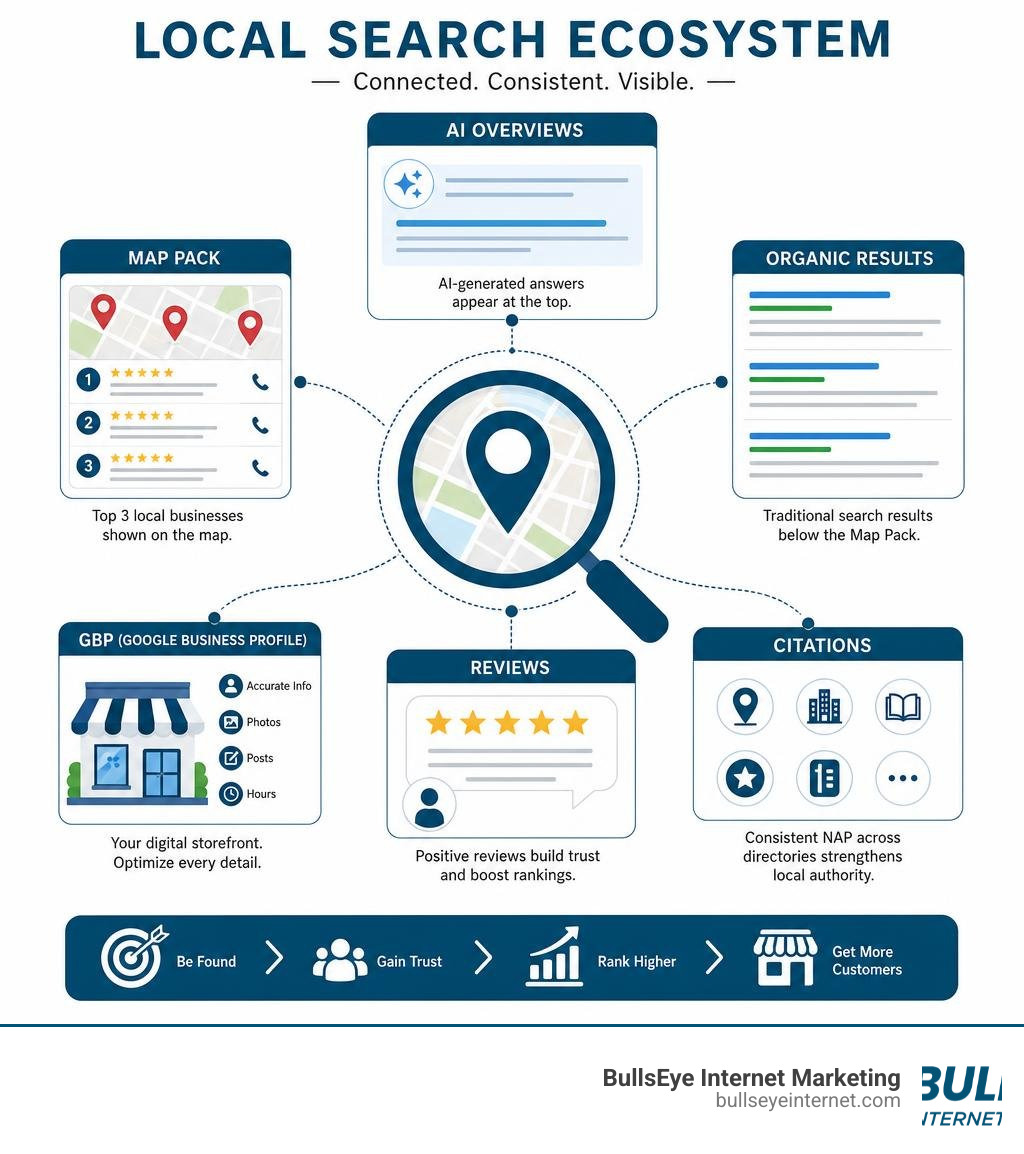
Dominate local search word list:
How to Dominate Local Search in 2026
To understand how to win the battle for local attention, we first have to understand the modern search engine results page (SERP). In June 2026, the local search landscape is no longer just a list of blue links. It is a highly dynamic, AI-influenced environment.
For any local query, Google typically splits its organic real estate into two distinct sections: the Google Map Pack (often called the Local 3-Pack) and standard organic search results. In 2026, we also have to contend with AI Overviews, which synthesize information from multiple sources and present them directly at the top of the page. This has led to a massive rise in “zero-click searches”—where a user finds their answer, phone number, or address without ever clicking through to a website.
Here is a quick comparison of how these elements function:
| Feature | Google Map Pack | Organic Search Results | AI Overviews |
|---|---|---|---|
| Primary Focus | Physical proximity, GBP optimization, and local prominence. | On-page content, technical SEO, and domain authority. | High-confidence entity data, schema, and structured reviews. |
| Average CTR | Extremely high for immediate transactional intent (~42%). | High for research and informational intent (first result gets ~27.6% CTR). | Captures high-intent conversational queries but drives zero-click behavior. |
| Key Ranking Assets | Google Business Profile, local reviews, and S2 cell occupancy. | Website pages, localized blogs, and high-quality backlinks. | JSON-LD Schema markup, authentic customer photos, and E-E-A-T signals. |
Traditional SEO focuses on ranking a website for broad, non-geographical keywords on a national or global scale. Local SEO, however, is a targeted strategy designed to boost your online visibility within a specific geographic area—such as West Palm Beach, Miami, or Fort Lauderdale.
Because we operate in South Florida, we know that a local business doesn’t need to rank in Chicago to be successful. You need to rank in the specific neighborhoods where your trucks roll and your storefront doors open. To dive deeper into the fundamentals of how these systems interact, check out our Local SEO Complete Guide.
The Three Pillars of Google’s Local Algorithm
Google does not use luck to decide who appears in the Map Pack. The algorithm relies on three core pillars: Relevance, Distance, and Prominence.
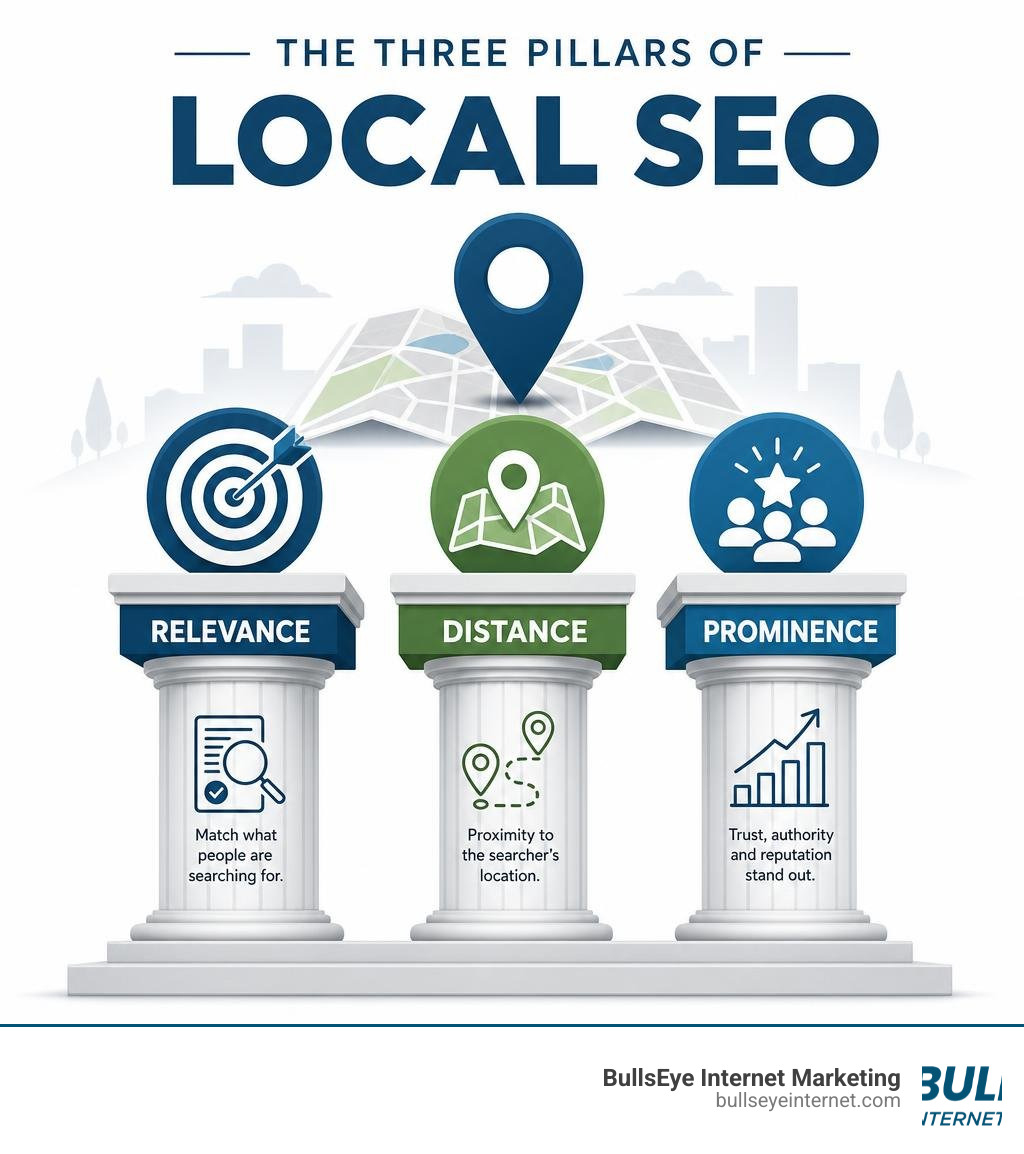
Understanding these pillars is the key to unlocking the Benefits of Local SEO for Your Business. If you can optimize for these three factors, you can outrank national chains that have million-dollar budgets but lack local specificity.
Relevance: Aligning Content to Dominate Local Search
Relevance is all about how well your business matches what the user is looking for. If someone searches for “emergency pipe repair in Davie,” Google wants to show plumbers, not general handymen.
To build relevance, your Google Business Profile must be meticulously categorized. Your primary category must align exactly with your most profitable, high-intent search terms. If you run a remodeling business, setting your primary category to “Kitchen Remodeler” rather than “Contractor” can instantly boost your visibility for high-value searches. Secondary categories should cover your other services (e.g., “Bathroom Remodeler,” “Tile Contractor”).
Your business description (which allows up to 750 characters, with the first 250 visible before the “read more” break) should naturally weave in your core services and primary geographic areas. This is where we implement tailored Florida SEO Strategies: Dominate Local Search Results.
By targeting specific long-tail keywords with geographic markers, you signal to Google exactly what you do and where you do it. For instance, if you offer Local SEO Services in West Palm Beach, FL – SEOMA, your content must reflect the specific needs of Palm Beach County clients. You can also explore How Local SEO Can Help Broward Businesses Dominate Search Results to see how regional relevance operates in nearby markets.
Distance and Proximity: Navigating the S2 Cell Grid
Distance is the trickiest pillar because, traditionally, you cannot change where your business is physically located. However, the way Google calculates distance has evolved dramatically.
Historically, proximity was an absolute barrier. If you weren’t within a mile of the searcher, you didn’t show up. Today, Google utilizes a geographic grid system based on S2 cells (specifically Levels 10 through 14 for neighborhood-scale search). Instead of treating proximity as a simple radius, Google evaluates S2 cell occupancy.
This creates what we call the Proximity Paradox: being physically closest to the user is no longer a guarantee of ranking. If your competitor has stronger relevance and prominence signals in an adjacent S2 cell, Google’s algorithm will bypass the closer business to show the more authoritative one.
Furthermore, Google relies on the precise mathematical layout of your GPS coordinates. If your map pin is off by even thirty feet in a shared strip mall or office complex, you risk falling victim to the “cluster filter”—where Google hides duplicate or closely located businesses in the same category to keep search results diverse.
Prominence: Building Authority to Dominate Local Search
Prominence is Google’s measure of how well-known and trusted your business is. It is the ultimate tiebreaker in local search. If two businesses are equally relevant and close to a searcher, the more prominent business will always win.
Prominence is built through:
- Review Velocity: The steady, consistent speed at which you acquire new reviews. Ten fresh reviews this month are far more valuable than one hundred reviews from three years ago.
- Local Backlinks: Links from trusted, neighborhood-specific websites. A backlink from a local Broward County youth sports league sponsor page or a chamber of commerce is often more powerful for local SEO than a generic link from a major national publication.
- Brand Mentions: Unlinked references to your business name, address, and phone number across local news sites and blogs.
- Entity Trust: How confidently Google’s knowledge graph connects your brand to your specific industry and location.
For a comprehensive roadmap on building this authority, take a look at The Ultimate Local SEO Playbook: Boost Your Business’s Online Presence.
Google Business Profile (GBP) Mastery for Storefronts and SABs
Your Google Business Profile is the absolute foundation of your local search presence. According to industry data, 25% of your local search ranking is directly dependent on your Google Business Profile. If you haven’t claimed, verified, and fully optimized this profile, you are leaving money on the table.
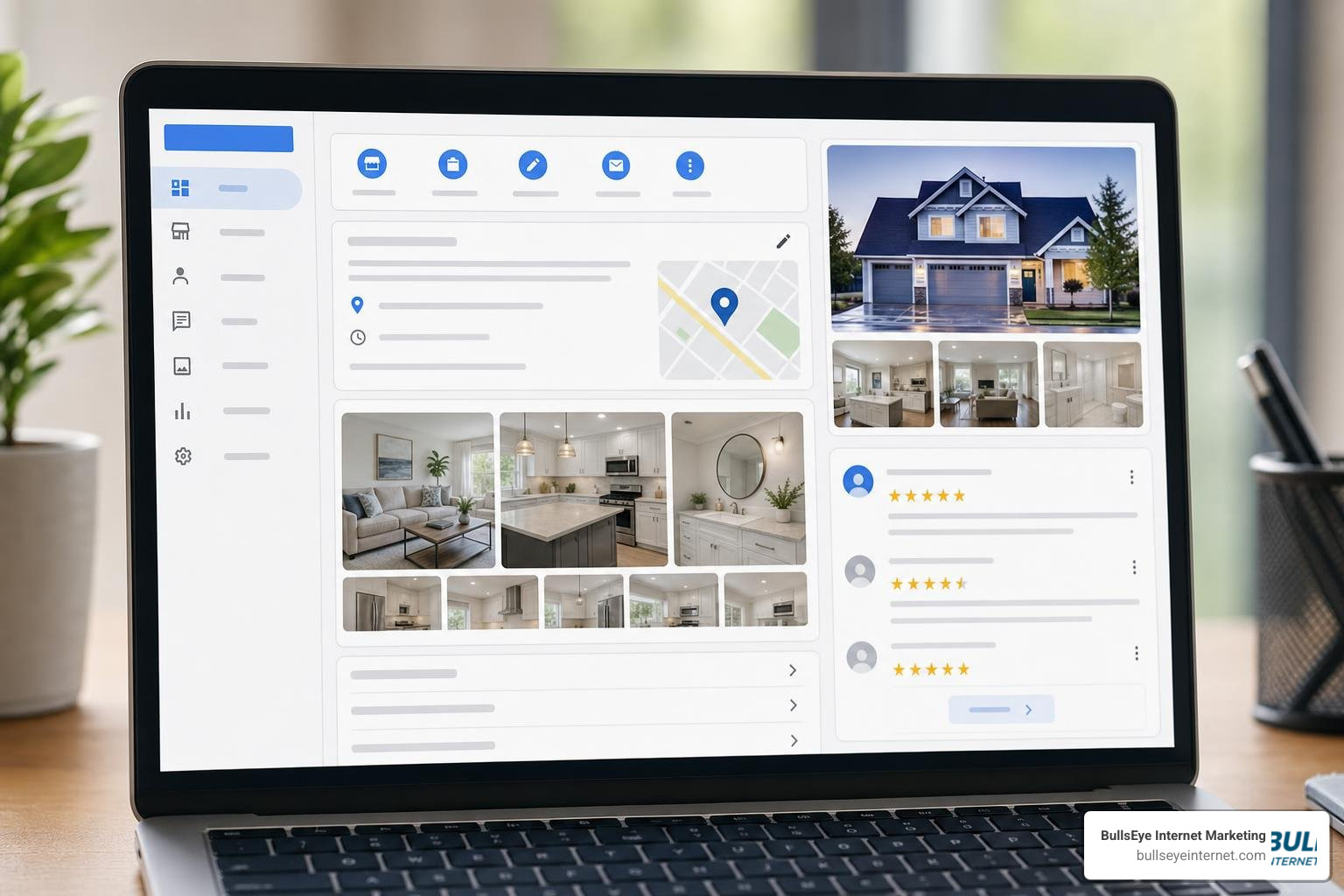
To unlock maximum visibility, you must treat your GBP as an active social media asset, not a set-it-and-forget-it listing. Here is our checklist for elite GBP optimization:
- Verify with Video: Google increasingly requires video verification showing your physical workspace, tools, and proof of registration.
- Maximize Your Business Description: Use all 750 characters to highlight your USP, history, and service areas.
- Upload Real Photos Weekly: Avoid stock photos at all costs. Uploading 2-3 genuine, high-resolution photos of your team, completed projects, or storefront every week signals to Google that your business is active.
- Flesh Out Your Services List: Don’t just select categories. Add custom descriptions and pricing details for every single service you offer.
For a step-by-step breakdown of this process, read our Local Pack Optimization Ultimate Guide.
Optimizing GBP for Service-Area Businesses (SABs)
If you are a plumber, electrician, or mobile pet groomer, you likely operate as a Service-Area Business (SAB) without a traditional physical storefront. Many SAB owners worry they can’t rank because they work out of a home office or a dispatch warehouse.
The truth is, you can absolutely dominate the Map Pack as an SAB. Google allows you to hide your physical address from the public while defining up to 20 specific service areas (by city, county, or zip code).
However, in 2026, simply listing cities is not enough. You must optimize for service area polygons. This means aligning your service areas precisely with where your technicians actually complete jobs. If you want to dive deeper into how service businesses can win online, read the insights in Local SEO for Service Businesses – Demand Influence Media.
Review Generation and Reputation Management
Reviews are the lifeblood of prominence. But in 2026, the algorithm looks far beyond your overall star rating.
First, Google values review diversity and geotagged metadata. When a customer takes a photo of your work on their mobile device and uploads it with their review, that photo contains forensic GPS metadata. Google trusts this user-generated data immensely because it proves the reviewer was physically at the location where your service was rendered. A review from a customer physically located in your service area carries up to three times the weight of a remote review.
Second, your response strategy matters. You must respond to 100% of your reviews—both positive and negative—within 24 to 48 hours. When responding, naturally incorporate your service categories and neighborhood landmarks (e.g., “We loved helping you with your AC repair near the historic Broward County Courthouse in Fort Lauderdale!”). This subtly feeds the algorithm with context without looking spammy.
Citations, NAP Consistency, and On-Page Local Signals
While your Google Business Profile is the primary engine of local search, your website and external directories act as the fuel. If your website lacks local optimization, Google will struggle to verify the information on your GBP.

Building High-Quality Local Citations
A local citation is any online mention of your business’s Name, Address, and Phone number (NAP). Business listings and citations account for roughly 11% of your local search ranking.
The golden rule of citations is absolute, unyielding consistency. If your business is listed as “BullsEye Internet Marketing” on Google, but “Bullseye Marketing Inc.” on Yelp, Google’s algorithm gets confused. This “data noise” weakens your prominence signal.
We recommend auditing your listings quarterly to clean up any duplicate or outdated information. Focus your efforts on core directories like Yelp, Bing Places, Apple Maps, and local government directories. For example, if you are a certified local business in South Florida, getting listed on resources like the Certified Small Businesses – Miami-Dade County page builds massive local authority. For more actionable steps on listing distribution, check out the 6 Ways to Dominate Local Search | BOS Digital guide.
To understand how to audit and protect your digital footprint, read Beyond the Pin: Mastering Local SEO for Google Maps Visibility.
Hyperlocal Content and On-Page SEO
If you want to rank in multiple cities across South Florida, you cannot rely on a single, generic homepage. You must build a City Silo architecture.
This involves creating dedicated, high-quality location pages for every city or major neighborhood you serve (e.g., West Palm Beach, Boynton Beach, Delray Beach, or Boca Raton). Avoid thin content; each city page should contain at least 1,500 words of highly unique, valuable local information.
To demonstrate true E-E-A-T (Experience, Expertise, Authoritativeness, and Trustworthiness), your city pages should include:
- Real local case studies and project photos.
- Mentions of local landmarks, municipal parks, or regional weather patterns (e.g., how South Florida humidity affects HVAC systems).
- Embedded Google Maps of your service areas.
- Local customer testimonials.
For instance, if you are targeting the Treasure Coast, tailoring your content to Digital Marketing in Martin County | UltraWeb Labs ensures you are speaking directly to the local community’s unique pain points and regional characteristics.
Tracking, Auditing, and Adapting to AI Search in 2026
You cannot improve what you do not measure. Traditional rank trackers that show a single, average ranking for a city are completely obsolete in 2026. Because Google’s local algorithm is S2-cell dependent, your business might rank #1 in the Map Pack when searched from your office, but rank #8 when searched from a neighborhood three miles away.
To get a true picture of your visibility, you must use geo-grid heatmaps.
These tools run localized scans across a grid of coordinates, showing your exact Map Pack position at every intersection or block. This allows us to pinpoint exactly where your competitors are stealing your leads and where we need to deploy targeted hyperlocal content or local link-building campaigns.
Additionally, we must prepare for the AI-first search reality. With generative search engines taking over a significant portion of query volume, your structured data must be flawless. Implementing LocalBusiness JSON-LD Schema on your website acts as a machine-readable business card that AI engines like Gemini, ChatGPT, and Perplexity use to recommend your business for conversational queries.
To stay ahead of these rapid shifts, watch [Local SEO 2026] The Complete Guide to Dominating Local Search and read our specialized resource on Local Search Domination: Google Maps SEO Secrets Revealed.
Frequently Asked Questions about Local SEO
How do AI Overviews and voice search affect local SEO in 2026?
AI Overviews and voice search rely heavily on conversational queries (e.g., “Where is the closest 24-hour plumber that handles broken pipes in Coral Springs?”). To rank in these generative summaries, your website must feature structured FAQ schema, natural-language content, and highly verified GBP data. AI engines prioritize businesses with high-confidence proximity signals, such as geotagged customer photos and consistent NAP data.
Can a service-area business rank without a physical storefront?
Absolutely. Service-Area Businesses (SABs) can easily rank in the Map Pack. During your GBP setup, you simply select “No” when Google asks if you have a physical location customers can visit, and then define your service area polygons. Google will still use your registered verification address (which remains hidden) to calculate distance, but your visibility will be driven by your relevance and prominence within your defined service zones.
How long does it take to see results from local SEO?
While some basic optimizations (like correcting a primary category or updating phone numbers) can yield a bump in impressions within 2 to 4 weeks, a comprehensive local SEO campaign typically follows a 90-day roadmap. It takes roughly 8 weeks for Google to index new S2 cell signals and neighborhood pages. By month three, businesses with consistent review velocity and localized content authority typically see a 40% to 50% increase in customer actions (calls, directions, website clicks).
Conclusion: Claim Your Local Monopoly
Dominating local search is not about tricks or shortcuts; it is about consistent, strategic execution. By optimizing your Google Business Profile, maintaining absolute NAP consistency, generating high-confidence reviews, and building hyperlocal content, you can turn your digital presence into an unstoppable lead-generation asset.
At BullsEye Internet Marketing, we specialize in helping South Florida businesses outshine their competition and capture high-intent buyers. We do things differently:
- No Long-Term Contracts: We earn your business month after month based on actual performance, not restrictive legal agreements.
- Geographic Exclusivity: We work with only one client per industry per geographic area. When you partner with us, we focus 100% of our local search strategy on making you the undisputed leader in your territory.
- Revenue-Focused Lead Generation: We don’t care about vanity metrics like impressions; we focus on generating tracked phone calls, form submissions, and actual sales.
Are you ready to stop losing customers to the competition down the street? Let us put your business on the map. Get started with our business listings services today, and let’s dominate your local market together.
