
Why Most Small Law Firms Struggle to Get Clients (And What Actually Works)
Marketing for small law firms is one of the most misunderstood challenges in the legal industry. Here’s a quick overview of the strategies that actually move the needle:
The 8 most effective marketing strategies for small law firms:
- Define your niche – Specialize in a specific client type or legal problem
- Build a conversion-optimized website – Mobile-friendly, fast, with clear calls to action
- Optimize your Google Business Profile – Drives 40-60% of calls for small firms
- Invest in local SEO – 96% of people searching for legal help start on Google
- Collect and manage client reviews – The single biggest factor in hiring decisions
- Create educational content – Blogs and guides that answer real client questions
- Run targeted Google Ads – For immediate, high-intent lead generation
- Amplify referrals systematically – Don’t just wait for word-of-mouth to happen
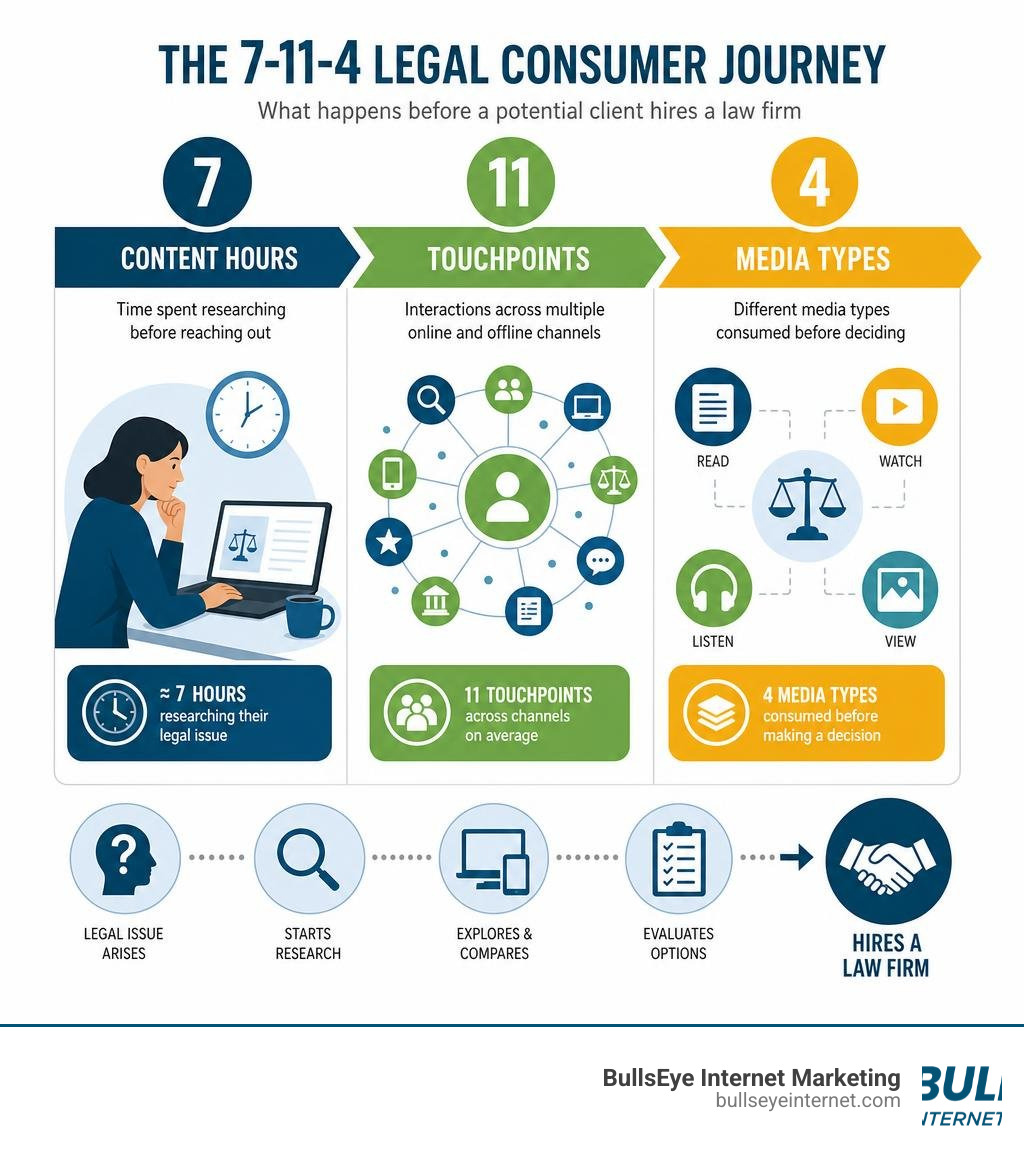
Here’s an uncomfortable truth: only 32% of small law firms with 2-9 attorneys have a formal marketing budget. Yet research shows that 92% of legal consumers research their issue online before ever calling an attorney.
That gap is where clients are lost every single day.
Small firms are often caught between two bad habits. They either rely entirely on referrals — which can dry up with no warning — or they throw money at a website or ad campaign with no strategy and wonder why the phone stays quiet.
The good news? You don’t need a massive budget or a full marketing department to compete. You need a system — one built around the channels and tactics that actually deliver signed clients, not just clicks.
I’m Ronnie Katz, founder of BullsEye Internet Marketing, and since 2006 I’ve helped businesses — including law firms — build exactly that kind of system through SEO, local search, PPC, and reputation management. My two decades of hands-on experience with marketing for small law firms means the strategies in this guide are grounded in what actually works in the real world, not just theory.
Important marketing for small law firms terms:
1. Creating a Strategic Plan for Marketing for Small Law Firms

Many managing partners treat marketing like a trip to an all-you-can-eat buffet: they try a little bit of everything—a local bus bench ad here, a social media post there, and maybe a few dollars on Google Ads—only to end up with a severe case of budget indigestion.
An effective marketing plan is not a random list of expenses. It is a structured decision framework designed to turn complete strangers into retained, paying clients. Before spending a single dollar, we must lay down a strategic foundation.
Defining Your Practice Niche and Ideal Client
Let’s be honest: nobody wants to hire a generalist who claims to do everything from dog bites to corporate mergers. In the legal world, claiming to be an expert in everything usually signals that you are an expert in nothing.
To stand out in highly competitive South Florida markets like West Palm Beach or Miami, you must “niche down.” This does not mean you reject other profitable cases, but it means your marketing focuses on solving one highly specific, painful problem for a clearly defined group of people.
For example, instead of marketing yourself as a general “family lawyer” in Fort Lauderdale, you might focus on “high-net-worth divorce cases for business owners.” Instead of advertising general “personal injury,” you could specialize in “bicycle and pedestrian accidents along the A1A corridor.”
When you narrow your focus, your messaging becomes sharper, your keyword bidding becomes cheaper, and your conversion rates climb. You can find more inspiration on narrowing your practice focus in this guide on Effective Marketing Ideas for Small Law Firms in 2026 | Attorney at Law Magazine.
To define your ideal client, write down a single paragraph that answers these questions:
- What is their exact legal crisis?
- What are their biggest fears or objections (e.g., cost, time, public exposure)?
- Where do they look for help when the crisis occurs?
- What specific outcome are they praying for?
Once you know exactly who you are talking to, writing website copy, blog posts, and ad campaigns becomes infinitely easier.
Setting a Realistic Budget for Marketing for Small Law Firms
How much should you actually spend?
According to the ABA, only 57% of all law firms have a marketing budget. If you don’t track your marketing spend, you are essentially flying blind.
The Small Business Administration (SBA) recommends that businesses spend between 7% and 8% of their gross revenue on marketing. In the legal industry, we typically see three tiers of spending:
- Maintenance Mode (2% to 5% of gross revenue): Best for established small firms in Broward or Palm Beach County that already have a steady stream of referral business and simply want to maintain their local presence.
- Steady Growth Mode (6% to 10% of gross revenue): Ideal for firms looking to actively capture market share, break into new practice areas, or expand their local reach.
- Aggressive Scale Mode (11% to 20%+ of gross revenue): Required for highly competitive practice areas (like personal injury or criminal defense) in major metro areas like Miami, where cost-per-click rates are high and the competition is fierce.
If your firm is currently generating $500,000 in gross revenue, a steady growth budget of 8% equals $40,000 annually (or about $3,333 per month).
When starting out, we highly recommend front-loading your budget into “owned” assets—such as a high-performing website and local search optimization—before pouring money into expensive PPC campaigns. To learn how to structure this budget for maximum yield, check out our guide on How To Build A Client Acquisition Machine For Your Law Practice.
2. Traditional vs. Digital Marketing Tactics
Historically, law firms relied entirely on handshakes, country club networking, and a massive yellow pages ad. While those traditional methods still hold value, the way modern consumers find professional services has fundamentally changed.
| Marketing Tactic | Pros | Cons | Best Suited For |
|---|---|---|---|
| Referrals & Networking | High trust, highest conversion rate, low direct cost | Hard to scale, unpredictable, single point of failure | Estate planning, business law, corporate defense |
| Local Sponsorships | Builds local goodwill, community trust | Low immediate ROI, hard to track direct sales | Family law, local criminal defense, probate |
| Search Engine Optimization (SEO) | High long-term ROI, compounding traffic, lower cost-per-lead | Takes 6 to 18 months to see full results, requires ongoing upkeep | All practice areas |
| Pay-Per-Click (PPC) Ads | Immediate leads, highly targeted, excellent for urgent needs | Expensive clicks, stops generating leads the moment you stop paying | Personal injury, bankruptcy, DUI, family law |
The Power of Referral Amplification
Do not make the mistake of treating referrals as a purely passive phenomenon. If your primary source of new cases is “hoping the phone rings because you did a good job five years ago,” your firm is vulnerable. If your top two or three referral sources retired or changed industries tomorrow, how long could your practice survive?
Systematizing your referrals is a core pillar of marketing for small law firms. You can amplify your word-of-mouth network by:
- Scheduling regular touchpoints: Don’t just call other attorneys when you need something. Set a recurring calendar reminder to take local attorneys, accountants, and real estate professionals out for lunch in Delray Beach or Boca Raton.
- Providing referral value first: The best way to get referrals is to give them. When a case comes across your desk that isn’t a perfect fit for your niche, actively refer it out to a trusted peer.
- Keeping past clients informed: Use a simple email marketing tool to send out quarterly updates, legal alerts, or helpful community news to your past client list. Research shows that 33% of law firms use email marketing, and 66% use email alerts to keep clients engaged.
For a deeper dive into how small firms can leverage community relationships and professional networks to sustain growth, read the Michigan State Bar’s analysis on Growth and retention: Marketing tactics for small firms.
Transitioning to Digital Client Acquisition
While a great referral network is wonderful, a digital client acquisition machine gives you something referrals never can: predictability.
When you build a system around local search and targeted digital ads, you create a pipeline of qualified leads that you can turn up or down depending on your current caseload. Instead of chasing clients, you position your firm so that clients find you at the exact moment they need your help.
Transitioning to digital doesn’t mean abandoning your roots; it means taking the trust you’ve built offline and projecting it online so that the 96% of people searching Google for legal help can see it. Learn how to make this transition seamlessly in our breakdown of Attorney Marketing Solutions How To Stop Chasing Clients And Start Attracting Them.
3. Building a High-Converting Website and Local SEO Foundation

Your website is the digital front door of your law firm. Yet, many small firms treat their website like a static online brochure.
Up to 75% of users admit to judging a firm’s credibility based entirely on its website design. If your site looks like it was built in 2012, is slow to load, or makes it difficult to find a phone number, prospective clients will click the “back” button and call your competitor down the street in Coral Gables.
To convert casual visitors into signed clients, your website needs:
- Blazing-fast speed: Test your site using Google PageSpeed Insights. Aim for a score of 80/100 or higher.
- Flawless mobile responsiveness: More than 57% of all legal searches happen on mobile devices. If your site is hard to read on an iPhone, you are losing half your market.
- An obvious Call to Action (CTA): Do not hide your phone number. Place a prominent “Call for a Consultation” button in the top right corner of every page, and ensure it is click-to-call on mobile.
- Practice-specific landing pages: If you practice both criminal defense and family law, do not send all your paid traffic to your homepage. Create dedicated pages for each service so that a person facing a DUI sees content only about DUIs, not child custody.
Optimizing Your Google Business Profile and Local SEO
For small law firms, your Google Business Profile (GBP) is your most valuable digital asset. When someone in West Palm Beach searches for a “bankruptcy attorney near me,” Google displays the “Local 3-Pack”—the three mapped business listings at the top of the search results.
An optimized GBP can drive 40% to 60% of a small firm’s total call volume. To claim your share of these local leads, follow these steps:
- Keep your NAP consistent: Your Name, Address, and Phone number (NAP) must be identical across your website, GBP, and all online directories (like Avvo, Justia, and Yelp).
- Choose the correct primary category: If you are a personal injury lawyer, make sure your primary category is “Personal Injury Attorney,” not just “Lawyer.”
- Add high-quality photos: Upload photos of your physical office, your team, and your community involvement. Businesses with 10 or more photos on their profile receive 42% more driving direction requests and 35% more website clicks.
- Post regularly: Treat your GBP like a social media platform. Use Google Posts to share case results, firm updates, and helpful legal tips at least once a week.
For a step-by-step blueprint on dominating local search in your specific Florida city, check out our guide on How To Increase Your Law Firms Online Presence With Local Seo.
Generative Engine Optimization (GEO) and AI Search
The search landscape is changing rapidly. With the rise of Google’s AI Overviews and AI search engines like Perplexity, users are no longer just looking at lists of blue links. They are asking complex, conversational questions and receiving AI-synthesized answers.
This shift has given birth to Generative Engine Optimization (GEO).
To ensure AI models cite your law firm when answering local legal questions, your content must be structured to match conversational user intent. AI engines look for highly authoritative, structured data.
Instead of writing short, superficial blog posts, focus on creating exhaustive, deeply researched guides that answer specific questions (e.g., “What are the asset protection laws for business owners divorcing in Florida?”). Use structured schema markup on your website to help search crawlers easily understand your location, practice areas, and FAQs.
To learn more about how to optimize your digital presence for the AI-driven search era, read the advanced strategies outlined in Marketing for Small Law Firms That Actually Generates Clients in 2026 | Superpractice.
4. Content, Video, and Social Media Marketing
Many lawyers dread the word “content.” They picture themselves chained to a desk writing dry, 3,000-word legal treatises that only other lawyers would enjoy reading.
But effective content marketing for small firms is actually simple: it’s about answering the exact questions your clients are already asking you during initial consultations.
Blogging and Content Campaigns for Lead Generation
Blogging is a highly effective way to build long-term organic traffic. In fact, 37% of law firms maintain a blog, and 34% of those firms have landed a client directly because of their blog content.
When planning your content campaigns, avoid dense legal jargon. Write at a 3rd-grade reading level to ensure your advice is accessible to someone who is stressed, overwhelmed, and looking for quick answers.
Great content campaigns for small law firms include:
- The “What to Expect” Guide: A step-by-step breakdown of what happens after a car accident, a DUI arrest, or filing for divorce in Florida.
- The “Local Law” Explainer: Content tailored to your specific geographic area, referencing local courthouses, judges, or regional statutes.
- The “Cost and Fees” Breakdown: Many clients hesitate to call a lawyer because they fear the cost. Writing an honest post about how contingency fees work or what factors influence the cost of probate builds immediate trust.
To kickstart your content strategy, explore the practical templates and campaigns suggested in 4 Effective Content Campaigns for Small Law Firms | LegalFuel.
Social Media and Video Marketing for Small Law Firms
You do not need to be on every social media platform. Maintaining a dead profile on five different channels looks worse than not being on social media at all. Instead, focus your energy on the platforms where your ideal clients actually spend their time.
Research shows that 86% of law firms have a social media presence, with the most popular platforms being:
- LinkedIn (83%): Unbeatable for B2B practices, business lawyers, and networking for professional referrals.
- Facebook (57%): Excellent for consumer-facing practices like estate planning, family law, and criminal defense.
- Video platforms (YouTube/Vimeo): Only 30% of law firms produce video content, which means video represents a massive competitive advantage.
Video is the ultimate shortcut to building trust. When a prospective client sees your face and hears your voice explaining a complex legal concept on camera, they feel like they already know you. Keep your videos short (under 2 minutes), upload them natively to your social channels, and focus on answering one common FAQ per video.
5. Ethical Guidelines and Measuring ROI
Before launching any marketing campaign, we must address the rules of the game. Legal marketing is not like marketing a local restaurant; we are bound by strict ethical standards.
Ethical Rules and ABA Guidelines for Lawyer Advertising
The American Bar Association (ABA) Model Rules of Professional Conduct (specifically Rules 7.1 through 7.5) lay down strict guidelines for attorney advertising. Furthermore, the Florida Bar has some of the most stringent advertising rules in the country.
To keep your firm safe from grievances, always adhere to these best practices:
- Never make misleading or false claims: Avoid statements like “The Best Criminal Defense Lawyer in Miami” or “Guaranteed Results.”
- Use clear disclaimers: When sharing past case results or testimonials, always include a prominent disclaimer stating that past success does not guarantee a similar outcome in future cases.
- Be careful with the word “Specialist”: In Florida, you cannot claim to be a “specialist” or “expert” unless you are board-certified in that specific practice area.
- Keep records: Many state bars require you to retain copies of all advertisements and landing pages for 2 to 3 years.
To ensure your digital campaigns remain fully compliant with the latest bar association regulations, read our detailed guide on Lawyer Advertising Rules Solutions For Modern Firms.
Measuring ROI and Tracking Campaign Success
If you don’t measure your results, you are not marketing—you are gambling. Many agencies will try to distract you with “vanity metrics” like impressions, clicks, or website visits. While those numbers are nice, they don’t pay the rent.
The only metric that truly matters for a small law firm is Cost Per Signed Client (CPSC).
To track this accurately, you must build a closed-loop tracking system:
- Implement Call Tracking: Use a tool like CallRail to assign unique tracking phone numbers to your Google Business Profile, website, and Google Ads. This allows you to trace every phone call back to its exact marketing source.
- Integrate Your CRM: Connect your call tracking and website forms to your legal practice management software (like MyCase or Clio). Tag every lead with their intake status (e.g., contacted, consulted, signed, declined).
- Calculate Your Metrics: At the end of every month, reconcile your marketing spend against your signed cases.
$$\text{Cost Per Signed Client} = \frac{\text{Total Marketing Spend on Channel}}{\text{Number of Signed Clients from Channel}}$$
For example, if you spent $3,000 on Google Ads last month and signed 3 clients, your CPSC is $1,000. If your average case value is $5,000, that is an excellent return on investment.
To learn how to set up airtight tracking and avoid common PPC budgeting mistakes, explore our Lawyer Ppc Advertising Ultimate Guide.
Frequently Asked Questions about Small Law Firm Marketing
What is a realistic marketing budget for a small law firm?
For a small law firm, a realistic marketing budget typically ranges from 5% to 10% of gross revenue. If your firm is in a highly competitive market or wants to grow aggressively, you may need to allocate up to 15% or more. If you are just starting out, focus your budget on high-ROI foundational assets like a fast, mobile-friendly website and Google Business Profile optimization before investing heavily in paid ads.
How long does it take to see results from SEO vs. PPC?
- PPC (Pay-Per-Click) Ads: Typically generate leads within 4 to 8 weeks. It is highly effective for immediate lead generation, but the leads stop the moment you stop paying for ads.
- SEO (Search Engine Optimization): Takes 6 to 18 months to build authority and show significant compounding results. However, once established, SEO delivers the highest long-term ROI and keeps generating leads without a cost-per-click fee.
Can small law firms do marketing without an agency?
Yes, small law firms can manage basic marketing efforts in-house by claiming their Google Business Profile, writing their own blog content, and systematically asking clients for reviews. However, as your firm grows, managing technical SEO, advanced PPC campaigns, and conversion optimization becomes incredibly time-consuming. Outsourcing to a specialized legal marketing agency allows you to focus on practicing law while experts build and scale your client acquisition machine.
Conclusion
At BullsEye Internet Marketing, we understand that managing a small law firm is a balancing act. You want to grow your practice, but you don’t have the time to become a full-time digital marketer.
We do things differently. We don’t lock our clients into long-term contracts because we believe our results should speak for themselves. Even better, we work with only one client per industry per geographic area, giving your firm an exclusive, unfair competitive advantage in your local market.
If you are ready to stop chasing leads and start attracting highly qualified, signed clients in South Florida, let’s talk. Check out An Essential Guide To Advertising For Lawyers to learn more about how we can help you build your client acquisition machine today.
