
The New Search Landscape
LLM content optimization is the practice of structuring your content so AI systems like ChatGPT, Google’s AI Overviews, and Perplexity can easily understand, extract, and cite your expertise when answering user queries. Here’s what you need to know:
- Focus on clarity and structure – Use conversational tone, clear headings, and short paragraphs
- Provide unique value – Include original data, specific statistics, and expert insights
- Build entity authority – Establish consistent brand information across the web
- Make content AI-crawlable – Implement schema markup and ensure fast page loads
- Track AI visibility – Monitor brand citations and AI-driven traffic
The search game has fundamentally changed. Over 52% of U.S. adults now use AI chatbots or LLMs for search, and 60% of searches end without any click-through to websites. Traditional search traffic has dropped 15-25% for many brands, while traffic from generative AI sources jumped 1,200% between July 2024 and February 2025.
This isn’t a temporary shift. It’s a complete change in how people find information.
When someone asks ChatGPT “What’s the best way to improve local SEO?” or Google’s AI Overview answers “How do I optimize for voice search?”, these systems scan millions of pages to synthesize an answer. If your content isn’t structured for AI understanding, you’re invisible—even if you rank well in traditional search.
The stakes are high, but so is the opportunity. Research shows that content with clear questions and direct answers was 40% more likely to be cited by AI tools. Content with statistics and proper citations sees 28-40% higher visibility in LLM responses. And remarkably, an AI referral visitor is worth 4.4x more than the average traditional organic visitor.
This guide will show you exactly how to optimize your content for this new reality—from understanding how LLMs select content, to implementing technical optimizations, to measuring your success.
I’m Ronnie Katz, founder of BullsEye Internet Marketing, and I’ve been helping businesses adapt to major search shifts since 2006. LLM content optimization has become essential for our clients competing in AI-powered search, and the strategies we’ve tested are delivering measurable results.
Quick LLM content optimization terms:
Understanding the Shift: Why LLM Content Optimization Matters
The digital landscape is constantly evolving, and Large Language Models (LLMs) are the biggest game-changer. What is LLM content optimization? It’s the strategic process of preparing your content to be easily understood and cited by AI systems like ChatGPT, Gemini, and Google’s AI Overviews. This makes your brand visible and trustworthy within AI-generated answers.
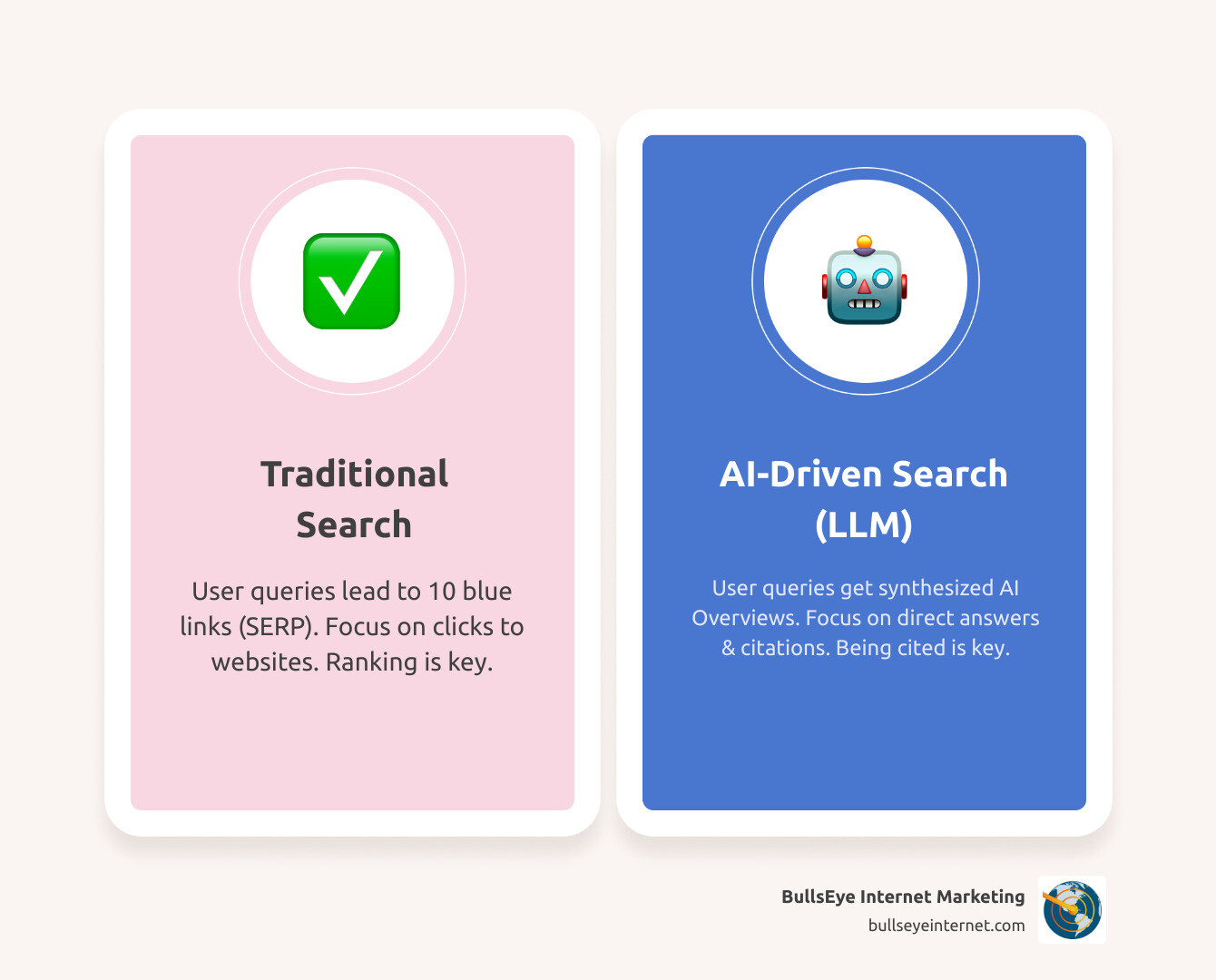
Why is this so important? Because the way people search has dramatically changed. We’ve moved from a “search-and-click” model to an “answer-first” paradigm. Users increasingly turn to AI chatbots for instant answers, creating a “zero-click search” environment where queries are resolved directly in the AI interface. This shift is evident in the data: 60% of searches now end without any click-through to websites.
This new reality is why LLM content optimization is a necessity, not just a trend. While traditional SEO helps us win page-one rankings, LLM content optimization helps us win AI citations and visibility inside these powerful answer engines. Without it, your carefully crafted content might never reach its audience. The Harvard Business Review has even suggested that traditional SEO roles are evolving so significantly that, soon, “SEOs will be known as LLMOs.”
For more in-depth insights, explore our More info about AI Search Optimization.
How LLMs Select and Evaluate Content
How do AI systems select content? It’s a sophisticated process beyond simple keyword matching, based on several key factors:
- Relevance Matching: LLMs don’t just look for keywords; they understand context, semantics, and the relationships between concepts. They prioritize content that comprehensively covers a topic using natural language and a conversational tone. This means your content must truly address user intent, not just contain keywords.
- Authority Signals: AI systems are designed to provide accurate information, so they prioritize credible sources. This involves looking for consistent entity information across channels (websites, social platforms, third-party sites), brand mentions, and topical depth. Content with consistent entity information is much more likely to be referenced by AI systems.
- Content Clarity & Structure: LLMs largely prefer well-organized content. They need clear signals about where information begins and ends. Research shows that clear formatting, like headings and bullet points, makes it easier for LLMs to extract information. LLMs are 28-40% more likely to cite content that includes structural elements.
- Information Quality & Freshness: Accuracy is paramount. LLMs favor content that provides unique value, verifiable statistics, and expert insights. They also pay close attention to how current the information is. Recency timestamps and explicit update signals help LLMs determine that your information isn’t outdated. Content with explicit update signals is significantly more likely to be selected.
To appear in LLM-generated answers, your content must be present in the data sources these models are trained on—most commonly, Common Crawl. Your website must be crawlable and indexable. Furthermore, LLMs often use Retrieval-Augmented Generation (RAG), retrieving relevant snippets from various sources to synthesize an answer. Your content must be chunked semantically and formatted for this snippet retrieval.
Traditional SEO vs. LLM Content Optimization: A New Mindset
While traditional SEO focuses on ranking in Google’s “10 blue links,” LLM content optimization is a complementary approach. It’s not about replacing SEO; it’s about evolving it.
Here’s a quick comparison to highlight the new mindset:
| Feature | Traditional SEO | LLM Content Optimization (LLMO) |
|---|---|---|
| Primary Goal | Rank high in search results (SERPs) for clicks. | Get cited/featured in AI-generated answers and overviews. |
| Content Focus | Keyword density, long-form content, backlinks. | Semantic relevance, concise answers, conversational tone. |
| Authority Signals | Backlink profile, domain authority, page rank. | Brand mentions, entity consistency, factual accuracy, citations. |
| Key Metrics | Organic traffic, keyword rankings, CTR. | AI answer inclusion rate, brand citation frequency, AI referral traffic. |
| User Experience | Exploration, findy via SERP. | Instant gratification, direct answers, zero-click. |
The shift is profound. We’ve seen traffic from traditional search drop 15-25% for many brands, while LLM traffic channels are projected to drive as much business value as traditional search by 2027. This isn’t just about getting clicks anymore; it’s about being the definitive answer. An AI referral visitor is worth 4.4x more than a traditional organic visitor. Because they are better equipped with information before visiting, they represent higher quality leads for businesses we serve in South Florida and across the United States.
The Core Pillars of LLM Content Optimization
Effective LLM content optimization isn’t about throwing spaghetti at the wall; it’s a strategic, multi-faceted approach built on foundational principles. From our experience helping businesses in Broward County, Miami-Dade County, and Palm Beach County adapt to this new era, we’ve identified three core pillars that are crucial for success. These pillars ensure your content is not only findable but also highly citable and authoritative in the eyes of AI.

For a deeper dive into these concepts, check out our AI Search Best Practices.
Pillar 1: Building Authority and Establishing Your Entity
In the AI-driven world, your brand isn’t just a name; it’s an entity—a recognizable concept with specific attributes and relationships. LLMs learn about brands and their expertise by analyzing patterns across the web. When your brand consistently appears alongside specific topics on authoritative sites, AI systems associate your brand with authority in those topics.
Here’s how we build that authority:
- Consistent Entity Information: Ensuring your NAP (Name, Address, Phone) citations and brand information are consistent across the web significantly improves how accurately LLMs identify and associate your brand with relevant queries. This consistency across your website, social profiles, and online directories (especially important for local businesses in Florida) is fundamental.
- Off-Page Signals & Digital PR: Visibility strategy must extend beyond your website to include mentions in credible publications and professional networks. When reputable industry sources cite your brand, it signals to LLMs that your information is trustworthy. This includes digital PR efforts, expert quotes in articles, and mentions on influential industry sites.
- Citations: Every time your brand is mentioned, cited, or linked to by a high-authority source, it reinforces your entity’s authority. These “unlinked brand mentions” are gold for LLMs, as they indicate genuine recognition and influence.
Pillar 2: Creating Content with High ‘Information Gain’
LLMs are hungry for knowledge, but not just any knowledge. They want content that adds genuine value—content with “information gain.” This means offering unique insights, not just regurgitating what’s already out there.
To achieve high information gain:
- Unique Insights & Original Research: Offer fresh perspectives, proprietary methodologies, or original case studies. If you can provide data or analysis that no one else has, LLMs will flock to it.
- Verifiable Statistics & Expert Quotes: Concrete statistics and evidence significantly boost LLM citation rates. GEO methods that inject concrete statistics lift impression scores by 28% on average. Always include specific numbers, recent data with explicit dates, and clear attribution to recognized sources. Content that includes quotes, statistics, and links to credible data sources is mentioned 30-40% more often in LLMs.
- Case Studies: Real-world examples and success stories demonstrate practical application and expertise, making your content more valuable and citable.
As one study found, adding verifiable citations, inserting hard numbers, and improving fluency each boosted a page’s share of word-count-adjusted citations by up to 41%! You can read more about this in A study on information gain.
Pillar 3: Mastering Content Structure and Clarity for AI
Content organization matters more for LLMs than for human readers. They need clear signals about where information begins and ends. Our goal is to make it as easy as possible for AI to understand, extract, and reuse your content.
Here’s how we structure content for maximum LLM visibility:
- Conversational Tone: LLMs excel at processing natural language. Writing in a conversational tone makes content more engaging and relatable for both AI tools and users. It mirrors how people naturally communicate, making it easier for LLMs to extract answers for their conversational interfaces.
- Q&A Format: Structure your content around specific questions (often using these as headings) and provide direct, concise answers immediately. Content with clear questions and direct answers was 40% more likely to be rephrased by AI tools like ChatGPT.
- Headings (H2, H3, H4): Use a clear HTML hierarchy with descriptive H2, H3, and H4 tags that signal topic shifts. This significantly improves an LLM’s ability to extract relevant information. ChatGPT cites content with a sequential heading structure nearly three times more often.
- Bullet Points & Numbered Lists: LLMs are 28-40% more likely to cite content that includes structural elements like headings, bullet points, and numbered lists. These formats make information easily scannable and digestible for AI. Pages cited by ChatGPT have an average of almost 14 list sections, significantly more than average Google SERP pages.
- Short Paragraphs: Keep paragraphs concise, ideally 2-3 sentences. This aids extractability and prevents LLMs from getting lost in dense text.
For more in-depth strategies on content structure, refer to our LLM SEO Best Practices Guide.
Technical Blueprint: Making Your Content AI-Findable
Beyond crafting compelling and authoritative content, we also need to ensure the technical foundation of your website is optimized for AI crawlers. Think of it as laying down a red carpet for the machines that will be evaluating your content. This involves making your content accessible, understandable, and explicitly signaling its value.
For a comprehensive dive into the technical aspects, visit our Large Language Model SEO guide.
Implementing Schema Markup for LLM Content Optimization
Schema markup, or structured data, is like a universal translator for search engines and LLMs. It explicitly tells them what your content is about, who created it, and its relationships to other entities. While some research suggests that AI crawlers may process JSON-LD injected via JavaScript differently, implementing schema markup remains highly beneficial for both traditional search engines and for LLMs. The key is to ensure your most important content is available in the HTML for direct parsing.
Here are key schema types we focus on for LLM content optimization:
- Organization Schema: Defines your business, its official name, logo, contact information, and social profiles. This helps LLMs understand your brand as an entity.
- Person Schema: For thought leaders, authors, or experts within your organization, this schema links their content to their professional identity, boosting authority.
- FAQPage Schema: Crucial for content organized in a Q&A format. It explicitly signals questions and their direct answers, making them easily extractable by AI.
- HowTo Schema: Ideal for step-by-step guides or instructional content, this schema outlines the steps, tools, and estimated time, perfect for LLMs summarizing processes.
- Article Schema: Provides metadata for your blog posts or articles, including publication date, author, and description, which helps AI understand the content’s context and timeliness.
Implementing these schema types helps explicitly communicate content type and structure, establish entity relationships and authority signals, and future-proof your content as AI crawling standards evolve.
Ensuring Crawlability and Signaling Freshness
For LLMs to find and use your content, their crawlers need to access and understand it efficiently.
- Robots.txt & LLMs.txt: Just as
robots.txtguides traditional search engine crawlers, a proposedLLMs.txtprotocol (similar torobots.txtbut for LLM crawlers) is being explored. ImplementingLLMs.txthas resulted in improved factual accuracy, better relevance, and improved response completeness for AI responses. We ensure our clients’ sites are properly configured to allow AI crawlers access to valuable content while respecting privacy. - HTML Content & JavaScript Dependencies: While LLMs are becoming more sophisticated, they still prefer content rendered directly in HTML. Minimizing reliance on JavaScript for core content ensures that AI crawlers can easily access and parse it.
- XML Sitemaps: These provide a roadmap for crawlers, listing all pages on your site that you want indexed, ensuring nothing important is missed.
- “Last Updated” Dates & Time-Specific Language: LLMs value fresh, accurate information. Explicitly displaying a “Last Updated” date on your content and using time-specific language (e.g., “In 2025…”) signals to AI systems that your information is current and reliable. Content with explicit update signals is significantly more likely to be selected.
A 90-Day Plan to Measure and Execute Your Strategy
Starting on an LLM content optimization journey might seem daunting, but a structured approach yields measurable results. Our 90-day plan builds a strong foundation, optimizes existing assets, and begins tracking your success.
Before we dive in, if you’re looking for an in-depth assessment, our LLM SEO Audit Best Practices can provide a great starting point.
Key Metrics for Measuring LLM Content Optimization Success
Measuring success in the AI era requires a shift from traditional metrics. Instead of just chasing clicks, we’re aiming for citation and influence.
Here are the key metrics we track:
- AI Answer Inclusion Rate: How often is your brand or content included in AI-generated answers for relevant queries? This is a direct measure of visibility.
- Brand Citation Frequency: How frequently are LLMs citing your brand as a source, either directly or indirectly?
- AI-Driven Traffic & Conversion Rates: Track referral traffic from AI platforms (like Google’s AI Overviews, ChatGPT, Gemini, Perplexity) to your website. An AI referral visitor is worth 4.4x more than a traditional organic visitor, often leading to higher conversion rates due to pre-qualified intent.
- Share of Voice in AI Responses: What percentage of AI mentions in your industry or topic area reference your brand versus your competitors?
- Sentiment Analysis of AI Mentions: Are LLMs mentioning your brand with positive, neutral, or negative sentiment? This helps us refine your brand’s narrative for AI.
- Topical Authority Expansion: Are LLMs associating your brand with a broader range of relevant topics over time?
For more details on tracking these evolving metrics, see our AI SEO Consulting Ultimate Guide.
Your 90-Day Action Plan
This phased approach helps us systematically improve your LLM visibility and authority.
Phase 1: Days 1-30: Audit & Foundation Building
- Week 1: Baseline Assessment:
- Conduct an initial audit of your top-performing pages for LLM content optimization friendliness (structure, schema, evidence).
- Manually test major AI platforms (e.g., ChatGPT, Gemini, Google AI Overviews) with 50-100 industry-relevant questions to establish a baseline for your brand’s AI answer inclusion and citation rates.
- Identify gaps in your content coverage and areas where your brand is currently invisible to AI.
- Week 2-3: Technical Foundation:
- Implement basic schema markup (Organization, Article) across your site.
- Add FAQPage schema to existing FAQ content or create dedicated FAQ sections on key pages.
- Ensure your NAP information is consistent across all online directories and your website for businesses in Florida and across the US.
- Verify your XML sitemaps are up-to-date and accessible to crawlers.
- Week 4: Quick Wins:
- Add “Last Updated” dates to all existing content and ensure time-specific language is used where appropriate.
- Identify and update existing content with concise answers to potential AI queries, packing in verifiable statistics and expert quotes.
Phase 2: Days 31-60: Content Optimization & Authority Building
- Week 5-6: Content Restructuring:
- Reformat top articles with proper heading hierarchies (H1, H2, H3) and ensure self-contained answer blocks for key questions.
- Add bullet points and numbered lists to break up dense text and improve extractability.
- Convert figurative language to plain, direct statements where clarity for AI is paramount.
- Week 7-8: Entity & Authority Improvement:
- Begin a digital PR outreach campaign to secure brand mentions and citations on authoritative industry publications relevant to our clients’ markets, whether they’re in Miami, Fort Lauderdale, or anywhere in the US.
- Ensure author bios are robust and linked to professional profiles, signaling expertise.
- Focus on creating content with high information gain, such as original research or detailed case studies.
- Week 9: Schema Expansion:
- Deploy HowTo schema for tutorial content.
- Implement Person schema for key team members or content authors.
Phase 3: Days 61-90: Creation & Measurement
- Week 10-11: Strategic Content Creation:
- Develop new, LLM-optimized content focusing on identified topic gaps and high-value user queries.
- Prioritize content that directly answers common questions in your niche, structured for maximum AI extractability.
- Create comprehensive topic clusters that demonstrate deep expertise.
- Week 12: Measurement & Analysis:
- Re-evaluate AI answer inclusion rates and brand citation frequency using your standardized query set.
- Analyze AI referral traffic in your analytics (e.g., GA4) to understand user behavior and conversion.
- Monitor competitive share of voice in AI responses.
- Gather insights to refine your LLM content optimization strategy.
- Week 13: Process Implementation:
- Document your LLM optimization best practices and integrate them into your ongoing content creation workflows.
- Educate your content teams on AI-friendly writing and structuring principles.
- Establish a monthly review cycle for AI visibility metrics.
Frequently Asked Questions about LLM Content Optimization
How is LLM content optimization different from traditional SEO?
Traditional SEO primarily focuses on ranking your website pages high in search engine results pages (SERPs) to drive clicks. It’s about keywords, backlinks, and technical elements that influence Google’s ranking algorithms. LLM content optimization, on the other hand, shifts the focus to being cited and featured directly within AI-generated answers. It prioritizes semantic understanding, concise answers, conversational tone, and verifiable facts over keyword density. While there’s overlap, LLMO is about being the answer rather than just a link.
What content formats work best for LLMs?
LLMs thrive on clear, structured, and easily extractable information. The most effective formats include:
- Q&A-structured articles: Using questions as headings with direct, concise answers (2-3 sentences) immediately following.
- Comprehensive guides with clear hierarchies: Logical H1 > H2 > H3 structures with bullet points, numbered lists, and summary elements.
- Data-rich resources: Content packed with specific statistics, expert quotes, and properly cited sources.
- FAQ sections: Easily extractable question-answer pairs, often improved with FAQPage schema.
- How-to guides with numbered steps: Clear procedural content, ideal for HowTo schema.
- Comparison tables: Structured data that AI can easily parse and reference for comparative queries.
The common thread is content that answers specific questions directly, with clear signals about where information begins and ends.
How long does it take to see results from LLM content optimization?
The timeline for seeing results from LLM content optimization can vary depending on your starting authority and the competitiveness of your niche. However, many brands begin to see measurable improvements within 60-90 days of implementing a systematic optimization strategy.
- Days 1-30: You’ll likely see initial improvements in technical clarity and minor increases in AI answer inclusion for very specific, low-competition queries.
- Days 31-60: More significant gains in AI citations and potentially a noticeable increase in AI referral traffic as content restructuring and authority-building efforts take hold.
- Days 61-90: This phase often shows the compounding effects, with improved share of voice, better sentiment, and more consistent AI referrals.
Unlike traditional SEO, where authority building can take months or even years, LLM content optimization can show faster results because you’re optimizing for extractability and clarity—factors more directly under our control.
Conclusion: Win the Future of Search
The shift to AI-mediated search isn’t coming; it’s already here. With Google’s AI Overviews reaching 1.5 billion monthly users by early 2025, and ChatGPT and Gemini boasting 600 million and 350 million monthly users respectively, ignoring LLM content optimization is no longer an option. It’s a fundamental requirement for digital visibility and business growth in the modern era.
Brands that adapt quickly will capture valuable territory in this new landscape, while those clinging to outdated SEO tactics will find themselves increasingly invisible. This isn’t about gaming a system; it’s about making your expertise accessible in the formats where people are now looking for answers.
Looking ahead, we anticipate several key trends:
- Multimodal Content Recognition: AI systems will increasingly understand and process not just text, but images, video, and audio. This means optimizing alt text, video transcripts, and audio descriptions will become even more crucial.
- Direct API Connections: We may see a future where structured data APIs allow for direct submission of content to AI systems, bypassing traditional crawling for certain types of information.
- User Feedback Loops: AI systems are incorporating user feedback on answer quality, emphasizing the continuous need to satisfy user intent and provide truly helpful information.
At BullsEye Internet Marketing, we are constantly testing and refining our LLM content optimization strategies to ensure our clients, from the smallest local business in Coconut Grove to larger enterprises across Florida and the US, maintain a competitive edge. We believe that LLM content optimization is rapidly becoming a core business capability, essential for generating calls and sales in this evolving digital landscape.
Don’t let your brand get lost in the AI revolution. Start your Answer Engine Optimization strategy with us today and speak the AI’s language fluently.
