
Why Starting an Advertising Company in 2026 is a Massive Opportunity
An advertising company startup is an accessible and lucrative venture in today’s digital economy. Here’s what you need to know:
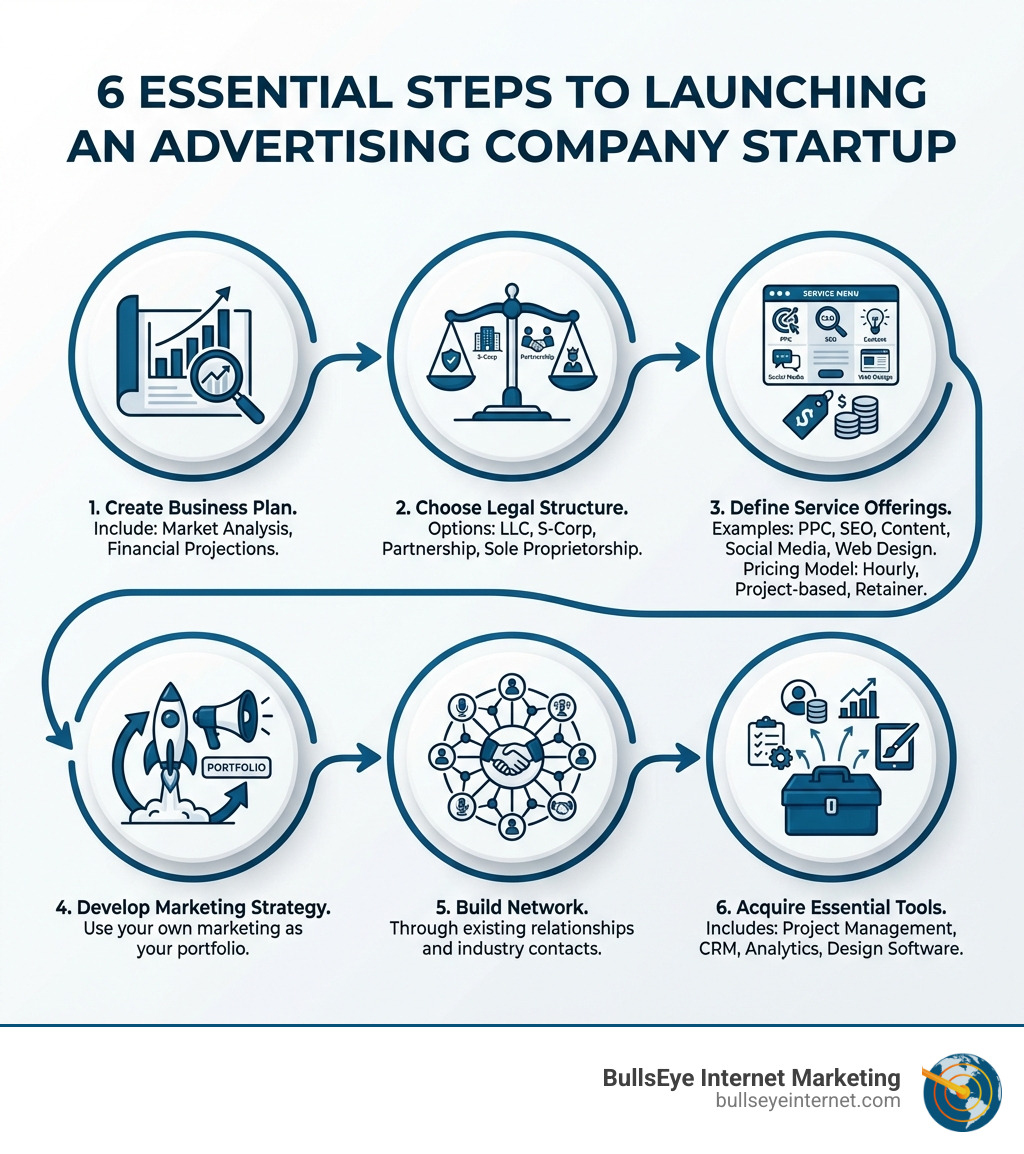
The 6 Essential Steps to Launch Your Advertising Agency:
- Create a comprehensive business plan – Define your focus, target market, and financial projections
- Choose your legal structure – Select between sole proprietorship, LLC, S-Corp, or partnership
- Determine your service offerings and pricing model – Decide on PPC, SEO, content marketing, social media, or full-service offerings
- Develop your marketing strategy – Use your own marketing as your portfolio to attract clients
- Build your professional network – Leverage existing relationships and industry contacts
- Acquire essential tools and software – Invest in project management, CRM, and analytics platforms
The advertising industry is stronger than ever, surpassing $1 trillion in revenue in 2024. With 50 million new startups annually and the rise of remote work, small agencies have unprecedented opportunities going into 2026 and beyond. The barrier to entry is low, overhead is minimal, and the client base is enormous.
Excitingly, bigger brands now consider smaller agencies viable partners. The pandemic accelerated an industry renaissance where agility, specialization, and personal service outweigh office size. A large production crew or budget is no longer a prerequisite.
The challenge? Most new agency founders struggle with finding their first clients, pricing services correctly, and standing out. About 90% of startups fail, but successful ones follow proven strategies and understand both the creative and business sides of the industry.
I’m Ronnie Katz, founder of BullsEye Internet Marketing. For nearly two decades, I’ve helped businesses steer digital marketing and guided many on their advertising company startup journey. Since 2006, I’ve seen what separates successful agencies from those that fail.
Quick look at advertising company startup:
Laying the Foundation: Business Plan and Legal Structure
Starting an advertising company startup requires a solid business foundation, not just creative ideas. Your business plan is the blueprint for success, helping secure funding, attract talent, and provide a clear roadmap. Without one, you’re navigating without a map.
Your plan must include market analysis, realistic financial projections (revenue, expenses, profitability), and SMART (Specific, Measurable, Achievable, Relevant, Time-bound) goals to keep your agency on track.

Crafting a Winning Business Plan
A business plan is a living document that evolves with your advertising company startup. Essential elements include:
- Executive Summary: Your agency’s elevator pitch, covering your mission, services, target market, and financial highlights.
- Company Description: Detail what your agency does, its unique value proposition, and your vision. What makes you different in Florida, from Miami to Palm Beach, or across the U.S.?
- Product/Service Overview: Clearly define your services. Will you specialize in Pay Per Lead, Google Business Profile Optimization, SEO, PPC, or conversion optimization, like us?
- Market Analysis: Identify your ideal clients and the competitive landscape in areas like Broward County or St. Lucie County. Understanding your audience is crucial.
- Financial Plan: Include startup costs, funding requests, revenue forecasts, and a break-even analysis. Be realistic and meticulous.
- Setting SMART Goals: For example, “Acquire 5 new clients in Palm Beach County within the first 6 months” is a SMART goal. “Get more clients” is not.
Choosing the Right Legal Structure for Your Advertising Company Startup
Your chosen legal structure has significant implications for liability, taxation, and administration. While not glamorous, this step is vital for your advertising company startup.
Here are the common options:
- Sole Proprietorship: Simple to set up but offers no personal liability protection.
- Partnership: Shares profits, responsibilities, and liabilities. Industry founders note that a partner with business sense is crucial, as a pure creative may overlook business operations.
- S-Corp: Can offer tax advantages by passing profits and losses to your personal income without corporate tax rates, but involves complex compliance.
- Limited Liability Company (LLC): A popular choice that provides personal liability protection while offering flexible taxation. For general information, see this guide on how to start an LLC. However, we strongly recommend consulting a legal professional familiar with your state’s laws to ensure you meet all local requirements.
Each structure has pros and cons; the best choice depends on your circumstances, growth plans, and risk tolerance.
Defining Your Niche: Services, Pricing, and Tools
In advertising, being a generic “ad agency” isn’t enough. To thrive, an advertising company startup must define its niche and specialize. This focuses your efforts on becoming an expert in a specific area.
For example, our agency, BullsEye Internet Marketing, specializes in generating calls and sales through Pay Per Lead, Google Business Profile Optimization, SEO, PPC, and conversion optimization. This clear focus allows us to provide unparalleled value to our clients.

A clear niche helps you stand out, attract the right clients, and build a reputation. Consider the problems you want to solve for businesses in Florida or across the U.S., whether it’s local search in Miami-Dade or social media for e-commerce brands. The opportunities are vast. For more, see our insights on Advertising for Startups.
Determining Your Service Offerings and Pricing Model
Once you’ve identified your niche, clearly define your service offerings and pricing.
Potential services you might offer:
- Paid Search (PPC): Managing Google Ads and Bing Ads campaigns for immediate ROI.
- SEO (Search Engine Optimization): Helping clients rank higher in organic search for sustained visibility.
- Content Marketing: Creating valuable content (blogs, videos) to attract and engage audiences. 83% of marketers rate content as their top demand-gen tactic.
- Social Media Marketing: Managing social profiles, running ad campaigns, and engaging communities.
- Web Design and Development: Creating or optimizing websites to support marketing and conversions.
- Conversion Optimization: Improving website performance to increase leads or sales.
Pricing flexibility is key for an advertising company startup. Common models include:
- Hourly Rates: Simple, but can lead to unpredictable costs for clients.
- Project-Based Fees: A fixed price for a defined scope of work.
- Monthly Retainers: A consistent monthly fee for ongoing services, providing predictable income.
- Hybrid Models: Combining a retainer with project-based or performance-based fees.
- Value-Based Pricing: Charging based on the results you deliver, which is attractive to clients seeking clear ROI.
Many agencies, like us, opt for models that align with client goals, such as Pay Per Lead, to demonstrate a commitment to tangible results.
Essential Tools and Software for Agency Operations
An efficient advertising company startup needs the right toolkit. Essential software streamlines operations, improves communication, and boosts productivity.
Here’s what we recommend:
- Project Management Software: Programs like monday.com help with organization, task assignment, and tracking progress. For more, see resources on Project management programs and tools to streamline your workflow.
- CRM Systems (Customer Relationship Management): A CRM is vital for managing leads and client relationships. A good CRM helps qualify leads by analyzing online behavior, centralizes data, and automates data entry to facilitate better decision-making.
- Accounting Software: For invoicing, expense tracking, and financial reporting.
- Graphic Design Tools: Industry-standard tools like Adobe Photoshop are essential for creative services, while online platforms offer user-friendly alternatives.
- Analytics Platforms: Google Analytics and other dashboards are non-negotiable for measuring performance and proving ROI.
- Communication Tools: Platforms like Slack provide an effective and accessible communication hub for your team.
Building Your Brand: Marketing and Client Acquisition
Attracting your first clients is a major hurdle for an advertising company startup. The startup industry is booming, with 50 million new companies annually creating a huge client base but also fierce competition. Your marketing prowess is key. For B2B insights, explore B2B Startup Marketing.
Effective Marketing Strategies to Attract Your First Clients
Your agency’s marketing strategy must be as robust as those you create for clients; it’s your prime opportunity to showcase your skills.
- Developing a Marketing Plan: Create a detailed marketing plan for your agency, defining your target audience, unique selling proposition, and channels.
- Content Marketing: This is a powerful tool. As our research shows, 83% of marketers rate content as their top demand-gen tactic. Create valuable content that addresses client pain points to position yourself as a thought leader.
- SEO for Your Agency: Your digital presence must be impeccable. 67% of marketers emphasize organic SEO. Rank for relevant keywords in your target areas, like “PPC agency Miami” or “SEO services Palm Beach.”
- Social Media Presence: Be active on platforms where your target clients spend time, like LinkedIn for B2B outreach. Share content, insights, and success stories.
- Custom Client Proposals: Research each potential client and tailor your pitch to their specific needs and goals.
The Power of Networking and Leveraging Your Own Marketing
Your own marketing efforts are your most potent sales tool. For an advertising company startup, your marketing is your portfolio.
- Using Your Agency’s Marketing as a Portfolio: Every blog post, social media update, and design you create for yourself demonstrates your expertise.
- Showcasing Expertise: Use your own case studies to highlight results. If you optimized your Google Business Profile to attract local leads, share the numbers.
- Building Media Contacts: Network with local media, industry influencers, and complementary businesses for referrals and collaboration.
- Leveraging Existing Professional Relationships: Your current network is powerful. Reach out to former colleagues, mentors, and acquaintances. They know your capabilities and may become your first clients or refer you to others. Pre-existing trust makes it easier for people to take a risk on a new agency.
- The Role of Testimonials and Referrals: Solicit testimonials and ask for referrals from your first clients. A positive word from a satisfied client is incredibly powerful for building trust. For more on this, explore Brand Reputation Management for Startups: A Complete Guide.
The Modern Advertising Company Startup: Thriving in a New Era
The advertising industry has changed significantly, presenting immense opportunities for an advertising company startup. The rise of remote work has reshaped how agencies operate and how clients choose their partners.
The industry has seen a renaissance where agility and specialized expertise are prized. Bigger brands now consider smaller agencies for their personalized service and faster turnarounds. This shift levels the playing field, allowing startups to compete with established giants.
Key Benefits and Opportunities for a New Advertising Agency
Starting an advertising company startup today has several advantages:
- Low Overhead and Startup Costs: A digital ad agency can start lean, unlike businesses needing a storefront. Operating remotely reduces office costs, especially in high-rent areas like Miami. A laptop and internet are often all you need.
- Large Potential Client Base: Every business needs to advertise. With the ad industry surpassing $1 trillion in revenue in 2024, the potential client base is virtually limitless.
- Opportunity to Scale: With efficient processes and a strong client acquisition strategy, your agency can scale rapidly without geographic limits, serving clients from Broward County to all 50 states.
- Low Barrier to Entry: The initial investment is small compared to other industries. Your primary assets are your skills and strategic thinking.
- High Demand for Specialized Services: Businesses seek experts in areas like PPC or SEO. Focusing on a niche positions your advertising company startup as the go-to solution. For more on expertise, read What Makes a True Digital Marketing Expert Stand Out in 2025.
How Small Agencies Can Compete and What Skills You Need to Succeed
Small agencies thrive by playing to their strengths.
- Niche Specialization: Focus on a specific industry, service, or client size to become a true expert and deliver exceptional results.
- Personalized Service: Unlike larger agencies with standardized processes, a small advertising company startup can offer a custom, hands-on approach. Clients value direct communication, responsiveness, and a deep understanding of their business.
- Faster Turnaround: With less bureaucracy, small agencies can execute campaigns and adapt strategies more quickly, which is a valuable asset.
Key skills for an advertising company startup founder to possess:
- Creativity: Generating fresh ideas and innovative solutions.
- Business Acumen: Understanding financials, sales, and operations.
- Communication: Clear and persuasive communication for clients, teams, and pitches.
- Leadership: Inspiring your team and setting a clear vision.
- Adaptability: The ability to learn quickly and pivot strategies is non-negotiable.
For Startups: How to Choose the Right Advertising Agency Partner
It’s important to understand the perspective of a startup looking for an agency. Many startups debate building an in-house team versus partnering with an agency. You don’t have to choose; our research shows a hybrid approach (in-house and consulting) makes startups 2.5x more likely to report marketing success. This blends internal knowledge with external expertise.
Here’s a quick look at the comparison:
| Feature | In-House Marketing Team | External Agency Partner |
|---|---|---|
| Control | High, direct oversight | Collaborative, but less direct day-to-day control |
| Cost | High fixed costs (salaries, benefits, tools) | Variable, project-based or retainer fees, often more cost-effective |
| Expertise | Limited to team’s skills, may lack specialized knowledge | Broad, specialized expertise across various channels and industries |
| Agility | Can be slow to adapt if team is small/overwhelmed | Highly agile, can quickly pivot strategies |
| Scalability | Difficult to scale quickly | Easy to scale services up or down as needed |
| Time to Market | Can be slower due to hiring, training, setup | Faster, agencies hit the ground running |
For small businesses seeking dedicated expertise without the overhead, partnering with a Digital Marketing Agency for Small Business often makes the most sense.
Key Considerations When Evaluating a Startup Marketing Agency
Whether you’re a startup seeking an agency or a founder understanding client needs, here are crucial evaluation criteria:
- Relevant Experience: Does the agency have a proven track record with similar businesses, especially in your industry or area (e.g., startups in Martin County)? Find an agency that understands the Florida market’s unique challenges.
- Portfolio Review: Examine their past work to see if it aligns with your brand vision.
- Case Studies: Request detailed case studies outlining challenges, strategies, and measurable results.
- Client Testimonials: What do past and current clients say? Positive testimonials indicate reliability.
- Team and Culture Fit: You’ll work closely with this team. Ensure your values align and there’s mutual respect.
- Communication and Reporting Style: How will they communicate and report? Will you have direct access to your account manager? Transparency is paramount.
- Pricing and Contract Terms: Understand their pricing models. Be wary of long-term contracts, especially as a startup. We offer no long-term contracts, ensuring clients stay for results, not out of obligation. For insights on proving ROI, refer to SEO for Startups: Why New Businesses in Sebastian Need Professional SEO Services.
Questions to Ask and Red Flags to Watch for in Your Advertising Company Startup Search
When interviewing agencies, come prepared with pointed questions to gauge their expertise and commitment.
Questions to Ask Potential Agencies:
- Can you provide examples of successful campaigns for similar businesses?
- How do you approach reporting and communication?
- What are your pricing structures and what’s included?
- How do you measure success and define ROI for our goals?
- What is your team’s experience in our industry?
- What are your initial thoughts on our current marketing?
- How do you handle strategic changes or challenges?
Red Flags to Watch Out For:
- Unrealistic Promises: Be skeptical of guarantees for #1 rankings or viral success without a clear strategy.
- Lack of Transparency: Vague answers about processes, team, or pricing are a warning sign.
- Poor Communication: Slow responses during the sales process are a red flag for future communication.
- High-Pressure Sales Tactics: An agency that rushes you into a long-term contract is often not the right fit.
- Vague Success Metrics: They should focus on business outcomes (leads, sales) not vanity metrics.
Frequently Asked Questions about Starting an Advertising Agency
What is the very first step to starting an advertising agency?
The first and most crucial step is to create a comprehensive business plan. This document will serve as your roadmap, outlining your business focus, target market, service offerings, financial projections, and strategies for growth. It’s the foundation upon which all other decisions will be built, helping you secure funding, attract talent, and maintain clarity as your advertising company startup grows.
How do new advertising agencies find their first clients?
New agencies often find their first clients through their existing professional network. Leveraging past relationships, showcasing expertise through the agency’s own marketing (like a strong website, insightful blog content, and active social media presence), and directly reaching out to ideal potential clients with custom proposals are effective initial strategies. Testimonials and referrals from these early clients then become invaluable for expanding your client base.
Can a small advertising agency really compete with larger, established ones?
Absolutely. Small agencies can compete by specializing in a specific niche, industry, or service. Their smaller size allows them to be more agile, offer more personalized client service, and often provide more cost-effective solutions, which is highly attractive to many businesses, especially startups. By focusing on deep expertise in areas like Pay Per Lead or conversion optimization, a small advertising company startup can become an indispensable partner, proving that sometimes, smaller really is better.
Advertising Agency Startup Essentials by BullsEye Internet Marketing
Starting an advertising company startup in today’s dynamic market is an exciting and rewarding journey. We’ve walked through the essential steps, from laying down a robust business plan and choosing the right legal structure, to defining your unique service offerings and mastering client acquisition. We’ve also highlighted the immense opportunities for new agencies in an industry that continues to grow and evolve.
The advertising industry is full of opportunity for those who are strategic, creative, and adaptable. By understanding the landscape, leveraging your own marketing as a powerful portfolio, and focusing on delivering measurable results, your agency can carve out a successful niche.
For startups that decide to partner with an expert instead of building from scratch, BullsEye Internet Marketing provides specialized services to generate calls and sales without long-term contracts. We believe in earning your business every month by delivering exceptional results, and we commit to working with only one client per industry per geographic area to ensure your competitive advantage, whether you’re in Palm Beach, Miami, or any of the 50 USA states.
Ready to take your startup’s advertising to the next level?
Get expert help with your paid ad management.
