
Why Most Leads Waste Your Time (And What to Do Instead)
Live call leads — also called live transfer leads — are pre-qualified prospects connected to you by phone in real time, the moment they express interest in your product or service.
If you’re looking for a quick answer on what they are and why they work, here it is:
What are live call leads?
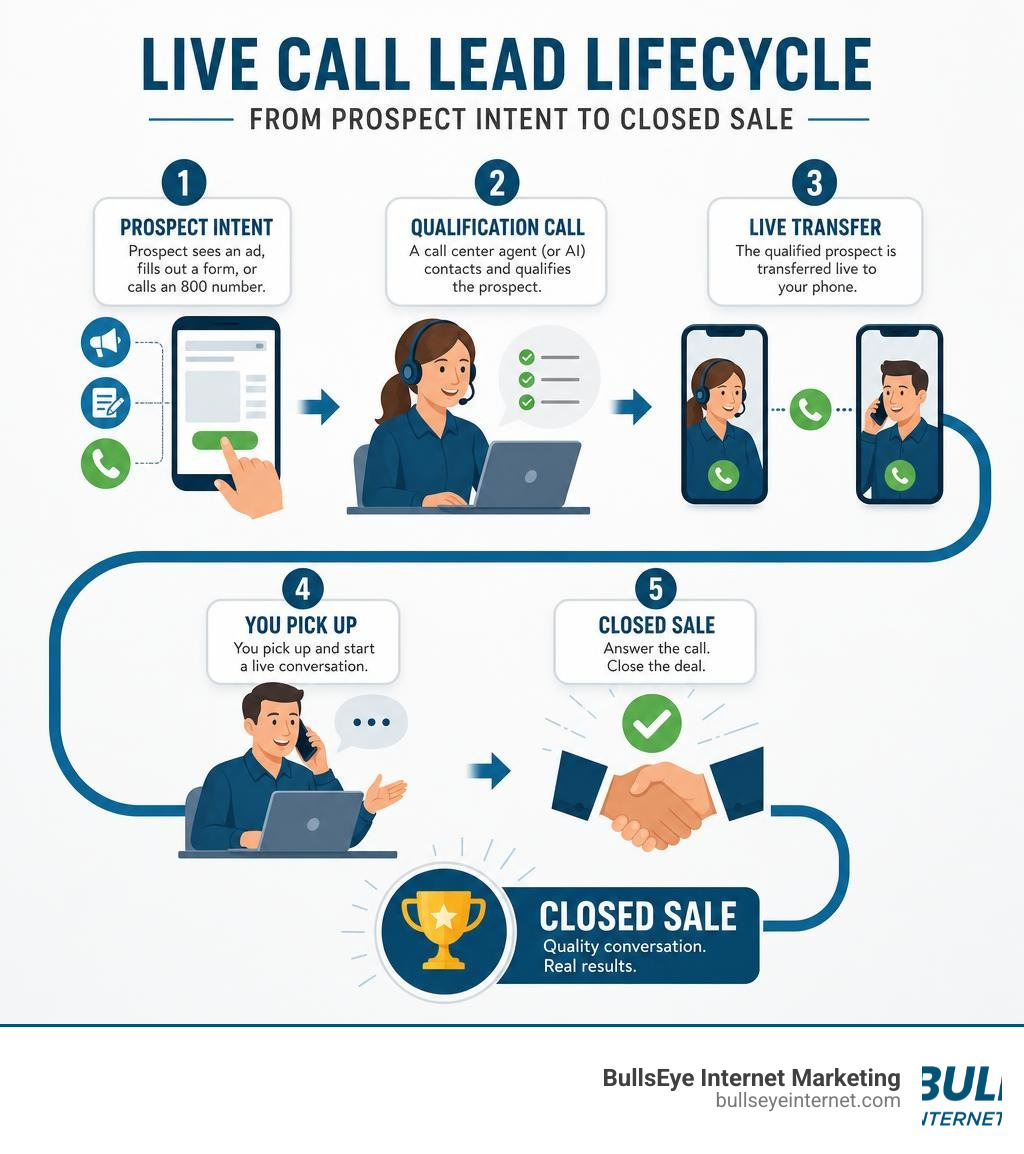
- A prospect sees an ad, fills out a form, or calls an 800 number
- A call center agent (or AI) contacts and qualifies them
- The qualified prospect is transferred live to your phone
- You pick up and start closing — no chasing, no voicemails
Why do they outperform other lead types?
- 100% contact rate — you’re speaking to someone the moment they’re connected
- 15%–30% conversion rates vs. 2%–5% for web form leads
- Exclusive — the lead goes to you, not 3–5 competing agents
- First-to-speak advantage — 78% of sales go to the first company that talks to the prospect
Here’s the frustrating reality most business owners know too well: you pay good money for internet leads, then spend hours calling numbers that ring out, go to voicemail, or belong to people who filled out a form three weeks ago and have already moved on.
That’s not a closing problem. That’s a lead quality problem.
The data backs this up. Responding to a lead within five minutes makes you 100x more likely to connect than waiting just 30 minutes. Most form-fill leads are contacted well outside that window — if they’re contacted at all.
Live call leads solve this by eliminating the gap between interest and conversation entirely.
I’m Ronnie Katz, founder of BullsEye Internet Marketing, and I’ve spent over 20 years helping businesses in competitive industries turn their marketing spend into real revenue — including building and managing live call lead campaigns that get phones ringing with buyers who are ready to talk. In this guide, I’ll walk you through exactly how live transfers work, what they cost, and how to set your business up to convert them at the highest possible rate.
Live call leads terms to learn:
Why Live Call Leads Outperform Traditional Form Fills
To understand why live call leads are the premium tier of modern lead generation, we have to look at how traditional digital marketing has evolved. Years ago, getting a prospect to fill out a form was a massive win. Today, consumers are bombarded with automated follow-ups, spam calls, and endless sales pitches. By the time you call a standard internet lead back, they have often blocked your number or forgotten why they filled out the form in the first place.
When you buy traditional form-fill leads, you are essentially buying a “ghost” — a digital footprint of someone who was interested at some point in the past. When you buy a live transfer, you are buying an active, real-time conversation.

The difference lies in three core factors:
- The Contact Rate: With web forms, your team might spend days dialing, reaching only 15% to 30% of those prospects. With live transfers, the contact rate is a flawless 100% because the prospect is already on the line when your phone rings.
- Exclusivity: Traditional lead brokers often sell the same form-fill lead to three, four, or five different buyers simultaneously. This triggers a stressful “race to dial” where agents must compete in real time. Live transfer leads are routed exclusively to one buyer.
- Consumer Intent: A consumer who answers a qualification call, passes a screening process, and agrees to be transferred to a specialist has demonstrated a far higher level of intent than someone who passively clicked a social media ad while watching TV.
How Live Call Leads Convert at 10x Higher Rates
The conversion math behind phone leads is clear. According to industry data, 65% of businesses rate phone calls as their highest-quality lead source, and inbound calls convert to revenue 10 to 15 times more frequently than standard web leads.
Because the consumer is engaged and present at the exact moment of transfer, live call leads convert at 3x to 5x the rate of standard internet leads, and up to 10x faster because you are speaking directly to someone in need of your services right now. In fact, many businesses using live transfers report consistent conversion rates between 15% and 30%, depending on the industry and the strictness of their qualification criteria.
To put this in perspective, let’s look at how the different lead types stack up:
| Metric | Live Transfer Leads | Web Form Leads | Aged Leads |
|---|---|---|---|
| Contact Rate | 100% | 15% – 30% | 5% – 15% |
| Conversion Rate | 15% – 30% | 2% – 5% | 1% – 3% |
| Exclusivity | 100% Exclusive | Often shared (3-5 buyers) | Highly shared / non-exclusive |
| Speed to Connect | Real-time (instant) | Hours to days | Weeks to months |
| Buyer Effort | Extremely low (just answer) | High (endless outbound dialing) | Very high (cold calling lists) |
When you are the first company to speak with a prospect, your closing ratio naturally skyrockets. Because 78% of all sales go to the first business that connects with a prospect, being on the receiving end of a warm transfer places you in the absolute best position to close the deal.
The Cost vs. Value of Real-Time Transfers
It is no secret that live call leads carry a higher upfront cost than standard form fills. A raw internet lead might cost you $20, while a fully vetted live transfer can range from $25 to $400+ depending on your industry.
However, evaluating your marketing spend solely on cost-per-lead (CPL) is a trap. The metric that actually matters is your Cost Per Acquisition (CPA) — the total amount spent to win a single paying customer.
Let’s break down the math:
- Scenario A (Web Form Leads): You buy 100 web leads at $20 each ($2,000 total spend). Your team spends hours calling them, successfully contacts 20 of them, and closes 3 sales. Your cost per closed deal is $666.
- Scenario B (Live Call Leads): You buy 15 live transfers at $100 each ($1,500 total spend). Because the contact rate is 100%, you speak to all 15. You close 3 of them. Your cost per closed deal is $500, and your sales team saved dozens of hours of outbound dialing.
By focusing on high-intent, real-time connections, you drastically reduce the time your staff spends chasing cold leads. This is why smart businesses view live transfers not as an expensive lead source, but as a highly efficient, performance-based shortcut to revenue. For more on structuring cost-effective marketing, check out our guide on Pay Per Call: A Cost-Effective Way to Generate Leads and learn how to optimize your pay per call campaigns.
How Live Transfer Programs Work: From Click to Hand-Off
A successful live transfer campaign is a finely tuned machine that combines targeted digital marketing with rapid human (or AI) qualification. The entire process, from the moment a consumer displays interest to the moment they are speaking to you, takes only a matter of minutes.

Here is how the typical live transfer workflow operates:
- Traffic Generation: High-intent consumers are captured online through targeted search engine marketing (PPC), social media ads, or localized SEO. They either fill out a brief inquiry form or click an ad to place a direct phone call.
- Intake & Qualification: The lead is routed to a specialized call center or an advanced AI voice screening platform. A representative answers the call or dials the form-submitter within seconds to verify their identity and interest.
- Screening & Vetting: The agent asks specific, pre-determined qualifying questions. For example, if you are an insurance agency in South Florida, the agent might confirm the caller’s geographic location, their current coverage, and their budget.
- The Hand-Off: Once the prospect is verified as a qualified match, the system automatically scans available buyers, matches the lead to your business, and initiates the transfer.
- The Warm Introduction: The transfer agent bridges you and the prospect onto the line together, introduces the prospect, and drops off the call, leaving you to close the sale.
AI Pre-Screening and IVR Qualification
As we move through 2026, technology has vastly improved the efficiency of the qualification stage. While human call centers are still highly effective, many modern campaigns utilize AI voice agents and Interactive Voice Response (IVR) pre-screening to qualify callers.
These automated systems use natural language processing to converse with prospects, asking targeted screening questions to filter out low-intent callers before they ever reach your phone. For instance, an AI agent can verify whether a homeowner in West Palm Beach is actually looking for immediate roofing repairs or simply researching prices for next year.
By leveraging structured screening, you ensure your sales team only spends time on high-value conversations.
The Warm Transfer Process
There is a major difference between a “cold” transfer and a “warm” transfer. A cold transfer occurs when a call center simply forwards a caller to your number without warning. When you pick up, the caller often has no idea who you are, leading to high hang-up rates.
A warm transfer, on the other hand, is a seamless, professional hand-off. The qualification agent stays on the line to introduce the prospect to you. For example:
“This is Sarah from the qualification team. I have John on the line from Fort Lauderdale, who is looking for a comprehensive home insurance quote. John, I’m transferring you to our specialist who is ready to help you today.”
This brief, scripted introduction establishes immediate trust, reduces early hang-up rates, and gives you the exact context you need to begin a natural, high-converting sales conversation.
Key Industries and Best Practices for Live Transfers
While almost any business that relies on phone sales can benefit from live transfers, certain high-value verticals see extraordinary results. These are typically industries where transactions are complex, require personal consultation, or carry high lifetime values.
- Insurance (Auto, Home, Life, Health, Medicare): Because insurance policies require personal details and tailored explanations, live transfers are the lifeblood of top-producing agencies. Implementing high-quality live transfer campaigns helps agencies scale rapidly, while precise regional targeting allows them to focus on high-value local markets.
- Real Estate: Connecting with motivated home sellers or buyers at the exact moment they are ready to transact is a game-changer for agents in competitive markets like Miami, Broward, or Palm Beach County.
- Home Services (Roofing, HVAC, Plumbing): When a homeowner has a leaking roof or a broken air conditioner in the middle of a South Florida summer, they don’t want to wait for an email reply. They need to speak to a local contractor immediately. You can read more about targeting these high-intent local buyers in our guide on Hyperlocal Hype: Maximizing Pay Per Call Leads in Your Area.
Setting Up Your Business to Receive Live Call Leads
To successfully convert live call leads, your internal operations must be built for speed and availability. Because these are real-time, live connections, missing a call means missing a highly valuable opportunity.
To maximize your ROI, follow these operational best practices:
- Configure Strict Availability Hours: Work with your lead provider to set precise time blocks for when you are available to take calls. If your team is in meetings between 12:00 PM and 1:00 PM, pause your campaign so no transfers are missed.
- Set Concurrency Caps: Ensure your daily call caps and concurrent transfer limits match your staff size. If you only have two licensed agents available in your West Palm Beach office, set your concurrency cap to two so you don’t receive three simultaneous transfers.
- Integrate Your CRM: Ensure your lead provider’s platform integrates directly with your CRM. This allows the prospect’s pre-qualification data to automatically populate your screen the moment you answer the phone. For a deeper look at how to manage these systems, explore our Pay Per Call Company Guide.
- Train Your Team for Inbound Conversions: Taking a live transfer requires a different mindset than cold calling. Your agents must be warm, authoritative, and ready to guide the conversation immediately without sounding like they are reading a rigid script.
Compliance, TCPA, and Quality Control
When dealing with telemarketing and live transfers, compliance is non-negotiable. Violating consumer privacy laws can lead to severe financial penalties and damage your brand’s reputation.
When sourcing live transfers, you must ensure your lead provider adheres to strict quality and legal standards, particularly regarding the Telephone Consumer Protection Act (TCPA). This includes verifying that every prospect has provided explicit, documented consent to be contacted. For businesses operating in highly regulated areas like Miami-Dade, staying aligned with local standards is critical; you can review local communication guidelines via Communications – Miami-Dade County .
To safeguard your business, ensure your campaigns implement these essential compliance and quality-control measures:
- Documented Consent (TCPA Opt-In): Every lead must have clear, verifiable consent records showing they agreed to receive calls.
- Call Recording & Archiving: All qualification and transfer calls must be recorded and stored with proper consent disclosures. This protects you in the event of a dispute.
- Clear Dispute and Refund Policies: Choose a platform that offers a simple, one-click credit request for calls that do not meet your agreed-upon criteria (e.g., wrong location, disconnected number).
- Scrubbed Do Not Call (DNC) Lists: Ensure your provider actively scrubs lists against federal and state DNC registries to prevent compliance issues.
Frequently Asked Questions About Live Transfers
What is the difference between a live transfer and a direct transfer?
A live transfer involves a three-way connection where a live call center agent (or advanced AI) speaks with the prospect first, verifies their intent and qualifications, and then introduces them to you via a warm handoff.
A direct transfer (sometimes called a blind or cold transfer) bypasses the human qualification step. The caller is routed directly to your phone via an automated IVR system without an agent verifying their intent first. While direct transfers are typically cheaper, live transfers yield much higher conversion rates because of the human vetting process.
How much do live transfer leads typically cost?
The cost of live call leads varies widely depending on your industry, geographic targeting, and qualification criteria.
- Insurance Leads (Auto, Home, Health): Typically range from $25 to $100 per transfer.
- Home Services Leads (HVAC, Roofing): Generally cost between $20 and $80.
- High-Value Legal Leads (Personal Injury, Mass Tort): Can range from $150 to $400+ per transfer because a single signed case can generate tens of thousands of dollars in revenue.
While the upfront cost is higher than standard leads, the extremely high conversion rate often results in a much lower overall cost per acquisition.
Can small agencies run live transfer campaigns without a call center?
Absolutely. Thanks to modern lead routing and distribution software, you do not need an in-house call center to leverage live transfers.
You can partner with a digital marketing agency like BullsEye Internet Marketing to manage the entire generation, qualification, and routing process for you. Our systems use advanced routing technology to deliver pre-screened, high-intent calls directly to your existing office phone or mobile device during your preferred business hours.
Conclusion
If your sales team is tired of chasing “ghosts” — spending their days dialing unresponsive web leads, leaving voicemails, and competing with five other companies for the same client — it is time to shift your strategy. Live call leads place your business exactly where it belongs: in direct, real-time conversations with motivated buyers.
At BullsEye Internet Marketing, we do things differently. We specialize in building custom, high-converting pay-per-call and SEO campaigns designed to make your phone ring with qualified prospects.
Our unique competitive advantages include:
- No Long-Term Contracts: We earn your business month after month based on real performance.
- Strict Exclusivity: We work with only one client per industry per geographic area. When you partner with us in your territory (whether that is Broward County, Miami-Dade, or Palm Beach County), we will never sell leads to your local competitors.
Stop wasting valuable hours chasing cold form fills. Let us build a predictable, exclusive pipeline of live call leads for your business. To learn more about how we can help you scale your revenue, explore our Pay Per Call Advertising Agency Ultimate Guide and contact us today to secure your exclusive local territory.
