
Why Most Startups Burn Out Before They Break Through
Customer acquisition for startups is the single biggest reason early-stage companies either take off — or quietly die.
Here’s the quick answer if you need it fast:
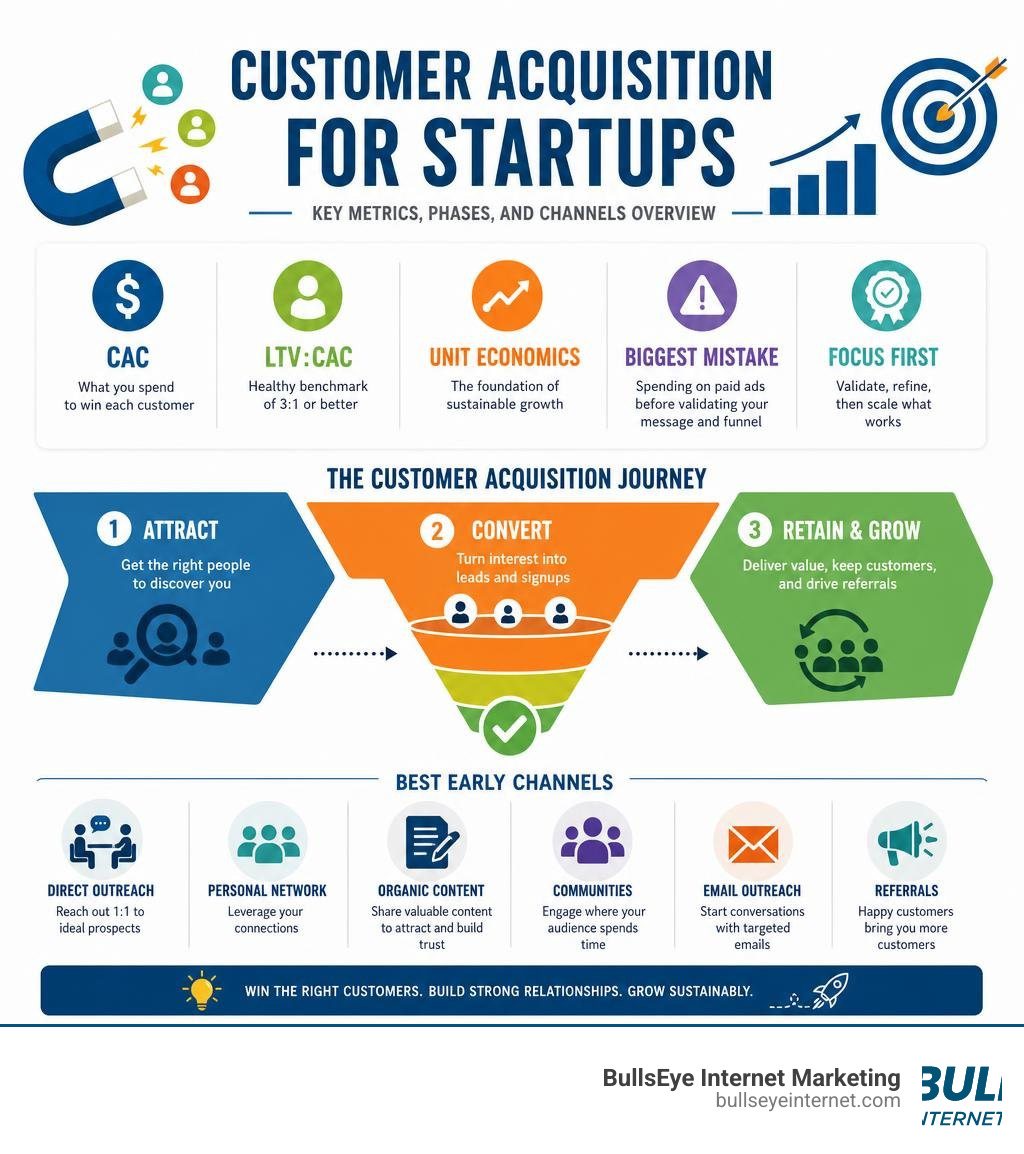
What is customer acquisition for startups?
| Element | What It Means |
|---|---|
| Definition | The process of attracting, converting, and keeping new paying customers |
| Why it matters | No customers = no revenue = no startup |
| Key metric | Customer Acquisition Cost (CAC) — what you spend to win each customer |
| Healthy benchmark | LTV:CAC ratio of 3:1 or better |
| Biggest early mistake | Spending on paid ads before validating your message and funnel |
| Best early channels | Direct outreach, personal network, organic content, communities |
You built something real. But if the wrong people are seeing it — or nobody is — it doesn’t matter how good the product is.
The hard truth? Sales and marketing at leading SaaS companies eats up 30–46% of revenue. For a startup still finding its footing, every dollar spent on acquisition is a dollar off your runway.
And yet most founders wing it. They spray budget across channels, chase vanity metrics, and wonder why growth stalls.
One VC advisor put it plainly: a founder who spends 15 minutes pitching product features and 15 seconds explaining how they get customers isn’t worth investing in. Because without a repeatable way to win customers, you don’t have a business — you have a hobby.
This guide breaks down exactly how to fix that.
I’m Ronnie Katz, founder of BullsEye Internet Marketing, and I’ve spent over 20 years helping businesses solve the exact customer acquisition for startups challenge you’re facing right now — cutting wasted spend and turning marketing into measurable revenue. Let’s get into what actually works.
The Fundamentals of Customer Acquisition for Startups
At its core, customer acquisition is the systematic process of bringing new business to your company. But for a startup, it is also a race against time. Your cash runway is finite, and every dollar you spend must push you closer to a sustainable, repeatable growth engine.
In June 2026, the funding landscape is tighter than ever. Marketing budgets have dropped by about 15% compared to previous years, down to an average of just 7.7% of company revenue. This means startups can no longer afford to throw cash at the wall to see what sticks. Unit economics are the new king.
To survive, we must understand exactly where our budget is allocated. In early-stage startups, the Go-To-Market (GTM) to engineering headcount ratio averages around 1.3x. This means commercial efforts require significant human and financial resources. If you allocate your budget blindly, you will quickly find your cash runway cut in half without any meaningful customer traction to show for it.
We must treat customer acquisition not as a series of disconnected marketing campaigns, but as a core financial model. Every channel we choose, every piece of content we write, and every sales call we make must be measured against the cost of that effort and the long-term value it brings to the business.
Mapping the Journey: ICP, Personas, and the Acquisition Funnel
Before we spend a single dollar on advertising, we have to know exactly who we are talking to and how they make decisions.

Defining Your Ideal Customer Profile (ICP)
Your Ideal Customer Profile (ICP) is not a vague description of “small businesses” or “tech companies.” It is a highly specific definition of the exact type of account that gets massive value from your product and pays you consistently.
To define your ICP, we must look beyond basic demographic data. We need to answer three critical questions:
- Who experiences the problem we solve most acutely?
- Who has the actual budget authority to buy our solution?
- Who can we realistically reach within 48 hours to start a conversation?
Once you have your ICP, we build buyer personas. These are semi-fictional representations of the actual decision-makers within those target accounts. What is their job title? What are their daily challenges? Are they the primary decision-maker, or do they need to get approval from a CFO or CTO? By mapping these customer pain points, we can tailor our messaging to speak directly to the problems they are desperate to solve.
Navigating the Customer Acquisition Funnel
The customer journey is traditionally split into three core stages, and your marketing must adapt to each one:
- Awareness Stage: The prospect realizes they have a problem but does not know your brand exists. Here, your goal is simply to get on their radar.
- Consideration Stage: The prospect is actively researching different ways to solve their problem. They are comparing your solution to competitors or manual workarounds.
- Decision Stage: The prospect is ready to buy but needs that final nudge—a demo, a free trial, or a personalized proposal—to choose you.
To move prospects through this funnel, we rely heavily on lead nurturing. This is the process of building relationships with prospects at every stage of the funnel through targeted, valuable content. It is a game of patience: in B2B markets, over 60% of closed deals come from persistent, thoughtful follow-ups rather than the initial touchpoint.
Choosing the Right Channels for Sustainable Growth
Not all acquisition channels are created equal. Choosing the wrong channel is one of the fastest ways to kill an early-stage company.

Organic vs. Paid Customer Acquisition for Startups
The classic debate for startups is whether to focus on organic search or paid media.
Paid media represents about 27.9% of the average marketing budget. While pay-per-click (PPC) ads are highly scalable and can yield fast results (often within a month, with an average ROI of 36%), they are also a cash bonfire if your messaging is unvalidated. If your landing pages convert at a standard 1% to 2% rate, you will spend thousands of dollars just training ad algorithms on unvalidated assumptions.
Organic channels, on the other hand, take longer to build but offer compounding returns. Organic search traffic converts 566% better than PPC traffic because the user is actively searching for a solution to their problem.
To build a balanced strategy, we recommend a mix of both. You can read more about balancing these channels in our guide on B2B Startup Marketing and explore how to structure your ad spend in our resource on Advertising For Startups. For a deeper dive into why timing is everything, check out Why Your Startup Needs A Digital Ad Strategy Yesterday.
High-Impact Channels for Early-Stage Traction
For early-stage startups, we must focus on high-impact, low-cost channels.
- Thought Leadership-Based SEO: This channel boasts an average ROI of 748%. By creating deep, authoritative content that answers complex industry questions, you build instant trust. It takes 4 to 6 months to see results, but the traffic compounds over time.
- Informal Networking: With an average ROI of 691%, building relationships in local business communities or niche online spaces is incredibly powerful. It requires time (often 12 months to fully mature), but the quality of leads is unmatched.
- Targeted Cold Outreach: Instead of sending spammy, automated sequences, we use a simple 4-sentence formula for cold emails or LinkedIn DMs:
- Show you did your homework on their specific business.
- State the exact problem you solve.
- Offer a friction-free, valuable resource (like a free audit or a custom interactive mockup).
- Include a single, low-commitment call to action.
To learn how to execute these manual tactics successfully, read about getting your First 100 Customers With Zero Budget and study the proven frameworks in How to Get Your First 100 Customers.
Mastering Unit Economics: CAC, LTV, and the Golden Ratio
If you do not master your unit economics, scaling your marketing will only accelerate your startup’s demise.
Calculating and Optimizing CAC and LTV
To understand if your startup is financially healthy, we must track two primary metrics:
- Customer Acquisition Cost (CAC): This is the total cost of your sales and marketing efforts divided by the number of new customers acquired during that same period. We must use blended CAC, which includes not just ad spend, but marketing software, content creation costs, and sales team salaries. $$\text{Blended CAC} = \frac{\text{Total Sales & Marketing Expenses}}{\text{Number of New Customers Acquired}}$$
- Customer Lifetime Value (LTV): This is the total net revenue a customer generates for your business over the entire duration of their relationship with you. $$\text{LTV} = \text{Average Revenue Per Customer (ARPU)} \times \text{Customer Lifetime}$$
To optimize these metrics, we must look for leverage points. Can we reduce CAC by improving our landing page conversion rates? Can we increase LTV by introducing sticky features that reduce customer churn? Even small, incremental improvements in these areas can dramatically change your startup’s financial trajectory.
The LTV:CAC Ratio: What Startups Need to Know
The LTV:CAC ratio is the ultimate metric for measuring acquisition efficiency. A common benchmark for a strong, sustainable business is an LTV:CAC ratio of 3:1. This means that, on average, a customer should provide three times more revenue than it cost to acquire them.
Let’s compare what healthy vs. unhealthy unit economics look like in practice:
| Metric | Unhealthy Startup (The Cash Burner) | Healthy Startup (The Growth Engine) |
|---|---|---|
| Average Monthly Revenue per Customer | $50 | $100 |
| Average Customer Lifespan | 6 months | 18 months |
| Calculated LTV | $300 | $1,800 |
| Blended CAC | $250 | $400 |
| LTV:CAC Ratio | 1.2:1 (Dangerous) | 4.5:1 (Excellent) |
| Business Outlook | High risk of running out of cash; burning money to acquire low-value users. | Highly efficient; ready to safely scale marketing spend to accelerate growth. |
If your ratio is below 3:1, do not try to scale your marketing. It means you either have an acquisition problem (CAC is too high) or a retention problem (LTV is too low). Focus on fixing the leak in your bucket before pouring more water in.
Scaling Your Strategy Across Growth Phases
Your acquisition strategy cannot remain static. What works when you have zero customers will actively hold you back when you are trying to reach one thousand.
Phase 1: The Manual Hustle (0 to 10 Customers)
At this stage, you are not looking for scalability; you are looking for validation. Founders must personally do the selling. The first 10 customers should feel like favors, and you should treat them as partners in your product development.
Forget paid ads. Use unscalable, high-touch tactics like reaching out directly to your personal network, sending highly personalized cold DMs, and participating genuinely in online communities. For a step-by-step breakdown of how to navigate this network-less stage, read the playbook on First 100 Customers With No Network and check out the How to Get Your First 100 SaaS Customers (2026 Guide).
Phase 2: Building a Repeatable Sales Machine (10 to 100 Customers)
Once you have validated your product with your first 10 customers, your goal shifts to building a repeatable process. This is where you begin to document your sales playbook and narrow down your acquisition channels to the top 1 or 2 that yield the highest conversion rates.
At this stage, we focus heavily on lead generation and optimizing the onboarding experience. You must map your onboarding flow to ensure users reach their first “aha moment” in under 10 minutes. To see how to structure this phase for rapid, repeatable growth, review the strategic blueprint in How I’d Get My First 100 SaaS Customers in 2026.
Phase 3: Scaling the Growth Engine (100 to 1,000+ Customers)
To scale past 100 customers, you must transition from manual processes to automated systems and broader distribution. This is where you build out a dedicated marketing team, invest in robust marketing automation tools, and diversify your acquisition channels.
At this scale, you must track a strict set of key performance indicators (KPIs) to ensure your unit economics do not break:
- Click-Through Rate (CTR): Are your ad creatives and messaging engaging your target audience?
- Cost Per Lead (CPL): How much does it cost to capture a prospect’s contact details?
- Activation Rate: What percentage of signups actually use the core features of your product?
- Trial-to-Paid Conversion Rate: How efficiently are you turning free users into paying customers?
- Blended CAC: Is your cost of acquisition remaining stable as volume increases?
To explore advanced growth tactics and channel scaling frameworks for this phase, dive into Customer Acquisition for Startups: Growth Tactics for the First 1000.
Balancing Customer Acquisition for Startups with Retention
It is a statistical fact: acquiring a new customer is five times more expensive than retaining an existing one. Yet many startups obsess over top-of-funnel acquisition while ignoring a leaky bottom funnel.
A simple 5% increase in customer retention can lead to an incredible 25% to 95% increase in profits. Why? Because retained customers buy more often, refer their peers, and have a much higher lifetime value.
We must protect the customers we acquire by investing in stellar customer support, clear onboarding, and proactive communication. To understand how to protect your brand’s image and keep customers happy, read our guide on Brand Reputation Management For Startups A Complete Guide.
Frequently Asked Questions about Startup Acquisition
What is a good customer acquisition cost for early-stage startups?
There is no single “perfect” CAC, as it varies wildly by industry, price point, and sales cycle. However, a good CAC is one that fits comfortably within your unit economics.
For early-stage startups, rather than stressing over a specific dollar amount, focus on your LTV:CAC ratio. If your average customer pays you $50 a month and stays for 10 months (LTV of $500), a blended CAC of $150 or less is healthy. If your CAC is $400 for that same customer, you are on a fast track to burning through your runway.
How long does it take to see results from organic SEO?
Organic search is a long-term play. Typically, it takes 6 to 12 months of consistent content creation and technical optimization to see significant, compounding organic traffic.
However, the wait is worth it. Because organic traffic converts so much better than paid traffic, it becomes the ultimate foundation for sustainable, low-CAC growth. If you are a new business in Florida looking to establish local search dominance, check out our insights on Seo For Startups Why New Businesses In Sebastian Need Professional Seo Services.
What are the biggest mistakes startups make when scaling acquisition?
The three most common mistakes we see are:
- Premature Scaling: Spending heavily on paid ads before validating the product-market fit or defining a clear ICP.
- Chasing Vanity Metrics: Obsessing over website traffic, social media followers, or free signups instead of focusing on actual paying customers and revenue.
- Scaling Bad Channels: Doubling down on a marketing channel that brings in high-volume, low-quality leads who churn almost immediately, destroying your LTV:CAC ratio.
Sustainable Growth Strategies with BullsEye Internet Marketing
Building a great product is only half the battle. To survive and thrive, your startup needs a predictable, highly efficient way to win customers without draining your bank account.
At BullsEye Internet Marketing, we specialize in helping businesses generate direct calls and sales through highly targeted digital marketing. We don’t believe in vanity metrics; we focus on what actually moves the needle—Pay Per Lead, Google Business Profile Optimization, high-intent SEO, PPC, and conversion optimization.
Our unique advantage? We offer no long-term contracts and work with only one client per industry per geographic area. This gives you an exclusive, highly competitive edge in your market. Whether you are building your GTM engine in Broward County, Miami-Dade, Palm Beach, or Indian River County, we are here to help you scale sustainably.
Ready to stop burning cash and start growing? Explore our BullsEye Internet Marketing Services today, and let’s build your growth engine together.
