
Why Integrated SEO PPC Management Is the Smarter Way to Win Search
SEO PPC management is the practice of running your organic search and paid search strategies together as one unified system — not as two separate campaigns that happen to share a budget.
Quick answer: What is SEO PPC management?
- SEO builds long-term organic visibility through content, keywords, and technical optimization (free clicks, but takes 3-6 months)
- PPC buys immediate visibility through paid ads at the top of search results (instant traffic, but costs money per click)
- Integrated SEO PPC management combines both channels so they share data, keywords, and goals — each making the other more effective
Most businesses run these two channels in silos. The SEO team is over here. The PPC team is over there. They rarely talk.
The result? Wasted budget. Duplicate keyword spending. Landing pages that hurt your ad Quality Score. Conversion data that never reaches your content team.
In fact, research shows that up to 76% of ad spend goes to waste in unmanaged or poorly coordinated campaigns. Meanwhile, businesses that do align their organic and paid strategies can increase total click share by as much as 50-80% when they rank organically and run ads on the same high-value keywords.
The fix isn’t spending more. It’s getting both channels working together.
I’m Ronnie Katz, founder of BullsEye Internet Marketing, and since 2006 I’ve helped businesses cut wasted spend and grow revenue through coordinated SEO PPC management strategies built on 20+ years of hands-on experience. In this guide, I’ll walk you through exactly how to stop the turf war between your search channels and start compounding your results.
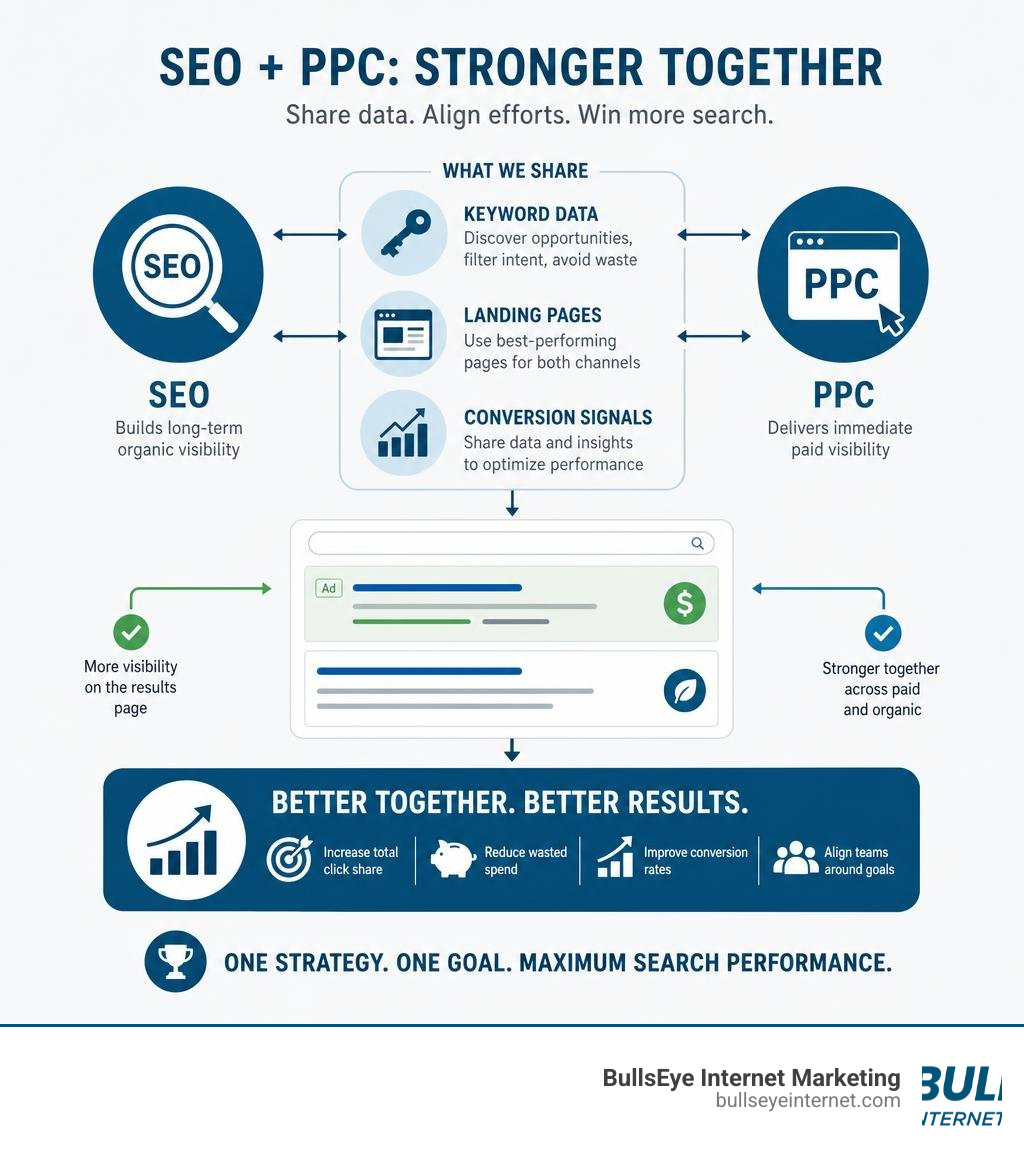
Seo ppc management vocab to learn:
The Cost of Siloed Search Marketing
When organic traffic and paid search operate as completely separate departments, your business pays a hidden tax. In June 2026, search engines are more competitive than ever. Average cost-per-click (CPC) rates have risen 15-25% year-over-year across most competitive verticals. If you are treating SEO and paid ads as two independent islands, you are actively burning cash.
The biggest issue with siloed marketing is keyword cannibalization. This happens when you bid heavily on keywords for which your website already holds the number-one organic ranking. While there are strategic reasons to run ads on keywords you rank for, doing so blindly without a unified plan means you are paying for clicks you could have easily captured for free.
Furthermore, you risk massive budget waste when your paid campaigns drive traffic to weak, unoptimized landing pages. If your SEO team isn’t working with your paid media team to optimize those pages, your Quality Scores drop, your CPCs climb, and your conversion rates plummet. To truly understand how these channels interact, it helps to understand the foundational differences in how they function. You can read more about this in our breakdown of SEO vs SEM: What’s the Difference and Why Both Matter.
Why Siloed Search Fails Without Unified SEO PPC Management
Siloed search marketing fails because it creates massive data silos. Your paid search campaigns gather incredibly rich, real-time data. Within days, your paid ads can tell you exactly which keyword variations, headlines, and offers drive actual revenue. If that conversion tracking data stays locked inside your ad account, your SEO team is left guessing which topics to write about. They might spend three to six months ranking for a high-volume keyword, only to discover too late that the search intent behind it doesn’t actually lead to sales.
At the same time, running search in silos hurts your brand awareness. A user’s journey is rarely a straight line. They might see your paid search ad on Google, browse your site, leave, search for your brand name organically a week later, and then convert. If your organic and paid strategies aren’t aligned, you won’t have the unified tracking required to attribute that sale correctly. You might end up pausing a “low-performing” ad campaign that was actually feeding your organic funnel.
The Friction Between Organic and Paid Teams
In many companies, the SEO and PPC teams treat each other like rivals rather than teammates. This turf war usually boils down to two things: attribution conflict and budget allocation.
Paid media managers want to show a high Return on Ad Spend (ROAS) to justify their budget. SEO specialists want to prove that organic search engine optimization is the primary driver of compounding growth. When a lead comes in, both teams want to claim 100% of the credit.
This internal friction is incredibly counterproductive. Instead of fighting over who gets the credit, a unified seo ppc management approach focuses on the only metric that actually matters: reducing your blended Customer Acquisition Cost (CAC) while scaling your overall business revenue.
The Core Components of Integrated SEO PPC Management

To build a search engine dominance strategy that actually works, you have to look at the search engine results page (SERP) as a single piece of real estate. Effective seo ppc management is built on five core pillars: keyword research, search intent mapping, landing page experience, Quality Score optimization, and unified conversion tracking.
If you want to dive deeper into how we structure paid campaigns for maximum efficiency, check out our PPC Management Complete Guide.
Shared Keyword Intelligence and Search Intent Mapping
The foundation of any integrated strategy is a shared keyword library. Instead of having your SEO team use one keyword tool and your PPC team use another, both teams must work off the same master data sheet.
By analyzing search volume, CPC, and actual conversion data together, you can map out your keyword strategy with surgical precision:
- PPC Search Term Reports: Your paid campaigns act as a real-time testing ground. By analyzing search term reports weekly, you can uncover high-converting, long-tail keywords that your SEO team should build dedicated content around.
- Negative Keywords: When your PPC team identifies search queries that drive traffic but never convert, they add them as negative keywords to save ad spend. This same list should be handed to the SEO team so they don’t waste months writing organic content for those same low-value terms.
- Search Intent Alignment: Not all keywords are created equal. High-intent, commercial keywords (like “emergency plumber in Fort Lauderdale”) are perfect for immediate PPC bidding. Informational keywords (like “how to fix a leaky faucet”) are better suited for organic topic clusters that build long-term brand authority.
Landing Page Optimization and Quality Score Alignment
Google doesn’t just show ads to the highest bidder; they care deeply about the user experience. This is where SEO principles directly improve your PPC performance.
Google calculates your Quality Score based on three things: expected click-through rate, ad relevance, and landing page experience. If your landing page is slow, hard to navigate on mobile, or lacks clear, authoritative content, your Quality Score will suffer. A low Quality Score forces you to bid significantly more to win the same ad placements.
By applying on-page SEO best practices—such as optimizing page speed, structuring headers correctly, and satisfying Google’s E-E-A-T (Experience, Expertise, Authoritativeness, and Trustworthiness) guidelines—you naturally improve the landing page experience. This boosts your Quality Score, which directly lowers your cost-per-click. It’s a win-win: your organic pages rank better, and your paid ads become cheaper to run.
Key Benefits of Combining SEO and PPC Strategies
To understand why this combined approach is so powerful, let’s look at how standalone channels compare to a fully integrated management strategy:
| Feature / Metric | Standalone SEO | Standalone PPC | Integrated SEO & PPC Management |
|---|---|---|---|
| Time to Results | Slow (3 to 6 months) | Immediate (Goes live in days) | Immediate wins + compounding long-term growth |
| Cost Structure | High upfront effort, free organic clicks | Continuous ad spend required per click | Optimized ad spend; organic offsets rising CPCs |
| SERP Real Estate | Single organic listing | Single paid ad listing | Double visibility (SERP Domination) |
| Data Sharing | Limited (high “not provided” data) | Rich, real-time conversion data | PPC data fuels SEO; SEO improves ad Quality Score |
| Algorithmic Risk | High (vulnerable to core updates) | Low (as long as you pay, you stay) | Highly resilient; paid acts as a backup system |
When you run both channels under one unified strategy, you achieve true SERP domination. If you rank number one organically and hold the top ad spot for a high-value search term, you capture a massive share of the clicks. This double-listing also builds immense brand authority. To searchers, your business appears as the clear industry leader.
Additionally, this integration opens up highly sophisticated retargeting opportunities. You can use cost-effective organic content to bring large volumes of top-of-funnel traffic to your site, and then use highly targeted PPC remarketing ads to close those leads later. To see how other paid channels fit into this ecosystem, read about How Display Advertising Complements Your SEO & PPC Strategy.
Short-Term Paid Wins vs. Long-Term Organic Authority
Every business needs a balance of short-term cash flow and long-term sustainability. PPC is your short-term sprint. It bypasses organic algorithms to give you immediate visibility, making it perfect for launching new services, running seasonal promotions, or generating instant calls in competitive South Florida markets like Broward or Palm Beach County.
SEO, on the other hand, is your long-term marathon. It builds compounding brand authority that continues to drive free traffic and leads long after you turn off your ad spend. By combining the two, you protect your business from sudden search engine algorithm changes. If an organic update temporarily shifts your rankings, your paid ads act as an immediate safety net to keep your lead volume steady. For home service businesses and local professionals, balancing these two levers is critical for survival. Dive deeper into this comparison with our guide on PPC vs Organic Search: Which Delivers Better Results for Home Service Businesses.
Step-by-Step Strategy to Align Your Search Channels
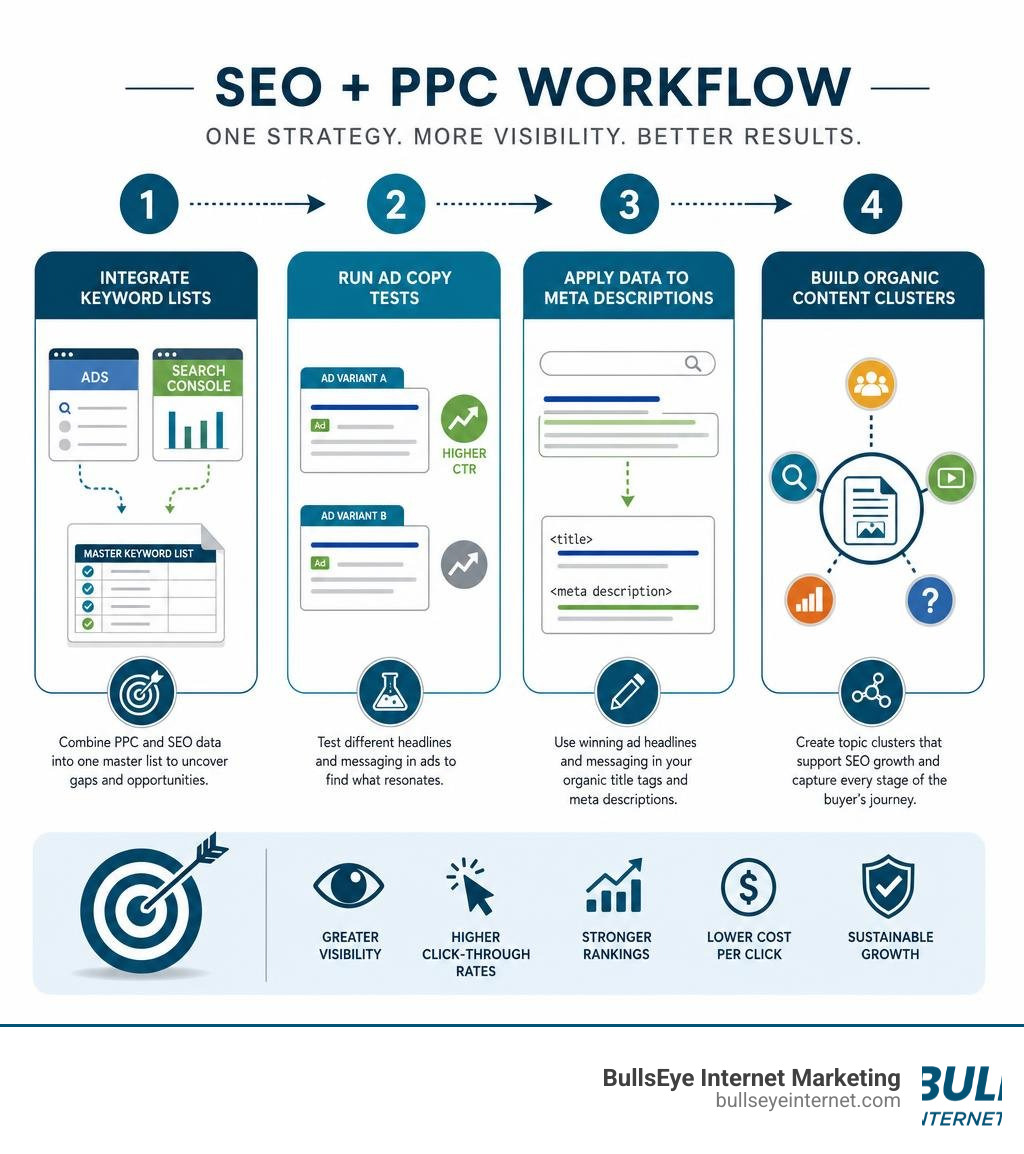
Ready to stop the turf war and align your channels? Here is our proven step-by-step framework to get your SEO and PPC strategies pulling in the same direction:
- Build a Shared Keyword List: Export your keyword data from Google Ads and Google Search Console into one master spreadsheet. Identify keywords where you have high ad spend but zero organic visibility, and vice versa.
- Separate Keywords by Funnel Stage: Map your keywords to the user’s buying journey. High-intent “buy now” keywords go to paid search; informational “how-to” keywords go to organic content creation.
- Run Ad Copy Tests for SEO: Use your paid ads to test different headlines and hooks. Once you find a variation that produces a high click-through rate (CTR), apply those exact headlines to your organic title tags and meta descriptions.
- Launch PPC Campaigns to Validate SEO Ideas: Before spending months trying to rank organically for a new keyword cluster, run a small, highly targeted PPC campaign for 30 days. If the traffic from those ads converts into actual leads or sales, you have validated that the keyword is worth your long-term SEO investment.
- Build Content Around PPC Winners: Take your highest-converting paid search terms and hand them to your content team to write comprehensive, high-quality landing pages and blog posts.
- Optimize the Landing Pages: Ensure these new organic pages are fast, mobile-friendly, and highly relevant. Once optimized, use them as the destination pages for your PPC ads to instantly boost your Quality Score and lower your CPC.
- Measure and Adjust: Monitor your combined ROI and blended CAC monthly. Adjust your budget dynamically based on which channel is delivering the most profitable leads.
Testing SEO Metadata with PPC Ad Copy
Writing the perfect title tag and meta description for SEO is often a guessing game. Because organic search takes months to show results, testing different variations to see which one gets the best click-through rate is incredibly slow.
PPC solves this problem instantly. You can set up an A/B test in Google Ads with two different headlines and run it for a week. The search engine will split-test the ads and give you clear, statistically significant CTR data. Once you know which headline wins, you can confidently write your organic title tag using that exact phrasing, knowing it is already proven to attract clicks.
Building Topic Clusters Around High-Converting Paid Keywords
Once your paid ads identify a keyword that brings in highly profitable customers, you shouldn’t just keep paying for those clicks forever. You want to own that search term organically.
To do this, build a “topic cluster” around that high-converting keyword. Create a main “pillar” landing page that is highly optimized for that term. Then, write several supporting blog posts that answer related, long-tail questions. Link all of these supporting posts back to your main pillar page. This internal linking structure signals to search engines that your site is a highly authoritative source on the topic, helping you secure top organic rankings and reduce your long-term PPC dependency.
Measuring Success and Avoiding Common Integration Mistakes
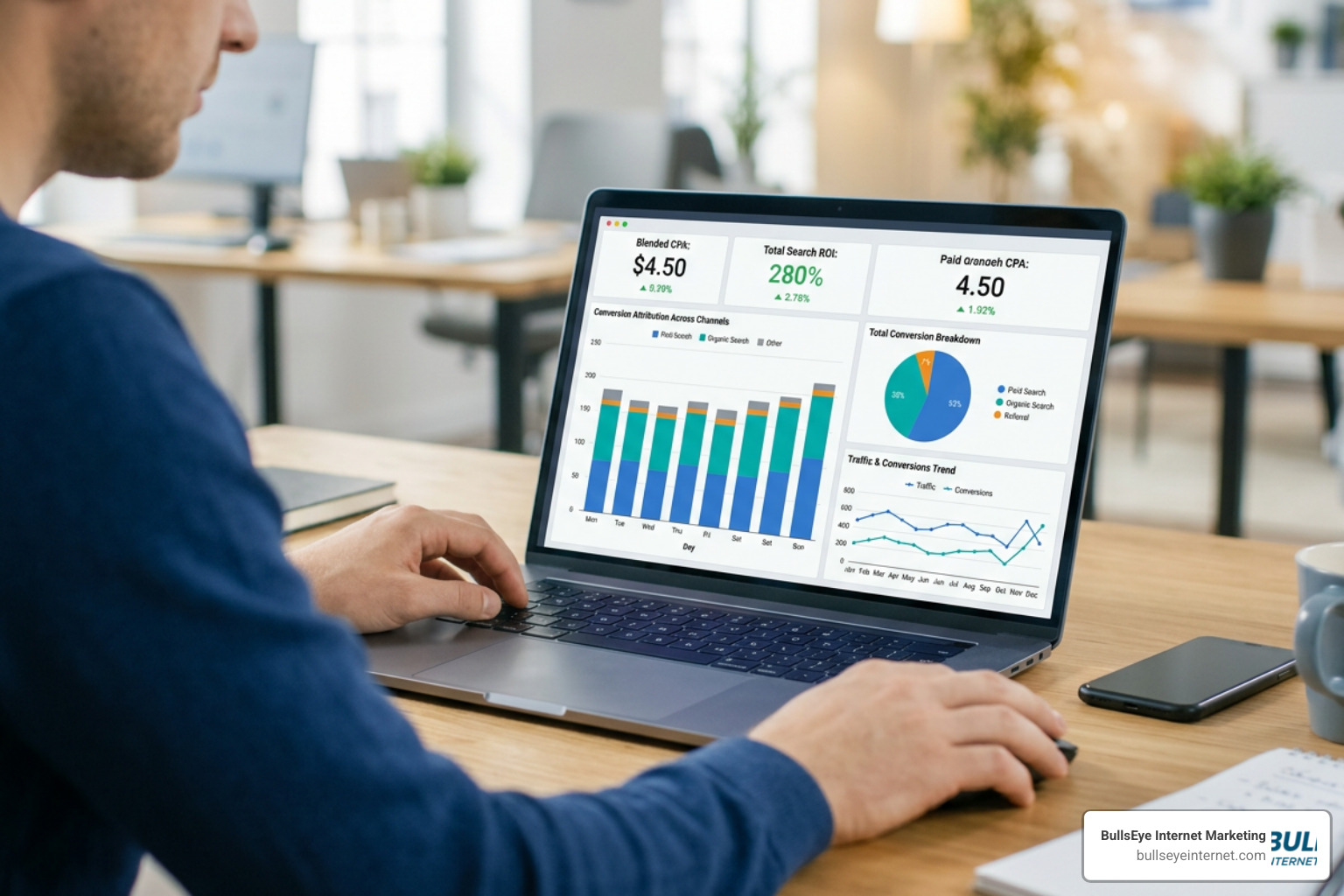
When you align your search channels, your reporting needs to change. You can no longer look at SEO rankings in one dashboard and Google Ads conversion rates in another. You need a unified view of your entire search engine presence.
To measure the true success of your integrated campaign, focus on these three primary metrics:
- Blended Cost Per Acquisition (Blended CAC): Calculate your total marketing spend (SEO efforts + PPC ad spend + management fees) and divide it by your total number of leads. This gives you an accurate picture of your actual acquisition costs.
- Total Search Share of Voice: Track how much total real estate you own on the SERPs for your core revenue-driving keywords.
- Combined Return on Investment (ROI): Measure the total revenue generated from both search channels against your total search marketing investment.
To ensure your organic foundation is strong enough to support your paid traffic, it is highly recommended to partner with a team that offers comprehensive Search Engine Optimization (SEO) Services.
Common Pitfalls in Combined Search Campaigns
Even with the best intentions, it is easy to make mistakes when managing these two complex channels together. Here are the most common pitfalls we see businesses make, and how to avoid them:
- Sending Paid Traffic to Weak Pages: Never point your paid ads at a generic homepage or a thin, unoptimized blog post. Always send paid traffic to highly relevant, fast-loading landing pages designed specifically for conversions.
- Keyword Stuffing SEO Content: In an attempt to rank organically for high-value paid terms, some businesses resort to keyword stuffing. This hurts your user experience, lowers your organic rankings, and damages your ad Quality Score. Write for humans, not search crawlers.
- Ignoring Negative Keywords: Failing to update your negative keyword list weekly is the fastest way to waste your PPC budget on irrelevant searches.
- Broken Conversion Tracking: If your Google Analytics 4, Google Tag Manager, or CRM tracking is broken, you are flying blind. Always audit your tracking setup before launching or scaling campaigns.
- Mobile Optimization Neglect: In 2026, the vast majority of local searches in South Florida occur on mobile devices. If your landing pages are not lightning-fast and incredibly easy to navigate on a phone, you are wasting your ad spend.
Frequently Asked Questions about Integrated Search
Does running PPC ads directly improve organic SEO rankings?
No. Running paid Google Ads does not directly improve your organic search rankings. Google’s organic search algorithms are completely separate from its paid advertising platform. Google prioritizes providing users with the most relevant organic results, and you cannot pay to influence those rankings.
However, PPC indirectly supports your SEO strategy in several powerful ways. It provides immediate keyword conversion data, allows you to split-test headlines for organic meta tags, and drives traffic to your site which can lead to natural backlinks, brand searches, and social shares—all of which positively impact your organic authority over time.
How do you allocate budget between SEO and PPC?
The ideal budget split depends on your business goals, industry competitiveness, and average cost-per-click.
- For New Businesses or Product Launches: We typically recommend a PPC-heavy split (e.g., 70% PPC / 30% SEO) to drive immediate traffic, generate quick cash flow, and gather conversion data.
- For Established Businesses: A more balanced split (e.g., 50% PPC / 50% SEO) is ideal to maintain immediate lead flow while aggressively building compounding organic authority.
- For High-CPC Industries: In highly competitive local markets where CPCs are extremely high, investing heavily in local SEO and Google Business Profile optimization is critical to offset rising paid acquisition costs.
What tools are best for managing combined SEO and PPC campaigns?
To manage combined campaigns effectively, we recommend using a unified stack of industry-standard tools:
- Google Ads & Google Search Console: The foundational platforms for tracking paid performance and organic search presence.
- Google Analytics 4 (GA4) & Looker Studio: Essential for building unified reporting dashboards that show your blended CAC and multi-touch conversion paths.
- SEMrush or Ahrefs: Invaluable for conducting keyword overlap analysis, tracking competitor paid and organic strategies, and identifying search intent gaps.
Conclusion
How to Choose Professional SEO PPC Management Services
Managing both SEO and PPC effectively is a full-time job. It requires daily monitor-and-adjust bid management, constant negative keyword pruning, ongoing content creation, and highly technical conversion tracking. For most business owners, trying to handle all of this in-house leads to wasted budget and missed opportunities.
When choosing a professional agency to manage your search presence, look for a partner that treats these channels as a single, unified system.
At BullsEye Internet Marketing, we do things differently. We specialize in generating actual calls and sales for our clients through a highly integrated mix of Pay Per Lead, Google Business Profile Optimization, SEO, PPC, and conversion rate optimization.
We believe in complete transparency and alignment with your business growth. That’s why we offer:
- No Long-Term Contracts: We earn your business month-to-month based on real, measurable results.
- Strict Industry Exclusivity: We work with only one client per industry per geographic area, giving you a massive, undivided competitive advantage in your local market.
Whether you are looking to dominate search in Miami, Fort Lauderdale, West Palm Beach, or anywhere across South Florida, we are here to help you stop the turf war and start growing your bottom line.
Ready to see how we can align your organic and paid search strategies for maximum ROI? Partner with us for integrated PPC management today, and let’s start compounding your search engine success.
