
Why So Many Startups Burn Cash Before Finding Customers
Marketing services for startups are the strategies, channels, and agency partnerships that help early-stage companies acquire customers, build brand awareness, and grow revenue — without burning through their runway.
Here are the most effective marketing services startups should know about:
| Marketing Service | Best For | Startup Stage |
|---|---|---|
| SEO & Content Marketing | Long-term organic growth | Early to Growth |
| PPC / Paid Ads | Fast, measurable customer acquisition | Seed to Series A |
| Social Media Marketing | Brand awareness & engagement | All stages |
| Conversion Rate Optimization | Turning traffic into customers | Growth stage |
| Email Marketing & Automation | Nurturing leads, reducing churn | All stages |
| Branding & Positioning | Differentiation & investor credibility | Pre-seed to Seed |
| Digital PR & Influencer Marketing | Trust-building & visibility | Growth stage |
Starting a business is hard. Getting customers is harder.
Most startups know they need marketing — but many don’t know where to start, what to spend, or who to trust. The result? Wasted budget, slow growth, and a shrinking runway.
The pressure is real. According to research, only 20% of surveyed startups have a dedicated marketing team. That means the other 80% are figuring it out as they go — often making expensive mistakes along the way.
Bad marketing decisions don’t just slow you down. They can kill a startup entirely.
This guide will help you cut through the noise, avoid the common traps, and find the right marketing partner for your stage.
I’m Ronnie Katz, founder of BullsEye Internet Marketing, and with over 20 years of experience delivering measurable results in SEO, PPC, lead generation, and more, I’ve helped businesses at every stage find the right marketing services for startups and established companies alike. In the sections ahead, I’ll walk you through exactly what to look for — and what to avoid.
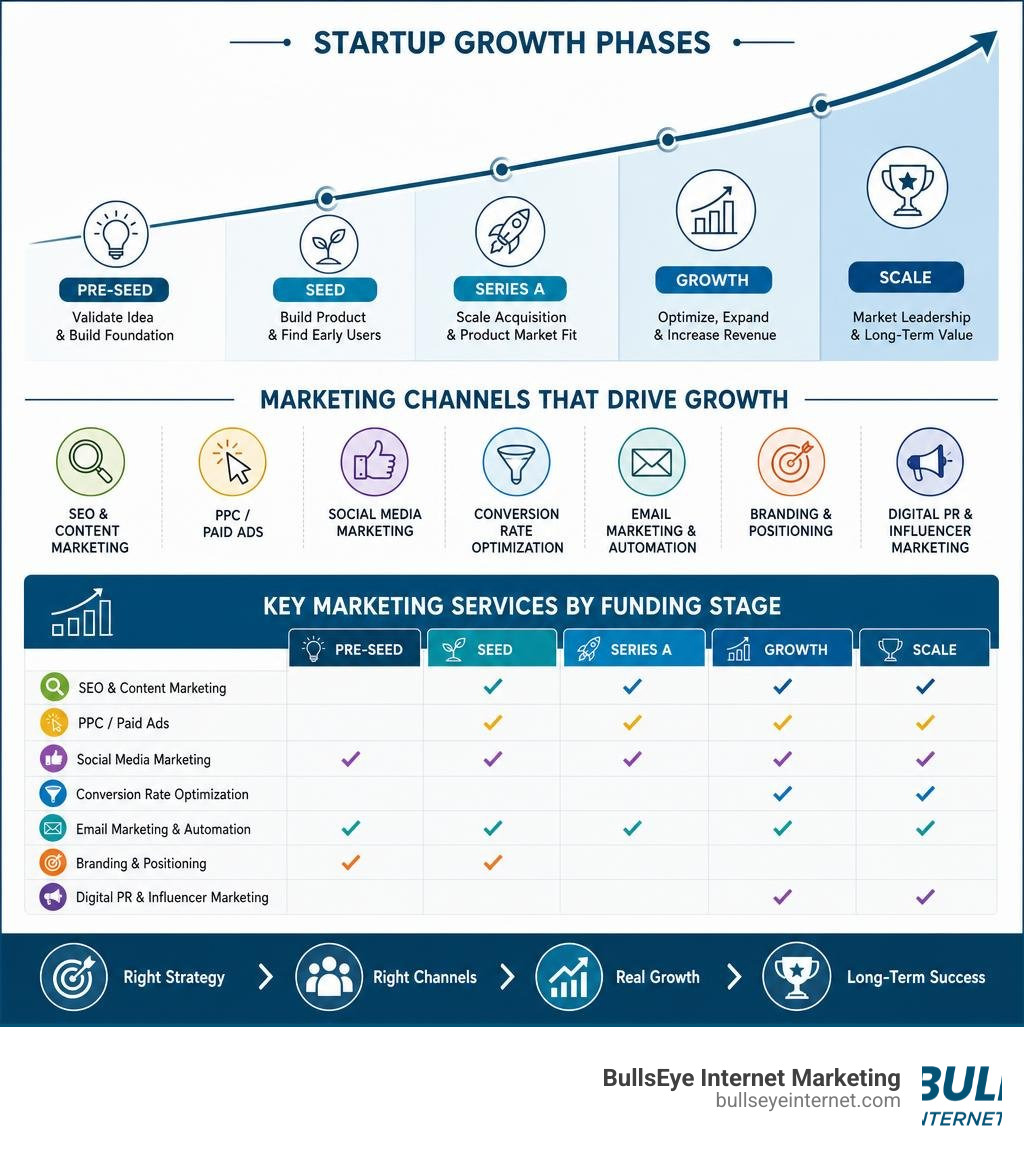
Marketing services for startups definitions:
The Real Cost of Bad Marketing Services for Startups
For an early-stage company, capital is oxygen. Every dollar spent must either extend your runway or accelerate your growth. Unfortunately, many founders fall into the trap of signing long-term retainer contracts with traditional agencies that promise the moon but deliver nothing but beautiful, useless slide decks.
When you invest in poor-quality marketing services for startups, the damage goes far beyond the monthly fee. You lose valuable time. In the startup world, a six-month delay in customer acquisition can mean the difference between raising your next round of funding or shutting down entirely. Consider this: only about 0.05% of startups overall manage to reach the coveted VC funding milestone. To put your business in that elite bracket, you cannot afford to waste 15% to 30% of your budget on agencies that operate in silos or rely on vanity metrics like “impressions” and “clicks” instead of actual calls and sales.
Common red flags of a bad marketing partner include:
- The Long-Term Lock-In: Demanding 6-month or 12-month commitments before proving they can generate a single lead.
- Lack of Transparency: Hiding actual ad spend behind bundled pricing or failing to provide real-time dashboard access.
- The “Bait-and-Switch”: Being pitched by senior executives, only to have your account handed off to an unsupervised junior intern.
- No Skin in the Game: Prioritizing deliverables (e.g., “we wrote 10 blog posts”) over business outcomes (e.g., “we generated 50 qualified demo sign-ups”).
To build a sustainable business, you must focus on metrics that matter to your bottom line and your investors. This means tracking Customer Acquisition Cost (CAC), Customer Lifetime Value (LTV), pipeline velocity, and return on ad spend (ROAS).

For B2B startups, building a robust lead generation engine early on is critical to surviving the pre-revenue phase. To learn more about tailoring your campaigns to other businesses, check out our guide on B2B Startup Marketing.
Critical Growth Channels: Early-Stage vs. Growth-Stage
As your startup moves from seed funding to Series A and beyond, your marketing priorities must evolve. What works when you are trying to find your first ten design partners will not work when you need to acquire hundreds of customers a month to satisfy your investors.

During the pre-seed and seed stages, your primary goal is finding product-market fit and validating your value proposition. You don’t need massive awareness campaigns; you need direct feedback from your ideal customer profile (ICP). At this stage, your marketing should focus on:
- Positioning and Messaging: Defining exactly who you are, what problem you solve, and why you are different.
- Foundational SEO: Setting up your technical SEO architecture and creating high-intent content so you are discoverable when buyers search for solutions to their problems.
- Targeted PPC: Running small, highly controlled paid search campaigns to validate search intent and test messaging.
Once you hit the growth stage (Series A and beyond), your focus shifts from validation to scale. This is where you optimize your funnel, lower your CAC, and diversify your channels. For a detailed breakdown of how to build this journey, see our guide on Seo For Startups Why New Businesses In Sebastian Need Professional Seo Services.
Organic Search and SEO as Core Marketing Services for Startups
Organic search is the ultimate compounding asset for a startup. Unlike paid ads, which stop delivering leads the moment you turn off the budget, a well-optimized SEO strategy continues to attract high-intent traffic month after month.
To build sustainable search visibility, startups must focus on three core pillars:
- Technical SEO: Ensuring search engines can easily crawl, index, and understand your website structure. This is especially critical for new domains that have yet to build domain authority.
- Problem-Based Content Strategy: Writing content that addresses the exact pain points your target buyers are searching for. Instead of writing generic industry articles, focus on “how-to” guides, comparison pages, and emerging category terms.
- Generative Engine Optimization (GEO): In 2026, discovery is rapidly shifting from traditional search engines to AI-driven platforms like ChatGPT, Claude, and Gemini. Optimizing your content so it is cited by these AI search engines is no longer optional — it is a primary requirement for early-stage tech companies.
To find vetted partners who specialize in these modern search strategies, you can explore directories such as the Top 40 Startup Digital Marketing Agencies in the United States – Clutch.
Paid Acquisition and Performance Marketing Services for Startups
Paid acquisition is like pouring rocket fuel on a validated marketing engine. When executed correctly, Pay-Per-Click (PPC) and paid social campaigns provide immediate traffic, rapid data accumulation, and measurable ROI.
However, running paid ads without a clear strategy is the fastest way to burn through your seed capital. Startups must pair their paid media campaigns with conversion rate optimization (CRO) and direct-response landing pages. If your website copy is confusing or your forms are too long, you are simply paying to send people to a page they will immediately abandon.
To maximize your paid budget:
- Start Small and Test: Allocate a modest budget to test channels like Google Ads, LinkedIn Ads, or Meta Ads before scaling.
- Target High-Intent Keywords: Focus on bottom-of-funnel search terms where buyers are actively looking to make a purchase decision.
- Optimize Daily: Monitor your campaigns closely to pause underperforming creatives and reallocate budget to high-performing audiences.
For a deeper dive into launching profitable paid campaigns, read our comprehensive resource on Advertising For Startups.
How to Choose the Right Marketing Partner
One of the most critical decisions a startup founder will make is choosing how to execute their marketing strategy. Should you hire a full-service agency, partner with a specialized boutique firm, or build an in-house team from scratch?
Each approach has distinct advantages and trade-offs:
| Marketing Model | Pros | Cons | Best For |
|---|---|---|---|
| In-House Team | Deep brand alignment, dedicated daily focus, agile execution | High overhead (salaries, benefits, equity), slow to hire, skill gaps | Core product positioning, daily social media, organic community building |
| Full-Service Agency | One point of contact, broad channel expertise, scalable resources | Higher monthly retainers, potential for “jack of all trades, master of none” | Growth-stage startups looking to scale multiple channels simultaneously |
| Specialized Agency | Deep technical expertise in a specific channel (e.g., SEO, PPC), fast onboarding | Requires managing multiple vendors, coordination overhead | Startups with clear, specific channel goals (e.g., scaling paid search) |
Many founders find success by starting with a hybrid model: outsourcing highly technical execution (like technical SEO and PPC management) to an agile agency partner while keeping core brand strategy and product messaging in-house.
To explore different frameworks for structuring your campaigns, take a look at A Comprehensive Guide To Startup Advertising Strategies.
Evaluating Agency Track Records and Pricing Models
When interviewing potential marketing partners, you must look past the flashy pitch decks and look at the actual data. Ask for verifiable case studies with clear, bottom-of-funnel metrics. An agency that boasts about “increasing traffic by 300%” is irrelevant if that traffic didn’t convert into qualified leads or sales.
You should also look for modern, flexible pricing models. Traditional agency retainers often incentivize activity (writing reports, attending meetings) rather than performance. Startups should look for partners that offer transparent, flat-fee pricing, project-based sprints, or performance-aligned models.
If you are a startup operating in South Florida, finding a local partner who understands your geographic target area can give you a massive competitive advantage. You can research regional agency rankings and reviews on platforms like THE BEST 10 Marketing in MARTIN COUNTY, FL – Yelp.
Aligning Marketing Strategy with Investor Expectations
If your goal is to raise venture capital, your marketing cannot exist in a vacuum. Your campaigns must directly support the growth story you plan to tell investors during your next fundraising round.
Venture capitalists look for clear indicators of traction, market demand, and capital efficiency. When evaluating your startup, they will look closely at:
- CAC-to-LTV Ratio: Is your customer acquisition model sustainable and profitable at scale?
- Month-over-Month Growth: Are you demonstrating consistent, predictable revenue expansion?
- Brand Authority and Reputation: Does your business own its category, and do buyers trust your brand?
To protect and elevate your market standing before entering a fundraising cycle, read our complete guide on Brand Reputation Management For Startups A Complete Guide.
Frequently Asked Questions about Startup Marketing
What are the most common marketing challenges startups face?
The most common marketing challenges startups face are limited budgets, lack of in-house expertise, and the pressure to scale rapidly. Because founders often wear multiple hats, they try to execute too many marketing channels simultaneously. This dilutes their focus and causes them to burn through capital without mastering a single channel. Successful startups focus on one or two high-performing channels, validate their strategy, and only then expand to new platforms.
How do startups measure the ROI of their marketing efforts?
Startups measure marketing ROI by tracking Customer Acquisition Cost (CAC), Customer Lifetime Value (LTV), and return on ad spend (ROAS). It is vital to use proper attribution models to understand which channels are driving actual sales, rather than just generating traffic. For B2B startups, measuring pipeline velocity — how quickly a lead moves from initial contact to a closed deal — is also a critical metric for evaluating marketing effectiveness.
What is the difference between growth marketing and traditional marketing?
Traditional marketing focuses primarily on top-of-funnel brand awareness, public relations, and broad reach. Growth marketing, on the other hand, is highly data-driven and focuses on the entire customer journey — from acquisition and activation to retention and referral. Growth marketers use rapid experimentation, A/B testing, and continuous optimization to find the most cost-effective ways to scale a business.
Achieving Sustainable Startup Growth with BullsEye Internet Marketing
Finding the right marketing services for startups doesn’t have to be a gamble. By avoiding long-term, restrictive contracts and focusing on measurable, bottom-of-funnel metrics, you can build a highly efficient customer acquisition engine that extends your runway and satisfies your investors.
At BullsEye Internet Marketing, we do things differently. We believe that startups shouldn’t be forced to sign long-term contracts for services that haven’t proven their value yet. That is why we offer flexible, no-contract arrangements built entirely around performance.
Even better, we provide a true competitive advantage by working with only one client per industry per geographic area. Whether you are scaling a local service business in West Palm Beach, Miami, Fort Lauderdale, or anywhere across South Florida, we make sure your competitors are locked out of our top-tier search engine optimization, Google Business Profile optimization, and high-converting PPC services.
Ready to stop wasting capital on bad marketing and start generating real calls and sales? Explore BullsEye Internet Marketing Services today and let’s discuss how we can scale your business together.
