
Why Your Website Needs More Than a Surface-Level Check
A strategic site audit is a comprehensive, data-driven examination of your website that goes far beyond checking if pages load correctly. It’s a systematic evaluation of your site’s technical health, content quality, user experience, and competitive positioning—all designed to uncover what’s holding your business back from getting more calls, leads, and sales.
Here’s what a strategic site audit evaluates:
- Technical Performance – Site speed, mobile responsiveness, broken links, and crawlability issues
- SEO Health – Keyword rankings, on-page optimization, backlink quality, and indexation status
- Content Quality – Relevance, engagement metrics, and gaps in your content strategy
- User Experience – Navigation, conversion paths, and interface design effectiveness
- Competitive Position – How your site stacks up against competitors in your market
- Conversion Optimization – CTAs, forms, and the friction points losing you customers
If your website isn’t driving the results you need despite your marketing efforts, you’re not alone. Up to 88% of users are less likely to return to a website with a poor user experience. Worse, 40% of visitors will leave for another website if yours takes more than three seconds to load. These aren’t just statistics; they’re potential customers walking away.
Most business owners know something is wrong when their phone isn’t ringing or inquiry forms sit empty. But without a strategic audit, you’re flying blind. You might be pouring money into ads that send traffic to slow-loading pages. Your content might be targeting the wrong keywords. Your mobile experience could be driving away most of your visitors (just under 55% of all global traffic is on mobile devices).
A strategic site audit gives you clarity. It shows you where you’re losing money, which fixes will have the biggest impact, and how to prioritize improvements that drive real business results, not just vanity metrics.
I’m Ronnie Katz, founder of BullsEye Internet Marketing, and I’ve been conducting strategic site audits for businesses since 2006. Through thousands of audits, I’ve learned that the businesses that win online aren’t those with the biggest budgets—they’re the ones who understand what’s broken and fix it strategically.
The Anatomy of a Comprehensive Website Audit
A comprehensive website audit is like a full physical for your digital storefront. It’s an in-depth assessment of how your website strategy aligns with your business objectives. The goal is to clarify how well your site attracts and engages your audience, guiding performance improvements. A website isn’t a static brochure; it’s a dynamic environment designed to guide visitors toward conversions.
While there are many types of website audits, a strategic site audit focuses on eight essential areas:
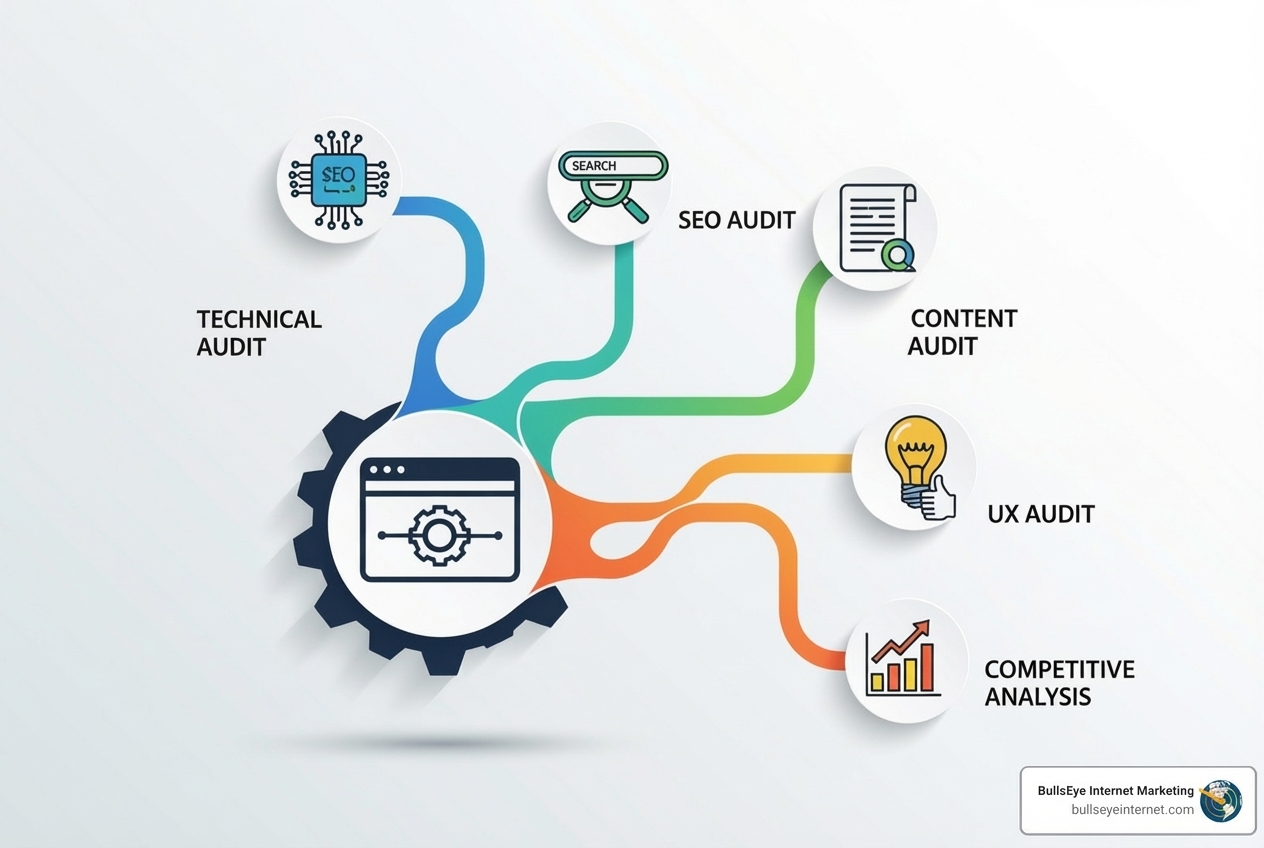
- Technical Audit: Ensures the website’s infrastructure is sound for search engines and users.
- SEO Audit: Optimizes visibility and ranking in search engine results.
- Content Audit: Evaluates the quality, relevance, and effectiveness of website content.
- UX/UI Audit: Focuses on user experience and interface design for engagement and conversions.
- Competitive Audit: Analyzes competitor strategies and performance.
- CRO Audit: Identifies opportunities to improve conversion rates.
- Social Media Audit: Assesses social presence and its impact on website traffic.
- Data Privacy Audit: Verifies compliance with privacy laws and user data protection.
Technical & SEO Audit Components
Your website’s technical foundation is the bedrock of its online success. If this foundation is shaky, other marketing efforts will struggle. A technical and SEO audit digs into your site’s mechanics to ensure it’s findable by search engines and usable by visitors.
- Site Speed: This is non-negotiable. 40% of visitors will leave for another website if yours takes more than three seconds to load. Google confirmed site speed as a ranking factor back in 2010. We look at Core Web Vitals like Largest Contentful Paint (LCP), Interaction to Next Paint (INP), and Cumulative Layout Shift (CLS) to diagnose and improve performance.
- Mobile Responsiveness: With just under 55% of all global traffic on mobile devices, and Google’s shift to mobile-first indexing completed in 2023, your mobile experience is critical. We ensure your site renders perfectly and functions flawlessly across all devices.
- Broken Links: While Google doesn’t penalize for a few broken links, they are still bad for user experience. We identify and fix 404 errors, ensuring users and search engines can steer your site without hitting dead ends.
- Crawlability & Indexability: Can search engines find and understand all your important pages? We examine your
robots.txtfile, XML sitemaps, and server responses to ensure crawlers can access and index your content efficiently. Many sites have 50-75% more indexed pages than expected due to these issues. - Backlink Profile: Backlinks are a vote of confidence from other websites. The top result in Google often has nearly four times more backlinks than pages in positions 2-10. We analyze your backlink quality and quantity, identifying opportunities for link building and spotting toxic links that could harm your SEO.
- On-page SEO Elements: This includes optimizing title tags, meta descriptions, headings, image alt text, and URLs. We ensure each page clearly communicates its topic to users and search engines. For a deeper dive, check out our page on Website SEO Audit.
Content & UX/UI Audit Components
With a solid technical foundation, we turn to the user experience. This involves analyzing your content and how people interact with it.
- Content Quality & Relevance: Does your content address your audience’s current needs? Is it informative, engaging, and unique? We assess content for relevance, engagement, and alignment with audience needs. This includes identifying content gaps, outdated information, and optimization opportunities. Google’s “information gain score” rewards content that offers new value, helping it rank better.
- User Engagement: How sticky is your website? Are users spending time on your pages or bouncing away? The average website engagement rate is around 55%. We use metrics like time on page and navigation patterns to understand user behavior.
- User Interface (UI) Assessment: We evaluate your website’s visual appeal, navigation, and overall aesthetic. This includes checking visual hierarchy, brand consistency, and the quality of imagery and video.
- Conversion Paths & Calls-to-Action (CTAs): Are users easily guided toward conversion? We scrutinize lead generation forms, checkout processes, and the clarity of your calls-to-action. We ensure your CTAs are visible, compelling, and easy to click on all devices.
- Website Navigation: An intuitive navigation menu is crucial. We assess if it’s simple, logical, and helps users find what they need quickly. Internal links are key, guiding users to relevant content and signaling authority to search engines.
- Readability: Is your content easy to consume? We check for clear language, short paragraphs, proper headings, and white space to ensure a pleasant reading experience.
Many of these issues are common, and we’ve helped many clients fix them. Learn more about common issues in our Top 7 Website Issues We Catch in a Free SEO Audit and How to Fix Them.
Competitive & Strategic Audits
Knowing your own strengths and weaknesses is only half the battle. A strategic site audit must include a competitive analysis to understand your market position and find growth opportunities.
- Competitor Benchmarking: We analyze competitor websites in your specific geographic area, like South Florida or Miami-Dade County. This includes their design, messaging, SEO performance, and content marketing. What are they doing well? Where are their weaknesses?
- Strategic Insights: A SWOT analysis of your competitors can uncover unique opportunities for your business. They might be missing key content, have slower site speeds, or a poor user experience. These insights help us craft strategies to differentiate your business and capture market share.
- Market Positioning & Identifying Opportunities: We assess how your messaging and offerings compare to competitors. Does your site clearly articulate your unique value proposition? Are there gaps in their offerings that you could fill?
- Content Gap Analysis: We identify topics and keywords your competitors rank for that you don’t. This helps create a roadmap for new content to attract more qualified leads.
- SEO Performance Comparison: We use advanced tools to compare your keyword rankings, organic traffic, and backlink profile against top competitors. This data is crucial for understanding where you stand and how to climb the search rankings.
For businesses in competitive markets, leveraging these insights is paramount. Read more about Conducting an Enterprise SEO Audit to see how we approach larger-scale projects.
Your Step-by-Step Guide to a Strategic Site Audit
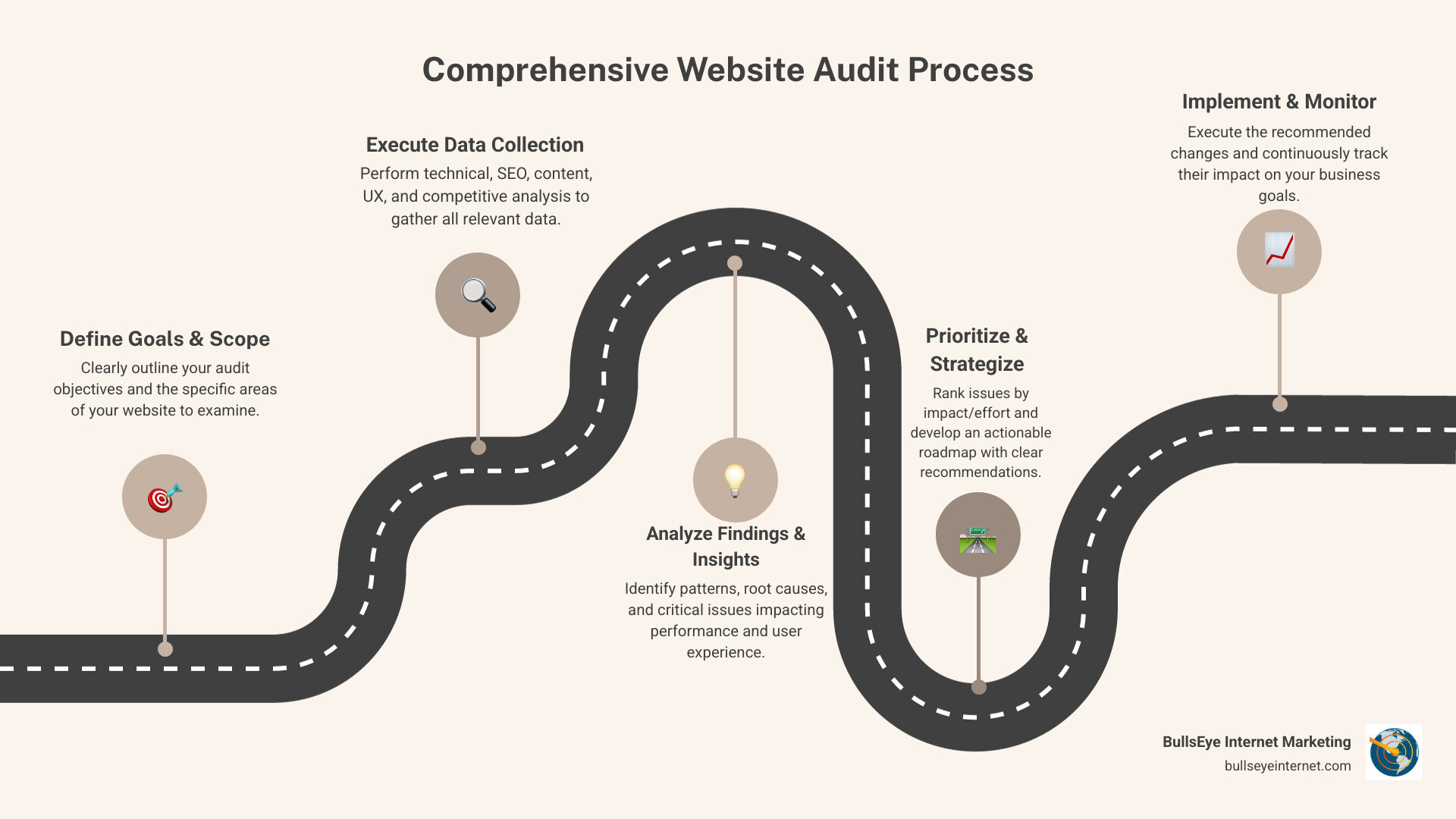
A strategic site audit is a planned process designed to provide actionable solutions. Our methodology ensures we uncover critical details, translate data into insights, and deliver a roadmap for improvement.

Phase 1: Goal Setting & Essential Tool Selection
Before touching any tools, we start by understanding your goals. What do you want your website to achieve? More calls? More form submissions? Higher quality leads? Clear objectives are the first step in a successful audit.
- Defining Objectives: We work with you to establish SMART goals for the audit. This could be improving local search rankings in Hollywood, Florida, or increasing conversion rates on a service page.
- Setting Scope: Based on your objectives, we determine the audit’s scope. Are we focusing on site-wide technical SEO or the UX of a specific conversion funnel?
- Essential Tools: To execute a thorough audit, we use a suite of powerful tools:
- Google Analytics (GA4): For understanding user acquisition, behavior, and conversions. We recommend analyzing six to twelve months of data to account for seasonality, like accounting firms in Miami Beach seeing more traffic during tax season.
- Google Search Console: Essential for monitoring crawl errors, indexation status, and search queries. It’s an underused tool by many marketers.
- Screaming Frog: A powerful site crawler for technical SEO issues like broken links and redirects.
- Hotjar: For visual insights into user behavior through heatmaps and session recordings.
- Semrush: A comprehensive SEO suite for site audits, keyword tracking, and competitive research.
- Other valuable tools include Google PageSpeed Insights, Ahrefs, and Schema Validator.
Phase 2: Executing Your Strategic Site Audit
With goals defined and tools ready, we begin execution, systematically collecting and analyzing data.
- Data Collection: We gather relevant data from our tools, covering traffic, user behavior, technical performance, and SEO metrics.
- Key Metrics: We focus on metrics like organic traffic, engagement rate, conversion rate, page load times, and keyword rankings.
- Technical Analysis: Here, we run a technical audit to find site errors, slow pages, or crawling and indexing issues. We check for broken links, security vulnerabilities (HTTPS), and overall performance.
- SEO Assessment: We analyze keyword rankings, on-page elements, and your backlink profile. We ensure your important pages target the right keywords and your site’s structure supports SEO best practices.
- Content Evaluation: We review content for relevance, engagement, and alignment with audience needs. We look for outdated content, optimization opportunities, and assess if your content provides “information gain.”
- UX Testing: We evaluate user experience by analyzing behavior with tools like Hotjar, assessing navigation, conversion paths, and mobile experience. This includes ensuring your website is accessible to users with disabilities. Navigating the site ourselves also reveals non-functional or overlooked UX elements.
- Competitive Review: We compare your website to top competitors, analyzing their strategies to find opportunities for your business.
Phase 3: Analyzing Findings from Your Strategic Site Audit
Raw data is just numbers until translated into meaningful insights. In this phase, we connect the dots, identify root causes, and prepare actionable recommendations.
- Identifying Patterns: We look for recurring issues, significant metric changes, and correlations between data points. For example, a drop in organic traffic might correlate with a Google update or new crawl errors.
- Root Cause Analysis: We don’t just point out problems; we dig deeper to understand the cause. Is slow page speed due to unoptimized images or server issues? Understanding the root cause is crucial for effective solutions.
- Data Points: We analyze a wide array of data, including:
- Traffic Sources: Where are your users coming from?
- Engagement Metrics: Bounce rate, time on page, pages per session.
- Conversion Rates: How effectively are visitors converting?
- Keyword Rankings: Performance of target keywords.
- Technical Health Scores: Performance, SEO, and mobile ratings.
- User Behavior Data: Heatmaps and session recordings.
- Translating Insights: The goal is to provide a clear understanding of your website’s current state and its impact on your business. This phase culminates in a report outlining our findings, their severity, and their potential business impact. For local businesses, this analysis includes how the website impacts your Google Business Profile Performance, which is vital for local search visibility in areas like Miami or Fort Lauderdale.
From Insights to Impact: Creating Your Actionable Roadmap
The value of a strategic site audit is turning insights into a clear, actionable roadmap for improvement. We help you prioritize fixes and develop a strategy aligned with your long-term business goals.
Prioritizing Findings and Building a Strategic Roadmap
Once we understand your website’s strengths and weaknesses, we prioritize action. Not all issues have the same impact or require the same effort.
- Impact vs. Effort Matrix: We use an impact vs. effort matrix to prioritize. This helps identify “quick wins” (high impact, low effort) for immediate results, and larger projects (high impact, high effort) that promise significant returns.
- Creating Action Items: Each finding becomes a specific, measurable action item. For example, instead of “fix slow pages,” an action item is “optimize images on product pages by compressing to WebP format.”
- Assigning Ownership & Setting Timelines: We assign ownership for each action item and set realistic timelines.
- Document Everything: We document all findings, solutions, and action plans. This ensures insights are communicated, acted upon, and measured, preventing them from being forgotten. This documentation is a living guide for your digital strategy.
Our SEO Audits are designed to give you this exact level of detail and strategic direction.
Integrating the Audit into Your Long-Term Business Goals
A website audit isn’t a one-off event. It’s part of a continuous improvement process, aligning digital assets with your business objectives.
- Continuous Improvement: The digital landscape is always evolving with new Google updates and changing user behaviors. Regular audits are essential to stay competitive and keep your website optimized.
- Aligning with KPIs: We ensure improvements from the audit are tied to your key performance indicators (KPIs). For example, to increase leads in Pembroke Pines, Florida, we’ll track conversion rates on contact forms and website call volume.
- Measuring ROI: We help you measure the ROI for each implemented change. This data-driven approach shows the tangible impact on your business growth, such as a significant boost in organic traffic or a drop in cart abandonment after improvements.
- Fostering a Data-Driven Culture: The audit process encourages a data-driven culture of continuous learning and optimization to drive real results. Our Audit Service is built on this philosophy.
Frequently Asked Questions about Website Audits
How often should you perform a website audit?
While there are no hard-and-fast rules, we recommend a comprehensive strategic site audit at least annually. For competitive markets or businesses with significant website changes, biannual or quarterly checks are better.
The frequency depends on several factors:
- Business Changes: Launching new products, expanding into new areas (like Doral or Kendall), or major marketing campaigns.
- Website Updates: Major content overhauls, platform migrations, or new features.
- Algorithm Updates: A significant Google update may require an immediate audit.
- Performance Drops: A sudden drop in traffic, rankings, or conversions is a clear signal an audit is needed.
The goal is continuous optimization, ensuring your site performs at its peak and adapts to digital trends.
Should you conduct an audit in-house or hire a specialist?
This depends on your internal resources, expertise, and website complexity.
- In-house Audit (Pros):
- Cost-effective: Can save on external fees.
- Internal Knowledge: Your team understands your business and audience.
- Faster Implementation: Direct control over fixes.
In-house Audit (Cons):
- Lack of Expertise: Technical SEO and advanced analytics require specialized skills many in-house teams lack.
- Bias: Internal teams might overlook issues due to familiarity.
- Resource Drain: A comprehensive audit is time-consuming and pulls resources from other tasks.
- Limited Tools: Advanced SEO and analytics tools can be expensive.
Hiring a Third-Party Specialist (Pros):
- Objectivity: An external team provides an unbiased assessment, free from internal politics or assumptions.
- Specialized Expertise: Agencies like BullsEye Internet Marketing have dedicated experts in technical SEO, content strategy, UX, and CRO.
- Advanced Tools: We invest in powerful SEO and analytics tools for deeper insights.
- Efficiency: Specialists conduct thorough audits faster, with a clear process.
- Strategic Recommendations: We identify problems and provide prioritized, actionable recommendations for your business goals.
For most businesses, outsourcing the audit to specialists yields the best results. Our Website Audit Service provides that external expertise.
What are the key benefits of a comprehensive website audit?
The benefits of a comprehensive strategic site audit directly impact your bottom line.
- Improved SEO Rankings: By fixing technical issues, optimizing content, and strengthening your backlink profile, an audit boosts search engine visibility. This means more organic traffic from customers in places like Coral Gables or Sunny Isles Beach.
- Improved User Experience: A smooth, fast website keeps visitors engaged. Fixing slow load times, improving navigation, and ensuring mobile responsiveness means users are more likely to convert. 88% of users won’t return to a site with a poor user experience.
- Higher Conversion Rates: By optimizing conversion paths and CTAs, an audit turns more visitors into leads and customers. This directly impacts your revenue.
- Data-Driven Decisions: The audit provides concrete data, allowing you to make informed decisions about your marketing investments.
- Competitive Advantage: By understanding competitors’ strategies and weaknesses, you can position your business to outperform them.
- Increased ROI: These benefits lead to a better ROI on your marketing investments. You’re investing in growth that generates more calls, leads, and sales.
Conclusion: Making Audits a Cornerstone of Your Digital Strategy
In today’s digital landscape, your website is often a potential customer’s first impression of your business. A strategic site audit is a necessity for any business looking to thrive online. It’s the health check that ensures your digital storefront is optimized to attract, engage, and convert customers.
We’ve explored how a comprehensive audit digs into technical foundations, SEO, content, user experience, and competitive positioning. We’ve highlighted the importance of translating data-driven insights into a prioritized, actionable roadmap.
At BullsEye Internet Marketing, we believe fixing what’s broken strategically is the key to winning online. Our expertise in generating calls and sales means we know how to turn audit findings into tangible business results for our clients across Florida, the US, Canada, and the UK. We offer no long-term contracts and work with only one client per industry per area, ensuring you have a competitive advantage.
Don’t let your website underperform. Take the first step towards a more successful online presence.
