
Why LLM Optimization Strategies Are Reshaping Digital Marketing
LLM optimization strategies are the new playbook for getting your brand found — not just on Google, but inside AI-powered answers from ChatGPT, Gemini, Perplexity, and beyond.
If you want the quick answer, here it is:
Core LLM Optimization Strategies at a Glance
| Strategy | What It Does |
|---|---|
| GEO-ready content structure | Formats content so AI systems can extract and cite it |
| Entity signal stacking | Builds consistent brand identity across the web |
| Offsite footprint expansion | Earns mentions on Wikipedia, Reddit, Quora, and news sites |
| Technical accessibility | Ensures AI bots can crawl and read your site |
| Content freshness | Keeps pages updated so AI prioritizes your content |
| RAG integration | Connects AI responses to accurate, up-to-date sources |
| Visibility tracking | Measures citations, mentions, sentiment, and position |
Search is changing fast. Traditional SEO was about ranking on page one. Today, millions of users ask AI tools a question and get a direct answer — no click required. In fact, research suggests 93% of AI Mode sessions end without a user ever visiting a website.
That means if your brand isn’t being cited by AI, you’re invisible to a growing share of your audience.
This shift has a few names: Generative Engine Optimization (GEO), Answer Engine Optimization (AEO), or AI Optimization (AIO). Whatever you call it, the goal is the same — become the source AI systems trust and quote.
And it’s not just about content. LLM optimization also covers the technical side: how efficiently AI models run in production, how accurately they respond, and how well they handle real-world workloads at scale. Whether you’re a marketer trying to win AI citations or a developer managing inference costs, optimization matters.
I’m Ronnie Katz, founder of BullsEye Internet Marketing, and with over 20 years of experience in SEO, AEO, and GEO, I’ve been helping businesses stay ahead of every major search shift — including LLM optimization strategies that drive real calls and conversions. In this guide, I’ll break down exactly what you need to do to stay visible in the age of AI.
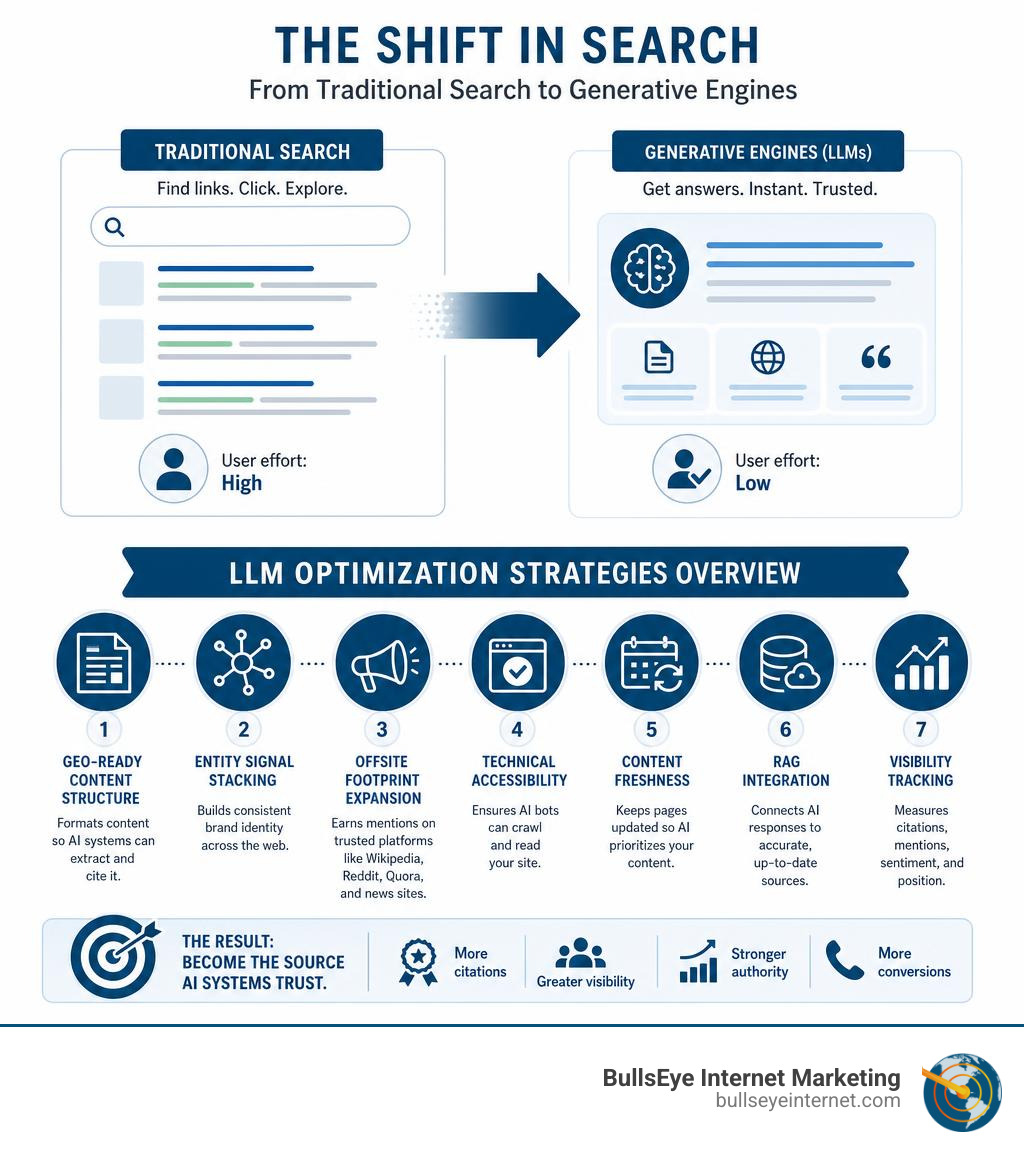
LLM optimization strategies terms explained:
Understanding LLM Optimization vs. Traditional SEO
To win in this new landscape, we must first understand how search engines and large language models (LLMs) differ under the hood. Traditional search engines are built on index-based retrieval. They crawl the web, index pages based on keywords, and use complex algorithms to rank those pages in a list of blue links.
LLMs, on the other hand, operate on token-based prediction. They don’t just point users to a page; they synthesize information from across their training data and real-time retrieval sources to generate a conversational response.

This fundamental shift changes how authority and trust are measured:
- Traditional SEO relies heavily on link authority (backlinks, PageRank) and keyword density.
- LLM Optimization prioritizes brand mentions, entity clarity, and context. AI models care about whether your brand is consistently associated with a specific topic across high-authority, unbiased platforms.
Furthermore, traditional search engines rely on real-time indexing of the entire web. While LLMs have training cutoff dates, modern AI search engines use Retrieval-Augmented Generation (RAG) to pull real-time data from search indexes and feed it directly into the LLM prompt. This means having your content structured for easy RAG extraction is critical.
To help visualize these differences, let’s look at a direct comparison:
| Feature | Traditional SEO | LLM Optimization (GEO/AEO) |
|---|---|---|
| Primary Goal | Rank in the top 10 blue links | Win AI citations and brand mentions inside generative answers |
| Core Technology | Index-based search & PageRank | Token-based synthesis & Retrieval-Augmented Generation (RAG) |
| Authority Signal | Backlink profiles and domain authority | Entity consistency, brand mentions, and unbiased citations |
| User Experience | Multi-click journey to find answers | Zero-click experiences with direct, synthesized answers |
| Indexing Speed | Near real-time via search crawlers | Dependent on model training cycles and RAG retrieval windows |
For a deeper dive into adjusting your strategy, check out our LLM SEO Best Practices Guide and explore how AI is redefining search in this AI & LLM SEO Guide.
Strategic Campaign Planning and EEAT Assessment
Planning a GEO campaign requires a different lens than traditional keyword research. We start with topic identification and prompt clustering. Instead of targeting “high-volume keywords,” we analyze the conversational prompts users type into ChatGPT or Gemini. We group these prompts into intent clusters to understand the exact questions our audience is asking.
Next, we run a rigorous EEAT (Experience, Expertise, Authoritativeness, Trustworthiness) and YMYL (Your Money or Your Life) assessment. LLMs are highly sensitive to credibility signals. If your content deals with financial, legal, or medical topics, the AI will actively filter out unverified sources.
During our competitor analysis, we don’t just look at who ranks on Google. We test target prompts inside different LLMs to see which brands are currently being cited and why. Are they getting cited because of a unique statistic? A comprehensive FAQ? An authoritative Wikipedia page? Understanding these citation triggers is the key to outmaneuvering them. To get your site ready, we recommend starting with our LLM SEO Audit Best Practices to uncover hidden gaps in your current setup.
Onsite and Offsite LLM Optimization Strategies
Optimizing for LLMs is a two-front war: what you do on your own website (onsite) and how your brand is represented across the rest of the web (offsite).

Onsite optimization ensures that AI bots can easily crawl, parse, and extract your content. Offsite optimization builds the digital footprint that tells the LLM your brand is a trusted authority in your space. Let’s look at how to execute both effectively, leveraging insights from A Practical Guide to LLM SEO Strategies and these LLM Optimization: 9 Strategies.
Onsite Content Structuring and FAQ Integration
To make your onsite content highly “citation-worthy” for AI engines, structure is everything. LLMs love structured, easily digestible data. Here are the core onsite techniques we implement:
- Q&A Formatting and Answer Blocks: Lead your core sections with a concise, 40-to-60-word direct answer block. This is the optimal length for an LLM to pull as a direct quote or summary.
- Question-Based Headings: Use H2 and H3 tags styled as natural language questions (e.g., “What are the best LLM optimization strategies for local businesses?”).
- JSON-LD Schema Markup: Implement advanced schema, specifically using the
knowsAboutproperty within your Organization schema, and Person schema for your authors to explicitly define your expertise to AI crawlers. - Content Refresh Cycles: LLMs prioritize fresh information, especially for rapidly evolving topics. In fact, pages updated within the last 2 months earn up to 28% more AI citations. Regularly updating 10% to 15% of your high-performing content keeps it relevant to RAG systems.
By structuring content this way, you make it incredibly easy for an AI model to extract your text. Discover how to write content that machines love to read in our guide: Speak the AI’s Language: Optimizing Content for Large Language Models.
Offsite Footprint Expansion and Entity Signal Stacking
You cannot win the LLM game by only optimizing your website. Because LLMs are trained on massive datasets, they look for consensus across the web. If your website says you are an expert, but no other platform mentions you, the LLM will doubt your authority.
To build a robust offsite footprint, we focus on entity signal stacking:
- Wikipedia and Wikidata: These are the holy grail of LLM training data. Ensuring your brand has a neutral, well-sourced Wikidata entry or Wikipedia mention dramatically boosts your entity authority.
- Reddit and Quora: AI engines frequently retrieve real-time discussions from forums to answer subjective queries. Engaging in active, unbiased discussions on these platforms ensures your brand is mentioned where users are looking.
- PR and News Distribution: High-quality, authoritative news mentions act as strong validation signals for LLMs.
- Consistent NAP (Name, Address, Phone): For local businesses in Florida, from Fort Lauderdale to Lake Worth, maintaining identical business descriptions and contact details across directories is vital. Consistent entity information across the web can increase your LLM citation probability by up to 40%.
For tactical workflows on creating content that naturally earns these offsite signals, read Write Smarter Not Harder: LLM Content Creation Strategies.
Measuring LLM Visibility and Tracking Performance
You cannot manage what you do not measure. In traditional SEO, we track keyword rankings and organic traffic. In LLM optimization, we track citations, brand share of voice, and sentiment.
Because AI search engines synthesize answers, we use a specialized tracking framework to measure performance:
- Mentions: How often is our brand named in the generated response?
- Citations: Does the AI link back to our website as a source? (Being the “Footnote of Truth” is the ultimate goal).
- Sentiment: Is the AI discussing our brand in a positive, neutral, or negative light?
- Position: Where does our brand appear in the response? Are we the first recommended option or an afterthought?
- LLM Visibility Score: We combine these metrics into a single score to benchmark our performance against competitors over time.
By tracking these metrics, we can see exactly which content pieces are driving AI citations and where we need to adjust our strategy. To learn how we build these reporting frameworks for our clients, explore the LLM SEO Services Ultimate Guide.
Navigating Agentic Traffic and AI Bot Crawling
As we look at the digital landscape in 2026, we are seeing a massive rise in agentic traffic. This refers to traffic generated by autonomous AI agents—like specialized web bots or personal AI assistants—crawling your site to gather information on behalf of a user.
This has led to a rise in zero-click experiences, where the user gets their complete answer directly within ChatGPT or Gemini without ever clicking through to your website.
To capitalize on this, we must optimize our sites to be easily crawled by these agents:
- Robots.txt Configuration: Ensure your robots.txt file does not accidentally block major AI crawlers (like GPTBot, ClaudeBot, or Google-Extended) unless you have a specific strategic reason to do so.
- Bot Behavior Tracking: Monitor your server logs to identify agent hits per URL. Tracking the success rate of these bot requests helps ensure they aren’t hitting bottlenecks on your site.
- URL Inspection and Clean Code: Keep your HTML clean and lightweight. AI agents prefer semantic HTML over complex JavaScript-heavy layouts, which can cause rendering issues and lead to crawl failures.
By ensuring your site is technically prepared for AI bots, you guarantee your business remains in the pool of resources these agents pull from. For a comprehensive look at technical crawlability, read The Complete Guide to Large Language Model SEO.
Technical and Production-Level LLM Performance Optimization
While marketing-focused GEO gets your brand cited, technical LLM optimization is what makes AI applications fast, cost-effective, and reliable in production. If your organization is hosting, fine-tuning, or serving LLMs, optimization is critical to control infrastructure costs and keep latency low.
When serving LLMs, inference quickly becomes the primary operational bottleneck. As sequence lengths grow and user concurrency increases, GPU memory pressure skyrockets. According to research published on LLM Inference Optimization Techniques, running naive, unoptimized models in production wastes up to 90% of GPU capacity.
To solve this, engineering teams use several production-level techniques:
- Quantization: This process reduces model precision by mapping weights from 32-bit floating-point numbers (FP32) to lower-precision representations like 8-bit or 4-bit integers (INT8/INT4). For example, 4-bit quantization can reduce GPU memory requirements by roughly 75% while maintaining up to 99.5% of the model’s original accuracy.
- Continuous Batching: Traditional static batching requires waiting for all requests in a batch to complete before processing new ones. Continuous batching dynamically injects new requests mid-inference, improving throughput by up to 50%.
- KV Cache Management: The Key-Value (KV) cache stores intermediate attention states to speed up generation. However, it can quickly fragment GPU memory, leading to severe latency spikes under heavy production loads.
Technical LLM Optimization Strategies for Production Workloads
To maximize hardware utilization, modern serving frameworks employ sophisticated architectural optimizations. Two of the most impactful are PagedAttention and FlashAttention:
- PagedAttention: Inspired by virtual memory paging in operating systems, PagedAttention allocates KV cache in non-contiguous, fixed-size memory blocks. This completely eliminates external memory fragmentation, allowing organizations to increase batch sizes and serve more concurrent users on the same hardware.
- FlashAttention: This technique optimizes the calculation of the attention mechanism by reducing memory read/write operations between fast on-chip SRAM and slower High Bandwidth Memory (HBM). In practice, FlashAttention typically delivers a 2x to 4x speedup in attention computation.
These infrastructure choices have a massive impact on the bottom line. Finding the perfect balance between throughput and latency is key to maintaining a highly responsive user experience without over-spending on GPU clusters. To explore advanced research on scaling these agentic systems, see Divide, Optimize, Merge: Fine-Grained LLM Agent Optimization at Scale.
Integrating RAG and Fine-Tuning into LLM Optimization Strategies
When it comes to improving model accuracy and alignment, prompt engineering is often just the starting point. To truly optimize an LLM’s output, organizations combine prompt engineering with Retrieval-Augmented Generation (RAG) and fine-tuning.
 [ Prompt Engineering ]  <-- Best for formatting, tone, and simple tasks
 |
 v
 [ Context Optimization: RAG ]  <-- Best for real-time data & proprietary knowledge
 |
 v
 [ Behavior Optimization: Fine-Tuning ] <-- Best for style, consistency, & custom logic
Understanding when to use which method is crucial:
- Use RAG (Context Optimization): When your model needs access to dynamic, real-time data, or proprietary internal knowledge bases. RAG retrieves the most relevant documents and injects them directly into the context window, drastically reducing hallucinations.
- Use Fine-Tuning (Behavior Optimization): When you need the model to follow a highly specific tone, output format, or complex reasoning pattern consistently. Fine-tuning actually updates the model's internal weights using a curated dataset of high-quality examples.
- The Hybrid Approach: The most powerful enterprise AI systems use both. They use fine-tuning to teach the model how to behave, and RAG to supply the factual knowledge it needs to answer queries accurately.
For step-by-step guidance on designing evaluation datasets and balancing these methods, refer to the official documentation on Optimizing LLM Accuracy | OpenAI API.
Frequently Asked Questions about LLM Optimization
What is the difference between traditional SEO and LLM optimization?
Traditional SEO focuses on optimizing websites to rank higher in search engine results pages (SERPs) by targeting index-based search algorithms and building link authority. LLM optimization (GEO/AEO) focuses on token-based prediction, structuring content so that AI engines can easily synthesize, extract, and cite your brand within conversational answers, often resulting in zero-click experiences.
How do you measure brand visibility within AI search engines?
We measure brand visibility using a combination of metrics, including mentions (how often your brand is named), citations (direct links back to your site), sentiment analysis (the tone of the AI's response), and position (where your brand appears in the generated answer). These are synthesized into an overall Visibility Score.
What is agentic traffic and why does it matter in 2026?
Agentic traffic refers to web visits and data requests made by autonomous AI agents or personal assistants crawling your site to gather information on behalf of a human user. In 2026, optimizing for agentic traffic is crucial because these bots generate zero-click experiences, meaning your content must be perfectly structured for them to extract and present to the end-user.
Securing Future Digital Growth with BullsEye Internet Marketing
The era of search being limited to a list of blue links is officially behind us. To keep your business growing in 2026, you must adapt to how AI engines retrieve, synthesize, and present information. Implementing robust LLM optimization strategies is no longer optional—it is the baseline for digital visibility.
At BullsEye Internet Marketing, we specialize in helping businesses navigate these massive shifts. Whether you want to dominate local search in Florida, capture high-intent leads in Miami-Dade, or scale your brand footprint nationally, we design tailored AEO and GEO campaigns that win AI citations and drive real calls and sales.
We do things differently:
- No Long-Term Contracts: We earn your business month after month based on real, measurable results.
- Exclusive Territory Advantage: We work with only one client per industry per geographic area, giving you an undisputed competitive edge.
Ready to make your brand the trusted source that AI engines recommend? Contact us today to get started with our specialized Answer Engine Optimization Services.
