
Why Conversational AI SEO Is Changing How Businesses Get Found Online
Conversational AI SEO is the practice of optimizing your content so that AI-powered search engines — like ChatGPT, Perplexity, and Google’s AI Overviews — find, trust, and cite your brand when users ask natural language questions.
Here’s a quick snapshot of what it covers:
| What It Is | What It Means for You |
|---|---|
| Optimizing for AI answer engines | Your brand gets cited in AI-generated responses |
| Natural language content structure | Content matches how people actually speak and ask questions |
| Structured data and schema markup | AI engines can read and categorize your content accurately |
| Entity authority and topical trust | AI systems treat your brand as a credible, go-to source |
| Generative Engine Optimization (GEO) | A new discipline alongside — and evolving beyond — traditional SEO |
Search has changed. Fast.
Not long ago, getting found online meant stuffing the right keywords onto a page and chasing Google’s top 10 blue links. That model is cracking.
Today, millions of people skip the search results page entirely. They ask ChatGPT a question. They get a direct answer. They move on — without clicking a single link.
The numbers back this up. Google’s U.S. market share across all devices dropped to 77.52% in late 2024 — nearly a 10% decline in a single year. Meanwhile, ChatGPT has surpassed 300 million active weekly users, and an Evercore survey found that 8% of U.S. adults now use ChatGPT as their primary search engine, up from just 1% in a prior survey.
This isn’t a trend on the horizon. It’s already here.
Businesses that adapt — structuring their content to be cited inside AI-generated answers — are gaining real ground. Those that don’t are becoming invisible in the fastest-growing search channels.
I’m Ronnie Katz, founder and Principal CEO of BullsEye Internet Marketing, and I’ve been helping businesses grow their online visibility since 2006 — long before Conversational AI SEO became the defining challenge it is today. In this guide, I’ll walk you through exactly what’s changed, what works, and how to position your business to win in this new era of search.
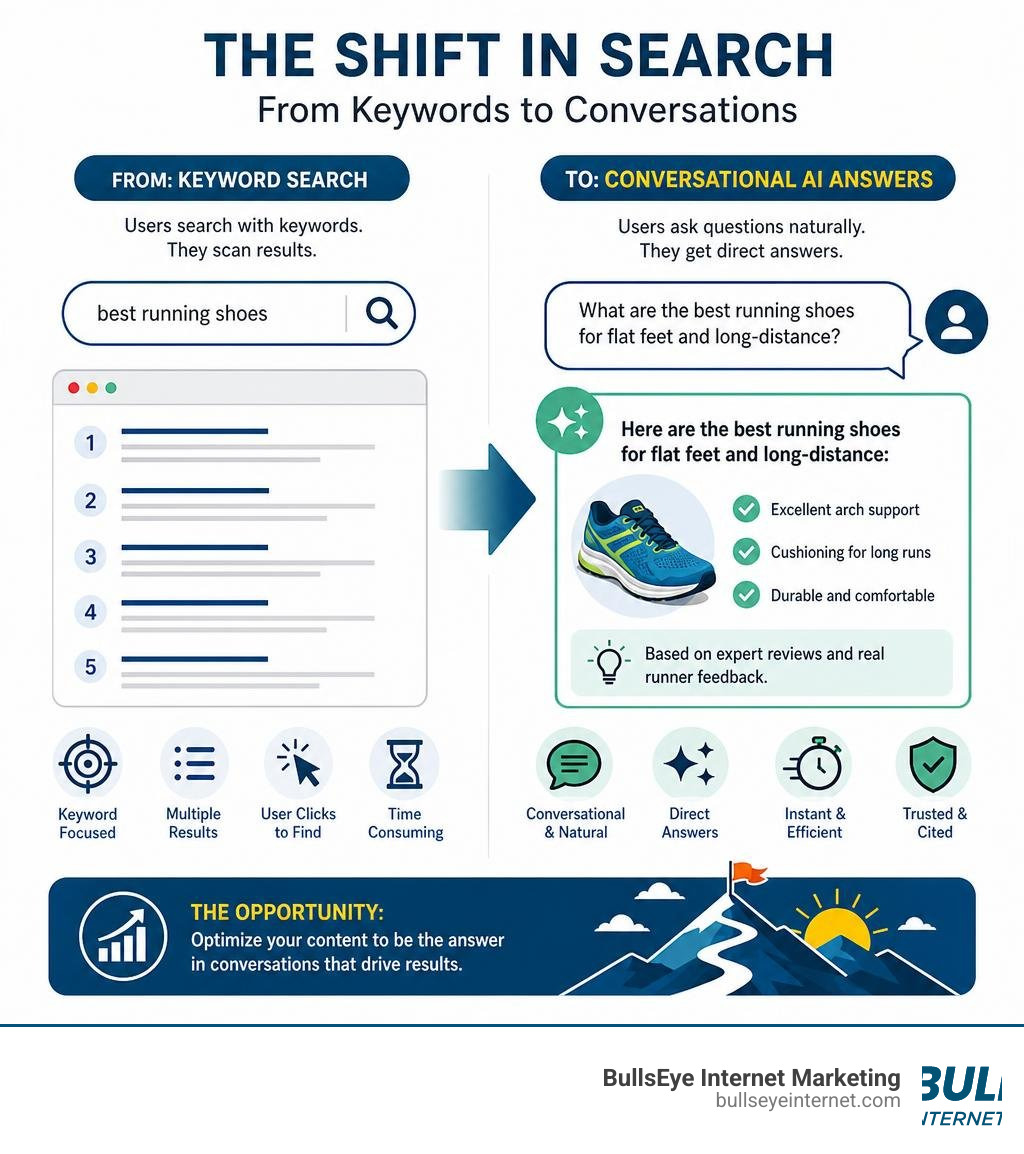
Know your Conversational AI SEO terms:
The Shift from Keywords to Conversational AI SEO
To understand why traditional search engine optimization is undergoing its most radical transformation yet, we have to look at how humans interact with machines.
For nearly three decades, we trained ourselves to speak “robot.” We typed fragmented, unnatural strings of text into search bars—queries like “best digital marketing Broward County” or “AC repair South Miami.” We did this because search engines were basic retrieval systems. They matched the literal strings of text on our screens to literal strings of text on a web page.
But the rise of advanced Natural Language Processing (NLP) has flipped this dynamic on its head. Now, the robots have learned to speak human.
With conversational search, users no longer type fragmented keywords. Instead, they engage in real-time, multi-turn dialogues with AI assistants like ChatGPT, Gemini, and Perplexity. They ask complex, highly contextual questions: “My air conditioner in Palm Beach Gardens is making a loud clicking sound and won’t blow cold air; is this something I can fix myself, or do I need to call a local technician who can come out today?”
This shift in user search behavior is driven by the sheer convenience of getting a synthesized, direct answer. Instead of clicking through five different websites, comparing their contents, and dodging intrusive pop-up ads, the user receives a single, cohesive answer built from across the web.
This behavioral change is reshaping the digital landscape:
- Rapid Adoption of AI Assistants: ChatGPT alone has crossed 300 million active weekly users.
- Erosion of Traditional Search Dominance: Google’s market share has slipped significantly as alternative answer engines capture high-intent users, particularly younger demographics. Perplexity AI, for example, attracts over 3 million daily visitors, with a core user base heavily concentrated in the tech-savvy 18-to-34 demographic.
- The Rise of Zero-Click Searches: When an AI engine provides the complete answer directly within the chat interface, the user has no reason to click through to your website.
This is where Conversational AI SEO comes in. If users aren’t clicking through to websites, your survival depends on being the source that the AI engine trusts, references, and cites inside its answer. If you are not cited, you do not exist in that consumer’s buying journey.
To navigate this change, businesses must understand how these tools think. If you want to dive deeper into the mechanics of these language models, take a look at our guide on The Pros and Cons of Using Chat GPT for SEO. To make sure your brand is positioned to win these conversational interactions, check out Is Your Brand AI-Ready? to learn how to transition your digital presence from basic keyword tracking to full conversational authority.
Generative Engine Optimization (GEO) vs. Traditional SEO
Because the underlying technology of search has shifted, the playbook for optimizing your website must shift too. This evolution has birthed a new discipline: Generative Engine Optimization (GEO).
Traditional SEO is built on a relatively straightforward loop: Retrieval and Ranking. Search engine crawlers index web pages, analyze signals like keyword density, metadata, and backlinks, and rank those pages in a static list. The primary metric of success is organic click-through rate (CTR) to your website.
GEO, on the other hand, operates on a Retrieval-Reasoning-Generation loop. When a user asks an AI engine a question, the system retrieves a set of relevant documents from the web. But instead of displaying them as a list, a Large Language Model (LLM) reads those documents, reasons through the information, synthesizes a custom response, and appends citations to the sources it trusted most.
In this new paradigm, success is measured not by where your page ranks on a list, but by your citation share and trust density—how often and how prominently your brand is cited as a source of truth within the generated answer.
To make this distinction clear, let’s compare the two approaches:
| Feature / Dimension | Traditional SEO | Generative Engine Optimization (GEO) |
|---|---|---|
| Primary Goal | Rank in the top 10 blue links on search engine results pages. | Earn citations and recommendations inside AI-generated answers. |
| Search Query Style | Short, fragmented, keyword-heavy strings (e.g., “PPC agency Miami”). | Long, natural, conversational questions (e.g., “Who is a highly rated PPC agency in Miami with no long-term contracts?”). |
| Key Ranking Signals | Backlink profiles, keyword placement, domain authority, page speed. | Semantic clarity, entity modeling, structured schema, factual citations. |
| User Experience | Drive users to click a link and browse a landing page. | Deliver immediate, clear, and comprehensive answers directly to the engine. |
| Primary Metrics | Organic impressions, keyword rankings, organic sessions. | Citation share, brand mention frequency, sentiment, prompt coverage. |
To win in the GEO landscape, your content cannot merely exist; it must be highly structured, factually dense, and easily digestible for an LLM’s retrieval system. The open-source community has begun documenting these exact mechanics in frameworks like the krillinai/GEO repository, which outlines how AI engines evaluate web pages.
By aligning your website with these technical standards, you ensure that when an AI engine searches the web for a reliable answer, your business is the one it confidently presents to the user. For a comprehensive breakdown of how to build a commercial strategy around these concepts, explore our dedicated resource on Generative Engine Optimization Services 101.
Core Strategies for Optimizing Content for AI Search Engines
To earn citations in generative search, you must design your content to be read and understood by both humans and LLMs. This requires a fundamental shift in content architecture.

Instead of writing long, winding narratives that bury the main point under paragraphs of fluff, you must adopt an Answer-Then-Depth content architecture. This means front-loading your content. You start with a direct, highly accurate, self-contained answer to the target query (typically 40 to 60 words), and then dive into deeper, contextual analysis, supporting data, and expert insights.
This structure allows AI crawlers to quickly extract the direct answer for their synthesized summaries, while still providing the comprehensive depth required to establish your site’s topical authority.
Additionally, your content must focus on:
- Semantic Clarity: Write in a clear, authoritative, and natural tone. Avoid overly complex jargon or flowery metaphors that can confuse an LLM’s parser.
- Entity Modeling: Clearly define the relationships between “entities” (your brand, your services, your location, and your industry concepts). AI engines do not just read words; they map concepts in a multi-dimensional database.
- Topical Clustering: Instead of writing isolated blog posts, build dense topical clusters. Create a central pillar page that covers a broad topic comprehensively, and link it to 8–15 supporting articles that address specific, long-tail questions. This signals to AI engines that you possess deep, systemic knowledge on the subject.
Implementing Conversational AI SEO for Long-Tail Queries
Conversational queries are inherently long-tail. Because users are speaking or typing full sentences, their queries are highly specific and often contain five or more words, complete with question modifiers (who, what, where, when, why, and how).
Optimizing for these queries requires a process called query fan-out—anticipating the secondary and tertiary follow-up questions a user is likely to ask once they receive their initial answer.
To capture these long-tail queries:
- Format Headings as Questions: Rewrite your H2 and H3 tags as exact, natural questions that users type or speak. For example, instead of using a heading like “Schema Markup Benefits,” use “How Does Schema Markup Improve SEO for Conversational AI?”
- Provide Immediate, Structured Answers: Directly beneath each question-based heading, write a concise, factual answer block.
- Map the Buyer’s Journey: Ensure your content answers questions across all stages of intent—from informational (“How does programmatic advertising work?”) to transactional (“Where can I find a South Florida digital marketing agency with no long-term contracts?”).
By structuring your articles as a series of connected question-and-answer pairs, you make it incredibly easy for AI engines to pull your content as a direct quote. For a practical guide on designing content for this conversational flow, see How To: Conversational Search Optimization. To understand how to align your writing style with the algorithmic preferences of modern language models, check out our guide on how to Speak the AI’s Language Optimizing Content for Large Language Models.
Technical Scaffolding and Structured Data
While AI engines are incredibly smart, they still rely on technical signals to validate and interpret web content. Structured data and schema markup act as a digital translator, providing unambiguous context that LLMs can read without having to guess.
If you want your business to appear in conversational results, you must implement a robust, consistent structured data layer across your entire website. The most critical schema types for Conversational AI SEO include:
- FAQPage Schema: Explicitly maps your question-and-answer content, making it highly extractable for featured snippets and AI overviews.
- Article Schema: Defines the author, publication date, and main entity of your blog posts, reinforcing your site’s freshness and editorial authority.
- HowTo Schema: Breaks down step-by-step processes, allowing AI engines to easily digest and present your instructions to users seeking practical help.
- LocalBusiness Schema: Crucial for local service providers in South Florida, Broward County, and Miami-Dade County. This schema explicitly defines your physical address, service areas, phone number, and operating hours, ensuring local AI queries recommend your business.
Additionally, you must manage your technical crawl accessibility. Many webmasters made the mistake of completely blocking all AI bots in their robots.txt files, accidentally blocking search-focused crawlers along with training crawlers.
To ensure your site can be cited in real-time search results, configure your robots.txt file to allow search-specific crawlers like OAI-SearchBot (OpenAI), PerplexityBot (Perplexity), and Googlebot (Google), while restricting training-only bots if you wish to protect your intellectual property.
For a detailed technical checklist on preparing your site’s backend for AI engines, review the Best GEO Strategy for AI Search: Complete 2026 Guide — NeuraPulse. To learn how to implement these technical structures to dominate Answer Engine Optimization, check out our step-by-step tutorial on How to Do Ansswer Engine Optimization.
The Role of Multimedia in Conversational AI SEO
Conversational search is not limited to text. Modern AI engines are multimodal—they can process, understand, and present text, images, video, and interactive tools simultaneously.
Including relevant, optimized multimedia elements on your web pages provides a massive boost to your visibility in AI-first search engines. Video content, in particular, acts as a powerful trust signal. When an AI engine synthesizes a response, it often pulls relevant video clips to visually demonstrate a step-by-step process or add depth to a product comparison.
To optimize your multimedia for AI discovery:
- Implement VideoObject Schema: Explicitly define your video’s title, description, thumbnail URL, upload date, and—most importantly—transcript.
- Provide Detailed Text Transcripts: Always include a clean, keyword-optimized text transcript beneath your videos. This gives AI crawlers the exact text they need to understand the video’s context.
- Use Descriptive Alt Tags and Captions: Ensure all images and interactive elements (like calculators or diagnostic tools) have clear, semantic descriptions that explain their function and findings.
By enriching your pages with high-quality multimedia, you create a more engaging user experience while giving AI engines multiple ways to interpret and cite your content. To explore the latest industry standards for multimedia optimization, check out our detailed guide on AI Search Best Practices.
Measuring Success and Overcoming Challenges in Generative Search
Transitioning to a Conversational AI SEO strategy comes with a unique set of challenges. Unlike traditional SEO, where rank-tracking tools provide clear, daily updates on your keyword positions, tracking your visibility inside conversational interfaces is much more complex.

Because AI responses are highly personalized and context-dependent—often changing based on a user’s previous prompts or implied persona—there is no single “ranking” to track.
To measure success in this probabilistic environment, businesses must focus on new metrics:
- Citation Share: The percentage of times your website is cited as a source in AI-generated answers for your target set of queries.
- Brand Mention Frequency: How often your brand name appears in conversational recommendations.
- Referral Traffic from AI Engines: Tracking sessions in Google Analytics 4 (GA4) originating from referrers like
chatgpt.com,perplexity.ai, orgemini.google.com. - Sentiment Analysis: Monitoring whether AI engines recommend your brand with positive, neutral, or negative framing.
Furthermore, groundbreaking research from the academic community highlights the critical relationship between traditional search visibility and conversational success. The C-SEO Bench paper, which represents the first comprehensive benchmark evaluating conversational search engine optimization, revealed a vital truth: traditional SEO remains incredibly impactful.
The study found that the initial retrieval ranking of a document (how well it ranks in standard search indexes) plays a dominant role in whether an LLM will select and cite that document in its final answer. Content modifications alone are largely ineffective if the page is not retrieved in the initial search phase.
This means you cannot abandon traditional SEO. Instead, you must build a hybrid model that combines technical SEO authority with generative content optimization. As more businesses adopt these techniques, the competitive space will become highly congested. Earning the trust of AI engines requires a sophisticated, multi-layered approach. To learn how to execute these advanced optimization techniques, read our guide on how to Supercharge Your AI Essential LLM Optimization Techniques.
Frequently Asked Questions about Conversational Search
What is the difference between featured snippets and AI overviews?
While they may look similar at first glance, featured snippets and AI overviews operate on entirely different technologies.
A featured snippet is a static extraction. The search engine identifies a single web page that answers a query particularly well, extracts a relevant paragraph, list, or table, and displays it at the top of the search results page with a link to that single source.
An AI overview is a synthesized answer. Instead of pulling from a single page, a generative engine reads multiple top-ranking sources across the web, reasons through the information, and writes a completely original, custom response. It then embeds inline citations linking back to the multiple sources it used to compile the answer.
Does traditional SEO still matter in the age of AI search?
Yes, traditional SEO matters now more than ever. As proven by the rigorous testing in the C-SEO Bench paper, AI search engines rely on traditional search indexes to retrieve the pool of documents they read to generate answers.
If your website lacks the traditional SEO foundation—high-quality backlinks, strong domain authority, fast page speeds, and clean technical indexability—AI crawlers will never retrieve your pages in the first place. Traditional SEO gets you into the room; Conversational AI SEO gets you chosen to speak.
How do AI search engines evaluate source credibility?
AI engines evaluate sources using a combination of semantic signals and technical authority:
- E-E-A-T (Experience, Expertise, Authoritativeness, Trustworthiness): AI systems look for expert authorship, clear credentials, transparent sourcing, and editorial standards.
- Citation Density: The frequency with which other reputable, trusted websites cite your brand as an authority on a given topic.
- Entity Authority: How strongly your brand is conceptually linked to your industry and location within local knowledge graphs.
- Factual Accuracy: AI systems cross-reference facts, statistics, and claims against established databases. Content supported by verifiable research, clear methodology, and outbound links to authoritative studies is highly favored.
Conclusion
The search landscape has shifted permanently. The days of relying solely on keyword matching to drive traffic are behind us. In this new era of conversational search, your business’s online visibility depends on earning the trust and citations of generative AI engines.
Adapting to this shift requires a sophisticated blend of traditional search foundation, advanced schema markup, semantic content structure, and authoritative brand building. It is a complex challenge, but for businesses that act early, it represents a massive competitive advantage.
At BullsEye Internet Marketing, we specialize in helping businesses navigate these technological shifts to generate real calls, leads, and sales. Whether you are looking to optimize your Google Business Profile, scale your Pay Per Lead campaigns, or dominate conversational search, we provide a unique, risk-free approach to digital marketing.
We operate with no long-term contracts, and we maintain a strict policy of working with only one client per industry per geographic area. This means when we partner with you in South Florida—whether you are in Broward County, Miami-Dade County, or Palm Beach County—our entire focus is on giving your business the ultimate competitive edge.
The future of search belongs to those who speak the language of conversational AI. Let us help you claim your spot at the top. For a deeper look at how to position your brand for generative search dominance, explore our comprehensive guide on Answer Engine Optimization AEO GEO LLM SEO, or contact us today to build a strategy that turns conversational potential into measurable growth.
