
What Are Citations? (The Quick Answer)
What are citations is one of those questions that seems simple — but the answer depends on where you’re using them.
Here’s a fast breakdown:
| Context | What a Citation Is |
|---|---|
| Academic writing | A reference that credits the original source of an idea, quote, or data |
| Local SEO | A mention of your business name, address, and phone number (NAP) on directories like Yelp or Google |
| Legal writing | A reference to a prior case, statute, or ruling that supports an argument |
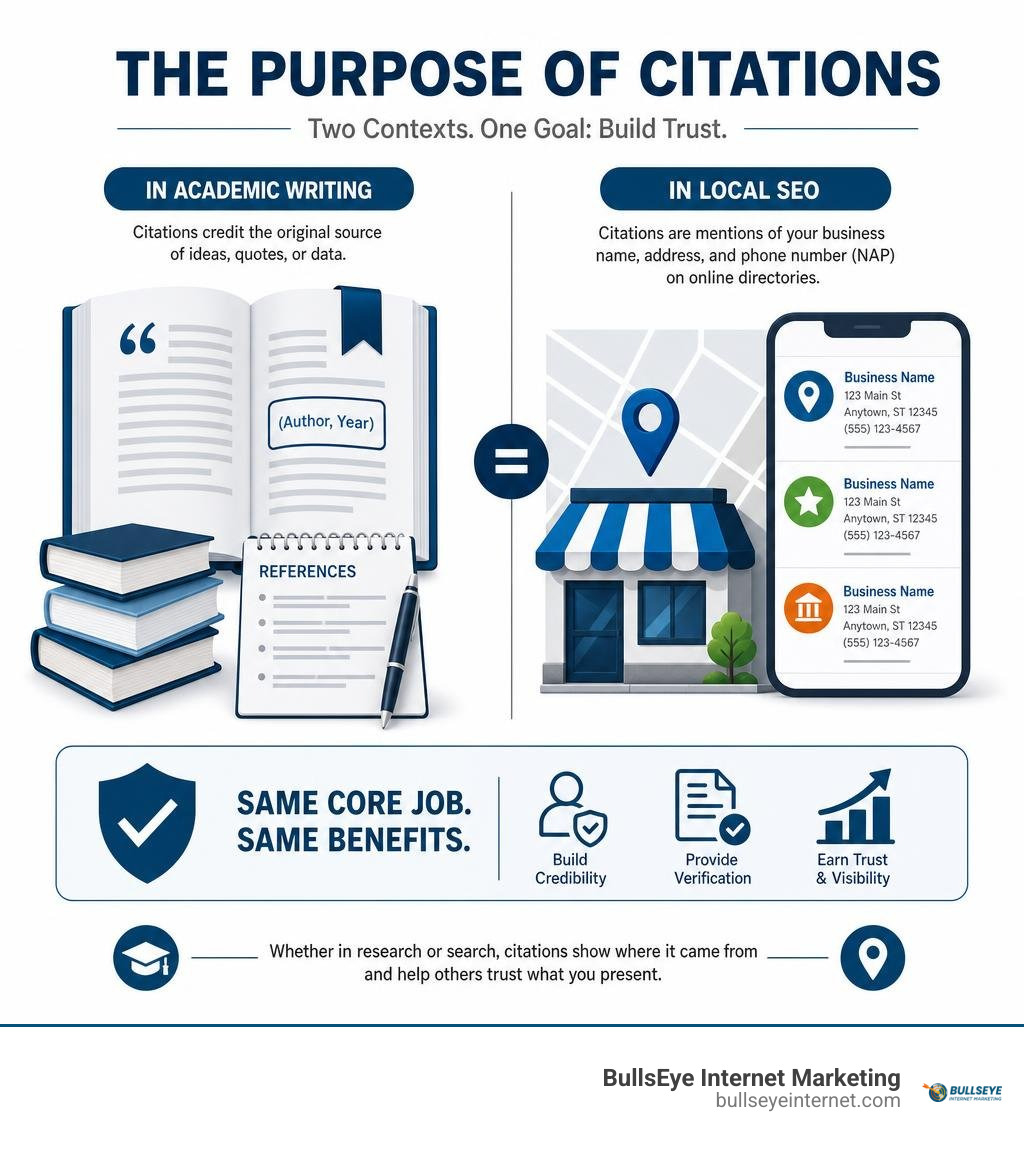
In both academic and business settings, citations do the same core job: they point to a source and build trust.
Think of a citation as a paper trail. When you write something — whether it’s a research paper or a business listing — citations tell your audience: “Here’s where this came from, and here’s how to verify it.”
They protect you from plagiarism. They boost your credibility. And in local SEO, they help Google confirm your business is real and rankable.
One widely used definition puts it simply: a citation is “a way of giving credit when certain material in your work came from another source.” That holds true whether you’re a student, a researcher, or a business owner trying to get found online.
I’m Ronnie Katz, founder of BullsEye Internet Marketing, and with over 20 years of experience in local SEO and online visibility, I’ve seen how misunderstanding what are citations — in both the academic and digital marketing sense — can hold businesses back. In this guide, I’ll walk you through everything you need to know, from the basics of referencing to how citations can directly impact your business’s online presence.
Common what are citations vocab:
Demystifying the Basics: What Are Citations?
At its core, a citation is an abbreviated alphanumeric expression embedded in the body of an intellectual work. It denotes an entry in a bibliographic references section, acknowledging the relevance of others’ work to the topic.
Whether you are writing a college essay or building a website for a local business in West Palm Beach, citations act as the foundational pillars of trust. They prove that you are not just making things up as you go.
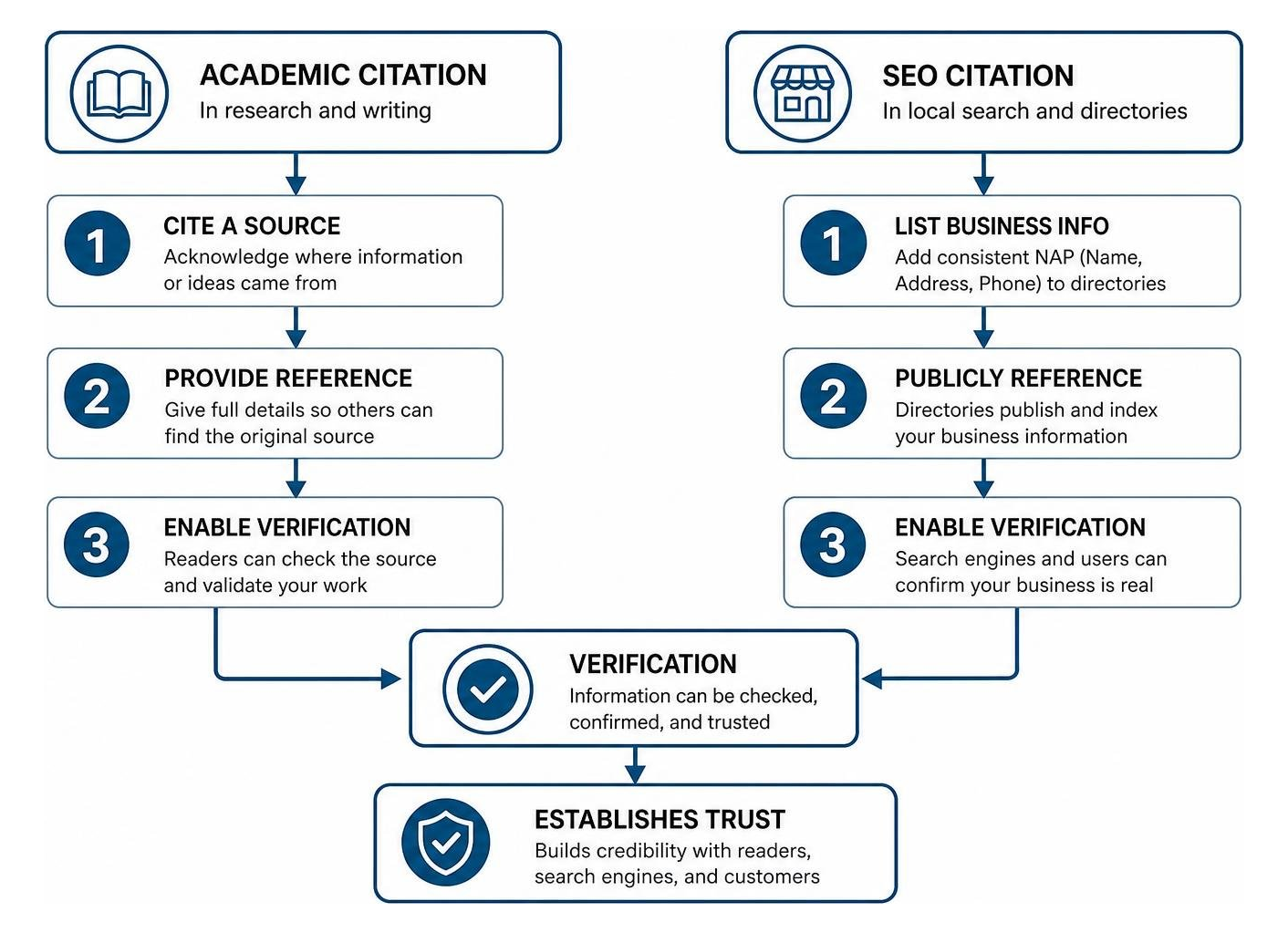
To understand the broader picture, we have to look at the two distinct worlds where this term is used: academic research and local search engine optimization (SEO). While they seem completely unrelated, they share a common goal: verification.
If you are a student, you might ask, What are citations and why should I use them? to ensure your term paper does not get flagged for plagiarism. If you are a business owner in Fort Lauderdale, you will want to look at The Ultimate Guide to Local Citations to understand how directories help local clients find your services.
Understanding What Are Citations in Academic Research
In the scientific and scholastic community, scholarship is viewed as an ongoing, global conversation. Researchers do not work in a vacuum; they build upon the discoveries, arguments, and data compiled by those who came before them.
When you insert a citation into an academic paper, you are mapping your place within this conversation. It tells the reader exactly which ideas are yours and which ones belong to someone else. It provides a clear research roadmap, allowing other scholars to follow your trail, verify your logic, and explore the foundational sources themselves.
As explored in the guide Why We Cite, proper attribution is not just an administrative chore. It adds strength and authority to your own arguments. By aligning your writing with established experts, you show that your conclusions are backed by rigorous, external evidence.
What Are Citations in the Context of Local SEO?
In the digital marketing world, the definition shifts from bibliography pages to online business directories. A local citation is any online mention of a business’s Name, Address, and Phone number (often referred to as NAP data).
Just as an academic citation proves to a professor that your research is credible, a local citation proves to search engine algorithms that your business is legitimate, active, and physically located where you claim it is. These mentions can appear on local business directories, review portals (like Yelp or TripAdvisor), social media platforms, or local chamber of commerce websites.
For businesses operating in highly competitive markets like Miami, Fort Lauderdale, or West Palm Beach, managing these mentions is critical. Securing accurate Google Business Citations directly impacts how high your business ranks in Google’s Local Map Pack. When search engine crawlers find consistent NAP data scattered across authoritative directories, they gain the confidence required to display your business to users searching for local services. If you want to expand your local footprint, strategic Citation Submissions for Local SEO are an absolute necessity.
Anatomy of a Citation: Key Components and Source Identification
To read or write a citation correctly, you must be able to break it down into its core components. Every citation contains specific metadata designed to help a reader locate the original source.
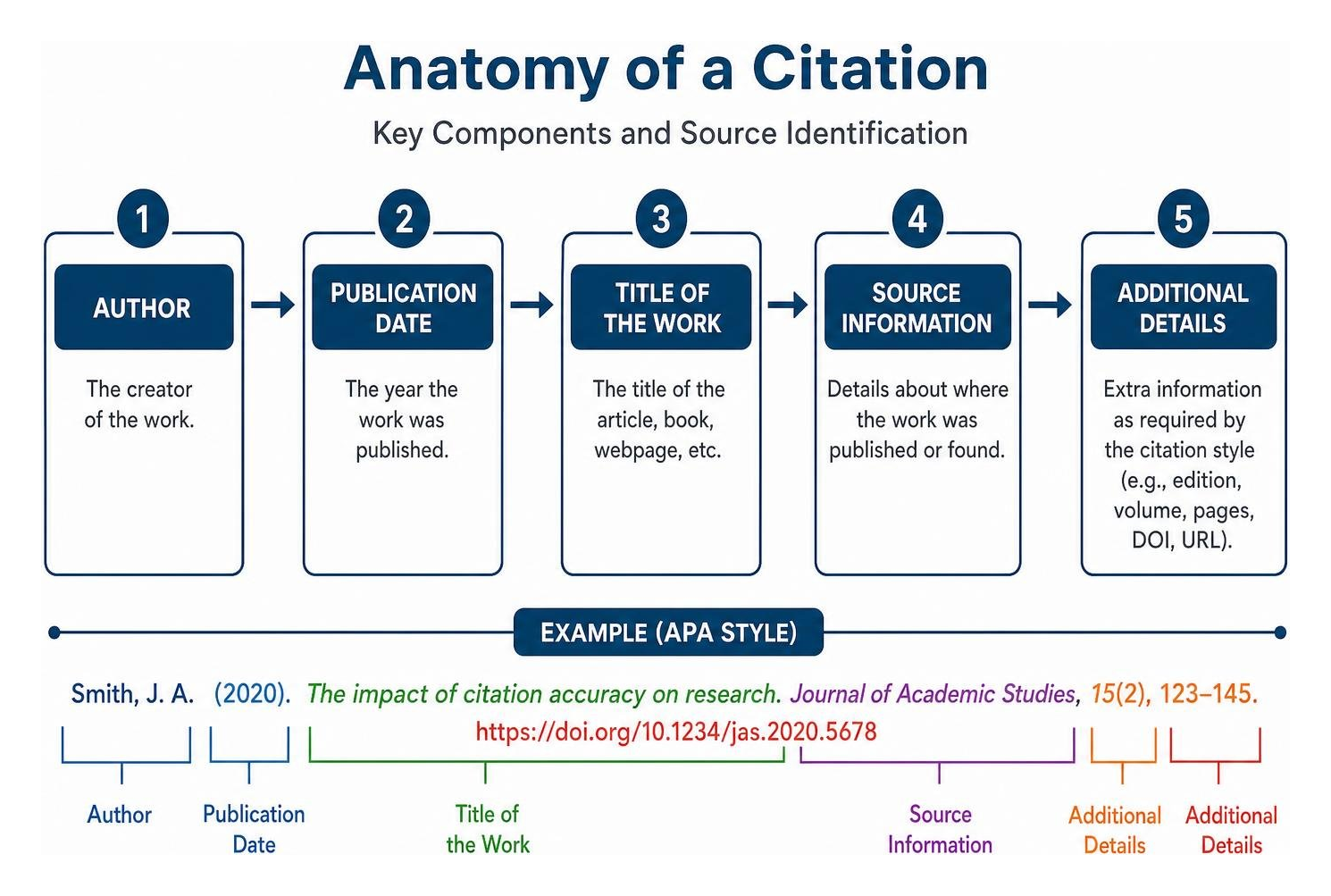
According to the official Citation entry, a standard citation must supply sufficient detail to identify the item uniquely. If any of these pieces are missing, the paper trail becomes cold and difficult to follow.
The Core Elements of Any Reference
Regardless of the citation style you are using, almost all bibliographic entries require five primary pieces of information:
- Author or Creator: Who wrote or created the work?
- Title of the Work: What is the name of the book, article, or webpage?
- Container: Is this article part of a larger journal, newspaper, or website?
- Publication Date: When was this work made public?
- Publisher: Who is responsible for producing and distributing the content?
In the modern digital landscape, citations also rely on unique identifiers to ensure long-term stability. Standard URLs are prone to changing or breaking over time. To combat this, academic publishers use Digital Object Identifiers (DOIs) for journal articles and International Standard Book Numbers (ISBNs) for physical books. These identifiers act as permanent digital fingerprints. When citing websites or online-only sources, including the exact URL and your access date (the day you viewed the page) is standard practice to account for live content updates.
How to Identify Source Types from a Citation
With experience, you can identify the exact type of source (a book, a journal article, or a website) simply by looking at the punctuation and structure of its reference entry.
For instance, if you spot a volume and issue number, you are looking at a journal article. If you see a publisher’s name and a city of publication without any volume numbers, it is highly likely a book.
Here is a quick comparison table to help you decode bibliographic structures:
| Source Type | Key Structural Clues | Example Format |
|---|---|---|
| Book | Single title, publisher name, city of publication, publication year. | Smith, J. (2021). The History of Florida. Palm Beach Press. |
| Journal Article | Two titles (article title + journal title), volume number, issue number, page range, DOI. | Davis, L. (2024). Estuary recovery in Martin County. Journal of Marine Science, 14(2), 45-58. https://doi.org/10.1002/jms.123 |
| Website | Article title, website name, publication date, exact URL, access date. | BullsEye Internet Marketing. (2026). Local SEO Complete Guide. https://bullseyeinternet.com/local-seo-complete-guide/ (Accessed July 2026). |
Citation Styles and Systems Explained
Different academic disciplines have different priorities, which is why we have multiple citation styles. A psychologist cares deeply about how recent a study is, so their style puts the publication date front and center. A literature professor cares more about the exact page of a quote, so their style emphasizes page numbers.
Following the proper guidelines, such as those outlined in Citation – Wikipedia, ensures that your formatting matches the expectations of your target audience or publisher.
Parenthetical Referencing vs. Note-Based Systems
All citation styles fall into one of two major structural systems:
- Parenthetical Referencing (The Harvard System): In this system, brief source details are embedded directly within the text inside parentheses. The author’s last name and the publication year (or page number) are placed immediately after the cited information, pointing the reader to an alphabetical reference list at the end of the document.
- Note-Based Referencing (The Vancouver System or Footnotes): This system uses sequential superscript numbers inline (e.g., like this^1). These numbers point the reader to corresponding footnotes at the bottom of the page or endnotes at the very end of the document, where the full citation details are displayed.
Major Citation Styles: APA, MLA, and Chicago
The academic world relies on three heavyweight citation styles. Here is when and where they are typically used:
- APA Style (American Psychological Association): Standard for the social sciences, education, and business. It prioritizes the author and the date of publication (e.g., Smith, 2024) to show the recency of the research.
- MLA Style (Modern Language Association): Standard for the humanities, literature, and art. It prioritizes the author’s name and the exact page number (e.g., Smith 42) to make finding specific quotes easy.
- Chicago Manual of Style: Highly flexible and commonly used in history, business, and fine arts. It offers two systems: a Notes and Bibliography system (using footnotes) and an Author-Date system (similar to APA).
Major Citation Styles by Academic Discipline
- Humanities & Literature: MLA, MHRA (Modern Humanities Research Association)
- Social Sciences: APA, ASA (American Sociological Association)
- History & Arts: Chicago Manual of Style
- Sciences & Medicine: CSE (Council of Science Editors), AMA (American Medical Association), Vancouver
- Law: Bluebook, ALWD (Association of Legal Writing Directors)
Best Practices: When to Cite and How to Avoid Common Errors
Using citations correctly is about maintaining academic and professional honesty. It ensures that you do not accidentally present someone else’s hard work as your own. Whether you are publishing an academic paper or updating a business blog, following the guidelines on Wikipedia:Citing sources will keep your writing clean and credible.
When Do You Need to Cite a Source?
A good rule of thumb is: when in doubt, cite it. However, to keep your writing flowing smoothly, you should know exactly when a citation is required:
- Direct Quotes: Any time you copy someone’s exact words, they must be placed in quotation marks and accompanied by an in-text citation.
- Paraphrasing: Even if you rewrite an author’s ideas entirely in your own words, the core concept still belongs to them. You must include a citation.
- Unique Terminology: If an author coined a specific phrase or framework to describe a phenomenon, you must credit them.
- Data and Statistics: Any charts, graphs, historical facts, or scientific statistics that are not common knowledge require a clear reference.
What does not need to be cited? You do not need to cite common knowledge (e.g., “Florida is a U.S. state” or “the atomic number of oxygen is 8”), well-known historical dates, proverbs, or general folklore.
Common Citation Mistakes and How to Avoid Them
Writing accurate citations requires attention to detail. Here are some of the most common citation errors discovered in academic and publishing research—and how you can avoid them:
- Copy-Pasting Citations (Plagiarized Citations): A study of major business ethics journals found that articles contain an average of three plagiarized citations because authors copied bibliographic entries from secondary sources without actually reading the original work. The Fix: Always consult the original source directly before citing it.
- Citing Retracted Papers: Research shows that only about 4% of citations to retracted papers clearly recognize that the paper was retracted. Citing retracted data destroys your credibility. The Fix: Use tools like Scite.ai or retraction databases to verify that your sources are still valid.
- Link Decay (Citation Half-Life): Online sources suffer from decay. Over time, web pages are taken down, resulting in broken links and useless footnotes. The Fix: Use stable identifiers like DOIs or archive your web sources using tools like the Wayback Machine.
- Impact Factor Boosting: In high-ranking medical journals, up to 30% of citations are generated by commissioned opinion articles designed to artificially boost citation metrics. The Fix: Prioritize peer-reviewed, original research papers over editorial opinion pieces.
- Unsupported Claims: Approximately 25% of all citations in published works do not actually support the claims they are used to back up. This often happens when writers rush their referencing. The Fix: Double-check that the source material explicitly supports your statement before finalizing your draft.
Frequently Asked Questions About Citations
What is the difference between a reference list and a bibliography?
While these terms are often used interchangeably, they have different scopes:
- A reference list includes only the sources that you have specifically cited within the body of your text. If there is an in-text citation for it, it belongs in the reference list.
- A bibliography is much broader. It is a master list of every source you consulted during your research process, whether you directly quoted from it, paraphrased it, or simply used it to build your background knowledge.
How do citations help avoid plagiarism?
Plagiarism is the act of taking someone else’s words or ideas and passing them off as your own. Citations prevent this by drawing a clear boundary line between your original thoughts and the borrowed ideas of previous authors. They show that you respect intellectual property and have conducted thorough, honest research. Additionally, properly citing your sources protects your reputation; if a source you cited turns out to be inaccurate, you will not take the blame for their poor data.
What tools can I use to manage and format citations?
Manually formatting every comma and period in a bibliography can be incredibly tedious. Fortunately, there are powerful, free citation managers designed to automate this process:
- Zotero: A free, open-source tool that lets you save citations directly from your web browser and generate bibliographies in seconds.
- Mendeley: A free reference manager and academic social network that is excellent for organizing PDFs and collaborating with other researchers.
- EndNote: A premium reference management tool favored by large research institutions for its advanced database capabilities.
Conclusion: Building a Trustworthy Footprint
Whether you are navigating the halls of academia or trying to grow your business’s digital footprint in South Florida, citations are the currency of credibility. In academic writing, they show that your arguments are built on a rock-solid foundation of peer-reviewed research. In the digital marketing landscape, accurate business listings and clean local citations prove to search engines like Google that your business is real, reliable, and ready to serve local customers.
If you are a business owner looking to dominate your local market, managing your online listings can feel just as complicated as formatting a Chicago-style bibliography. That is where we come in.
At BullsEye Internet Marketing, we specialize in helping businesses across the United States—with a deep focus on Florida, including Broward, Miami-Dade, Palm Beach, Martin, St. Lucie, and Indian River counties—grow their online visibility. We handle everything from Business Listings management and Google Business Profile optimization to comprehensive SEO and Pay-Per-Lead campaigns.
Our unique selling proposition is simple: we offer no long-term contracts, and we work with only one client per industry per geographic area. This gives you an unmatched competitive advantage in your local market. Whether you are located in West Palm Beach, Fort Lauderdale, Miami, or any of the surrounding South Florida communities, we are here to help you turn online searches into paying customers.
Ready to clean up your local citation footprint and boost your search rankings? Explore our Local SEO Complete Guide or run a Local Business Listings Scan to see how your business looks to Google today. Let’s make your digital marketing work for you!
