
Why Website Authority Is Your Most Valuable SEO Asset in 2026
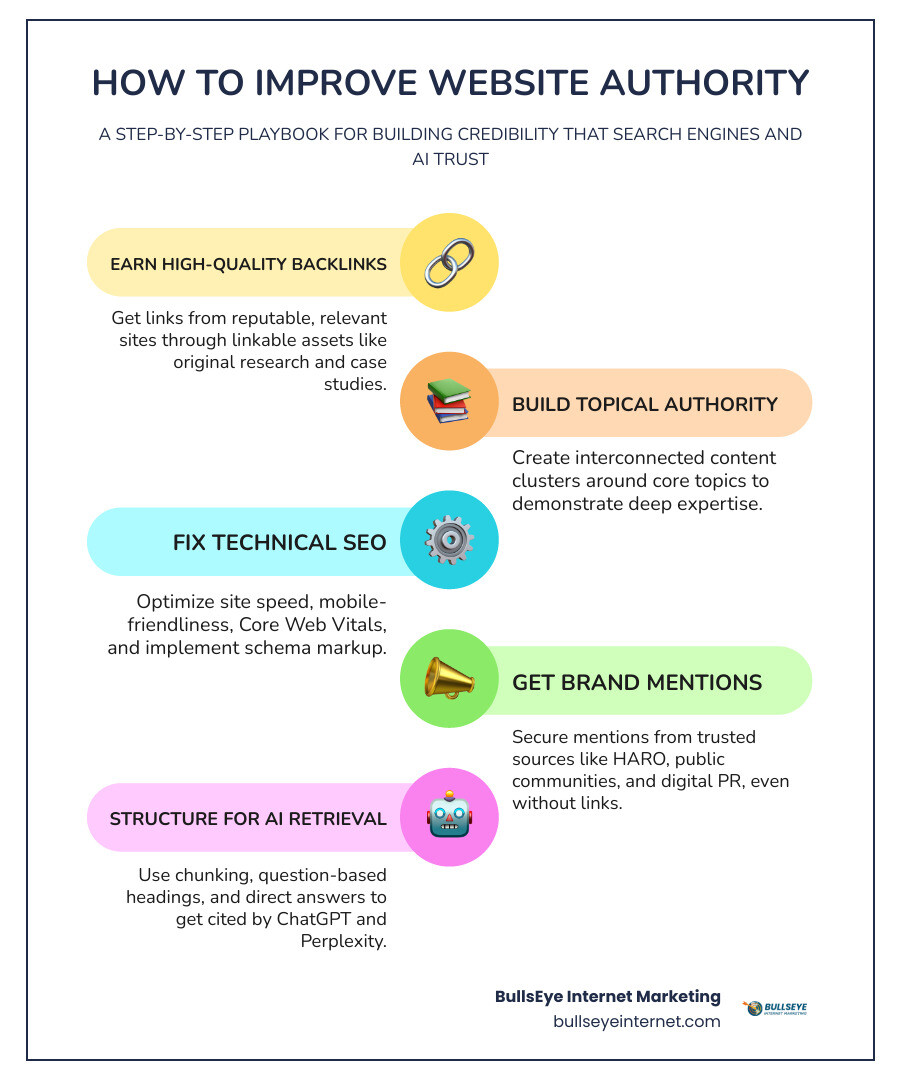
To improve website authority, focus on these core actions:
- Earn high-quality backlinks from relevant, reputable sites
- Build topical authority through interconnected content clusters
- Fix technical SEO — speed, mobile, schema markup
- Get brand mentions from trusted sources, even without links
- Optimize internal linking to spread authority across your pages
- Structure content for AI retrieval so ChatGPT and Perplexity cite you
If you want your business to show up — whether in Google search results or in AI-generated answers — authority is the foundation everything else is built on.
Here’s the reality: search engines and AI systems like ChatGPT don’t just rank pages. They rank trusted sources. A site with strong authority earns better rankings, attracts more clicks, and gets cited by AI tools that millions of people now use to find answers.
And the bar is rising. Google’s December 2025 algorithm update rewarded sites with deep, specialized expertise while pushing broad, surface-level sites down. At the same time, AI search engines are pulling answers from the sources they trust most — meaning your authority now determines your visibility in two search ecosystems at once.
The good news? Authority is buildable. It’s not magic, and it’s not reserved for big brands with massive budgets. One digital analytics company, for example, grew its organic traffic by 311% after executing a focused content and authority-building strategy over 18 months — starting from the same place many businesses find themselves today.
50% of small and medium-sized businesses don’t use SEO as part of their marketing strategy — which means the businesses that do have a significant edge.
I’m Ronnie Katz, founder of BullsEye Internet Marketing, and with over 20 years of experience helping businesses improve website authority and grow their online visibility, I’ve seen what separates sites that rank from sites that stall. In this guide, I’ll walk you through exactly what works in 2026 — no fluff, no guesswork.
Improve website authority vocabulary:
- search engine optimisation companies
- search engine optimization company
- search engine optimization consultants
What is Website Authority and Why Does It Matter in 2026?
To understand how to improve website authority, we first need to define what it actually means in 2026. Historically, website authority was viewed purely through the lens of backlinks. If a site had thousands of external links pointing to it, search engines assumed it was important.
Today, the concept has evolved into a multi-layered ecosystem:
- Website Authority: The overall perceived trust and credibility of your entire domain, heavily influenced by link profiles and sitewide quality signals.
- Brand Authority: How recognizable and trusted your brand name is across the web. If people are actively searching for your business name or mentioning you on social media, search engines take note.
- Entity Authority: How search engines and Large Language Models (LLMs) map your business as a distinct “entity” (a person, place, or thing) and connect it to specific topics, industries, or geographic locations.
In 2026, building authority is no longer just about satisfying Google’s PageRank algorithm. It is equally about optimizing for AI retrieval systems (like OpenAI’s SearchGPT, Perplexity, and Gemini). These systems do not simply count links; they traverse multiple web pages, assess entity density, analyze content relationships, and read community discussions on platforms like Reddit, Quora, and LinkedIn to verify if your business is the real deal.
This shift makes Google’s E-E-A-T (Experience, Expertise, Authoritativeness, and Trustworthiness) guidelines more critical than ever. Google uses sophisticated quality systems to map sitewide authority. If your site publishes shallow, generic content, it dilutes your authority. Conversely, if you focus on deep, specialized expertise, search engines and AI models will confidently recommend you.
For local businesses throughout South Florida—from Miami and Fort Lauderdale up to West Palm Beach and Vero Beach—this means you cannot rely on generic, cookie-cutter content. You need to establish local and topical trust. If you are just starting out, check out The Ultimate Seo Starter Guide For New Businesses to lay down a rock-solid foundation.
How Major SEO Tools Calculate Authority Scores
It is important to remember that “Website Authority” itself is not a direct metric used by Google. Instead, major SEO software providers have developed their own proprietary scores to estimate how strong a domain is.
These scores run on a logarithmic scale from 0 to 100, meaning it is much easier to grow from a score of 10 to 20 than it is to jump from 70 to 80. Let’s look at how the three leading tools calculate this metric:
| SEO Tool | Metric Name | Core Calculation Factors | Best Used For |
|---|---|---|---|
| Moz | Domain Authority (DA) | Logarithmic prediction model based on machine learning, link counts, and spanning across linking root domains. | Comparative benchmarking against direct SERP competitors. |
| Ahrefs | Domain Rating (DR) | Based purely on the quantity and quality of unique external backlinks (referring domains). Does not factor in traffic or spam. | Vetting link prospects and measuring raw link equity popularity. |
| Semrush | Authority Score (AS) | Calculated using three pillars: link power (backlink quality/quantity), organic traffic (estimated monthly visits), and spam factors (to resist link manipulation). | Assessing overall domain health and resistance to search spam. |
While these scores are incredibly useful for benchmarking, they are ultimately third-party estimations. Your primary focus should always be on real-world business outcomes like organic traffic, keyword rankings, and leads.
Proven Strategies to Improve Website Authority Through Backlinks
If website authority is a digital popularity contest, backlinks are the votes. However, not all votes are created equal. A single link from a highly trusted, topically relevant industry site carries more weight than fifty links from obscure, low-quality blogs.
To sustainably improve website authority, we must focus on earning high-quality, editorially placed backlinks. This is the cornerstone of any professional Link Building Service. When a reputable site links to yours, it passes “link equity” (or “link juice”).
If you want to dive deeper into why this matters so much in the modern era, read our detailed breakdown on The Role Of High Quality Backlinks In Modern Seo Why They Matter More Than Ever.
Earn High-Quality Backlinks with Linkable Assets
The absolute best way to build links is to create content that people want to reference. These are called linkable assets. Journalists, bloggers, and industry analysts are constantly looking for data, visual aids, and expert insights to back up their claims. If you provide those resources, they will link to you as the source.
Here are the most effective linkable assets you can build in 2026:
- Original Research and Proprietary Data: Conduct surveys or analyze anonymized internal data to reveal unique trends in your industry. For example, McKinsey & Company published a single original research piece on the state of AI that attracted over 125,000 backlinks from 22,400 domains.
- Interactive Free Tools: Build simple, highly useful calculators, templates, or generators. A free tool naturally attracts recurring traffic and links because people bookmark and share it.
- High-Quality Infographics and Visuals: Complex concepts are easier to understand when visualized. When other blogs use your infographic, they will credit you with a link.
- Comprehensive, Definitive Guides: Write the ultimate resource on a niche topic, covering it so thoroughly that other writers refer to your guide rather than explaining the concept themselves.
To see how these assets fit into a broader SEO campaign, explore the Top 10 Link Building Strategies For 2024 What Works And What Doesnt.
Leverage Digital PR and Brand Mentions to Improve Website Authority
In 2026, search engines and AI systems do not just look at direct hyperlinks; they also track unlinked brand mentions and citations across the web. If reputable news outlets, industry forums, or social media spaces frequently discuss your brand in a positive context, search engines associate your business with that industry’s topics.
According to a guide on 5 Ways to Increase Your Website Authority in 2026 , getting mentions from across the web is a primary pillar of modern off-page authority. You can earn these valuable mentions and links through several digital PR methods:
- HARO (Help a Reporter Out) / Connectively: Sign up as an industry source and respond to queries from journalists looking for expert quotes. A prompt, high-quality response can land you a mention in major publications.
- Targeting Trust Hubs: Identify the dominant publications, resource pages, and directories in your specific niche or geographic area (such as local business associations in Broward, Miami-Dade, or Palm Beach County) and build relationships with their editorial teams.
- Public Community Engagement: Participate genuinely in industry-specific discussions on platforms like Reddit, Quora, and LinkedIn. Because LLMs heavily source data from these community hubs to assess public sentiment and brand trust, having an active, respected presence there directly influences your AI authority.
Building Topical Authority for Search Engines and AI Systems
While traditional domain authority is built on backlinks, topical authority is built on content depth. Google used to rank individual pages that targeted isolated keywords. Today, it rewards sites that demonstrate complete, exhaustive coverage of an entire subject.
As explained in Dominate Your Niche Strategies For Building Topical Authority, owning a niche allows smaller websites with lower backlink metrics to routinely outrank massive, multi-topic enterprise competitors.
To build topical authority, you must organize your content using the Hub-and-Spoke (or Topic Cluster) model:
- Pillar Page (Hub): A comprehensive, high-level guide covering a broad topic (e.g., “The Ultimate Guide to Commercial SEO”).
- Cluster Pages (Spokes): Deep-dive articles addressing highly specific subtopics (e.g., “How to Optimize Robots.txt for Enterprise Sites,” “Schema Markup for Local Businesses”).
By interlinking these pages, you signal to search engines that you have covered every possible angle of a subject. The 2024 Google API leak confirmed that Google calculates internal metrics like “site focus score” and “site radius” to determine a website’s semantic boundaries. If you publish content outside your core focus, you risk diluting your authority.
For a deeper look at how search engines measure this mathematically, check out Ahrefs’ guide on Topical Authority: What It Is, How Google Measures It, and How to Build It .
Structure Content for AI Retrieval and ChatGPT Citations
AI search engines like ChatGPT, Claude, and Perplexity retrieve information differently than traditional search engines. They rely on “chunking”—breaking web pages down into small, digestible blocks of information to extract direct answers.
To ensure your content is easily retrieved, cited, and recommended by AI models, apply these structural best practices:
- Use Question-Based Headings: Use clear H2 and H3 tags that mirror the exact questions users ask AI models (e.g., “How is website authority calculated?”).
- Lead with Direct Answers: Start the first 1-2 sentences immediately following a heading with a direct, concise answer. This makes it incredibly easy for an LLM to extract your text as a snippet.
- Ensure Clean HTML Rendering: Avoid heavy JavaScript execution for primary text. Use server-rendered or static HTML so AI crawlers can access your content without rendering delays.
- Add Entity-Rich Schema Markup: Use JSON-LD schema to explicitly define your organization, authors, and topics, linking them to verified external profiles (like official social media accounts or Wikipedia) using the
sameAsproperty.
For a step-by-step blueprint on aligning your content with LLM retrieval patterns, refer to Backlinko’s guide on How to Build Topical Authority in the AI Search Era (7 Steps) .
Use Internal Linking to Distribute Authority Across Your Site
You can earn the most powerful backlinks in the world, but if that link equity is trapped on a single landing page, it won’t help the rest of your site rank. Internal linking is the highway system that distributes authority from your high-power pages (like your homepage or major linkable assets) to your commercial service pages.
To optimize your internal linking structure and Improve Website Seo:
- Use Descriptive, Entity-Rich Anchor Text: Avoid generic anchors like “click here” or “read more.” Instead, use descriptive terms like “learn about our Link Building Services Explained Why Quality Matters Over Quantity.”
- Build Bidirectional Links: Within a topic cluster, ensure every subtopic page links back to the main pillar page, and the pillar page links out to each subtopic.
- Eliminate Orphan Pages: An orphan page is a page with zero internal links pointing to it. Search engines struggle to crawl these, and AI systems rarely find them.
- Fix Broken Links: Routinely audit your site to identify and repair broken internal links (404 errors) to prevent link equity from leaking into dead ends.
Technical SEO and Common Mistakes to Avoid
You can write the most authoritative content in your niche, but if your website takes ten seconds to load or breaks on mobile devices, users and search engines will abandon you. Technical health is the silent backbone of website authority.
To ensure your technical foundation is flawless, we recommend conducting a regular Website Seo Audit. Key areas to monitor include:
- Page Load Speed & Core Web Vitals: Optimize your Largest Contentful Paint (LCP) and Cumulative Layout Shift (CLS) by compressing images, minifying code, and leveraging browser caching.
- Mobile-Friendliness: Google uses mobile-first indexing, meaning it primarily evaluates the mobile version of your site to determine rankings and authority.
- Schema Markup (JSON-LD): Structured data acts as a direct translator for search engines and AI systems, helping them understand your site’s structure, author credentials, and business details.
A clean, fast, and professionally designed website not only satisfies search algorithms but also dramatically improves user engagement. To understand how design and SEO work hand-in-hand, read about The Role Of Professional Web Design In Seo And Online Visibility.
Common Mistakes That Slow Authority Growth
Building authority is a long-term game, and making critical mistakes can halt your progress or even trigger search engine penalties. Here are the most common pitfalls we see businesses make:
- Buying Cheap, Spammy Backlinks: Purchasing low-quality links from link farms or public blog networks (PBNs) is a fast track to a Google penalty. If you want to protect your investment, learn about the Dont Waste Budget Link Building Services To Avoid In 2025.
- Ignoring Your Existing Backlink Profile: Spammy or toxic links pointing to your site can drag down your authority score. Regular audits are essential to keep your profile clean. Discover how to evaluate yours in What Your Backlink Profile Says About Your Business And How An Audit Helps Fix It.
- Keyword Cannibalization: This occurs when multiple pages on your site target the exact same keyword and search intent, forcing search engines to guess which page is the authority. This dilutes your rankings.
- Publishing Thin or Unrelated Content: Writing short, superficial blog posts on topics completely unrelated to your core business signals a lack of focus, which harms your topical authority.
Frequently Asked Questions About Website Authority
How long does it take to improve website authority?
Building genuine, sustainable website authority is a gradual process. Generally, most businesses begin to see measurable improvements in their authority scores and search visibility within 3 to 6 months of executing a consistent strategy.
According to the framework in How To Increase Website Authority In 7 Practical Steps , authority-building gains compound over time. The first few months are focused on laying the foundation—fixing technical errors, mapping topic clusters, and earning initial high-quality links. Between months 6 and 12, those efforts begin to yield exponential growth in organic traffic and keyword rankings.
Can I build authority without buying backlinks?
Yes, absolutely. In fact, earning backlinks organically through high-quality content, digital PR, and relationship building is far safer and more effective than buying them.
When you focus on publishing original research, building helpful free tools, and engaging in guest posting on reputable industry sites, you earn editorial links that competitors cannot easily replicate. To understand why editorial integrity matters so much, read our guide on Link Building Services Explained Why Quality Matters Over Quantity.
How do I track my website authority progress?
To accurately track your progress, you should look at a combination of third-party metrics and real-world business KPIs. We recommend reviewing these metrics on the first of every month:
- Referring Domains: Track the total number of unique, high-quality websites linking to you.
- Organic Traffic & Impressions: Monitor your Google Search Console to ensure your overall search visibility is growing.
- Keyword Breadth: Track the number of keywords your site ranks for in positions 1-10.
- AI Citation Rate: Track how often your brand and content are referenced in AI search engines like ChatGPT and Perplexity.
To get a clear, comprehensive picture of where your site stands today, we recommend starting with a professional Seo Analysis.
Conclusion
In 2026, learning how to improve website authority is no longer a luxury—it is an absolute necessity for survival in a highly competitive digital landscape. By earning reputable backlinks, building deep topical authority, structuring your content for AI search engines, and maintaining a flawless technical foundation, you can elevate your business above the noise.
At BullsEye Internet Marketing, we specialize in helping businesses across South Florida and the entire United States dominate their local and national markets. Our unique competitive advantage is simple: we offer no long-term contracts, and we work with only one client per industry per geographic area. This means when you partner with us, we focus 100% of our local search power on helping you win.
Ready to turn your website into an authoritative industry leader? Let’s build a strategy that drives real calls, leads, and sales. Explore our custom Search Engine Optimization Services today, and let’s get to work!
