
Why ChatGPT Brand Mentions Matter for Your Business
ChatGPT brand mentions happen when the AI names your company in an answer, whether or not it includes a clickable source link. To earn more of them, make your brand easy to understand on your own site, then earn credible mentions in the reviews, comparisons, forums, and industry publications that AI systems use to form answers.
This matters because buyers increasingly ask AI tools which product, provider, or local business they should choose. A mention can put your brand into the shortlist before a prospect ever visits Google or sees an ad. And because many AI answers are zero-click, being named correctly can matter as much as being linked.
The hard truth: you cannot submit a business directly to ChatGPT or buy a reliable recommendation. Lasting visibility is earned through clear entity information, useful content, strong reputation signals, and independent third-party validation.
I am Ronnie Katz, founder and Principal CEO of BullsEye Internet Marketing, with more than 20 years of experience helping businesses improve visibility, traffic, and conversions through SEO, local search, reputation management, AEO, and GEO. In this guide, I will show how the same authority-building discipline can help businesses compete for ChatGPT brand mentions and turn AI discovery into more calls, leads, and sales.
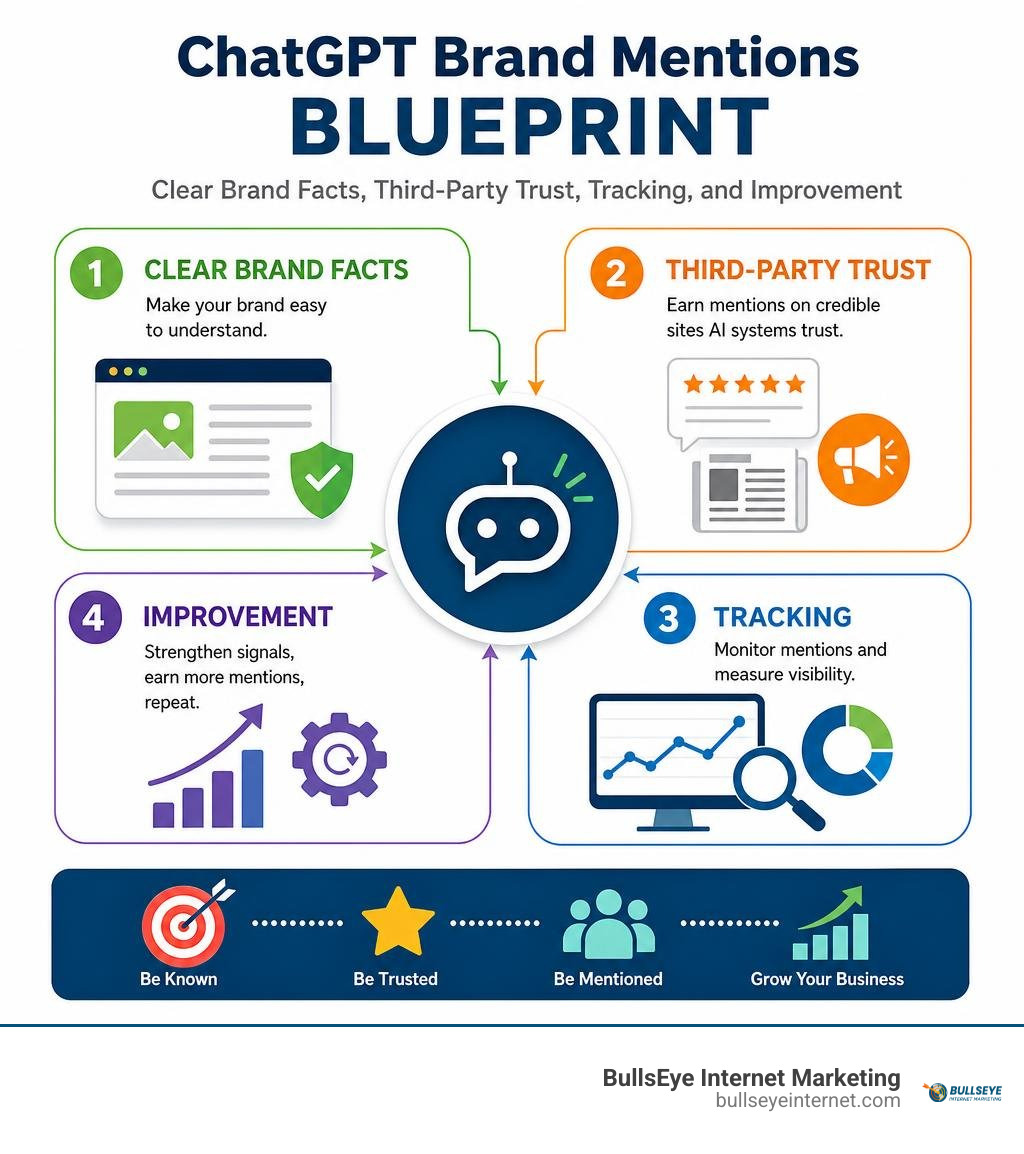
Basic chatgpt brand mentions vocab:
What Are ChatGPT Brand Mentions and Why Do They Matter in 2026?
The way people discover services, evaluate software, and choose local businesses has fundamentally shifted. With ChatGPT handling roughly 2.5 billion prompts daily and more than 70% of consumers using conversational AI for product research, the conversational interface has become the frontline of brand discovery.
When a prospective buyer asks ChatGPT for recommendations, the response directly shapes their perception. Unlike a traditional search engine results page (SERP) that presents a list of ten blue links, an AI answer engine synthesizes information to provide direct, decisive recommendations.
Understanding how to position your company for these zero-click answers requires a strategic approach. To stay ahead of these algorithmic changes, our comprehensive AI search optimization guide for 2026 breaks down how modern search interfaces extract and summarize company profiles across the web.
| Metric / Dimension | Unlinked Brand Mention | Live Web Citation | Traditional Backlink |
|---|---|---|---|
| Primary Mechanism | Entity recognition within base weights or RAG | Hyperlink reference during real-time web retrieval | Hyperlink passing PageRank between static web pages |
| User Action | Brand awareness, zero-click trust, direct search | Click-through referral to specific URL | Click-through referral, traditional SEO ranking signal |
| LLM Correlation | High (0.664 correlation to AI visibility) | Moderate-High (Depends on query browsing trigger) | Moderate-Low (0.218 correlation to AI visibility) |
| Primary Value | Consideration set inclusion and conversational authority | Immediate verification and referral traffic | Domain authority and traditional search indexing |
Inline ChatGPT Brand Mentions vs. Linked Citations
There is a critical technical distinction between an inline brand mention and a linked citation inside ChatGPT. An inline mention occurs when the language model generates your company’s name directly in its conversational prose—recommending your services, listing your product features, or identifying your business as a category leader.
According to a detailed data report on the most-mentioned brands in ChatGPT, approximately 45% of all brand references generated by ChatGPT carry no link at all. In these cases, the AI presents the brand based purely on anchorless authority stored in its neural network or extracted from synthesis layers.
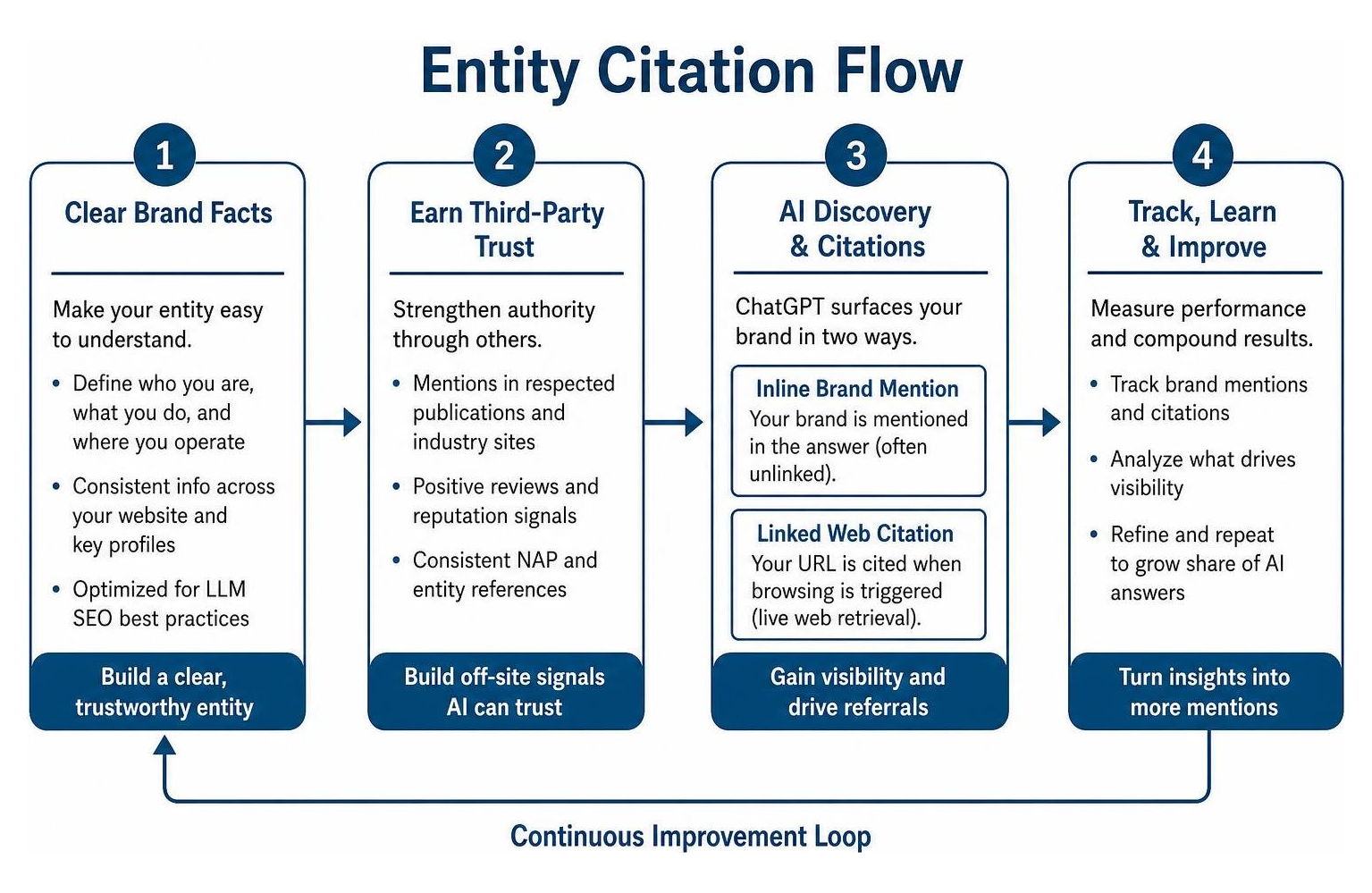
Linked citations, conversely, appear when ChatGPT activates its real-time browsing tool (often powered by Bing indexing). When browsing is triggered, the model retrieves live URLs to back up its statements with clickable source citations. Understanding both mechanisms is essential: inline mentions demonstrate that your company is embedded in the AI’s foundational understanding of your industry, while linked citations drive direct referral traffic from active buying queries.
The Economic Value of Generative Search Visibility
The business impact of appearing in conversational answers is massive. Industry data reveals that 50% of B2B buyers now start their purchasing journeys inside an AI chatbot rather than a traditional search engine. Among those buyers, 47% prefer ChatGPT over any other AI tool—nearly triple the adoption rate of competing platforms.
Furthermore, traffic generated from AI platform recommendations converts at 11x the rate of traditional search traffic (averaging 1.66% vs. 0.15% for lead sign-ups and calls). When an answer engine highlights your brand as a premier solution, the prospect arrives pre-educated and pre-sold.
This transformation in buyer behavior is the core reason businesses must understand what is AEO (Answer Engine Optimization). By optimizing your digital footprint for AI synthesis, you capture high-intent buyers at the precise moment they evaluate their options.
How LLMs and ChatGPT Decide Which Brands to Surface
Language models do not choose brands by pulling names out of a hat. Their recommendations are governed by complex mathematical representations called embeddings, semantic associations, and real-time retrieval scoring algorithms. Mastering large language model SEO means understanding the underlying mechanics of how these models store, process, and retrieve brand entities.
A crucial finding for modern digital marketing is that visibility does not automatically transfer across platforms. ChatGPT and Google AI Overviews disagree on which brands to surface 62% of the time for identical queries. ChatGPT evaluates brand presence through its own unique blend of pre-trained neural weights and Retrieval-Augmented Generation (RAG).
Training Set Embeddings vs. Live RAG Search
To diagnose and improve your brand presence, you must understand the two distinct layers ChatGPT uses to construct answers:
- Base Model Weights (Parametric Memory): This is the core knowledge the model acquired during its initial pre-training runs across vast web corpora. When web search is turned off, ChatGPT relies entirely on these internal connections. If your brand entity is strongly linked to your industry’s core topics within these weights, you will appear consistently in conversational answers.
- Retrieval-Augmented Generation (RAG / Live Search): When a user asks a query requiring real-time, local, or highly specific product data, ChatGPT activates web search bots (such as GPTBot and OAI-SearchBot). It searches the live index, retrieves top passages, and dynamically summarizes the findings.
If your company appears when search is toggled on, but disappears when search is toggled off, you have a solid live RAG footprint but need to build deeper, long-term brand authority across persistent web assets to penetrate future model training sets.
Sentiment, Entity Authority, and Reciprocal Rank Fusion
When ChatGPT evaluates which brands to include in a comparative recommendation, contextual relevance and source authority heavily outweigh simple mention frequency. In a comprehensive study on how ChatGPT evaluates brand mentions, researchers found that positive sentiment and authoritative source placements significantly increase the likelihood of being recommended, while neutral or negative mentions are frequently ignored.
Statistical research confirms that brand mentions correlate more than 3x more strongly with AI visibility than traditional backlinks (a 0.664 correlation coefficient for brand mentions versus 0.218 for backlinks).
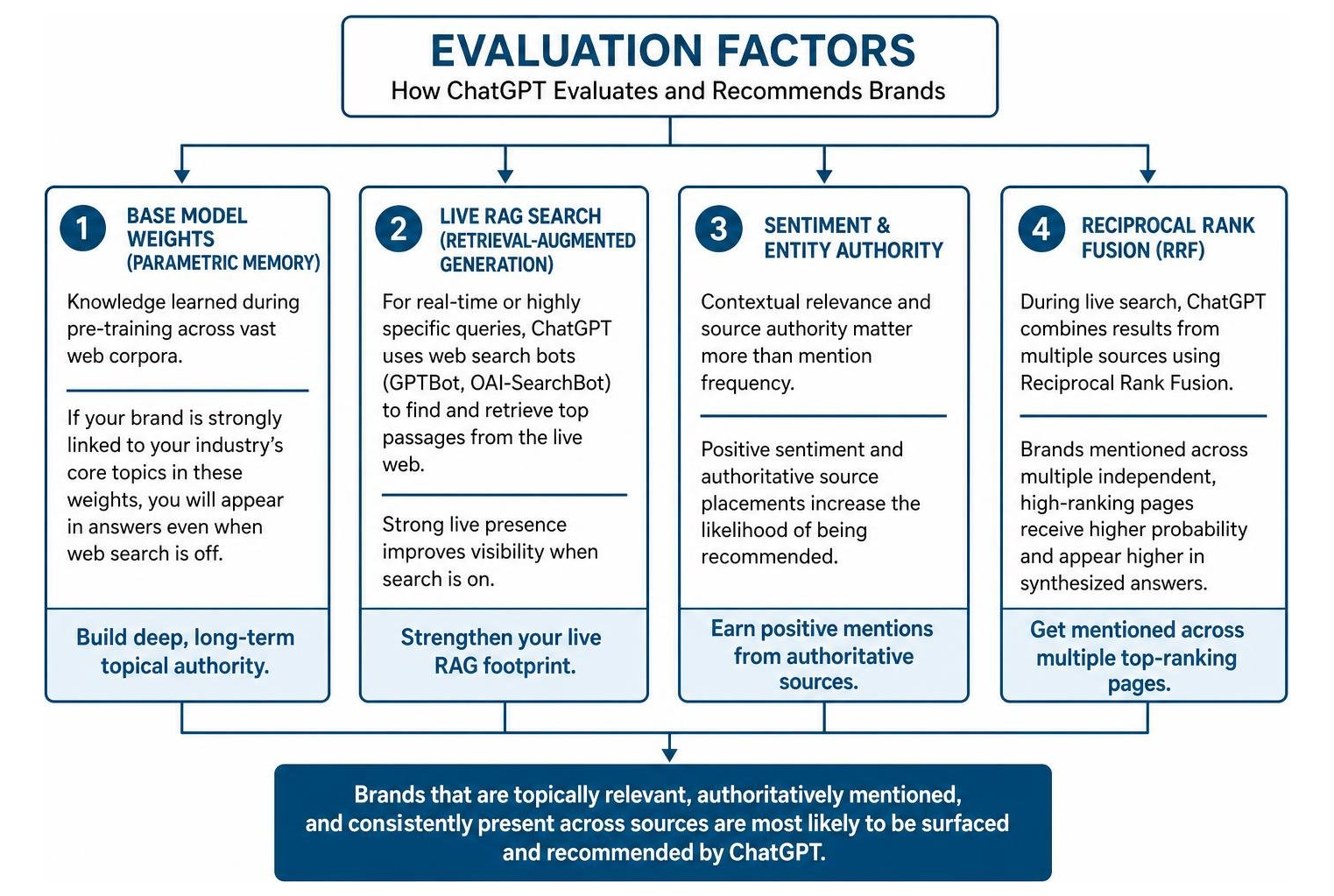
Additionally, when ChatGPT queries live search engines during RAG operations, it frequently leverages algorithms like Reciprocal Rank Fusion (RRF). RRF evaluates multiple search results across different sources and prioritizes entities that appear repeatedly across distinct, high-ranking pages. If your brand is mentioned across several independent, top-ranking articles, RRF assigns your business a higher probability score, ensuring your company appears at the top of the AI’s synthesized response.
Proven Strategies to Increase Your Presence in AI Search
Earning reliable recommendations in ChatGPT requires a proactive, multi-channel strategy. You cannot rely solely on self-published blog posts on your own domain. Businesses looking to scale their AI presence often partner with a dedicated generative engine optimization service to systematically build off-site validation and structure digital assets for AI ingestion.

Dominating Third-Party Real Estate and External Reviews
The most critical rule of generative search optimization is that external validation drives 6.5x more visibility than owned content. In fact, research demonstrates that 85% of brand visibility in AI search originates from third-party sources rather than your primary website.
Furthermore, nearly 90% of third-party mentions that influence AI recommendations stem from three specific content formats:
- Listicles and category roundups (“Top 10 Providers in…”)
- Head-to-head comparison articles
- Independent customer review platforms
Data shows that 80% of brands recommended by AI systems appeared in the first three positions of the source articles cited during the query. To capitalize on this, your marketing strategy must prioritize digital PR, co-branded research, and active presence on high-authority platforms that AI models trust, including Reddit, industry directories, and authoritative publications.
Formatting Owned Content for LLM Extraction and Machine Ingestion
While third-party validation establishes trust, your owned website must be mathematically easy for AI scrapers to read, parse, and cite. When structuring your website, optimizing content for large language models requires clean technical architecture and explicit content formatting.
Key technical and editorial practices include:
- Direct Definitions and Short Answers: Place concise, 1-2 sentence definitions immediately following subheadings so AI extractors can easily clip them into conversational answers.
- Data and Statistical Backing: Incorporating specific statistics and original data points into your content improves AI visibility by 41%, as language models prioritize factual claims with verifiable data.
- Machine-Readable Tables and Bullet Points: Use structured HTML tables and unordered lists to present comparisons, pricing tiers, and service features.
- Comprehensive Schema Markup: Implement Organization, Product, LocalBusiness, and FAQPage schema to explicitly define your entity attributes for web crawlers.
- Crawler Permissions: Ensure your
robots.txtfile explicitly permits AI user-agents, including GPTBot, OAI-SearchBot, and Bingbot.
Monitoring, Measuring, and Auditing AI Visibility
Because large language models produce non-deterministic outputs—meaning answers can shift slightly depending on prompt phrasing and system updates—monitoring your AI presence requires a systematic benchmarking routine.
How to Track and Benchmark ChatGPT Brand Mentions
To track your brand’s AI performance accurately, avoid spot-checking a single prompt once a month. Instead, implement a repeatable auditing framework:
- Develop a Structured Prompt Set: Create 10 to 20 realistic prompts representing different stages of your buyer’s journey (e.g., problem awareness, direct vendor comparisons, and local service queries).
- Use Phrasing Variations: For each core intent, create 3 to 5 phrasing variations to neutralize prompt bias and model randomness.
- Execute Clean Tests: Test prompts in incognito windows while logged out to prevent personalization algorithms or saved chat memories from skewing your baseline results.
- Benchmark Free vs. Paid Modes: Test queries across both the standard model and web-browsing modes to isolate your parametric memory footprint from your live RAG retrieval footprint.
- Conduct Comprehensive Audits: Follow established LLM SEO audit best practices to calculate your overall Share of Voice (SoV) and track your position relative to competitors over 4-to-8-week cycles.
Diagnosing Zero Mentions, Discrepancies, and Outdated Data
If an audit reveals that your company has zero mentions, inaccurate service descriptions, or outdated pricing in ChatGPT, execute the following remediation framework:
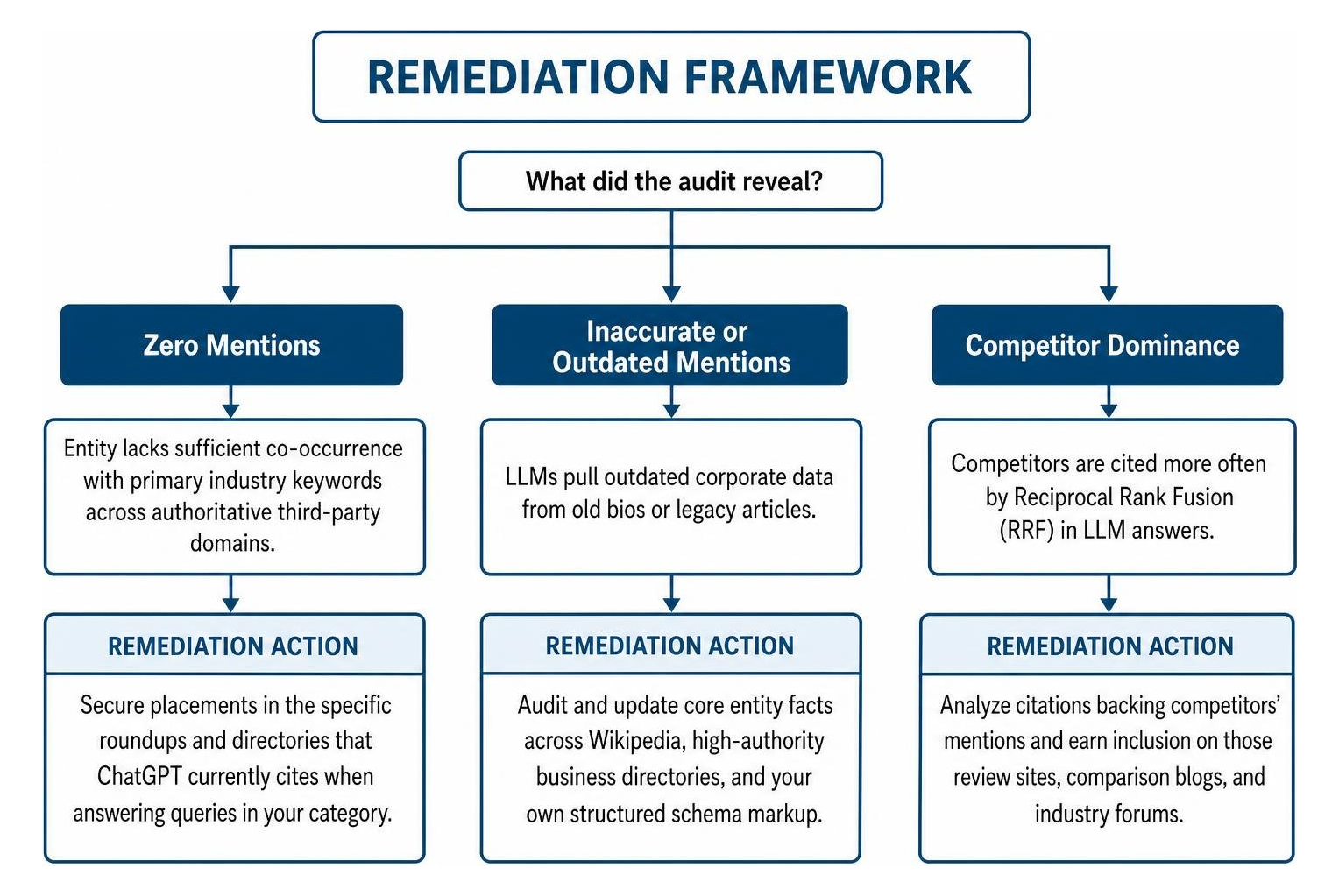
- For Zero Mentions: Your entity likely lacks sufficient co-occurrence with your primary industry keywords across authoritative third-party domains. Focus on securing placements in the specific roundups and directories that ChatGPT currently cites when answering queries in your category.
- For Inaccurate or Outdated Mentions: Audit external profiles, directory listings, and historical PR releases. LLMs often pull outdated corporate data from old bios or legacy articles. Update your core entity facts across Wikipedia, high-authority business directories, and your own structured schema markup.
- For Competitor Dominance: Analyze the citations backing your competitors’ mentions. Identify which review sites, comparison blogs, and industry forums are repeatedly surfaced by Reciprocal Rank Fusion, then execute a targeted campaign to earn inclusion on those exact URLs.
Frequently Asked Questions About AI Brand Visibility
How does ChatGPT decide which brands to recommend for a query?
ChatGPT determines brand recommendations by synthesizing data from its pre-trained neural network weights and real-time retrieval layers (RAG). It evaluates the contextual relevance of your brand to the user’s specific query, the overall authority of the domains where your brand is discussed, and the sentiment of user reviews and editorial coverage. Brands with extensive validation across independent, authoritative third-party websites receive the highest algorithmic priority.
Why do ChatGPT and Google AI Overviews show different brand recommendations?
ChatGPT and Google AI Overviews operate on distinct underlying architectures, training datasets, and retrieval indexes. Research indicates that the two platforms disagree on brand citations 62% of the time for identical queries. While Google AI Overviews relies heavily on Google’s traditional search index and Knowledge Graph, ChatGPT utilizes its own pre-trained parametric weights combined with Bing search retrieval and distinct ranking algorithms like Reciprocal Rank Fusion.
What is the fastest way to get a new brand mentioned in ChatGPT?
The fastest way to achieve visibility for a new brand is to target live RAG retrieval sources. Because training set updates take time, focus on earning inclusion in high-ranking comparison listicles, launching active profiles on major review platforms, distributing data-driven digital PR campaigns, and publishing clear, schema-rich content with verifiable statistics on your owned website.
Building Lasting Brand Authority in AI Search
Earning consistent, high-converting brand visibility inside conversational AI platforms is not a matter of chance. It requires a disciplined, entity-first marketing strategy that combines technical content structure, proactive reputation management, and aggressive third-party validation.
At BullsEye Internet Marketing, we have spent more than two decades helping businesses dominate search visibility and drive measurable revenue. We build customized search strategies that generate phone calls and qualified sales through Pay Per Lead, SEO, PPC, Google Business Profile optimization, and cutting-edge answer engine optimization and LLM SEO strategy.
We believe in earning our clients’ trust every single month, which is why we operate with no long-term contracts and maintain a strict one client per industry per geographic area policy to give you an uncompromising competitive advantage.
Whether your target market is in Miami-Dade County, Broward County, Palm Beach County, Martin County, St. Lucie County, Indian River County, or anywhere across the United States, our team has the expertise to establish your company as the premier authority in your market. Contact us today to audit your generative search presence and build lasting authority across the AI platforms shaping the future of commerce.
