
Why Large Language Model SEO Matters Right Now
Large Language Model SEO is the practice of optimizing your content so AI-powered search systems like ChatGPT, Google’s AI Overviews, Perplexity, and Gemini can easily find, understand, and cite your brand when answering user queries. Here’s what you need to know:
Key Components of Large Language Model SEO:
- Focus on citations over clicks – Your goal is to be mentioned inside AI-generated answers, not just ranked on a SERP
- Structured, conversational content – Use clear headings, bullet points, FAQ formats, and natural language
- Entity optimization – Build consistent brand signals across the web with schema markup and Knowledge Panels
- Information gain – Provide original data, unique insights, and factual accuracy that LLMs can’t find elsewhere
- Technical readiness – Ensure your site is crawlable, fast, and uses semantic HTML and JSON-LD schema
Over the past year, 58% of consumers have turned to generative AI tools for product and service recommendations—up from just 25% in 2023. During the 2024 holiday season alone, U.S. retail sites saw a 1,300% surge in AI search referrals. One company reported that ChatGPT referrals climbed from 1% to 10% of new sign-ups in just six months, while another saw AI search become their biggest acquisition channel, driving growth from $2M to $3M in annual recurring revenue in four months.
This isn’t a distant trend—it’s happening now. And if your brand isn’t visible in these AI-generated answers, you’re invisible to a rapidly growing segment of high-intent searchers.
Traditional SEO focused on ranking for keywords and earning backlinks. Large Language Model SEO shifts the goal to being cited, referenced, and recommended by AI systems that answer questions before users ever click a link. Google’s AI Overviews alone reach 1.5 billion people monthly, and some estimates predict that 10-15% of search queries will migrate to generative AI platforms by 2026.
The challenge is urgent: Google’s AI Overviews can reduce clicks by as much as 34.5% compared to searches without them. But the opportunity is just as significant—visitors arriving from AI search convert at 4.4 times the rate of traditional organic traffic.
The good news? Many of the fundamentals still apply. Content quality, factual accuracy, clear structure, and technical excellence matter more than ever. But now you need to optimize for machines reading your content just as much as humans. LLMs use Retrieval-Augmented Generation (RAG) to pull information from the web in real time, favoring content that is crawlable, structured, and semantically clear. They reward brands that demonstrate expertise, provide original insights, and build consistent entity signals across the web.
My name is Ronnie Katz, and since 2006, I’ve helped businesses adapt to every major shift in online marketing—from the early days of SEO to mobile-first indexing, voice search, and now Large Language Model SEO. At BullsEye Internet Marketing, we’ve developed cutting-edge strategies to ensure our clients’ brands appear in AI-generated answers, driving high-converting traffic from the next generation of search.
This guide will walk you through everything you need to know: how LLMs process content, what structures they reward, how to build entity authority, and how to measure your success in this new landscape—all in plain language, with actionable steps you can implement today.
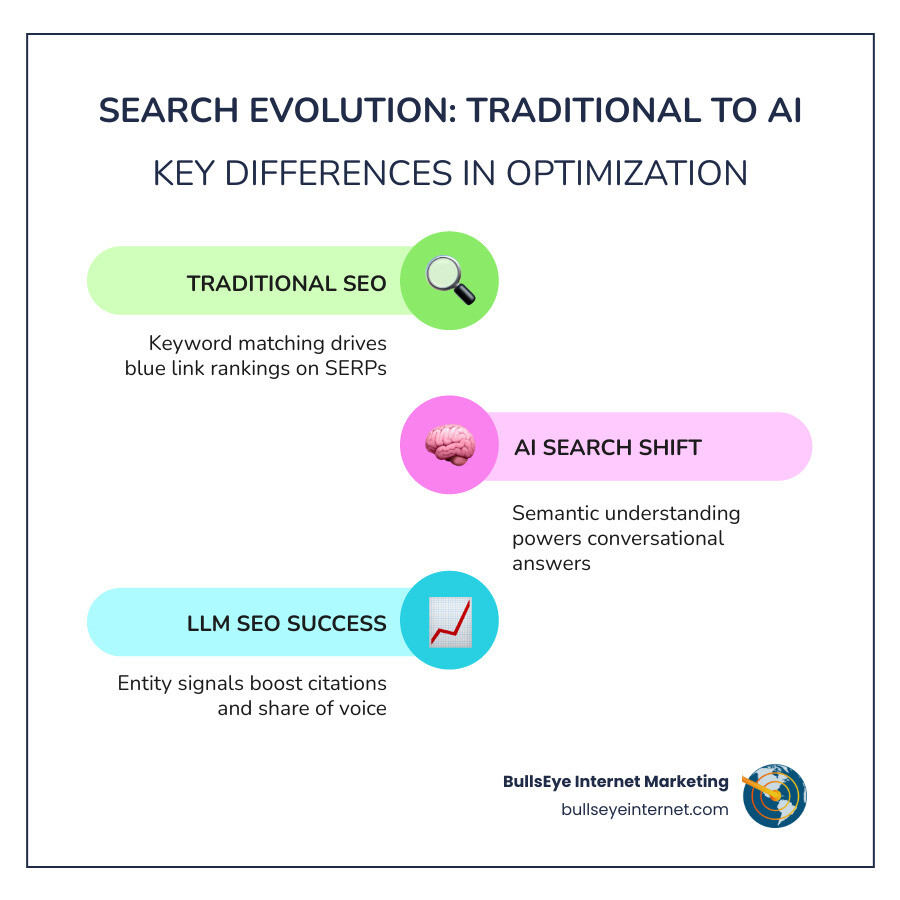
Large language model SEO terms to learn:
Understanding Large Language Model SEO and the AI Search Shift
The world of search is evolving from a library of links into a conversation with an assistant. In the past, we optimized for “blue links.” Today, we optimize for the “Answer.” Large language model SEO (also known as LLMO or GEO) is the process of ensuring your brand is the one the AI chooses to talk about.
What is LLM SEO?
While traditional SEO aims to rank a website in the top 10 results of a search engine, Large language model SEO focuses on becoming a cited source within an AI’s generated response. This involves a shift from keyword matching to semantic understanding. We aren’t just trying to “rank”; we are trying to provide the best, most extractable answer to a specific question.
GEO and AEO: New Acronyms, Same Mission
You might hear terms like Generative Engine Optimization (GEO) or Answer Engine Optimization AEO GEO LLM SEO. These all point to the same goal: making your content the “source of truth” for AI models. The focus here is on “zero-click answers”—providing so much value that the AI cites you as the authority.
Traditional SEO vs. LLM SEO: The Differences
The shift in consumer behavior is massive. With 58% consumer adoption of Gen AI for product research, the old playbook needs an update.
| Feature | Traditional SEO | Large Language Model SEO |
|---|---|---|
| Primary Goal | Ranking in SERPs (Top 10) | Being cited in AI responses |
| Success Metric | Click-Through Rate (CTR) | Share of Voice / Citation Frequency |
| Content Focus | Keyword density & Backlinks | Information gain & Semantic clarity |
| User Interaction | Search -> Click -> Browse | Ask -> Read Answer -> (Maybe) Click |
| Key Technicals | Meta tags & Sitemaps | Schema markup & RAG-ready structure |
The Importance of Large Language Model SEO for Brands
Why should a business in South Florida or anywhere across the U.S. care? Because the traffic coming from AI search is incredibly high-quality. As mentioned, AI referrals convert 4.4x better. This is because the AI has already done the “vetting” for the user. By the time they click your link, they are already convinced you are the expert.
Implementing a strategy based on an LLM SEO Services Ultimate Guide gives you a massive competitive advantage. While your competitors are fighting for the last few remaining clicks on page one of Google, you are being recommended by the AI as the definitive choice. This is the ultimate way to future-proof your digital presence.
How LLMs Process and Reward Content
To win at Large language model SEO, we have to understand how these “brains” work. Modern AI doesn’t just look for words; it uses a process called Retrieval-Augmented Generation (RAG).
When a user asks a question, the AI searches its index (or a live search engine like Bing or Google), retrieves relevant snippets of content, and then synthesizes an answer. It uses word embeddings to understand the semantic relationships between concepts. If your content is vague or fluffy, the AI won’t be able to turn it into a clear answer.
The Power of Information Gain
One of the most critical findings in recent AI research is the concept of Information Gain. A study found that content providing unique data, quotes, or original analysis receives a 30-40% mention boost in LLM responses. If you are just repeating what everyone else said, the AI has no reason to cite you specifically.
To follow LLM SEO Best Practices Guide standards, you must:
- Be Factually Accurate: LLMs are prone to “hallucinations,” but they are getting better at checking facts against multiple sources.
- Signal E-E-A-T: Experience, Expertise, Authoritativeness, and Trustworthiness are more important than ever. Use author bios, link to credible sources, and show your work.
Content Structures for Large Language Model SEO
LLMs love structure. They aren’t reading your blog post for leisure; they are scanning it for data points to extract.
- Hierarchical Headings: Use H1, H2, and H3 tags logically. Don’t skip levels.
- Bulleted and Numbered Lists: AI models are 17x more likely to cite content that uses lists compared to standard paragraph text.
- Conversational Tone: Write like you are answering a friend’s question. Use “You” and “We.”
- FAQ Sections: These are “citation magnets.” By posing a question as a heading and answering it immediately below, you make the AI’s job easy.
From a technical standpoint, using modern frameworks like Next.js for crawlability ensures that AI bots can see your content without struggling with heavy JavaScript. For more on this, check out our LLM SEO Company Complete Guide.
Technical Optimization and Entity Recognition
If the content is the “soul” of Large language model SEO, technical optimization is the “skeleton.” You need to help the AI understand exactly who you are and what you do.
Schema Markup: The Language of AI
Schema.org markup and JSON-LD are essential. This is code that tells the AI, “This is a product,” “This is a price,” or “This is an expert review.” According to an Authoritative guide on Schema, using structured data is the single best way to ensure your content is interpreted correctly.
When we perform an LLM SEO Audit Best Practices review for our clients, we focus on:
- Organization Schema: Defines your business name, location, and social profiles.
- Product/Service Schema: Lists specific details that AI can use for recommendations.
- FAQ Schema: Directly feeds into AI answer boxes.
Entity Consistency and Knowledge Panels
An “entity” is a person, place, or thing that the AI recognizes as a distinct concept. You want your brand to be a recognized entity. This happens through consistency. Ensure your business name, address, and phone number (NAP) are identical across the web. If the AI sees conflicting info, it won’t trust you enough to cite you.
Securing a Google Knowledge Panel is a major milestone. It signals to all LLMs that you are a verified, authoritative source. Additionally, don’t ignore Bing Webmaster Tools. Since Bing powers the “Browse with Bing” feature in ChatGPT, your ranking in Bing directly impacts your visibility in ChatGPT.
Building Authority for Large Language Model SEO
Authority in the AI era isn’t just about backlinks; it’s about “mentions.”
- Wikipedia and Wikidata: LLMs are heavily trained on Wikipedia. While it’s hard to get a page, following Wikipedia guidelines to contribute factual info can help.
- Digital PR: Getting mentioned in reputable industry news sites creates a “paper trail” for the AI.
- Community Platforms: Reddit and Google’s data deal proves that AI models value authentic human conversation. Engaging on Reddit and GitHub can seed citations that LLMs pick up.
By owning “frontier concepts”—being the first to write comprehensively about a new trend—you become the definitive source that the AI defaults to. For a deeper dive, see our LLM SEO Agency Ultimate Guide.
Measuring Success and AI Visibility
You can’t manage what you can’t measure. In traditional SEO, we looked at Google Search Console. For Large language model SEO, we have to look at new data points.
Tracking AI Referrals in GA4
You can see who is sending you traffic from AI tools by using a specific filter in Google Analytics 4. Use a regex pattern to look for referrals from chatgpt.com, perplexity.ai, and google.com (for AI Overviews).
Tools for Monitoring AI Visibility
Several tools are emerging to help us track our “Share of Model.”
- AI SEO Toolkit: Helps track brand mentions and sentiment across LLMs.
- Peec AI: A specialized tool for monitoring how your brand appears in conversational search.
- Brand Monitoring tool: Excellent for finding unlinked mentions that AI bots use to build entity strength.
Our A Practical Guide to LLM SEO Strategies emphasizes tracking Citation Frequency. How often does Perplexity or ChatGPT link to you when asked about your industry? That is the new “Rank #1.”
Frequently Asked Questions about LLM SEO
How does LLM SEO differ from traditional SEO?
Traditional SEO is about keyword matching and blue links. Large language model SEO is about semantic intent and conversational answers. In the old world, you wanted to rank for “best plumber Miami.” In the LLM world, you want the AI to say, “BullsEye plumbing is the most reliable in Miami because of their 24/7 service and 5-star reviews.” It’s a shift from being a result to being the recommendation. This is often called LLMO.
Can AI-generated content rank in LLMs?
Yes, but with a major catch. If you just copy-paste raw AI text, you aren’t providing any “Information Gain.” LLMs crave novel, human-written information to improve their own training. Research on Stochastic Parrots suggests that AI without human oversight often lacks the nuance and factual verification needed to be a “definitive source.” Always keep a human-in-the-loop to ensure originality and accuracy.
Which tools are best for tracking AI visibility?
For monitoring your brand’s digital footprint, we recommend using Google Alerts for real-time mentions and Ahrefs Brand Radar to see how your entity strength is growing. Perplexity Pro reports can also give you direct insight into how that specific model views your site.
Dominate AI Search with LLM SEO – BullsEye Internet Marketing
The future of search is no longer just about being found; it’s about being chosen by the most powerful AI models on the planet. Large language model SEO is the key to maintaining your visibility in an era of zero-click answers and conversational discovery.
At BullsEye Internet Marketing, we don’t just follow the trends—we help set them. Whether you are in Fort Lauderdale, Miami, or anywhere across the United States, our team is ready to help you dominate this new landscape. Our unique approach—offering no long-term contracts and exclusive industry representation in your geographic area—gives you the ultimate competitive edge.
Don’t wait for your organic traffic to disappear. It’s time to Large Language Model SEO your brand. Implement a refresh cadence, update your sitemaps, and start building the authority that AI rewards.
Ready to lead the conversation? Optimize your brand for the future of AI search with BullsEye Internet Marketing today. Let’s make sure that when the world asks AI for the best in your industry, the answer is you.
