
What Is an SEO Audit and What Does It Include in 2026?
SEO audits are worth the investment when they deliver a prioritized, revenue-focused roadmap tied to platform changes, traffic drops, or scaling needs—but they waste budget for brand-new sites with minimal content or when your team lacks the capacity to implement the findings. An SEO audit is a comprehensive diagnostic evaluation of your website’s technical health, structural integrity, content relevance, and search authority. It is designed to uncover the friction points preventing your site from ranking higher, capturing qualified organic traffic, and converting visitors into paying customers.
In the past, many agencies treated an audit as a routine checklist export: run a crawler, export a PDF showing 300 missing image alt tags, and present it as strategic insight. Today, search engines have evolved far beyond basic on-page checks.
With around 60% of Google searches ending without a click and conversational AI engines directly answering complex queries, modern search auditing has shifted. A 2026 audit evaluates how well search engine bots and Large Language Models (LLMs) parse, understand, and trust your brand’s digital footprint.
A thorough professional diagnostic evaluates your site across three distinct operational layers.
Technical Crawlability, Render Integrity, and Core Web Vitals
The technical layer is the foundation of your website. If search engine spiders cannot efficiently crawl, render, and index your pages, none of your content marketing or backlink efforts will yield results.
A modern technical diagnostic covers:
- Crawl Budget and Indexation Barriers: Pinpointing crawl bloat, rogue
noindexdirectives, improperrobots.txtdisallows, and canonical misconfigurations that waste search engine resources. - JavaScript Rendering Integrity: Diagnosing client-side rendering bottlenecks where dynamic content or internal navigation links fail to register in Google’s render tree.
- Site Architecture and Internal Equity Flow: Analyzing URL hierarchy, orphaned pages, and internal link distribution to ensure your most important commercial pages receive maximum authority.
- Real-World Core Web Vitals (CrUX Field Data): Moving beyond synthetic lab tests to evaluate real user performance metrics, particularly Interaction to Next Paint (INP), Largest Contentful Paint (LCP), and Cumulative Layout Shift (CLS). Performing a deep Core Web Vitals audit reveals the exact server latency and rendering bottlenecks hurting both your rankings and conversion rates.
On-Page Intent, AI Search Readiness, and Content Risk Mapping
Creating content without understanding intent alignment or structural clarity is one of the fastest ways to stall organic growth. Search engines now evaluate content using site-wide quality systems rather than grading each page in complete isolation.
Our on-page and content analysis focuses on:
- Commercial Search Intent Alignment: Ensuring high-value landing pages match the actual transactional needs of prospective buyers rather than relying on outdated keyword stuffing tactics.
- Site-Wide Content Risk Mapping: Identifying low-quality, outdated, or duplicate content clusters that drag down the overall domain’s helpfulness rating in Google’s automated evaluation systems.
- AI Search Parsability and Answer Engine Optimization (AEO/GEO): Probing platforms like ChatGPT, Perplexity, and Google AI Overviews to understand how your brand is cited. Industry research shows that 76% of AI Overview citations come from pages already ranking in the top 10 organic results. Following a structured comprehensive SEO audit guide ensures your content uses the clear semantic headings and structured entity formatting required to capture both traditional organic positions and AI-driven summary snippets.
Off-Page Signals, Citation Integrity, and Backlink Health
Off-page SEO establishes your brand’s authority and trust across the wider web. An audit examines whether your external footprint reinforces your search positions or leaves you vulnerable to algorithmic suppression.
- Local Citation and Entity Consistency: Discrepancies in your business name, address, phone number (NAP), and category mapping confuse search engines and dilute local map rankings. Running a targeted citation audit for local search eliminates duplicate listings and verifies your presence across key business directories.
- Backlink Equity and Profile Hygiene: Evaluating the distribution of domain authority, anchor text balance, and referral traffic. A systematic backlink profile audit uncovers harmful link spikes, scraper-site syndication risks, and valuable lost backlinks that can be reclaimed.
How Much Does an SEO Audit Cost and What Drives the Price?
The cost of an SEO audit varies based on website size, technical complexity, and the level of strategic analysis provided. Legitimate audits for small-to-mid-sized websites under 50 pages typically run between $1,500 and $3,000, while complex enterprise platforms require a much larger investment.
| Audit Tier | Typical Cost | Deliverables Provided | Turnaround Time | Best Suited For |
|---|---|---|---|---|
| Automated Tool / Entry Freelance | $500 – $2,500 | Automated crawler exports, raw checklist PDFs, basic technical issue flags | 3 to 7 Days | Early-stage startups, local micro-sites (<20 pages), preliminary sanity checks |
| Senior Consultant / Agency Diagnostic | $2,500 – $10,000 | Deep technical review, Search Console log analysis, competitor gap review, developer-ready tickets, 30/60/90-day prioritized roadmap | 2 to 4 Weeks | Established SMBs, lead-generation sites, mid-market e-commerce (100–10,000 pages) |
| Enterprise Strategic Audit | $10,000 – $50,000+ | Full architectural crawl mapping, server log file analysis, internationalization/hreflang, JavaScript framework profiling, executive workshops | 4 to 8 Weeks | Large publishers, multi-brand corporations, international portals (100,000+ URLs) |
The primary factors driving these cost differences include the total number of indexable URLs, dynamic e-commerce faceted filtering, JavaScript rendering frameworks, custom CMS platforms, and the depth of competitive analysis. More detailed breakdowns of these variables can be found in recent industry insights on auditing services.
Freelancer and Automated Tool Tiers ($500 – $2,500)
At the lower price point, you are generally paying for an initial scan supplemented by light manual curation. A freelancer or junior auditor runs your domain through automated platforms, bundles the raw data, and flags standard deviations like missing meta descriptions, basic redirect chains, and missing alt text.
While this tier can be helpful for small local websites needing a baseline analysis of your website SEO, it carries risks if relied upon for complex platforms. Automated tools flag hundreds of harmless notices without understanding your business model, often leading internal teams to spend weeks fixing minor issues that produce zero revenue impact.
Senior Consultant and Agency Strategic Diagnostics ($2,500 – $10,000+)
When you partner with experienced SEO consultants or specialized agencies, you are paying for strategic problem-solving rather than raw data collection.
At this level, the deliverable is not a bloated PDF; it is a developer-ready execution plan. The auditor investigates your historical Google Search Console trends, cross-references server logs to see how search engines crawl your site, and evaluates competitor commercial positioning.
Every recommendation is scored by estimated business impact versus developer effort. Understanding the true financial investment of a comprehensive audit helps leadership allocate budget effectively across diagnosis, technical implementation, and content expansion.
When Is an SEO Audit Worth the Investment Versus a Waste of Money?
An SEO audit is worth every dollar when it provides an accurate diagnosis of why revenue-critical pages are underperforming and gives your team a clear, actionable plan to fix them. It becomes a waste of money when it simply restates obvious site flaws or sits in an inbox without implementation.
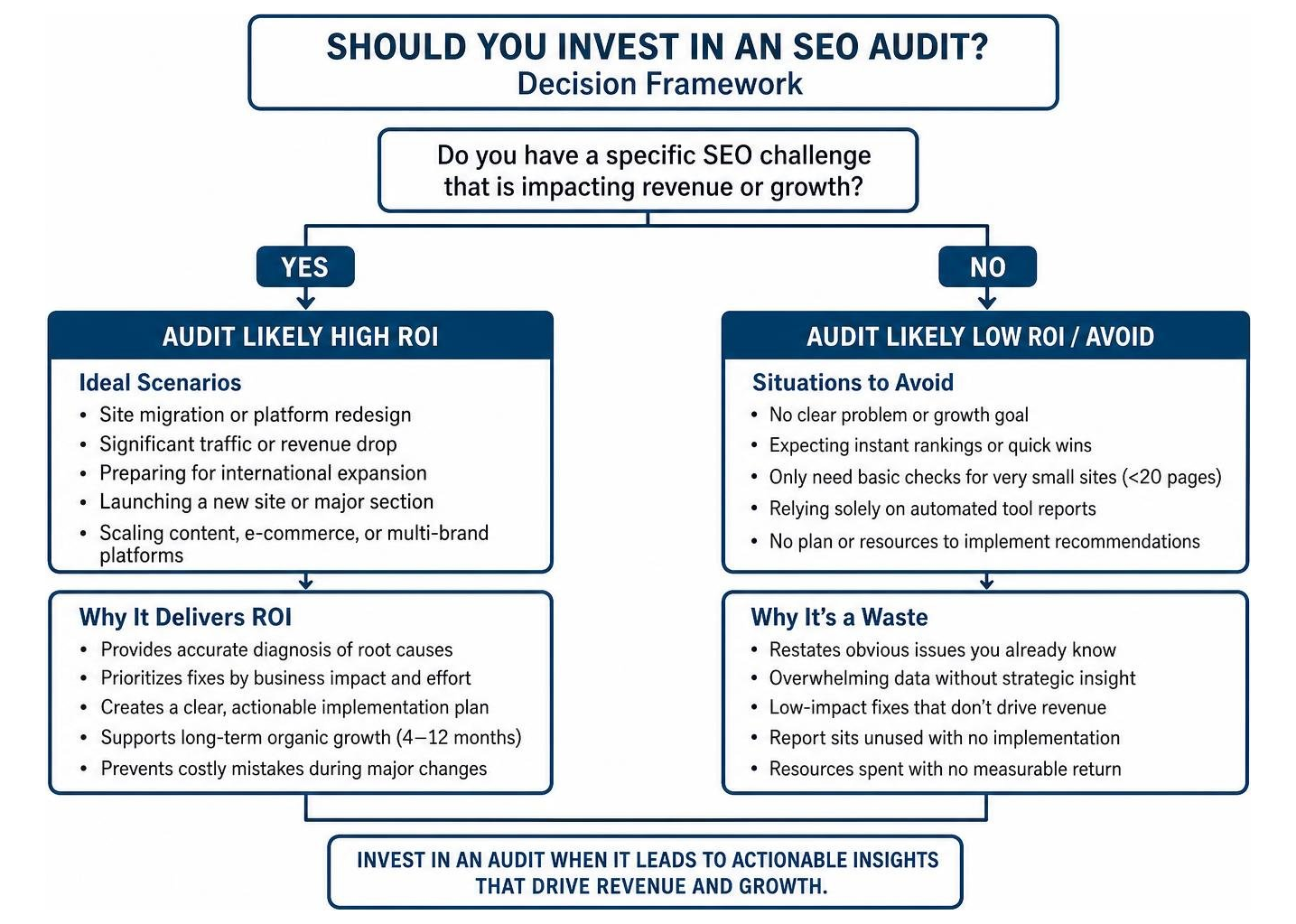
Google’s own hiring guidance reminds businesses that organic search improvements generally require four to twelve months to fully mature. Because SEO is a long-term investment, starting with an accurate diagnostic ensures your budget is spent on the right activities.
At BullsEye Internet Marketing, we operate with a strict standard: we do not lock clients into rigid long-term contracts, and we work with only one client per industry per geographic area to maintain an exclusive competitive advantage.
High-ROI Scenarios: Migrations, Traffic Drops, and Platform Redesigns
Investing in a professional SEO audit delivers exceptional ROI in several specific situations:
- Unexplained Organic Traffic Drops: If your website experiences a sharp 20% to 50% traffic drop following a Google Core Update, an audit identifies whether the decline stems from technical crawl blocks, algorithmic helpfulness demotions, or shifting query intent.
- Website Migrations and CMS Redesigns: Migrating to a new platform or restructuring your URL hierarchy without a rigorous audit is one of the easiest ways to lose organic revenue. Mistakes in 301 redirect mapping, canonical tags, and internal link structures can wipe out 20% to 50% of your organic search traffic overnight. A pre- and post-migration audit protects your historical search equity.
- Websites with Over 5,000 URLs: Large e-commerce and multi-location directories often suffer from index bloat, duplicate product variations, and faceted navigation loops. An audit identifies crawl waste and consolidates link equity where it generates conversions.
- Local and Regional Market Expansion: When scaling into competitive geographic areas, investing in an expert regional SEO audit helps you understand local search behavior, map citation gaps, and outmaneuver regional competitors.
When Paying for an SEO Audit Is a Waste of Budget
An SEO audit is rarely worth the financial investment in these circumstances:
- Brand-New Websites with Minimal Content: If your site was launched two weeks ago and has five pages with no backlinks, you do not need a $3,000 audit to explain why you are not ranking. You simply need to build helpful content, earn authority, and let search engines index your domain.
- No Technical Execution Capacity: If your development team has a six-month backlog and no available bandwidth to update metadata, modify code, or adjust server settings, commissioning an audit produces nothing but a dusty report.
- The “Free Audit” Sales Trap: Many low-cost agencies offer “100% Free SEO Audits” as lead magnets. These automated reports flag generic warnings (such as 404 error codes on obsolete pages) to pressure you into a monthly retainer. As highlighted in this analysis on why standard audits become sales documents, a business that spends six months paying $1,500/month ($9,000 total) to fix harmless technical items recommended by a free audit often sees zero ranking gains and a full year of lost growth.
- Evaluating General Worth: If you are still weighing whether a paid evaluation makes sense for your stage of growth, reviewing a practical guide on whether an SEO audit is worth paying for in 2026 can help clarify your internal readiness.
How Can You Tell a Good SEO Audit from a Sales Pitch or Data Dump?
The SEO industry contains a wide range of audit quality. Some providers deliver high-impact diagnostic roadmaps, while others produce automated spreadsheets that overwhelm marketing teams without providing clear direction.
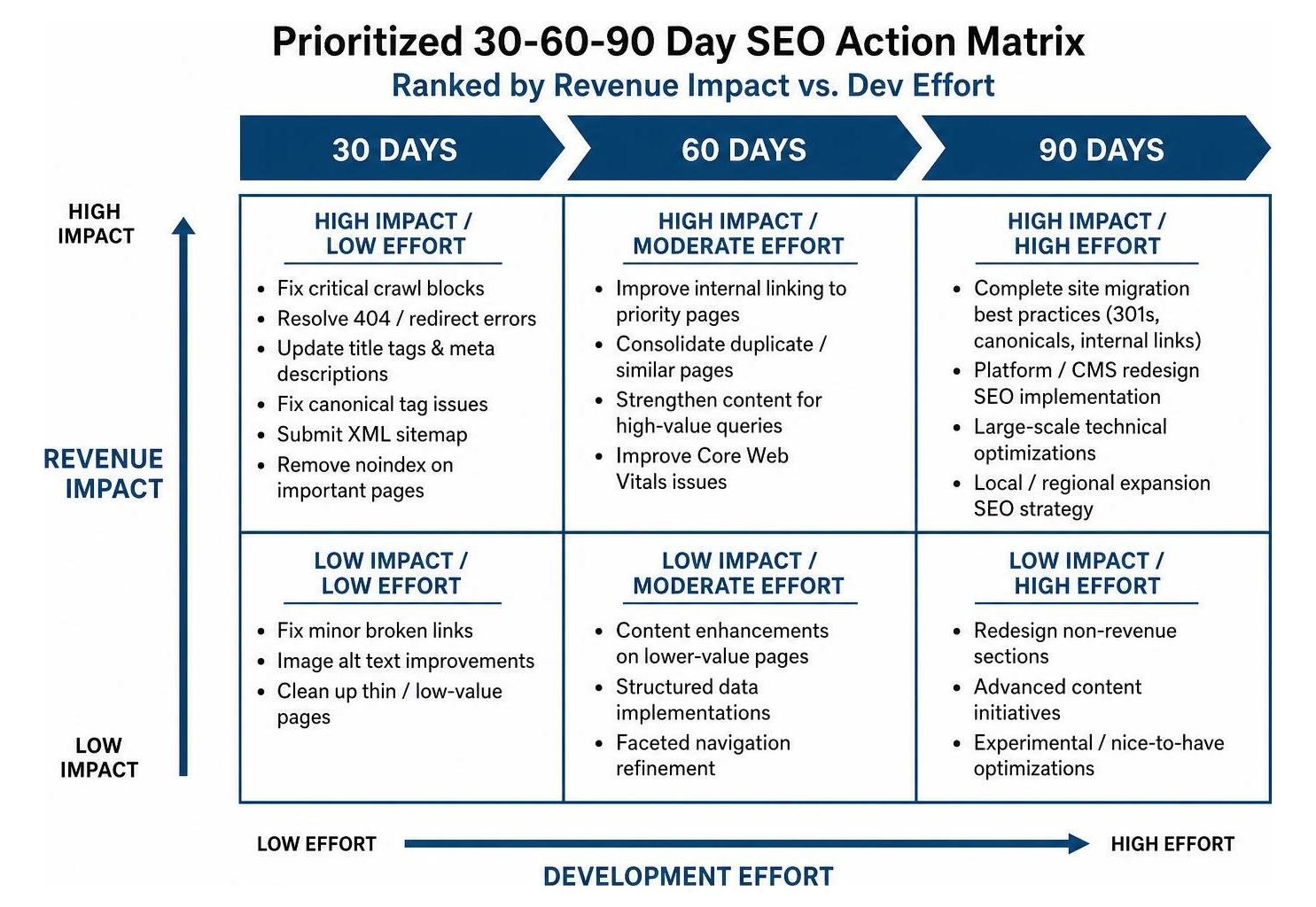
To evaluate whether an audit is a strategic asset or an automated sales pitch, measure it against three fundamental criteria:
- Specificity: Does each finding identify the exact URL, the precise code or content change required, and the underlying reason for the issue?
- Sequencing: Are recommendations arranged in a logical 30/60/90-day implementation order based on impact versus effort, or are you handed an unsorted list of 400 tasks?
- Falsifiability: Can the expected outcome of each fix be tracked and verified in Google Search Console performance data within 90 days of implementation?
The Hallmarks of Low-Quality and Automated Audits
Low-value audits typically exhibit these recurring characteristics:
- Fixation on Minor Technical Issues: Dedicating pages of analysis to missing image alt tags, meta description lengths, or harmless 404 errors on URLs that receive zero traffic and have no backlinks.
- Reliance on Third-Party Vanity Scores: Emphasizing proprietary third-party metrics like “Domain Authority” or “Spam Score” as primary KPIs instead of analyzing verified Google Search Console impressions, clicks, indexation status, and conversions.
- One-Size-Fits-All Checklists: Recommending complex schema markup or site-wide rewrites without reviewing your business model, customer acquisition journey, or profit margins.
The Hallmarks of a High-Impact Strategic Diagnostic
A high-value SEO audit provides:
- Search Console and Log Integration: Combining real performance data with server access logs to uncover how search engine crawlers actually interact with your site.
- Impact vs. Effort Prioritization: Categorizing every task into a clear matrix (Quick Wins, Strategic Projects, Low Priority) so your developers tackle revenue-moving fixes first.
- Competitive Gap Benchmarking: Comparing your technical infrastructure, backlink velocity, and content depth against market leaders through a detailed competitor website audit.
- Developer-Ready Implementation Briefs: Providing explicit instructions, code snippets, and redirect maps that your internal team or web agency can execute immediately without ambiguity.
Can You Conduct a DIY SEO Audit and When Should You Hire Professionals?
If you run a smaller website (under 500 pages) and have basic technical familiarity, you can perform an effective DIY SEO health check using reliable free tools.
Follow this step-by-step DIY diagnostic process:
- Inspect Google Search Console Indexation: Navigate to the Pages report. Review the “Not Indexed” section. Look for unintended spikes in “Crawled – currently not indexed” or “Discovered – currently not indexed,” which often signal site-wide content quality or duplicate content problems.
- Audit Real-World Core Web Vitals: Run your primary homepage, top conversion pages, and key category templates through PageSpeed Insights. Focus specifically on mobile field data for INP (under 200ms) and LCP (under 2.5s).
- Run a Desktop Crawl: Use the free version of Screaming Frog (covers up to 500 URLs) to crawl your site. Filter for 4xx client errors, broken internal redirects (301 loops), missing canonical tags, and unintended
noindextags on live pages. - Probe AI Answer Engines: Query ChatGPT, Claude, and Perplexity with your primary service keywords and brand name (e.g., “Who are the leading commercial contractors in [Your City]?”). Note whether your brand is cited, what source domains are referenced, and where your competitors appear.
When to Transition to a Professional SEO Diagnostic
While a DIY approach catches basic surface-level errors, it has limitations. Free tools cannot easily evaluate complex JavaScript rendering, analyze server crawl logs, resolve faceted e-commerce duplication, or provide unbiased strategic prioritization.
When your organic revenue plateaus, your website scales beyond hundreds of pages, or you are preparing for a major platform rebuild, hiring specialists for a professional SEO audit provides the deep analysis required to safeguard and grow your market position.
Before hiring any SEO agency or consultant, ask these critical qualifying questions:
- Will this audit be manually conducted and interpreted by a senior strategist, or generated via automated software?
- How do you prioritize recommendations between high-impact revenue tasks and minor technical items?
- Can you share a redacted sample of a previous audit deliverable?
- Do you provide post-audit implementation support and developer walkthroughs?
Frequently Asked Questions About SEO Audits
How long does it take to see results after implementing an SEO audit?
The time required to see measurable improvements depends on the specific issues addressed:
- Critical Technical Fixes (Days to Weeks): Removing accidental
noindextags, fixing brokenrobots.txtfiles, or correcting critical redirect loops often produces noticeable indexation recoveries within 7 to 21 days as search engines re-crawl your site. - Core Web Vitals Updates (28-Day Rolling Window): Google’s field data is aggregated from Chrome user metrics over a 28-day rolling cycle. Measurable score updates will reflect in Search Console roughly one month after shipping technical speed improvements.
- Content and Link Strategy Improvements (3 to 6 Months): Building content authority, resolving site-wide quality issues, and earning backlink equity requires sustained effort. Industry studies show that only 1.74% of newly published pages reach the top 10 search results within a year, and the average number-one ranking page across Google is roughly five years old. Organic growth is a compounding process, not an overnight switch.
How often should a website undergo an SEO audit?
We recommend a three-tiered auditing cadence:
- Annual Comprehensive Diagnostic: A full architectural, content, backlink, and AI-readiness review once every 12 months to set yearly strategic priorities.
- Quarterly Mini-Audits: A focused quarterly review of Search Console indexation health, Core Web Vitals stability, and recent content cluster performance.
- Event-Driven Audits: An immediate audit whenever you launch a major website redesign, migrate CMS platforms, restructure primary navigation menus, or experience an unexpected drop in organic traffic.
Does an SEO audit guarantee higher Google rankings?
No. An SEO audit is strictly a diagnostic and strategic deliverable; on its own, it produces zero ranking changes.
The value of an audit depends entirely on execution. A 10-page diagnostic whose top three recommendations are fully implemented by your development team within 30 days will generate substantially more traffic and revenue than a 100-page enterprise audit that sits untouched in a shared drive.
Conclusion
Are SEO audits worth it in 2026? Yes—provided you receive a prioritized strategic roadmap tied to commercial revenue rather than an automated data dump, and your team has the commitment to execute the findings.
Search engines and AI answer engines demand clean technical architecture, well-structured content, and genuine brand authority. A thorough diagnostic cuts through vanity metrics, pinpoints the structural bottlenecks holding back your business, and ensures every marketing dollar is spent on work that drives measurable growth.
If you are ready to evaluate your website’s performance, uncover untapped search opportunities, and build an organic acquisition strategy without long-term contracts, we are here to help. Reach out to schedule a complimentary strategic consultation with BullsEye Internet Marketing today, and let us help you turn your search visibility into sustainable, profitable revenue.
