
Why Is Pay-Per-Lead the Ultimate Customer Acquisition Model in 2026?
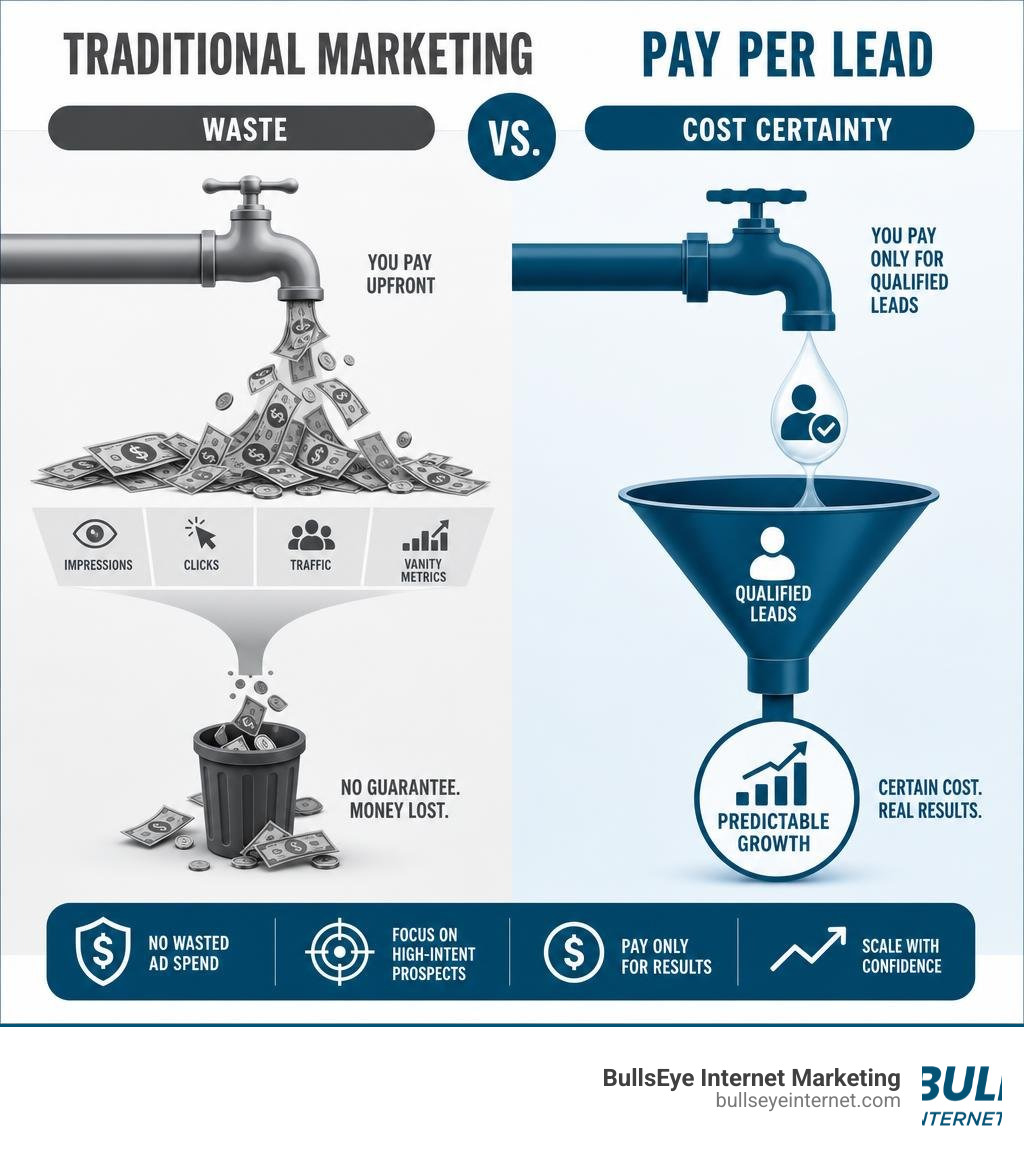
In July 2026, the digital advertising landscape is more crowded, expensive, and volatile than ever before. Traditional marketing models that rely on upfront retainer fees or pay-per-click (PPC) pricing are increasingly failing to deliver sustainable growth. For many business owners, writing a massive check to an agency every month without any guarantee of sales has become an unsustainable gamble.
The core issue lies in what these traditional models optimize for: vanity metrics. Traditional agencies will happily report on “impressions,” “clicks,” and “traffic increases.” However, clicks do not pay the bills. In fact, 55% of marketers report barely reaching their lead generation targets last year, and the struggle has only intensified. Modern businesses cannot afford to fund an agency’s learning curve while hoping that traffic eventually translates into revenue.
This frustration has driven a massive industry shift toward pay-per-lead (PPL) services. A pay-per-lead service is a pure performance-based marketing model where you only pay when a qualified prospect takes a direct, high-intent action to contact your business—such as calling your office or submitting a detailed inquiry form.
The data highlights why this shift is occurring:
- 54% of B2B marketers state that improving lead quality and conversion rates is their single greatest marketing challenge.
- 41% of B2B marketers are consistently challenged with simply generating enough leads to keep their sales pipelines full.
- Traditional digital advertising models are increasingly inefficient; B2B companies spend an average of 8.7% of their revenue on advertising, yet much of that budget is lost to low-intent clicks and high website bounce rates.
By transitioning to a pay-per-lead model, you align the marketing agency’s incentives directly with your business goals. If the agency does not deliver qualified prospects, you do not pay. This simple, transparent arrangement makes PPL the ultimate customer acquisition model for growth-minded businesses looking to scale predictably.
What Is a Pay-Per-Lead Service and How Does It Work?
To understand why the pay-per-lead model is so disruptive, it helps to compare it directly to other common marketing structures.
| Feature | Pay-Per-Lead (PPL) | Pay-Per-Click (PPC) | Monthly Retainers |
|---|---|---|---|
| What You Pay For | Valid, qualified leads (calls or forms) | Clicks on ads (regardless of intent or conversion) | Ongoing services, strategy, and management |
| Financial Risk | Low (The agency fronts all ad spend and setup costs) | High (You pay for every click, even if they bounce immediately) | High (You pay the flat fee regardless of lead volume or quality) |
| Cost Predictability | High (Fixed, agreed-upon cost per lead) | Low (Fluctuating keyword costs and unpredictable click volume) | Medium (Fixed monthly cost, but highly variable cost-per-lead) |
| Lead Quality | High (Pre-screened and filtered based on your criteria) | Variable (Unfiltered search traffic of varying intent) | Variable (Dependent on the agency’s skill and optimization) |
| Contract Terms | Flexible (Typically performance-based with no long-term lock-ins) | Variable (Self-managed or short-term agency contracts) | Rigid (Often requires 6-month to 12-month commitments) |
Under the PPL framework, the mechanics of a campaign are straightforward but require significant expertise from the provider. Instead of charging you to build a website, write ad copy, and manage campaigns, the PPL provider funds the entire infrastructure. They conduct the market research, design high-converting landing pages, buy the search engine ads, and manage the optimization.
When a prospect in your target geographic area searches for your service, they land on these proprietary assets and submit their information or call the tracking number. The platform validates the lead in real time and routes it directly to your team. You are billed a flat, pre-negotiated fee only for leads that meet your exact qualification criteria.
This model is a direct answer to the inherent risks of click-based advertising. When you consider that the average click-through rate for PPC ads is just 2.35%, with more than 90% of those clicks bouncing without taking action, it becomes clear that paying for clicks is a highly speculative venture. By shifting to PPL, you let the agency assume that click-to-conversion risk. To learn more about how this model can revolutionize your pipeline, read our guide on how to Transform Your Lead Generation Strategy with Pay Lead Marketing.
The Role of the Lead Generation Agency
In a true pay-per-lead partnership, the agency acts as your outsourced, fully funded customer acquisition engine. Because the agency fronts 100% of the advertising costs, setup fees, and creative development, they are highly incentivized to build incredibly efficient campaigns.
We build custom landing pages, write compelling direct-response ad copy, and continuously optimize the conversion funnels. If our ads perform poorly or target the wrong keywords, we absorb the financial loss. This complete transfer of marketing risk from your business to our agency ensures that we only succeed when you succeed.
The Lead Delivery Process
For a PPL campaign to be successful, the transition from prospect to sales team must be seamless and instantaneous. Modern PPL platforms utilize advanced routing technology to deliver leads in real time.
When a customer fills out a web form or places a call, the data is pushed instantly via webhooks or direct integrations into your CRM (such as Salesforce, HubSpot, or GoHighLevel). Speed-to-lead is a critical factor in closing deals; top-tier agencies route web leads to your sales team in under 8 seconds. For phone leads, the call is routed directly to your office phone or call center, accompanied by automated text or email notifications so your team is primed to answer immediately.
What Are the Main Benefits of Using Pay-Per-Lead Services?

The primary appeal of pay-per-lead services is the sheer predictability they bring to your balance sheet. Instead of guessing how many customers your marketing budget will yield this month, you can calculate your acquisition costs down to the penny. This level of control allows you to scale your business up or down based on your current operational capacity. If your crews are fully booked, you can request a temporary pause on lead delivery; if you hire new staff, you can increase your lead volume. To understand the broader impact of this approach, explore How Pay Per Lead Marketing Drives Real Results.
Guaranteed Performance and Cost Certainty
With PPL, there is a direct, unbreakable correlation between your marketing expenditure and your business opportunities. You are no longer paying for “brand awareness” or “search engine visibility”—you are paying for actual hand-raisers.
This cost certainty is why performance-based models are highly lucrative. For example, industry data shows that local service clients utilizing structured pay-per-call marketplaces achieve an average 8.5X return on investment. Because you only pay for valid inquiries, every dollar spent is directly tied to a prospective customer, maximizing your marketing efficiency and protecting your cash flow.
Higher Lead Quality and Intent
Because PPL agencies only get paid for qualified leads, they implement strict pre-screening and qualification filters to weed out low-value traffic. This means the prospects delivered to your team are high-intent buyers actively searching for a solution to their immediate problem.
By filtering out solicitors, spam, wrong numbers, and out-of-area inquiries before they ever reach your phone line, your sales team can focus entirely on closing deals. This rigorous vetting process results in exceptionally high engagement; for instance, top-tier performance campaigns deliver an average of 37 calls per month with a 61% average appointment rate on those calls. Your sales team spent less time chasing dead ends and more time booking profitable jobs.
What Are the Risks and Drawbacks of the Pay-Per-Lead Model?
While the benefits of pay-per-lead are substantial, the model is not without its risks. The performance-marketing industry is highly competitive, and not all lead generation providers operate with the same standards of quality and integrity. If you partner with a low-quality provider, you may find yourself dealing with recycled data, non-compliant opt-ins, or hyper-competitive bidding wars. Vetting your partners is essential, which is why choosing a reputable Pay Per Lead Marketing Agency is critical to protecting your brand.
The Pitfalls of Shared Leads
One of the most common complaints about high-volume lead generation platforms is the use of “shared leads.” In a shared lead model, the agency sells the exact same prospect’s contact information to three, four, or even five competing businesses simultaneously.
This setup creates an incredibly stressful environment for both the consumer and your sales team. The consumer is immediately bombarded with phone calls from multiple companies, while your sales team is forced to engage in a race to the phone. If you aren’t the first to call back within 60 seconds, your chances of closing the deal drop dramatically. Furthermore, shared leads inevitably force businesses to compete on price, driving down your profit margins. Exclusive leads, where the prospect is routed solely to your business, are vastly superior and yield much higher close rates, easily justifying their higher upfront cost.
Compliance and Brand Integrity Risks
In 2026, data privacy and consumer protection laws are stricter than ever. Operating a lead generation campaign requires strict adherence to regulations such as the Telephone Consumer Protection Act (TCPA), CAN-SPAM, CCPA, and GDPR.
If a lead provider uses deceptive ads, spammy cold emails, or fails to secure proper, documented consent (such as prior express written consent for automated calls), your business can be held legally liable. Class-action TCPA lawsuits can result in devastating fines ranging from $500 to $1,500 per non-compliant call. Reputable lead generation agencies mitigate this risk by utilizing independent, third-party lead-certification and consent-verification tools. These platforms document the user’s journey, capturing a visual record of the consent given to protect your brand and ensure total legal compliance.
What Variations of the Pay-Per-Lead Model Exist?
The pay-per-lead model is highly adaptable, with several variations designed to match different business models, sales cycles, and target audiences. Choosing the right variation depends on whether your sales team thrives on live phone conversations or prefers to work through structured email and CRM follow-ups. To explore how these models are deployed across different campaigns, read about Pay Per Lead Advertising.
Key Qualification Criteria for Pay-Per-Call Leads
To ensure that you only pay for high-intent phone calls, reputable agencies establish strict qualification parameters. Common criteria include:
- Minimum Call Duration: The call must last a minimum length of time (typically 30 to 90 seconds) to filter out wrong numbers and quick hang-ups.
- Geographic Filtering: The caller must be located within your specific service area, verified by their area code or zip code.
- Service Match: The caller must be seeking a service you actually provide, rather than an unrelated request.
- New Customer Status: The lead must be a first-time caller, not an existing customer calling for billing or support.
Pay Per Qualified Lead (PPQL)
The Pay Per Qualified Lead (PPQL) model goes a step beyond standard lead generation by requiring prospects to pass through detailed custom intake forms or interactive AI-powered screening quizzes before they are delivered to your CRM.
This model is highly effective for high-value B2B services, niche consulting, or complex home remodeling projects where specific criteria must be met (such as homeownership, budget size, or project timeline). By requiring the prospect to answer multiple detailed questions, you naturally filter out low-intent window shoppers. Furthermore, a transparent PPQL agreement includes a clear dispute and credit process, allowing you to get a full refund or replacement lead if a contact bypasses the filters with fake information or invalid phone numbers.
Pay Per Call (Pay-Per-Call)
For local service businesses, inbound phone calls are the single most valuable lead type. When a homeowner has a burst pipe, a leaking roof, or an air conditioner failure in the middle of a Florida summer, they do not want to fill out a form and wait for an email response. They want to speak to a professional immediately.
Pay-per-call campaigns leverage this high-intent behavior by running call-only search ads and mobile-optimized campaigns. Because the prospect is actively placing the call, these leads represent the absolute highest intent in the market. In fact, industry data shows that live phone calls convert 3 to 10 times better than standard web form submissions, making them incredibly easy for your team to close.
Which Industries Benefit Most From Pay-Per-Lead Services?
While PPL can work for almost any business, it is exceptionally powerful for industries characterized by high transaction values, strong profit margins, or urgent, immediate-need customer scenarios. In these verticals, a single closed lead can easily cover the cost of an entire month’s worth of lead generation.
Local Home Services
Urgent-need home services are the perfect match for pay-per-lead marketing. When disaster strikes, homeowners need immediate help, and they turn to search engines to find local professionals.
For local businesses operating in South Florida—from the busy streets of Miami to the residential communities of Palm Beach County—dominating your local service radius is critical. PPL allows local contractors to secure a steady stream of exclusive phone calls without having to manage complex ad campaigns or waste money on broad, non-converting search terms. Whether you are looking to grow a specific trade or expand your local footprint, targeted performance campaigns are highly effective. Explore our specialized guides to see how this works in your specific field:
- Water Damage Pay Per Lead
- Roofing Pay Per Lead 101
- HVAC Pay Per Lead Guide
- Electrician Pay Per Lead
- Pest Control Pay Per Lead
Additionally, local businesses can leverage resources provided by municipal entities, such as the Marketing & Advertising guidelines in Miami-Dade County, to align their outreach with local compliance standards. By focusing on geo-targeted marketing and local compliance, businesses across South Florida can build highly effective campaigns that resonate with regional consumer behavior.
Legal and Personal Injury
The legal vertical—particularly personal injury and motor vehicle accident (MVA) law—is one of the most competitive advertising spaces in the world. Keywords like “car accident lawyer Miami” can cost upwards of $150 to $300 per click on Google Ads, with no guarantee that the clicker even has a valid case.
Because of these astronomical costs, many law firms are moving away from traditional PPC management and partnering with exclusive legal lead providers. By paying a flat rate for exclusive, pre-screened accident victims who have verified injuries and are not currently represented by another attorney, law firms can build a highly predictable caseload. This performance-driven approach allows lawyers to focus on litigating cases rather than managing complex digital ad accounts. To learn more about scaling your practice, read our guide on Pay Per Lead for Lawyers.
B2B Tech and Real Estate
In the B2B technology sector, sales cycles are long, and reaching decision-makers is incredibly difficult. The average cost per lead (CPL) within the tech industry is $208, and traditional content syndication often results in cold, unresponsive contacts. By utilizing targeted pay-per-lead campaigns that focus on qualified appointments or content downloads from verified decision-makers, tech companies can accelerate their sales pipelines without wasting budget.
Similarly, in the highly competitive South Florida real estate market, securing exclusive buyer and seller inquiries is the key to maintaining a healthy pipeline. Rather than spending thousands of dollars on broad branding campaigns, real estate professionals can use PPL to receive high-intent inquiries from local residents looking to buy or sell properties in their specific zip codes. For a detailed breakdown of how to implement this in your agency, check out our guide on Real Estate Pay Per Lead.
For B2B tech companies seeking enterprise-scale customer acquisition, implementing strict pay-for-performance models ensures that marketing budgets are directly tied to measurable results. By structuring custom performance campaigns, high-value service providers can scale their outreach across multiple industries while maintaining a highly predictable cost per acquisition.
How Do You Choose the Right Pay-Per-Lead Provider for Your Business?
Choosing a pay-per-lead partner is a major business decision. The right provider will act as a seamless extension of your sales team, delivering a steady flow of high-converting opportunities. The wrong provider will drain your intake resources with junk calls, lock you into rigid contracts, and sell your leads to your direct competitors. To protect your investment, it is vital to understand how to evaluate these agencies. Read our comprehensive guide on how to Unlock Your Potential: Understanding Pay Per Lead Marketing Agencies for a deeper look at the vetting process.
Exclusivity and Geographic Monopolies
The single most important factor when choosing a PPL provider is lead exclusivity. If an agency sells the same lead to you and three of your competitors, they are actively undermining your conversion rates and forcing you into a price war.
At BullsEye Internet Marketing, we take a fundamentally different approach. We work with only one client per industry per geographic area. This exclusive partnership gives you a massive competitive advantage. When we generate a high-intent phone call or web inquiry in your target Florida market—whether that’s in Miami, Fort Lauderdale, West Palm Beach, or Stuart—that lead belongs 100% to you. We build a geographic monopoly around your business, ensuring that your competitors never see the opportunities we generate for you.
Transparent Tracking and Dispute Policies
A reputable PPL agency operates with complete transparency. You should have access to a real-time dashboard where you can view every lead, read form submissions, and listen to call recordings. This level of tracking is essential for verifying lead quality and training your intake team.
Furthermore, the agency must offer a fair, no-questions-asked dispute policy for invalid leads. If a lead turns out to be a wrong number, a solicitor, a duplicate, or is located outside your agreed-upon service area, you should receive an immediate credit. Finally, avoid agencies that attempt to lock you into long-term contracts or charge massive, upfront setup fees. A true performance-based agency is confident in their ability to deliver results, which is why we offer no long-term contracts—our performance is what keeps our clients partnering with us month after month.
In-House vs. Outsourced Leads: BullsEye Internet Marketing
While outsourcing to a pay-per-lead service offers immediate results and zero financial risk, it is not always the best long-term strategy for every business. Depending on your business goals, internal resources, and growth horizon, investing in building your own digital assets can sometimes make more financial sense.
Long-Term Brand Equity and Cost Efficiency
When you buy leads from a PPL provider, you are essentially renting their digital marketing infrastructure. While this is highly effective for generating immediate revenue, it does not build long-term value for your own brand.
Building your own in-house lead generation engine—by investing in search engine optimization (SEO), optimizing your Google Business Profile, and managing your own PPC campaigns—creates permanent digital assets. Once your website ranks organically at the top of Google search results for high-intent keywords in your local South Florida market, those organic leads are essentially free. Over time, a successful in-house SEO and local map strategy can drive your average cost-per-lead far below what you would pay a third-party provider, while simultaneously building massive brand equity in your local community.
The Hybrid Lead Generation Strategy
For most growing businesses, the ideal solution is not a strict choice between outsourcing and building in-house—it is a hybrid strategy.
You can leverage pay-per-lead services to secure immediate, high-intent phone calls and keep your crews busy today, while simultaneously investing in long-term organic SEO and Google Business Profile optimization to build your own brand’s digital footprint. This dual approach ensures that your sales pipeline remains full and consistent, protecting your business from seasonal fluctuations and changes in search engine algorithms.
What Are the Most Common Questions About Pay-Per-Lead Services?
How much do pay-per-lead services typically cost?
The cost-per-lead (CPL) in a performance-based model varies widely based on your industry, geographic location, level of competition, and the strictness of your qualification criteria.
- For highly competitive local home services (such as emergency water damage restoration or roofing in South Florida), exclusive, high-intent phone leads typically range from $25 to $150+ per lead.
- For legal verticals (such as personal injury or motor vehicle accidents) and B2B tech appointments, leads are much more valuable and typically range from $75 to $250+ per lead.
To determine if a provider’s CPL is realistic for your business, you must calculate your Customer Lifetime Value (CLV) and your sales team’s close rate. For example, if your average profit per closed job is $2,000 and your team closes 20% of your leads, you can comfortably afford a $100 CPL while maintaining a highly profitable return on ad spend.
What is the difference between exclusive and shared leads?
Exclusive leads are routed in real time to only one business. This means the prospect is expecting your call, you face zero competition on price, and your close rates are significantly higher. Shared leads are sold to multiple competing businesses simultaneously. While shared leads are cheaper upfront, they require your team to call the prospect within seconds of submission, and they frequently result in low close rates and thin profit margins as competitors undercut each other on price.
How do pay-per-lead companies verify lead quality?
Reputable PPL agencies use a multi-step verification process to ensure that you only pay for genuine, high-intent opportunities. This includes:
- One-Time Passcode (OTP) Verification: Verifying that the prospect’s phone number is active and reachable before routing the lead.
- Interactive Voice Response (Response Filters): Using automated phone menus to ensure the caller is seeking a service you actually offer.
- AI-Powered Screening: Analyzing form submissions and call recordings in real time to filter out spam, solicitors, and repeat callers.
- Duration-Based Filters: Ensuring that phone leads are only billable if the call lasts past a specific duration (e.g., 60 seconds), giving your team ample time to qualify the caller.
How Can You Get Started with a Pay-Per-Lead Strategy Today?
Transitioning to a performance-based marketing model is the single most effective way to eliminate wasted ad spend, take control of your customer acquisition costs, and accelerate your business growth in July 2026. By letting the marketing agency assume all the financial risk, you can focus on what you do best: delivering exceptional service to your customers and closing sales.
If you are ready to stop paying for empty promises and start paying for real, measurable results, we are here to help. At BullsEye Internet Marketing, we specialize in generating high-intent phone calls and booked appointments for businesses across South Florida and nationwide. With our strict policy of working with only one client per industry per geographic area and offering no long-term contracts, we provide you with a powerful, exclusive competitive advantage.
Take the first step toward predictable, risk-free growth. Contact our team at BullsEye Internet Marketing today to secure your geographic monopoly and launch your custom Pay Per Lead campaign.
