
Why Trust is the Currency of Local Service Leads
Google Local Service Ads background check is a mandatory screening process that verifies your business and employees before you can advertise on Google’s platform. Here’s what you need to know:
- Who’s Checked: Business owners, field workers, and your company itself
- What’s Verified: Criminal history, licenses, insurance, business registration, and civil litigation records
- Who Does It: Pinkerton Consulting and other trusted third-party partners
- Cost: Free for businesses
- Timeline: 3-4 weeks on average
- Frequency: Annual renewal required, plus checks for new employees
- Failure Impact: 30-day wait to reapply (180 days for second denial)
If you’ve ever searched for a local service provider on Google, you’ve probably noticed those businesses with a green checkmark and “Google Screened” or “Google Guaranteed” badge at the top of results. That badge isn’t just for show—it signals to customers that Google has vetted your business through a rigorous background check process. For service businesses competing in crowded local markets, that badge is the difference between a phone call and being scrolled past.
The screening process exists for one simple reason: customer safety and trust. Google knows that people searching for plumbers, lawyers, electricians, or childcare providers are inviting these businesses into their homes, offices, and lives. By requiring thorough background checks, license verification, and insurance proof, Google builds confidence for consumers while giving verified businesses a massive competitive advantage in search results.
But here’s the reality many business owners face: the verification process can feel like a black box. What exactly does Google check? How long does it take? What happens if something goes wrong? And most importantly—is it worth the effort?
I’m Ronnie Katz, founder of BullsEye Internet Marketing, and I’ve helped hundreds of local service businesses steer the Google Local Service Ads background check process and leverage that verification badge to dominate their markets. The screening requirements are strict, but they’re also your ticket to standing out in the most competitive space in local search.
Google local service ads background check terms to remember:
Deconstructing the Verification: Core Components of the LSA Screening
When we talk about the Google Local Service Ads background check, we’re really talking about a comprehensive screening process designed to protect consumers and lift trustworthy businesses. Think of it as Google’s way of saying, “We’ve done our homework on this one, so you don’t have to.” The primary purpose is to ensure customer safety and build an ecosystem of credible service providers. This rigorous process is what allows businesses like yours to gain that coveted “Google Screened” or “Google Guaranteed” badge, which instantly communicates reliability and professionalism to potential clients.
The screening process isn’t just a formality; it’s a critical component that underpins the entire Local Services Ads program. It allows us to assure customers that when they choose a business through LSA, they’re choosing a vetted and reputable provider. This commitment to verification is a significant part of why Local Services Ads are so effective at generating high-quality leads – customers trust the Google badge.

Who Performs the Background Checks?
So, who are these unsung heroes diligently digging into business histories? Google doesn’t do it all themselves. For businesses in North America, the Google Local Service Ads background check is primarily performed by specialized third-party partners. One of the most prominent names you’ll encounter is Pinkerton Consulting and Investigations, Inc. They are a well-known provider tasked with conducting these thorough checks.
These aren’t just random checks; these are conducted by reputable third-party risk management companies. Google’s commitment to consumer safety means these partners must adhere to strict data security audits and maintain confidentiality regarding the results. Your sensitive information is handled with care and discretion. If you have questions about what information is checked or how to appeal a decision, your first point of contact will usually be these local background check partners, as the results are strictly confidential between your business and them. You can learn more about their processes through resources like Pinkerton Consulting and Investigations, Inc.
What Does the Screening Look For?
The Google Local Service Ads background check is a multi-faceted process that examines both your business as an entity and the individuals associated with it. It’s like a deep dive into your professional history, ensuring everything is above board.
Here’s a breakdown of what the screening typically looks for:
Business-level Checks: This involves verifying your business’s legitimacy and history. In the United States, this often includes checking for a D-U-N-S® number from Dun & Bradstreet, which helps confirm your business identity. If you’re unsure about your D-U-N-S® number, you can easily look it up or apply for one through the Dun & Bradstreet lookup page. Company-level checks also dig into civil litigation history, such as judgments and liens from federal and state courts in the US. This helps ensure your business doesn’t have a pattern of significant legal disputes.
Employee-level Checks: This is where the individual scrutiny comes in. Google’s rigorous verification process includes background checks on you as the business owner and any employees who will be interacting with customers in the field. These checks include:
- Identity Verification: Confirming the validity of Social Security numbers and other identifying information.
- Criminal History: A thorough check for criminal records, including cross-references against national sex offender, terrorist, or sanctions registries. This is crucial for ensuring the safety of customers who invite service providers into their homes or trust them with their families.
- Important Note: It’s worth highlighting that these background checks do not involve a credit check or credit pull. Google is focused on safety and legitimacy, not your financial standing. Also, not all employees need to be checked; typically, it’s the business owners and field workers, not office staff, clerical workers, or customer support representatives who don’t directly service customers.
License Verification: Google verifies that your business and relevant individuals hold all applicable state, provincial, or country-level licenses. For instance, a licensed electrician in Florida will have their state license verified. For healthcare verticals in the US, National Provider Identifier (NPI) verification is a prerequisite, ensuring medical professionals are properly registered. Lawyers in Florida, for example, will have their State Bar license verified.
Insurance Verification: Proof of appropriate insurance coverage is a must. This typically includes general liability insurance, and in some cases, professional liability insurance, depending on your industry. Google needs to see valid certificates of insurance that meet specific minimum coverage requirements and are active for a certain period post-submission. The name on your insurance documents must match the name you’re advertising with, and the business address should cover your service area.
Business Registration: Beyond the D-U-N-S® number, Google verifies that your business is properly registered according to relevant state and federal laws. This might involve providing documentation from the Secretary of State, your EIN with the IRS, or registration with the Department of Revenue.
This detailed screening process ensures that businesses earning the Google badge are not just legitimate, but also uphold a standard of safety and trustworthiness that consumers can rely on.
Cost, Timeline, and Frequency
Good news for your budget: the Google Local Service Ads background check itself is free of charge for your business. Google covers the cost of these third-party checks, which is a fantastic benefit for small and local businesses looking to expand their reach.
However, “free” doesn’t mean instantaneous. The screening and verification process typically takes about a month, or 3-4 weeks to complete, after you’ve submitted all the necessary documents. This timeframe can vary based on the complexity of your business structure and how quickly the third-party partners can process your information. So, patience is a virtue here!
Once you’ve successfully passed the initial checks and received your Google badge, the process doesn’t stop forever. Background checks need to be renewed on an annual basis. This annual re-check ensures ongoing compliance and maintains the integrity of the program. Additionally, if you bring on new team members who will be working in the field and interacting with customers, they will also need to undergo a Google Local Service Ads background check to ensure everyone representing your business meets Google’s standards.
Local Service Ads Verification Guide: BullsEye Internet Marketing
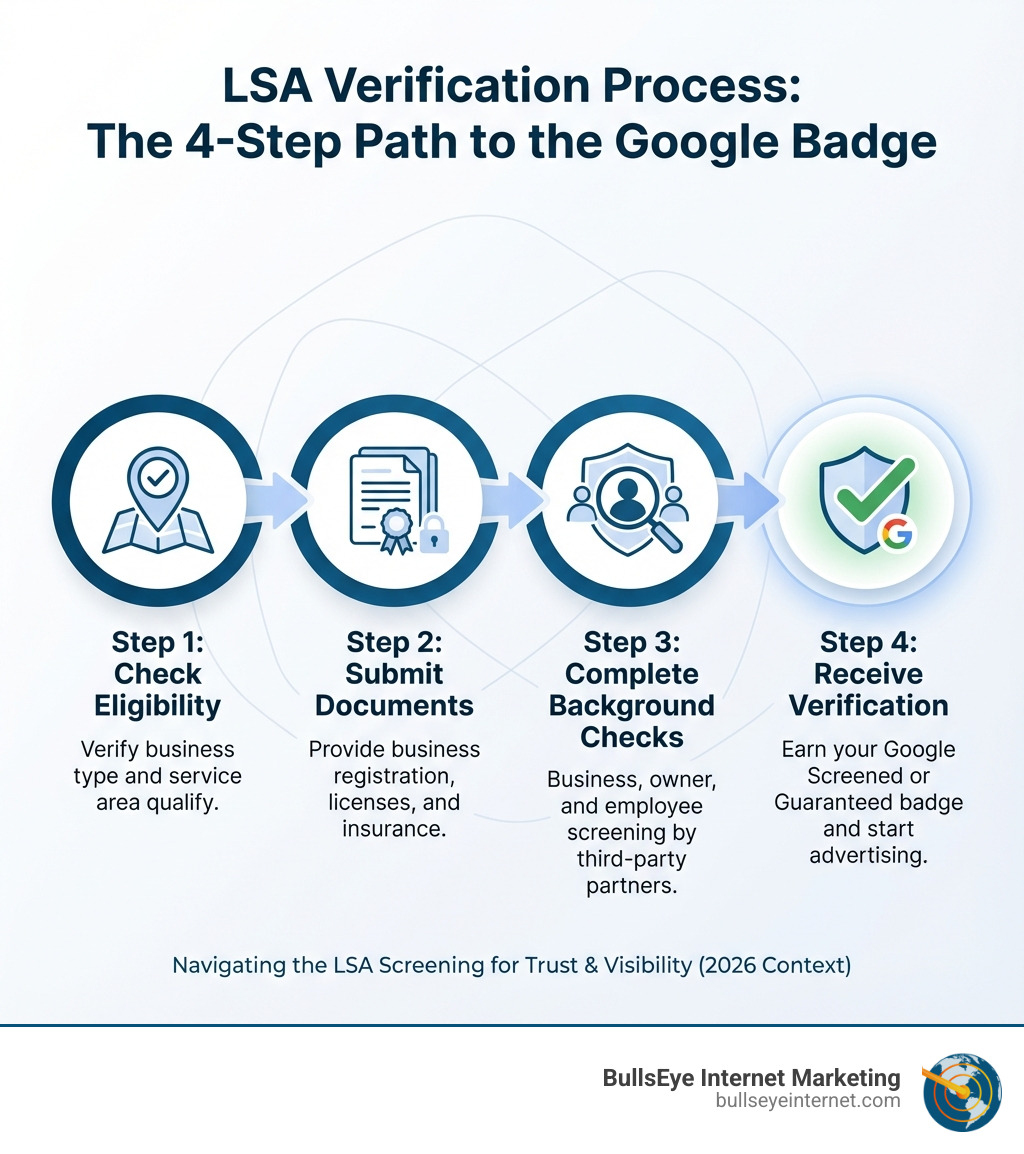
Navigating the Google Local Service Ads background check and verification process might seem daunting at first, but with a clear roadmap, it’s entirely manageable. We’ve helped countless businesses in Florida, from Miami-Dade to Palm Beach County, successfully get their LSA campaigns up and running. It all boils down to a few key steps. This isn’t just about ticking boxes; it’s about building a foundation of trust that will attract more leads to your business.

Step 1: Confirm Your Eligibility
Before you even think about background checks, you need to confirm that your business is eligible for Local Services Ads. Google has specific criteria based on your industry and geographic location. For instance, we’ve seen great success with Google Local Services Ads for Lawyers and Google Local Services Ads for Home Services across our service areas.
Here’s how to figure it out:
- Service Categories: Local Services Ads are designed for service-based businesses in various categories, including home services (plumbers, electricians, HVAC), business services, health (dentists, chiropractors), learning (tutors, childcare), care (pet care, funeral homes), wellness, beauty, and automotive. If you’re a painter in Broward County or a roofer in Martin County, chances are you’ll find your category.
- Geographic Availability: While LSA is widely available across the United States, specific categories might have regional limitations. Always check eligibility on Google’s website to ensure your specific service and location—like a tattoo studio in Miami or an insurance agency in Palm Beach County—are supported.
This initial step is crucial. There’s no point preparing documents and undergoing checks if your business type isn’t supported. Once you confirm eligibility, you’re ready to move to the next stage of the Google Local Service Ads journey.
Step 2: Prepare Your Business, License, and Insurance Documents
This is where the paperwork comes in, but don’t let it intimidate you! Having all your ducks in a row for this stage will significantly speed up your Google Local Service Ads background check process. Google needs to verify that your business is legitimate, properly licensed, and adequately insured.
Here’s what you’ll need:
- Business Registration: You’ll need to provide proof that your business is legally registered. This could be your business registration with the Florida Secretary of State, your EIN from the IRS, or registration documents from the Department of Revenue. Ensure the business name on these documents precisely matches what you use everywhere else.
- General Liability Insurance: This is almost always a requirement for Google Guaranteed businesses, especially for home service providers. You’ll need to submit a Certificate of Insurance. Make sure your policy is active and valid for at least 14 days after submission. Crucially, the name on your insurance must match your advertised business name, and the coverage area should include all the Florida counties you plan to service, such as Miami-Dade, Broward, and Palm Beach.
- Professional Licenses: Depending on your industry, you’ll need to provide proof of any required professional licenses.
- For Lawyers: If you’re a lawyer in Florida, your State Bar license is essential. Google verifies that your license is active, as lawyers are typically already required to pass background checks to obtain their licenses.
- For Healthcare Providers: If you’re running a dental practice in Coral Gables or a dermatology clinic in Doral, National Provider Identifier (NPI) verification is a prerequisite. This is done through an integration with the NPPES NPI Registry API. If there are any issues with finding your NPI or if multiple NPIs are found, you’ll need to contact Local Services Ads support to clarify. For more details on healthcare services, check out our insights on Google Local Services Ads for Dentists.
Having these documents ready and accurate will help you sail through this part of the verification.
Step 3: Initiate the Background Checks for Owners and Field Workers
This is the core of the Google Local Service Ads background check process, focusing on the people behind the business. Google’s goal is to ensure that customers can trust the individuals who will be entering their homes or providing services.
Here’s how this step typically unfolds:
- Submitting Information: Once your business documents are in order, you’ll be prompted to provide information for the background checks. This includes details for yourself as the business owner and for any employees who perform services in the field.
- Owner Checks: As the business owner, you’ll undergo a comprehensive check that includes identity verification and a criminal history check against national registries. This is a standard procedure to ensure the leadership of the business is trustworthy.
- Field-Worker Checks: Every technician, plumber, electrician, or other service professional who will be dispatched to customer locations must also pass a background check. This means providing their identifying information for similar identity and criminal history checks. It’s vital to ensure all technicians are linked to your specific business name and service area for their background checks. Office staff, clerical workers, or anyone not directly servicing customers usually doesn’t need to be checked.
- Consent Process: Before any individual background checks are conducted, each person will be given the opportunity to review necessary disclosures and must agree to the terms. This ensures transparency and compliance with privacy regulations.
- Authorized Representative: An authorized representative of your business will typically be responsible for completing the business entity background check and providing the list of service professionals for their individual checks.
This step is arguably the most critical for establishing the credibility that the Google badge represents. It’s Google’s way of vouching for the people who will be representing your business.
Google Screened vs. Google Guaranteed: Understanding the Badges (And What’s Next)
When you see a green badge next to a Local Services Ad, it means that business has passed Google’s stringent verification process. Historically, there have been two main types of these badges: “Google Screened” and “Google Guaranteed.” Understanding the differences between them has been key for businesses like ours, particularly when guiding our clients through the Google Screened vs Google Guaranteed decision. However, Google is making some changes.
Key Differences and Industry Applications
Let’s break down the traditional distinctions between Google Screened and Google Guaranteed:
| Criteria | Google Screened | Google Guaranteed |
|---|---|---|
| Industry Type | Professional services like lawyers, real estate agents, and financial planners. | Home services like plumbers, HVAC technicians, and electricians. |
| Financial Guarantee | No money-back guarantee. | Includes a money-back guarantee (up to a lifetime cap, like $2,000 in the US) if a customer is dissatisfied with the work. |
| Verification Level | Involves business-level and owner-level background and license checks. | Involves business-level, owner-level, and field worker background checks, plus license and insurance verification. The guarantee adds an extra layer of consumer protection. |
