
What You’re Really Paying for With Google Ads Services Pricing
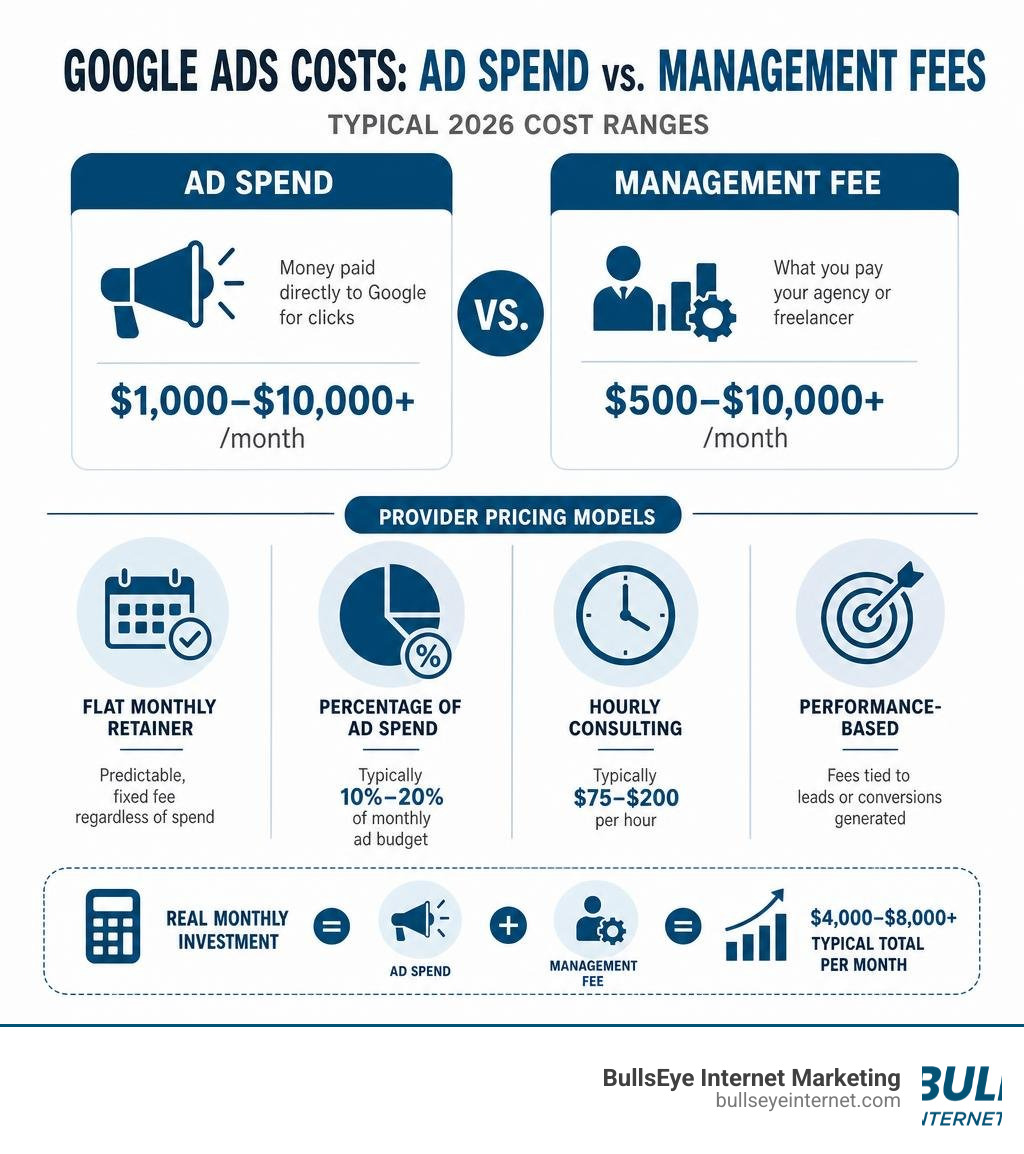
Google Ads services pricing confuses a lot of business owners — and for good reason. There are two separate costs involved, and most providers don’t explain them clearly upfront.
Here’s a quick breakdown so you know exactly what to expect:
| Cost Type | What It Is | Typical Range (2026) |
|---|---|---|
| Ad Spend | Money paid directly to Google for clicks | $1,000–$10,000+/month |
| Management Fee | What you pay your agency or freelancer | $500–$10,000+/month |
| Onboarding/Setup | One-time fee to get campaigns launched | $399–$5,000 |
The pricing model your provider uses matters just as much as the number. The four most common models are:
- Flat monthly retainer — predictable, fixed fee regardless of spend
- Percentage of ad spend — typically 10%–20% of your monthly Google Ads budget
- Hourly consulting — usually $75–$200/hour for audits or training
- Performance-based — fees tied to leads or conversions generated
The average Google Ads account spends $3,127 per month on ads alone. Add a management fee on top, and your real monthly investment is often $4,000–$8,000 or more. That’s a significant commitment — and picking the wrong pricing model or provider can quietly drain your budget without delivering results.
This guide cuts through the noise and shows you exactly what different providers charge, what’s included (and what isn’t), and which model actually aligns with your business goals.
I’m Ronnie Katz, founder of BullsEye Internet Marketing, and I’ve spent over 20 years helping businesses navigate Google Ads services pricing — from setting up first campaigns to auditing accounts where thousands of dollars were quietly being wasted. I’ll give you the straight facts here, no sales spin.
Google Ads services pricing helpful reading:
Demystifying Google Ads Services Pricing: The Core Models
Before you sign any agreement, you need to understand how your PPC partner calculates their bill. The pricing model dictates the relationship dynamics, how your account is managed, and where the agency’s primary motivations lie.
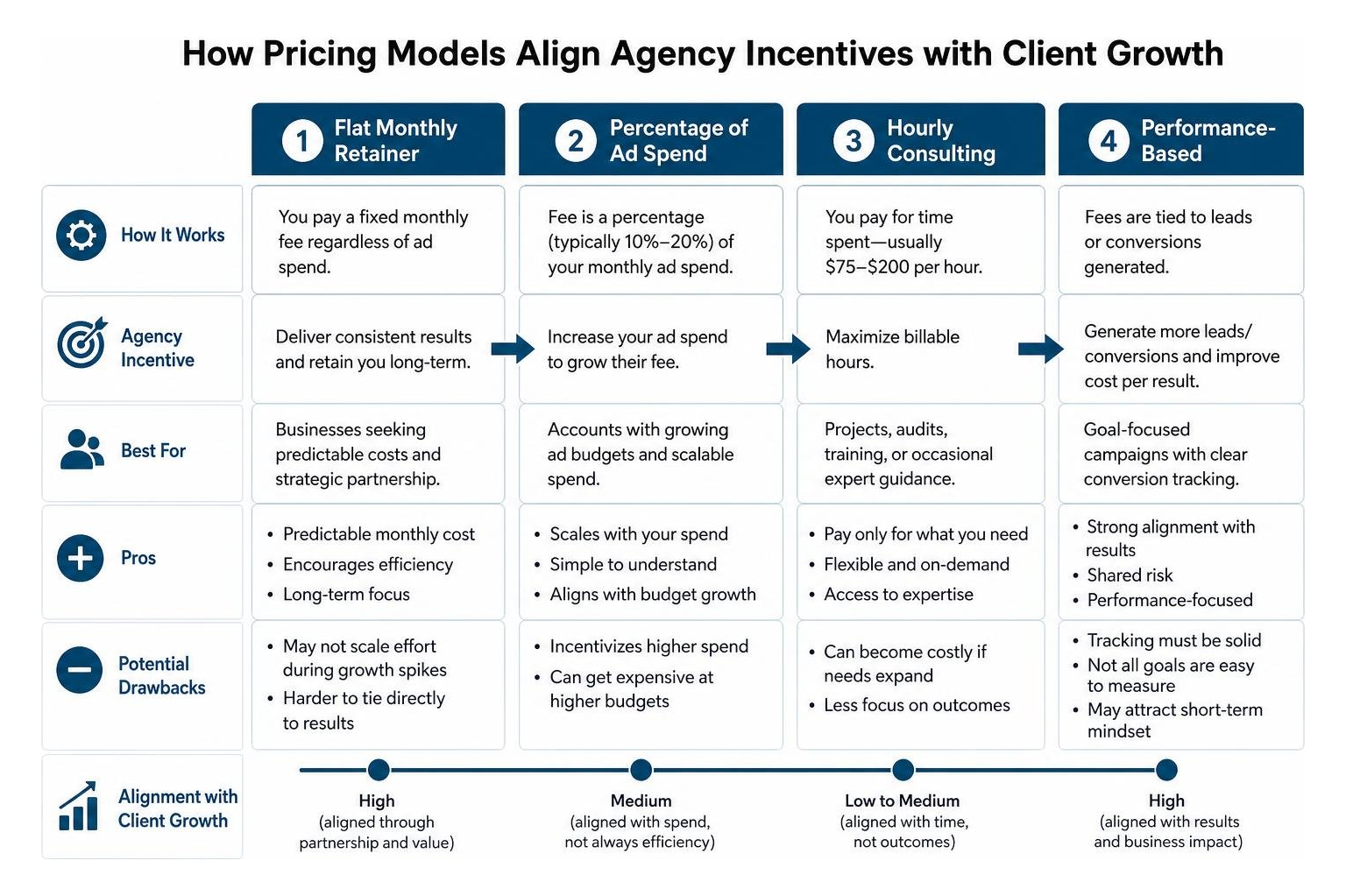
Let’s look at the four core models used across the industry in 2026: flat monthly retainers, percentage of ad spend, hourly consulting, and performance-based structures.
Flat Monthly Retainer vs. Percentage of Spend
The debate between a flat monthly retainer and a percentage-of-spend model is one of the most critical in digital marketing.
Under a percentage of ad spend model, the agency charges a set percentage (typically 10% to 20%) of your total media budget. For example, if your monthly ad spend is $10,000 and your agency’s fee is 15%, you pay them $1,500. If you scale your budget to $20,000, their fee automatically jumps to $3,000 — even if the campaign structure, keyword lists, and daily maintenance tasks remain exactly the same.
This creates a structural conflict of interest. The agency is financially incentivized to recommend larger budgets, regardless of whether that extra spend actually drives incremental revenue or simply dilutes your return on ad spend (ROAS).
Conversely, a flat monthly retainer charges a predictable, fixed fee for a defined scope of work. Whether you spend $3,000 or $10,000 on Google Ads, your management fee remains identical. This model removes the incentive for budget inflation and allows you to forecast your overhead with absolute certainty. We believe in keeping interests aligned; our focus should be on maximizing conversions, not inflating your media bill. To learn how to structure your campaigns for maximum efficiency without wasting dollars, check out our Ultimate Google PPC Management Guide.
Performance-Based and Hourly Google Ads Services Pricing
For businesses looking for alternative arrangements, hourly consulting and performance-based models exist, though they carry distinct trade-offs.
Hourly consulting (typically ranging from $75 to $200+ per hour) is best suited for one-off strategic audits, account setups, or team training. It is rarely practical for ongoing, daily campaign optimization because a healthy Google Ads campaign requires continuous monitoring, search term filtering, and bid adjustments that are difficult to box into a few billable hours.
Performance-based pricing sounds highly appealing on paper: you only pay when the partner generates leads or sales. However, this model often incentivizes quantity over quality. To hit their payout thresholds, providers may target low-intent, cheap keywords that drive a high volume of unqualified form submissions that your sales team cannot close.
Additionally, advertisers must ensure their landing pages and ads comply with Google’s strict advertising policies, particularly regarding transparent pricing. Misleading consumers with bait-and-switch pricing to drive cheap leads can lead to severe account penalties. For official guidance on maintaining compliant pricing structures on your landing pages, refer to the Misrepresentation: Dishonest pricing practices – Advertising Policies Help resource.
Average Cost of Google Ads Management by Provider Type
The cost of Google Ads services pricing varies dramatically depending on whether you hire an independent freelancer, a boutique local agency, or a massive enterprise-level firm.
| Provider Type | Typical Monthly Fee | Ideal Monthly Ad Spend | Common Risks |
|---|---|---|---|
| Freelancer | $500 – $3,000 | $1,000 – $5,000 | Single point of failure, high client load, inconsistent availability |
| Boutique Agency | $1,500 – $5,000 | $3,000 – $20,000 | Smaller creative teams, may require minimum commitments |
| Enterprise Agency | $5,000 – $10,000+ | $50,000+ | Passed down to junior staff, high overhead, rigid contracts |
Freelancer Google Ads Services Pricing and Deliverables
Freelancers are often the most budget-friendly entry point for small businesses, with monthly retainers typically sitting between $500 and $3,000, or a standard 10% to 15% of ad spend.
While the lower cost is attractive, the freelancer model comes with structural risks. Most full-time PPC freelancers must manage between 8 and 15 clients simultaneously to remain profitable. This high client load leads to frequent context switching. Research shows that switching between complex accounts can cost a manager significant focus and lead to critical details being missed.
Furthermore, a freelancer represents a single point of failure. If they get sick, take a vacation, or abruptly end the engagement, your campaigns are left completely unmonitored. In fact, a recent industry survey revealed that roughly 30% of small business owners have experienced a freelancer becoming entirely unreachable or suddenly disappearing. If you are new to paid search and want to understand how to monitor your own account’s activity to ensure work is actually being done, read our Google Ads Management for Beginners: A Complete Guide.
Boutique and Enterprise Agency Cost Structures
Mid-market boutique agencies generally charge between $2,500 and $10,000 per month, or 10% to 20% of the total monthly ad spend. These agencies offer a balanced middle ground, providing dedicated account teams, structured reporting, and specialized creative resources.
Enterprise agencies, on the other hand, typically require minimum monthly retainers starting at $10,000 and require monthly ad budgets of $50,000 or more. While they bring massive resource departments to the table, smaller accounts are frequently treated as “small fish” and passed down to junior, inexperienced account managers while the senior strategists focus on high-budget clients. For a deeper look into selecting an agency partner that matches your specific business size and operational goals, consult our Google Ads Services Agency Guide.
What is Included in Standard Management Fees vs. Extra Costs
When reviewing a proposal for Google Ads management, you must look closely at the scope of work. What one agency considers a standard inclusion, another may charge as an expensive add-on.
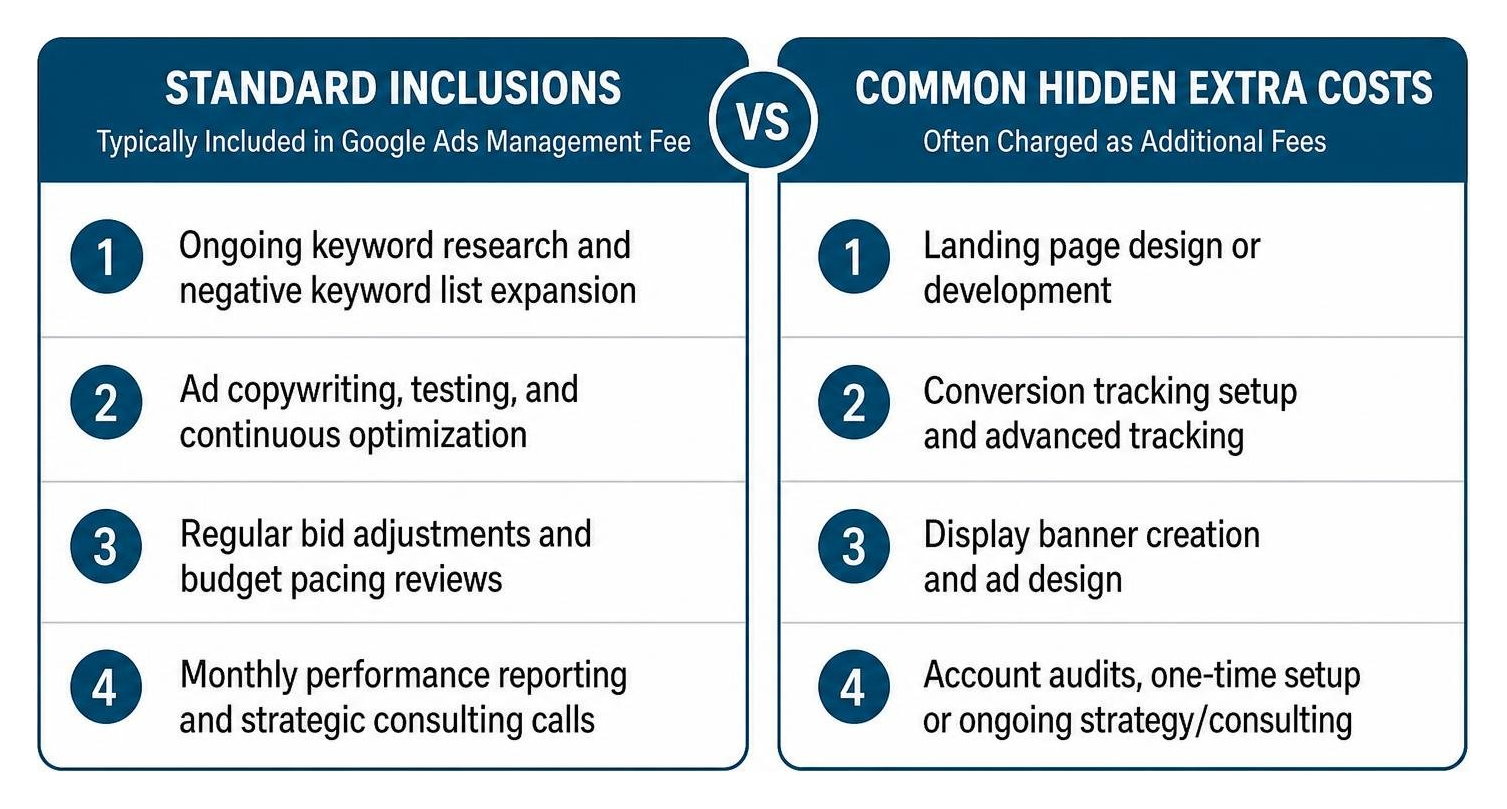
A comprehensive, professional management fee should cover:
- Ongoing keyword research and negative keyword list expansion
- Ad copywriting, testing, and continuous optimization
- Regular bid adjustments and budget pacing reviews
- Monthly performance reporting and strategic consulting calls
However, several critical components often carry extra costs:
- Onboarding and Setup Fees: Most agencies charge a one-time fee ranging from $399 to $5,000 to cover initial competitive research, account structuring, and strategic planning.
- Landing Page Creation: Your ad copy can be flawless, but if your landing page is slow, confusing, or unoptimized, you will waste your budget. Some agencies include custom landing page builds in their premium tiers, while others charge $1,000 to $3,000+ per page as a creative add-on.
- Conversion Tracking Setup: Implementing advanced tracking (such as call tracking, form submission attribution, and CRM integrations like HubSpot) requires technical expertise and is often billed as a separate setup fee if not bundled into the onboarding phase.
Key Factors That Influence Your Google Ads Management Costs
No two Google Ads campaigns are identical, which is why reputable agencies rarely offer one-size-fits-all pricing. Several unique variables dictate the complexity and cost of managing your account:
- Industry Competitiveness and CPC: In highly competitive sectors like legal services, emergency home repairs, or dental services, the average cost per click can be exceptionally high. For example, legal keywords in major metropolitan areas can easily exceed $50 to $100 per click. Managing high-CPC campaigns requires precise bidding strategies to prevent rapid budget depletion.
- Campaign Volume and Account Complexity: Running a single-location search campaign is far simpler than managing a multi-state franchise campaign with dozens of location-specific ad groups, or an e-commerce account with thousands of product SKUs requiring continuous product feed optimization.
- Geographic Targeting: Advertising across highly competitive major metropolitan markets requires far more aggressive testing and granular local optimizations than running campaigns in smaller, less dense suburban territories.
- Tracking and CRM Integration: Connecting your Google Ads account to offline conversion signals within your CRM to track actual closed sales (rather than just digital form fills) increases the technical setup and ongoing management demands.
To get an official estimate of keyword costs and budget pacing benchmarks in your specific industry and geographic location, you can utilize the Google Ads Cost Tool: Take Control of Your Ad Budget.
Human Management vs. Autonomous AI Platforms: The 2026 Trade-offs
As we move through 2026, the integration of artificial intelligence in paid search has created a clear divide: should you pay for dedicated human management, or rely on autonomous AI optimization platforms?
AI platforms excel at processing massive volumes of data at incredible speeds. An autonomous system can make thousands of minor bid and budget adjustments every single day based on real-time search trends and competitive shifts. This level of continuous, micro-optimization is physically impossible for a human manager, who may only log into your account a few times a week.
However, AI has severe structural blind spots. It operates purely on historical data and mathematical algorithms. An AI cannot understand your business’s unique local competitive advantages, coordinate with your offline sales team, or craft a creative, emotionally resonant brand message. Furthermore, if your conversion tracking is slightly misconfigured, an AI will happily optimize your campaigns for junk leads, burning through your budget with incredible efficiency.
The ideal solution in 2026 is a hybrid approach: leveraging advanced machine learning models for rapid bidding and budget pacing, guided by senior human strategists who understand local market dynamics and business fundamentals. For a detailed roadmap on how to evaluate these technological trade-offs when hiring a local partner, see our guide on Google Ads Agency Near Me: 7 Smart Ways to Choose the Best.
Frequently Asked Questions About Google Ads Services Pricing
What is the minimum ad spend required for Google Ads in 2026?
While Google does not enforce a strict minimum budget, starting too low will severely limit your campaign’s performance. For most small businesses, we recommend a minimum starting budget of $1,000 to $2,500 per month in pure ad spend.
If your budget is too small (e.g., $300/month), Google’s machine learning algorithm will not collect enough conversion data to exit the “learning phase” and optimize your bids effectively. In highly competitive local service industries, a healthy daily budget is essential to secure visible ad placements and generate consistent leads.
How do I calculate the ROI of my Google Ads campaigns?
To calculate your true return on investment, you must track conversions all the way to closed revenue. Use this simple formula:
$$\text{ROI} = \frac{\text{Revenue Generated from Ads} – (\text{Ad Spend} + \text{Management Fees})}{\text{Ad Spend} + \text{Management Fees}} \times 100$$
For local service businesses, tracking ROI requires setting up robust call tracking and form attribution to connect phone inquiries directly to your sales records. Understanding your customer lifetime value (CLV) is also critical; a campaign that looks barely profitable on the first transaction may actually be highly lucrative when you account for repeat business over several years.
Why do some agencies charge a setup or onboarding fee?
A setup or onboarding fee (typically ranging from $399 to $1,500+) covers the intensive upfront labor required to build a high-performing campaign from scratch.
During the onboarding phase, a team must conduct exhaustive competitor research, perform keyword intent mapping, write multiple variations of ad copy, build dedicated landing pages, and configure complex conversion tracking codes. This upfront work sets the foundation for your campaign’s long-term success, ensuring you don’t waste budget on unqualified clicks from day one.
Conclusion
Navigating Google Ads services pricing doesn’t have to be a guessing game. By understanding the core fee structures, identifying the hidden costs of landing pages and tracking, and choosing a model that aligns your agency’s incentives with your bottom line, you can make a highly profitable investment in paid search.
At BullsEye Internet Marketing, we do things differently to give our clients a true competitive advantage. We offer no long-term contracts, meaning we have to earn your business every single month through transparent, real-world results. More importantly, we maintain a strict policy of working with only one client per industry per geographic area. When you partner with us, we focus entirely on making your business dominate your local market, rather than quietly managing your direct competitors down the street.
Ready to stop wasting your ad budget on unqualified clicks and start generating real, measurable calls and sales? Get started with expert Google Ads management from BullsEye Internet Marketing today.
