
Why Most Websites Stay Stuck on Page 2 (And How to Improve Search Ranking)
To improve search ranking on Google in 2026, focus on these core actions:
- Match your content to search intent — give users exactly what they’re looking for
- Optimize on-page elements — title tags, headings, and meta descriptions
- Fix technical issues — page speed, mobile-friendliness, and Core Web Vitals
- Build quality backlinks — earn links from trusted, relevant websites
- Target striking distance keywords — pages ranking positions 5–15 are your fastest wins
- Demonstrate E-E-A-T Show real experience, expertise, and trustworthiness
- Allow AI crawlers — so ChatGPT, Perplexity, and Google AI Overviews can find and cite you
Roughly 60% of Google searches now end without a click. When an AI Overview appears, clicks to the top organic result drop by about 34.5%. If your site is already invisible on page 2, that number is even more brutal — you’re getting almost nothing.
Here’s the uncomfortable truth: most businesses aren’t losing to better competitors. They’re losing because their websites have fixable problems — thin content, slow load times, missing signals — that Google quietly penalizes every single day.
Getting 30 clicks a month isn’t a traffic problem. It’s a visibility problem. And visibility problems have solutions.
I’m Ronnie Katz, founder of BullsEye Internet Marketing, and since 2006 I’ve helped hundreds of businesses improve their search ranking and turn organic traffic into real revenue. In this guide, I’ll walk you through exactly what works in 2026 — no fluff, no guesswork.
Basic Improve search ranking terms:
The Core Pillars of SEO: How to Improve Search Ranking in 2026
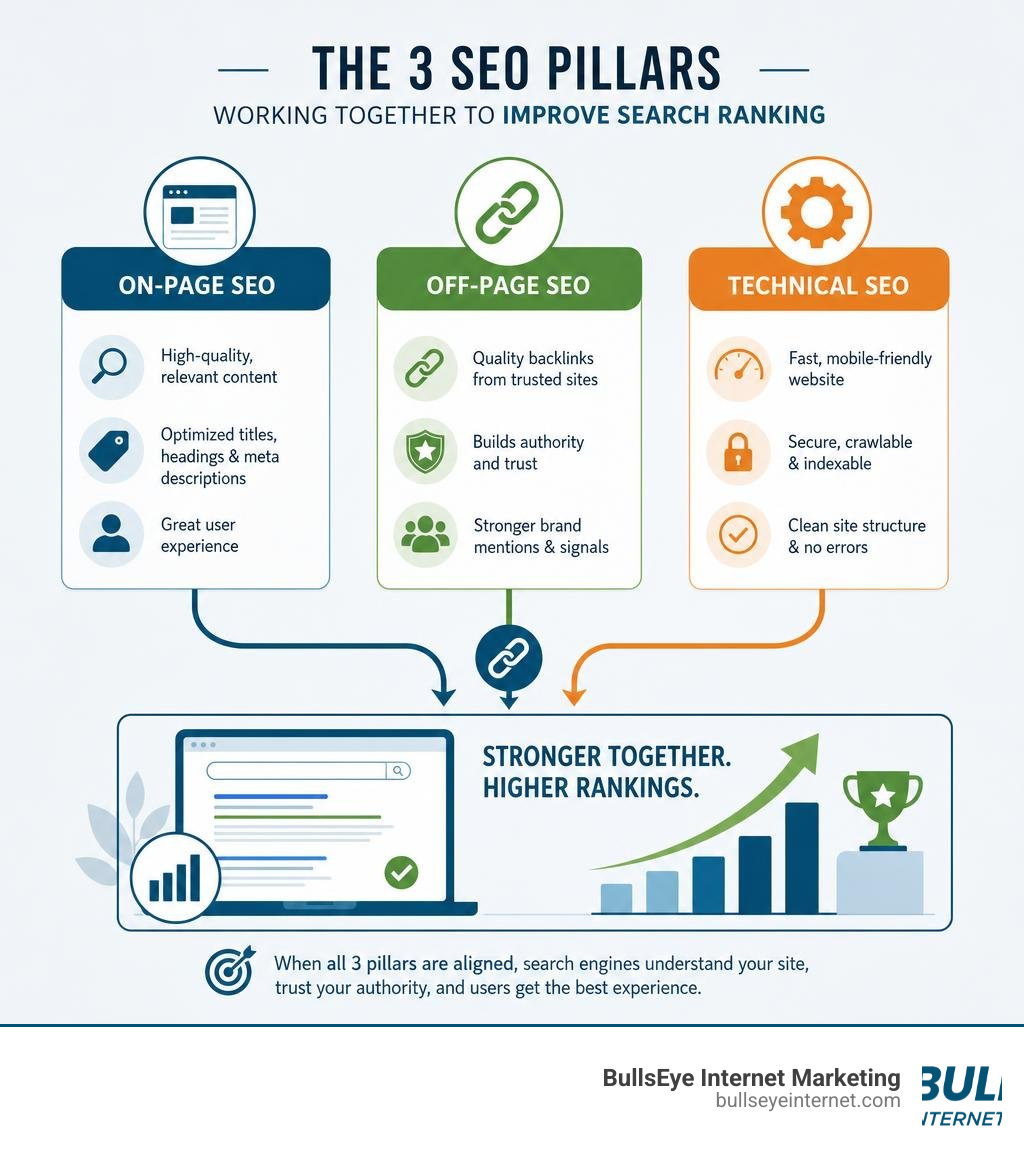
To understand how to improve search ranking, we first have to understand how Google’s modern search algorithms evaluate your website. SEO is not a single task; it is an interconnected system of three main pillars: on-page optimization, technical stability, and off-page authority.
When Google rolls out massive algorithm updates—like the March 2026 core update, which caused an unprecedented 79.5% of top-three search positions to shift and moved over 90% of URLs in the top ten—it is evaluating these three pillars. If you ignore any of them, you are effectively gambling with your organic traffic.
Let’s break down these pillars using modern search guidelines and SEO Ranking Best Practices to see how they keep your site healthy and visible.
On-Page SEO: Aligning Content with Search Intent
On-page SEO is the art of optimizing the visible elements on your website so search engines can easily understand and catalog your content. In 2026, content quality and search intent are the absolute rulers of on-page success.
Google’s systems are incredibly sophisticated. They no longer look for exact-match keywords repeated over and over. Instead, they evaluate how thoroughly your page satisfies a user’s query. If a user searches for “how to fix a leaky pipe,” they want a step-by-step tutorial (informational intent). If they search “best plumber in Fort Lauderdale,” they want a list of service providers (commercial intent).
When you build content, you must design it around what the user actually wants to achieve. To organize your workflow, you can refer to a comprehensive on-page SEO checklist to ensure your title tags, headings, and meta descriptions are perfectly aligned.
While a classic HubSpot study from 2021 suggested that the ideal blog post length for SEO should be 2,100 to 2,400 words, modern search engines favor depth over fluff. Do not write long paragraphs just to hit a word count. The average user reads at most 20 to 28 percent of the words on a page during an average visit. Keep your content scannable by using bullet points, short paragraphs, and bold text. Bolded terms help search engines understand the semantic meaning of your page while keeping human readers engaged.
Technical SEO: Core Web Vitals and Mobile Optimization
Your content could be written by a Nobel Prize winner, but if your website takes five seconds to load on a smartphone, Google will bury it. Technical SEO is the foundation that allows search engines to crawl, index, and render your pages without friction.
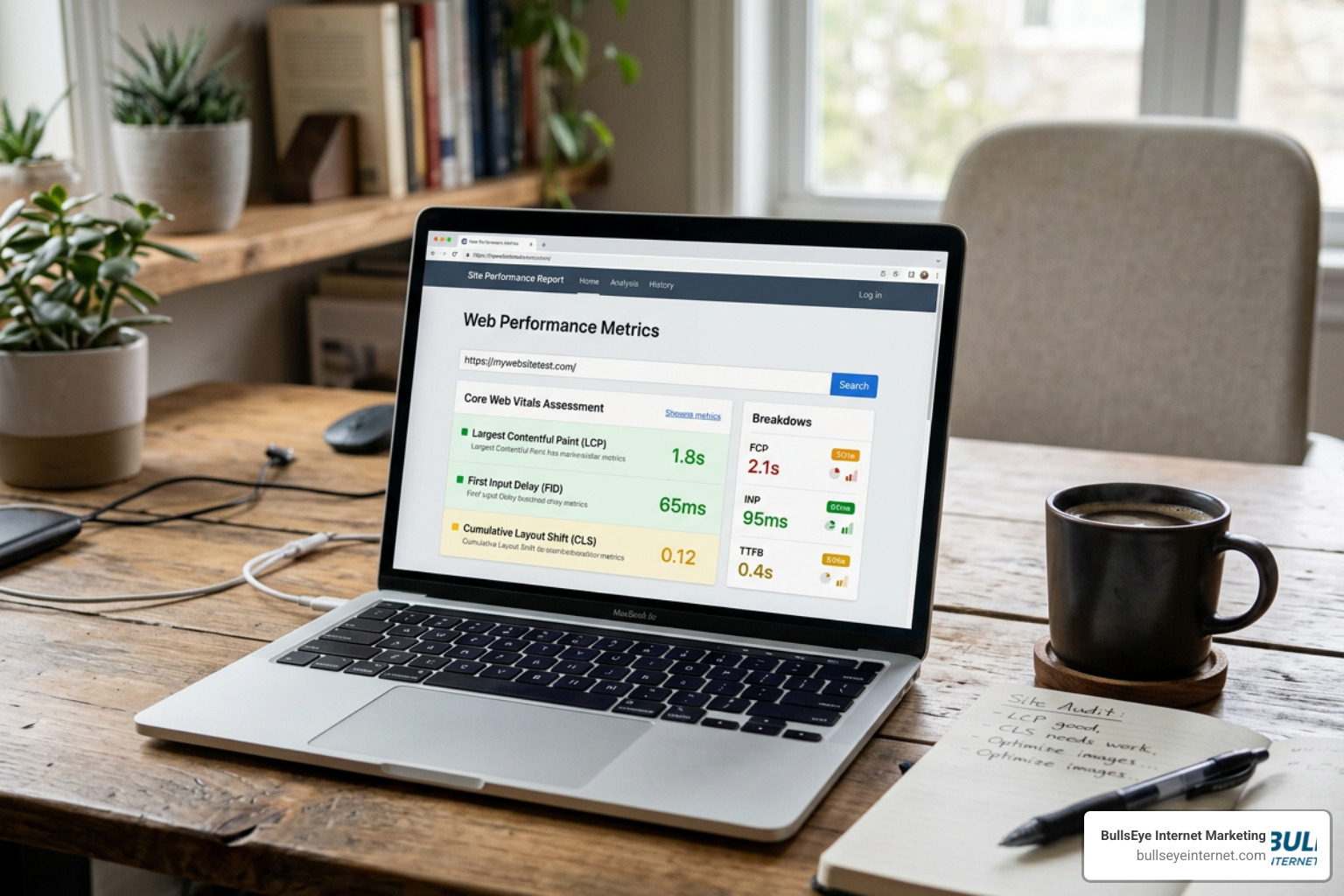
The most critical technical metrics to monitor are Google’s Core Web Vitals, which measure real-world user experience:
- Largest Contentful Paint (LCP): Measures loading performance. Your page’s main content should load in 2.5 seconds or less.
- Interaction to Next Paint (INP): Measures page responsiveness. This replaced First Input Delay (FID) and must be kept under 200 milliseconds.
- Cumulative Layout Shift (CLS): Measures visual stability. Keep this score under 0.1 to prevent annoying layout shifts while loading.
Websites with a load speed of more than 3 seconds experience massive bounce rates. In fact, a real-world study showed that compressing images and lazy-loading media to reduce LCP from 4.2 seconds to 1.8 seconds yielded a 28% boost in organic traffic within just 30 days. To keep your technical foundation strong, you should regularly audit your site and take steps to Improve Website SEO by optimizing your codebase and ensuring complete mobile responsiveness.
Off-Page SEO: Building Authority and Backlinks
Off-page SEO is everything that happens outside of your website to build your brand authority and domain trust. While on-page and technical SEO are fully within your control, off-page SEO relies on the digital community recognizing your value.
The primary currency of off-page SEO is the backlink. Think of a backlink as a vote of confidence from another website. However, not all votes are equal. In 2026, search engine algorithms easily detect and penalize low-quality, spammy link-building networks. Buying cheap directory links or participating in private blog networks (PBNs) is an outdated technique that will get your site de-ranked.
Instead, focus on digital PR and earning high-quality, contextually relevant backlinks from respected industry sites. One link from an authoritative, trusted local source—such as a major Florida publication or an established educational institution—passes more link equity and trust than fifty low-quality spam links. For example, because Miami-Dade ranked #1 in nation for small business growth , getting cited by local South Florida business directories and local news outlets is an incredibly powerful way to signal regional authority to Google.
How to Optimize On-Page Elements and Site Structure
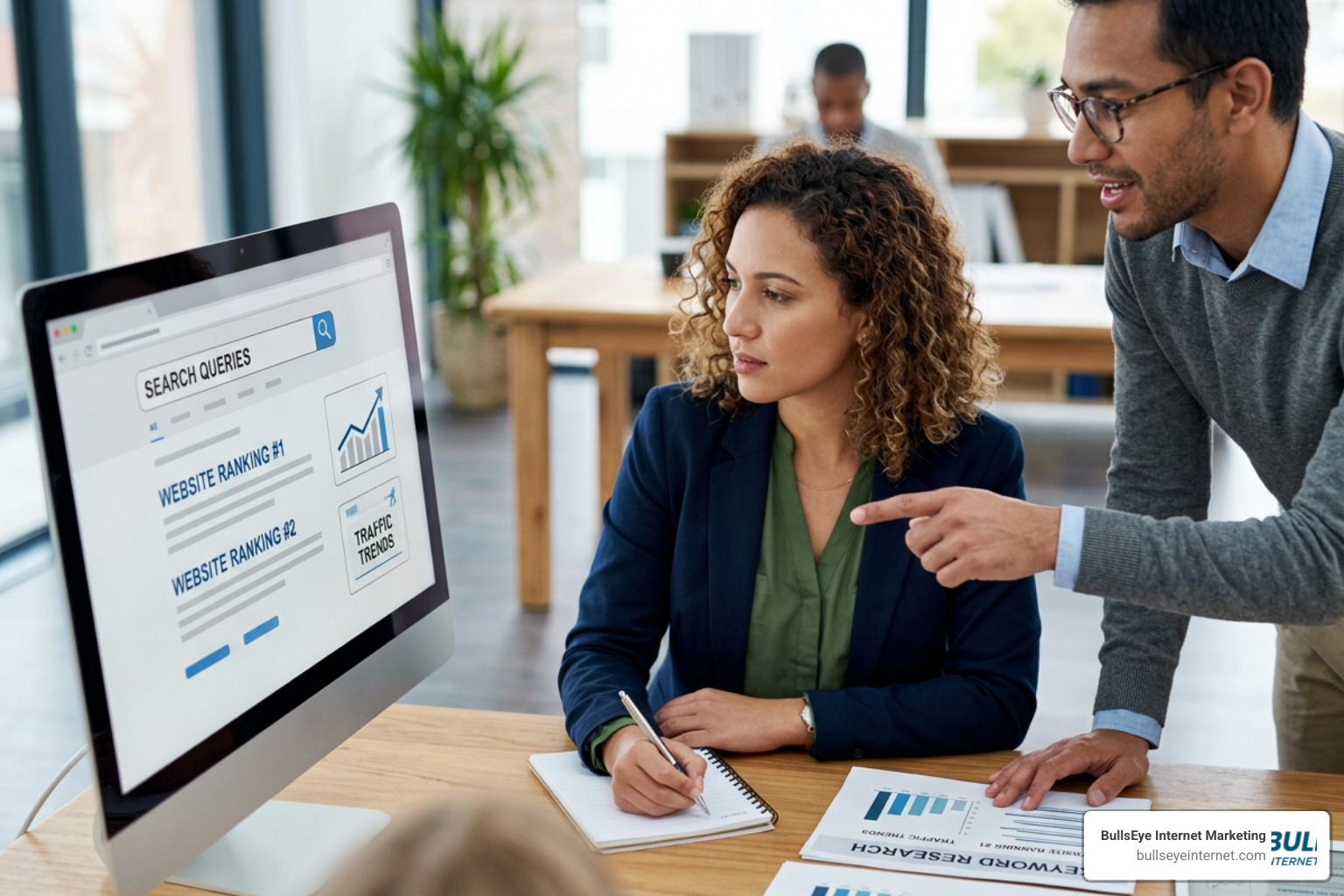
Once you understand the core pillars, it is time to roll up your sleeves and optimize. To make your site easy for both Google and human visitors to navigate, you must build a clean site architecture, establish smart internal linking, and systematically eliminate content gaps.

Optimize Striking Distance Keywords to Quickly Improve Search Ranking
If you want to see a rapid increase in traffic, you do not need to start from scratch. The fastest, most reliable shortcut in SEO is targeting “striking distance” keywords.
Striking distance keywords are search queries for which your website already ranks on page two of Google (typically positions 5 to 15). These pages already have established authority, but they are just missing a few semantic signals to push them onto page one, where 95% of all clicks happen.
Here is how to find and optimize them:
- Log into Google Search Console and navigate to the Performance report.
- Filter the queries by average position and look for terms ranking between 5 and 15.
- Identify the page ranking for that query and check if the exact keyphrase or its semantic synonyms actually appear in the title, H1, and body copy.
- Use Google Autocomplete and “People Also Ask” boxes to find semantically related phrases.
- Integrate these missing phrases naturally into your content.
According to the advanced strategies outlined in “On-Page and Content Optimization That Moves Rankings” , implementing a post-publish 90-day refresh ritual—where you check your ranking trajectory at day 30, audit CTR at day 60, and perform a semantic refresh at day 90—can outperform static, “set-and-forget” pages by roughly 40% in organic traffic over 12 months.
Align Content with E-E-A-T to Improve Search Ranking
Google wants to show its users reliable, accurate information, especially for topics that impact health, finance, or major life decisions. To do this, Google’s Helpful Content System evaluates websites based on E-E-A-T (Experience, Expertise, Authoritativeness, and Trustworthiness).
While E-E-A-T is not a direct, individual ranking factor, it is a critical conceptual framework that influences how Google scores your content’s quality. Websites featuring original data and transparent expertise experienced an average visibility increase of 22% post-update, while thin, templated, or unedited AI-generated content suffered massive visibility drops of 30% to 50%.
To align your content with E-E-A-T as detailed in Google’s SEO Starter Guide:
- Show Real Experience: Include original screenshots, case studies, and personal insights rather than generic advice.
- Highlight Expertise: Add clear author bios with real-world credentials, professional certifications, and links to active LinkedIn profiles.
- Build Trust: Ensure your site features easily accessible Contact and About Us pages, clear editorial policies, and secure HTTPS encryption.
Structure URLs, Headings, and Internal Links for Maximum Visibility
A disorganized website confuses search engine crawlers and drives visitors away. To maximize your search visibility, you must establish a logical hierarchy.
- URL Structure: Keep your URLs short, lowercase, and descriptive. Use hyphens to separate words instead of underscores (Google treats hyphens as spaces, but underscores as characters that join words). For example, use
yoursite.com/seo-tipsinstead ofyoursite.com/page?id=1234. - Heading Hierarchy: Use exactly one H1 tag per page, and ensure it contains your primary target keyword. Organize your subtopics logically using H2 and H3 tags. Think of your headings as a book’s table of contents.
- Internal Linking: Internal links distribute ranking power (PageRank) across your site. Use descriptive, keyword-rich anchor text (like “our digital marketing services”) instead of generic text like “click here.”
For South Florida businesses, local relevance is key. If you are a business looking to expand in Palm Beach County, optimizing your internal structure to highlight localized services is essential. By structuring your location pages correctly and targeting regional buyers in areas like Port St. Lucie, you can ensure your business stands out. Combining these structural elements with localized keyword research and working with a Florida SEO expert will ensure your site dominates regional search.
Adapting to AI Search: GEO and AI Overviews
The search landscape is changing rapidly. With the rise of Google AI Overviews, ChatGPT Search, and Perplexity, users are increasingly getting direct answers without ever clicking through to a website. To survive, you must optimize for both traditional search engines and AI engines through Generative Engine Optimization (GEO).
| Optimization Factor | Traditional SEO | Generative Engine Optimization (GEO) |
|---|---|---|
| Primary Target | Search engine crawlers (Googlebot) | Large Language Models (LLMs) & AI agents |
| Content Structure | Keyword-optimized headings & paragraphs | Front-loaded answers & definition-first sentences |
| Key Metrics | Keyword density, backlinks, meta tags | Synthesis fitness, citations, authority sources |
| Crawler Access | Standard XML sitemaps, indexing | Explicitly allowed AI bots in robots.txt |
Optimizing for Google AI Overviews and ChatGPT
AI Overviews now appear on roughly 30% of informational queries, and ChatGPT handles billions of searches every month. To ensure these systems cite and link to your website, you must structure your content for AI synthesis.
As explained in the SEO Guide 2026, AI engines look for highly structured, clear, and direct answers.
- Use Question-Shaped Headings: Phrase your H2 headings as direct questions that users ask (e.g., “How do I improve my search ranking?”).
- Front-Load Your Answers: Immediately follow your question-shaped heading with a direct, 40-to-60-word answer. This makes it incredibly easy for an AI crawler to extract your text as a cited snippet.
- Keep Your Robots.txt Open: Ensure you are not accidentally blocking AI crawlers like GPTBot, OAI-SearchBot, ClaudeBot, and PerplexityBot in your robots.txt file. If they cannot crawl your site, they cannot recommend you.
Best Practices for Image and Video Optimization
Visual search is another massive driver of high-intent traffic. Optimizing your media ensures you capture searchers who browse via Google Images or video tabs.
- Image Compression: Keep all image file sizes under 100KB and convert them to next-gen formats like WebP or AVIF to preserve site speed.
- Descriptive Alt Text: Write descriptive, keyword-natural alt text for every image. Do not use alt text to stuff keywords; write it to describe the image for visually impaired users and search crawlers.
- Video Sitemaps: If you use video content, implement video schema markup and submit a video sitemap to Google Search Console to ensure your videos are properly indexed.
Frequently Asked Questions about Search Rankings
How long does it take to see SEO results?
On-page optimizations—such as rewriting title tags, improving heading structures, and adding schema markup—typically produce noticeable ranking improvements within 2 to 8 weeks. However, deeper authority building, such as earning high-quality backlinks and establishing topical authority across a brand-new domain, usually takes 3 to 6 months to show compounding organic growth.
How do I use Google Search Console to find ranking opportunities?
Google Search Console is the ultimate free, first-party source of truth for your website. To find quick opportunities, open your Performance report and look for queries with high impressions but low click-through rates (CTR). This indicates that your page is visible, but users aren’t clicking. You can fix this by writing a more compelling, CTR-driven title tag (such as using numbers or brackets) and optimizing your meta description to act as inviting ad copy.
How can I avoid common SEO mistakes like keyword stuffing?
Keyword stuffing is an outdated, manipulative practice that will quickly trigger search penalties. Write naturally for human readers first, aiming for a keyword density of no more than 1% to 2%. Additionally, avoid duplicate content issues by using canonical tags (rel="canonical") to tell Google which version of a page is the primary one. If you have recently experienced a sudden drop in traffic, you can read our guide on Bouncing Back After a Ranking Drop with Local Search Optimization to diagnose and fix the issue, and consult Google’s official Tips to improve your local ranking on Google to regain your local standing.
Conclusion
Improving your search ranking in 2026 requires a strategic, modern approach. From targeting low-hanging striking distance keywords to optimizing for AI search engines, success comes down to providing an exceptional, fast, and highly authoritative experience for your users.
At BullsEye Internet Marketing, we don’t believe in vanity traffic metrics. We focus on what actually matters to your bottom line: qualified leads, phone calls, and closed sales. We do things differently to give our clients a massive competitive advantage:
- No Long-Term Contracts: We earn your business month after month based on real, measurable results.
- Strict Geographic Exclusivity: We work with only one client per industry per geographic area. When we partner with you, we won’t work with your local competitors.
If you are ready to stop getting only 30 clicks a month and start dominating your local market, get a professional SEO Audit today, or explore BullsEye Internet Marketing’s SEO Services to see how we can help your business grow.
