
Why Every Business Needs a Competitive Website Audit
A competitive website audit is one of the most powerful moves you can make to grow your business online — yet most businesses skip it entirely.
Here’s the quick answer if you need it fast:
What is a competitive website audit?
A competitive website audit is a structured analysis of your competitors’ websites to uncover their SEO strategies, content gaps, backlink sources, site structure, and user experience — so you can identify what they’re doing better, where they’re weak, and how to outrank them.
What does it cover?
- Keyword targeting and content gaps
- Backlink profiles and domain authority
- Technical SEO and Core Web Vitals
- Site structure and user experience
- Conversion pathways and messaging
- Search visibility across Google and AI search engines
Who needs one?
Any business competing for attention online — especially if traffic has dropped, a competitor is climbing in rankings, or you’re entering a new market.
Here’s a sobering stat: 8 out of 10 of your best referrals will walk away after visiting your website. That means even warm leads — people already sold on your business — can be lost because your site doesn’t hold up against the competition.
Understanding what your competitors are doing right (and wrong) is the fastest way to fix that.
I’m Ronnie Katz, founder of BullsEye Internet Marketing, and with over 20 years of hands-on experience in SEO and online marketing, I’ve helped businesses across competitive industries use the competitive website audit process to stop guessing and start winning. Let’s break down exactly how to do it.
Basic competitive website audit glossary:
What is a Competitive Website Audit and Why Does It Matter?
At its core, a competitive website audit is a systematic teardown of your primary competitors’ digital storefronts. Instead of looking at your website in a vacuum, you are assessing it against the exact benchmarks set by the rivals who are currently winning the traffic, leads, and sales you want.
In the fast-moving digital landscape of June 2026, relying on guesswork is a recipe for falling behind. If you are a business owner operating in highly competitive markets—such as Palm Beach County, Broward County, or Miami-Dade County—you know how fierce local and national competition can be.
When you conduct a competitive audit, you peel back the layers of your competitors’ online strategies to discover:
- Why they rank higher for your dream keywords.
- How they structure their user journeys to maximize conversions.
- What specific platforms, technologies, and backlink networks are fueling their authority.
To truly win, you must understand What Your Competitors Know That You Don’t: Insights from Competitive SEO Audits. This process transforms abstract metrics into a practical blueprint for dominating your local or national market.

How a Competitive Website Audit Differs from a General Audit
Many business owners confuse a general website audit with a competitive audit. While both are essential, they serve completely different purposes.
A general website audit acts like a routine medical check-up. It looks inward, identifying broken links, crawl errors, slow-loading pages, and basic on-page issues on your site. It answers the question: Is my website technically healthy?
A competitive website audit, on the other hand, is an external scouting report. It evaluates your site’s positioning, architecture, and authority relative to the market leaders. It doesn’t just tell you that your page loads in 2.5 seconds; it tells you that your top competitor’s page loads in 1.2 seconds and features structured schema that helps them secure the Google AI Overview citation you both want.
| Audit Feature | General Website Audit | Competitive Website Audit |
|---|---|---|
| Primary Focus | Internal technical health and basic on-page SEO. | External benchmarking, gap analysis, and differentiation. |
| Data Scope | Your website’s historical and current performance. | Multiple competitor sites evaluated alongside your own. |
| Key Output | A technical clean-up checklist (broken links, redirects). | A strategic roadmap highlighting content, UX, and link gaps. |
| Search Engine Context | Standard indexing and crawlability. | Multi-surface visibility (Google, Bing, Perplexity, SearchGPT). |
| User Experience (UX) | Basic mobile responsiveness and navigation fixes. | Conversion pathway mapping and interactive UX teardowns. |
When Should Your Business Conduct an Audit?
Timing is everything. While we recommend integrating a competitive review into your annual strategy, there are several critical trigger events that demand an immediate deep dive:
- Entering a New Market or Launching a Product: If you are expanding your services—for example, moving your professional services from West Palm Beach into Fort Lauderdale or Miami—you need to know who owns the digital share of voice in that new territory before spending a single dollar on ad campaigns.
- Sudden Traffic or Ranking Declines: If your analytics dashboard shows a sudden dip in organic traffic or search rankings, it’s rarely a random glitch. A competitor has likely optimized their content, secured high-authority backlinks, or restructured their site to leapfrog you.
- A Competitor is Rapidly Climbing: When a smaller player in your industry suddenly starts appearing everywhere—winning featured snippets, ranking for high-intent transactional keywords, and capturing local pack listings—you need to figure out their playbook immediately.
- Preparing for a Website Redesign: Never redesign a website based on visual trends alone. A competitive audit ensures you preserve your existing SEO strengths while actively building features designed to beat your competitors’ site structures.
To learn more about the strategic triggers and requirements, you can read the resource guide on How To Perform An Effective Competitor Website Audit.
How to Identify Your Direct and Indirect Competitors
Before you can analyze the competition, you have to know exactly who they are. One of the most common mistakes businesses make is auditing the wrong websites. Your real-world business competitors (the company down the street) are not always your search engine competitors (the sites occupying the top spots on Google).
To build a highly accurate competitor list, we use a four-list consolidation approach:
- Client-Stated Competitors: The businesses you lose deals to in real-world sales conversations.
- Organic SERP Competitors: The websites ranking in the top 10 for your primary target keywords.
- AI Surface Competitors: The domains cited most frequently in AI search engines like Perplexity, ChatGPT Search, and Google AI Overviews for your industry queries.
- Business Model Competitors: Companies with the exact same business model and target audience, even if they operate in a slightly different geographic region.
Consolidating these lists ensures you don’t miss hidden rivals who are silently stealing your organic visibility. For a deeper look at setting up this framework, refer to this detailed SEO Competitor Analysis Guide.

Differentiating Direct vs. Indirect Competitors
When building your master audit list, you must categorize your rivals into direct and indirect competitors. Failing to do this will skew your data and lead to wasted resources.
- Direct Competitors: These are businesses that offer the exact same products or services to the exact same target audience. For example, if you are a commercial roofing contractor in Fort Lauderdale, another commercial roofing contractor in Broward County is a direct competitor. You compete for the same customers, the same local keywords, and the same search landscape.
- Indirect Competitors: These are websites that solve the same user problem or target the exact same keywords, but have a different business model or offering. In our roofing example, an indirect competitor might be a national home improvement blog like Bob Vila, a local directory like Yelp, or a manufacturer like GAF.
While you won’t copy the business model of an indirect competitor, auditing them is incredibly valuable. They can show you how to structure educational content, what types of link-bait assets attract high-quality backlinks, and how to format pages to win featured snippets.
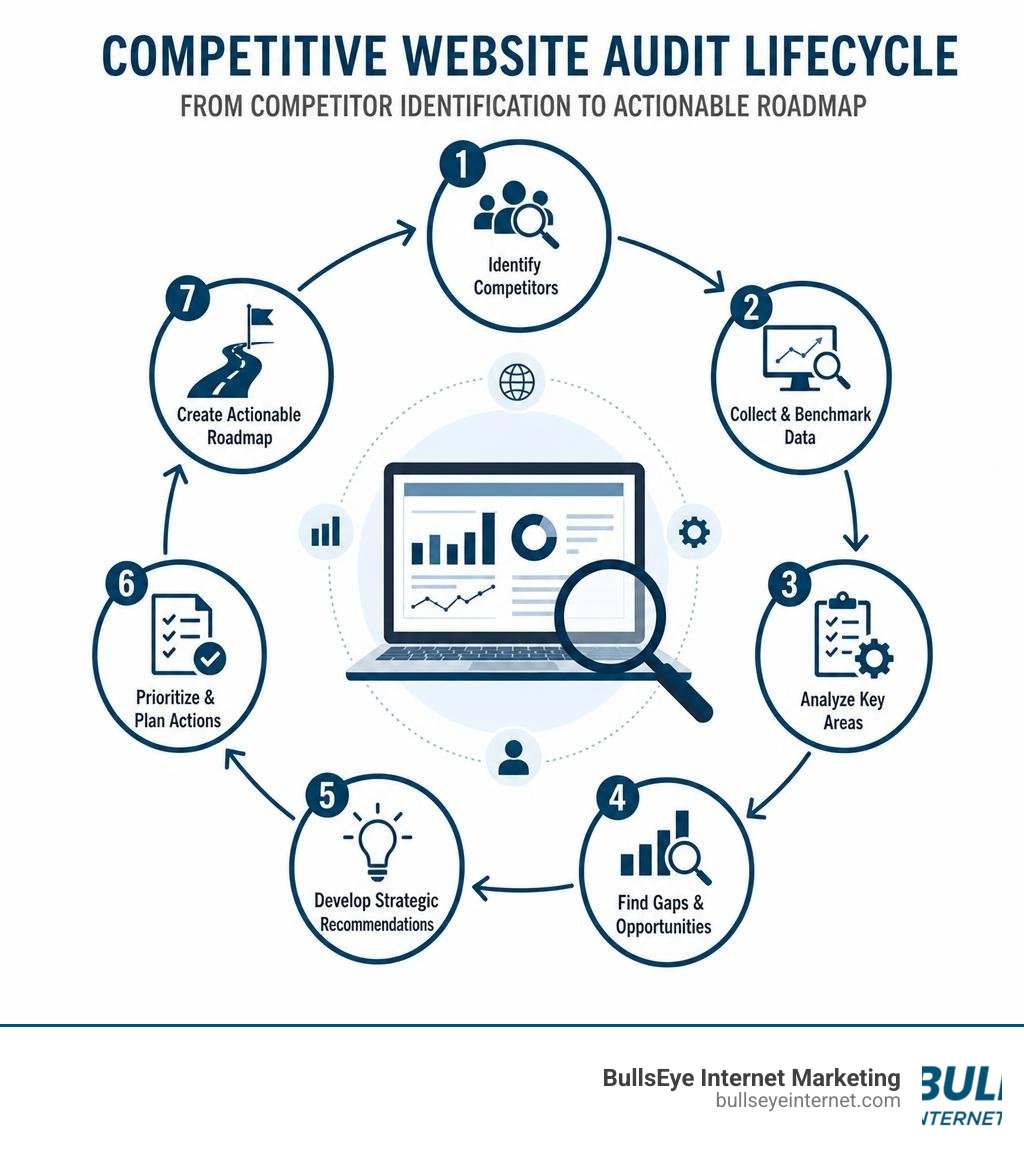
The 7-Step Framework for a Competitor Website Audit
To turn raw competitor data into a winning digital strategy, you need a repeatable, systematic process. At BullsEye Internet Marketing, we follow a rigorous 7-step framework that leaves no stone unturned.
Whether you are performing this audit internally or working with an agency, following these steps ensures you build an airtight plan. For a broader look at how professional agencies structure these evaluations, check out our SEO Audit Agency Complete Guide.
Step 1: Define Competitors and Audit Goals
Every successful audit starts with clear objectives. Are you trying to close a massive traffic gap, improve your local lead generation, or optimize your site for AI search visibility?
During this step, you will:
- Consolidate your master competitor list to 3–5 primary targets.
- Identify 20–50 high-value, high-intent target keywords that represent the core of your business.
- Define your benchmark metrics, such as current domain authority, average organic traffic, and conversion rates.
Step 2: Analyze Website Structure and User Experience
How your competitors organize their websites tells you exactly how they guide users toward a purchase decision.
Use a crawler tool to map out their site architecture. Look closely at:
- Navigation Flow: How many clicks does it take to get from the homepage to a high-value landing page?
- Subfolder Organization: Do they group their services into clean, logical directories (e.g.,
/services/residential/vs/services/commercial/)? - Internal Linking: How do they pass authority from their high-performing blog posts to their primary money pages?
Pay close attention to user experience (UX) friction points. If their site is highly intuitive, features clear visual hierarchies, and has an average engagement rate well above the standard 55% benchmark, take notes on their layout patterns.
Step 3: Evaluate Content Strategy and Topic Coverage
Content is the engine that drives search visibility. To beat your rivals, you must run a thorough content gap analysis to identify the keywords they rank for that you completely miss.
- Topic Clusters: Group their top-performing pages into thematic clusters. Are they building deep topical authority around specific subjects?
- Content Depth: Analyze the average word count, multimedia density (images, videos, infographics), and readability of their top-performing pages.
- E-E-A-T Signals: Look for how they demonstrate Experience, Expertise, Authoritativeness, and Trustworthiness. Do they feature verified author bios, link to trusted external sources, or showcase real-world case studies?
Step 4: Assess Technical SEO and Core Web Vitals
A beautiful website is useless if search engine crawlers struggle to index it, or if users abandon it because it loads too slowly.
Evaluate your competitors’ technical setups, including:
- Core Web Vitals: Benchmark their Largest Contentful Paint (LCP), Interaction to Next Paint (INP), and Cumulative Layout Shift (CLS) against your own.
- Mobile Responsiveness: Test how their pages render on various mobile devices.
- AI Readability: In 2026, you must optimize for both human searchers and LLM crawlers. Analyze how easily AI agents can parse their site structure, check their schema markup, and review their crawler visibility ratio. For advanced techniques, see our guide on LLM SEO Audit Best Practices.
Step 5: Review Backlink Profiles and Authority
Backlinks remain one of the most powerful ranking factors in search engine algorithms. If a competitor is consistently outranking you despite having similar content, the gap is almost certainly in their link profile.
Use authority tools to analyze:
- Referring Domains: How many unique websites link to them compared to you?
- Link Quality: Are they earning links from highly trusted, industry-relevant publications, or are they relying on low-quality directories?
- Link Intersect: Run a link intersect analysis to find high-authority websites that link to multiple competitors but do not link to you. These represent your immediate outreach opportunities.
For a step-by-step breakdown of how to execute this, check out the industry-standard guide on How to Do an SEO Competitor Analysis.
Step 6: Map Conversion Pathways and Messaging
Traffic is a vanity metric if it doesn’t turn into revenue. Step 6 is where you analyze how your competitors convert casual visitors into paying clients.
- Value Proposition: What is the very first message a user sees when they land on their site? How do they differentiate themselves from the rest of the market?
- Calls to Action (CTAs): Are their CTAs prominent, clear, and strategically placed? Do they use low-friction offers (like a free instant quote) alongside high-friction offers (like scheduling a 30-minute call)?
- User Journey: Map the path from a blog post to a lead form. Do they use internal links, related content modules, or exit-intent popups to keep users engaged?
Step 7: Compile Findings into an Actionable Roadmap
An audit is only as good as the action it inspires. The final step is to compile your mountain of data into a visual, prioritized roadmap.
We recommend organizing your findings into a 4-Quadrant Gap Matrix:
- High Impact, Low Effort (Quick Wins): Easy technical fixes, optimizing meta tags, or reclaiming broken internal links.
- High Impact, High Effort (Strategic Projects): Creating comprehensive topic clusters, launching a targeted link-building campaign, or redesigning key conversion pathways.
- Low Impact, Low Effort: Minor design tweaks or updating older, low-traffic blog posts.
- Low Impact, High Effort: Complex custom functionality that offers little search or conversion value.
Benchmarking Key Metrics and Leveraging Audit Tools
To keep your audit objective and free from bias, you must rely on verifiable data. By benchmarking specific metrics across your site and your competitors’ sites, you can track your progress over time and see exactly where you are gaining ground.
When benchmarking, focus on these essential metrics:
- Organic Share of Voice: The percentage of search visibility your brand owns for your target keyword set compared to your rivals.
- Domain Trust & Authority Scores: A comparative metric of overall link authority.
- Indexed Page Count: The total number of high-quality, indexable pages on each site.
- Average Engagement Rate: The percentage of visits that last longer than 10 seconds, view 2 or more pages, or trigger a conversion event.
- AI Citation Share: How often your brand is cited in AI search engines compared to your competitors.
Essential Tools for Your Competitive Website Audit
You don’t have to compile all of this data manually. A robust stack of modern competitive intelligence tools can automate the heavy lifting:
- Site Crawlers: Tools like Screaming Frog allow you to map out your competitors’ site structures, find broken pages, and inspect their XML sitemaps.
- Visibility and Keyword Trackers: Platforms like SE Ranking and Ahrefs are invaluable for running keyword gap analyses, tracking organic rankings, and monitoring daily ranking fluctuations.
- Automated Tracking Platforms: Services like WatchMyCompetitor allow you to set up real-time alerts so you are immediately notified when a competitor changes their pricing, publishes new content, or alters their website structure.
- Technical & LLM Auditing Tools: Modern tools like CompetitorScan or CrawlByAI are fantastic for analyzing how search engines and AI crawlers read websites. They compare static HTML versus dynamically rendered content, evaluate JSON-LD schema coverage, and audit security headers side-by-side.
By combining these tools with a clear, strategic framework, you can turn raw data into a massive competitive advantage.
Frequently Asked Questions About Competitive Website Audits
How often should a competitor website audit be performed?
In the fast-moving search landscape of 2026, we recommend conducting a comprehensive, deep-dive competitive website audit at least once a year. However, you should not wait 12 months to check in on your rivals.
We suggest setting up a quarterly tracking cadence to monitor major changes, such as new high-authority backlinks, content velocity shifts, or new keyword rankings. Additionally, keeping a monthly pulse on AI search engine citation changes ensures you maintain your share of voice in generative search environments.
What if my website already outperforms my competitors?
If your website is already the market leader, congratulations! But now is not the time to get comfortable. Market leadership is highly dynamic.
When you are at the top, you have a giant target on your back. Competitors are actively auditing your site to reverse-engineer your success. Conducting regular audits when you are winning allows you to:
- Identify emerging rivals before they become major threats.
- Discover new niche markets or content topics you haven’t yet covered.
- Continuously refine your user experience to push your conversion rates even higher.
How long does a comprehensive competitor audit take?
The duration of a competitor website audit depends entirely on the size of the websites and the depth of the analysis.
- Light Audit (8–16 hours): Perfect for a quick health check or lead qualification, focusing on high-level SEO metrics and basic keyword gaps.
- Standard Audit (24–40 hours): The ideal depth for most businesses, providing a complete breakdown of 3–5 competitors across technical SEO, content strategy, UX, and link profiles.
- Deep Enterprise Audit (60–120+ hours): Designed for large websites with complex structures, requiring deep data ingestion, custom API tracking, and detailed per-competitor profiles.
Conclusion
A successful competitive website audit is not a one-time project; it is an ongoing digital marketing strategy. By systematically analyzing your competitors’ strengths and weaknesses, you can build a highly optimized, authoritative website that turns search traffic into revenue.
At BullsEye Internet Marketing, we specialize in helping businesses across Florida—from Miami and Fort Lauderdale up to West Palm Beach and the Treasure Coast—outsmart their rivals online. Our unique competitive advantage is simple: we work with only one client per industry per geographic area, and we offer no long-term contracts. That means we focus 100% of our energy on making sure your business dominates the local search landscape.
Ready to stop guessing and start outranking your competitors? Contact us today to schedule your comprehensive SEO Audit and take the first step toward digital market leadership.
