
Proven Organic Strategies to Grow Online Sales
Relying entirely on paid advertising to generate revenue creates a fragile business model. When ad spend stops, customer acquisition grinds to a halt. To grow online sales sustainably, you must establish organic channels that bring high-intent shoppers to your store every single day without incurring direct ad costs.
Organic growth relies on building brand authority, establishing search engine visibility, and delivering genuine value through content marketing. When buyers find your site organically, they enter with higher trust and stronger purchase intent.
How Search Engine Optimization Helps Grow Online Sales
Search engine optimization (SEO) is the foundational pillar of zero-ad e-commerce growth. Unlike social media feeds where content vanishes in hours, optimized product and category pages continue attracting prospective buyers month after month.
To drive organic transactions, your SEO strategy must align directly with search intent:
- Target High-Intent Commercial Keywords: Optimize category and product pages around specific search phrases that signal immediate intent to buy (e.g., “leather weekend bag for men” rather than just “leather bags”).
- Implement Structured Product Schema Markup: Use JSON-LD schema markup across all product pages. Incorporating product details like price, live availability, star ratings, and shipping information directly into Google’s search results increases click-through rates.
- Architect Clean Category Hierarchies: Group products logically so search engines can crawl and index your site efficiently while giving human shoppers a seamless browsing experience.
- Maintain Speed and Technical Health: Fix broken links, implement canonical tags to avoid duplicate content penalties, and keep page loading times beneath 2.5 seconds.
According to the official Quarterly Retail E-Commerce Sales Report, online retail sales continue reaching record highs. Capturing a larger share of that expansion requires ranking where your customers are already looking.
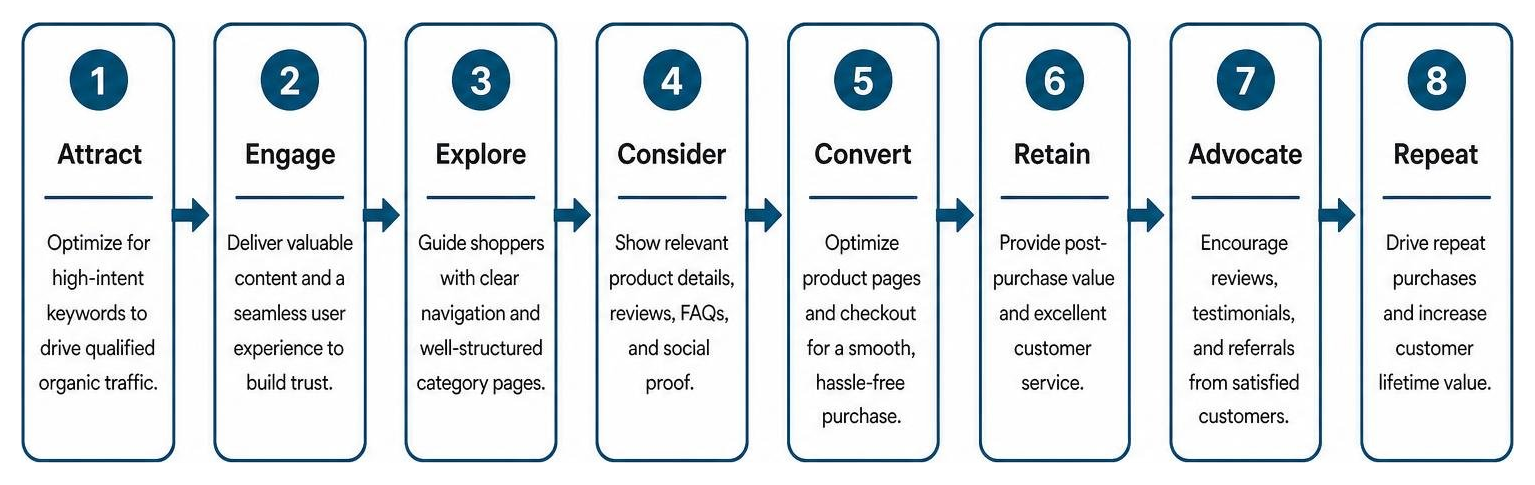
Content Marketing and Social Strategies to Grow Online Sales
Search engines aren’t the only channel for driving free, targeted traffic. Content marketing and organic social engagement allow you to connect with prospects earlier in their buying journey.
To convert social attention into actual checkout events, implement these high-converting tactics:
- Solve Specific Pain Points: Write detailed comparison guides, buying guides, and “how-to” articles that address common questions buyers ask during their research phase.
- Leverage User-Generated Content (UGC): Encourage existing buyers to share unboxing videos and photos of your products in action. Real customer media provides powerful social proof that influences hesitant shoppers.
- Master Storytelling on Visual Channels: Platforms like Instagram and TikTok allow brands to demonstrate product functionality in real-world scenarios, building organic brand loyalty without paying for sponsored placements.
Building Trust and Optimizing Conversions for Online Stores
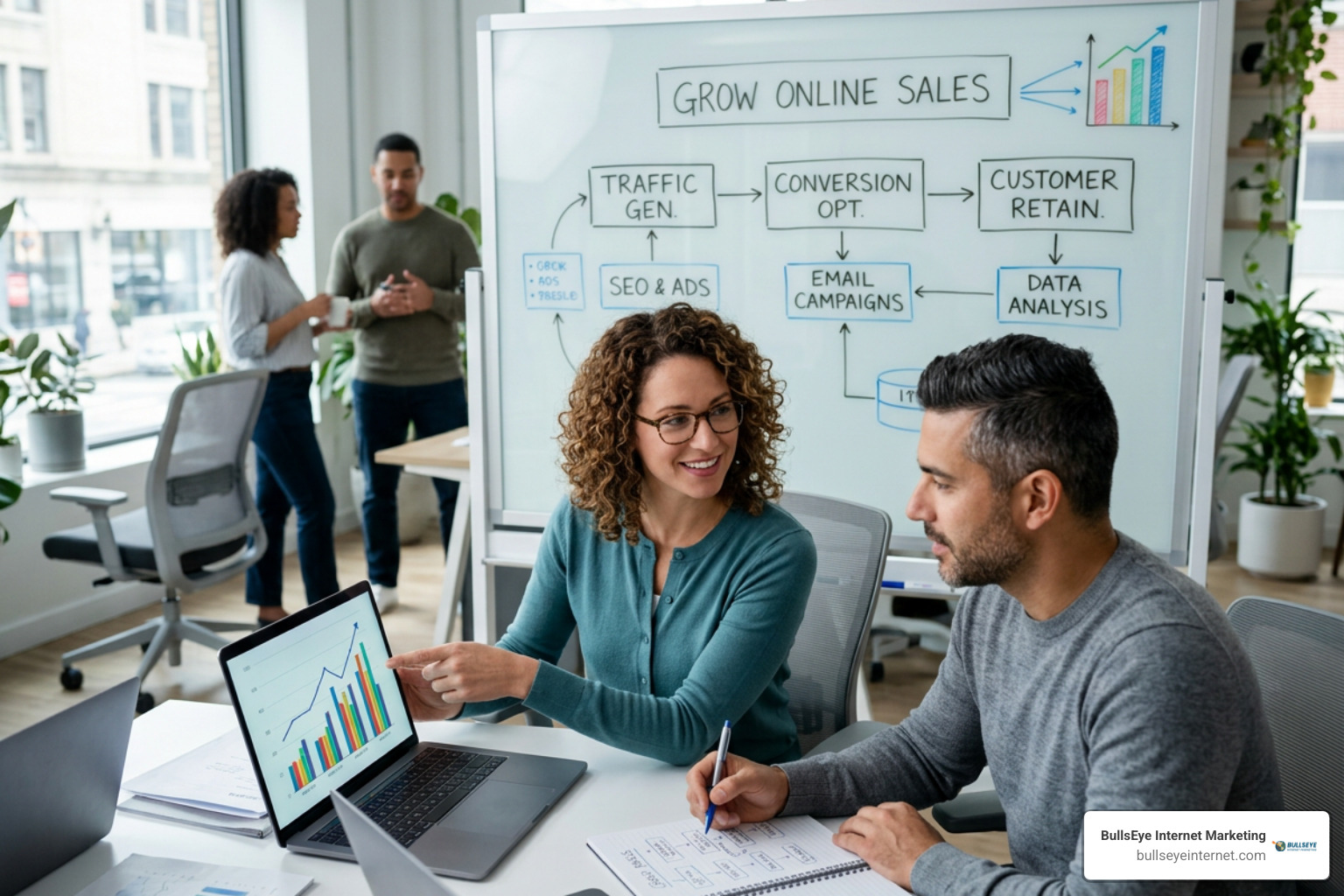
Bringing traffic to your website is only half the battle. If your digital storefront lacks credibility or introduces buying friction, visitors will leave without purchasing. To consistently grow online sales, converting existing traffic into paying customers must become a primary operational focus.
Our dedicated Conversion Optimization Services help online stores identify invisible friction points across product pages and checkout flows to maximize revenue per visitor.
Eliminating Checkout Friction and Cart Abandonment
With documented shopping cart abandonment hovering around 70.22%, most online store owners are losing seven out of every ten potential orders at the final stretch. Roughly 39% of shoppers abandon carts specifically because extra fees—like unexpected shipping costs or taxes—were added at checkout.
To recover lost revenue and streamline conversion flows, focus on these critical adjustments:
- Offer Guest Checkout Options: Forcing users to create an account before completing a purchase creates immediate friction. Always offer a one-click guest checkout alternative.
- Provide Total Price Transparency: Display clear shipping estimates, taxes, and fees directly on the product or cart page so buyers encounter zero pricing surprises later.
- Integrate Express Payment Gateways: Enable instant, secure payment options like Shop Pay, Apple Pay, Google Pay, and PayPal so mobile users can complete orders in seconds.
Investing in targeted page updates and checkout simplification yields massive results. You can read more about how strategic design adjustments convert traffic into revenue in our detailed guide on How a Website Redesign Can Boost Your Sales and Conversions.
Maximizing Mobile Usability and Site Performance
Smartphones currently account for 73% of all website traffic and 71% of completed e-commerce orders. If your store is not fully optimized for small screens, you are actively driving away the majority of your potential buyers.
Furthermore, page speed directly affects your bottom line. Research reveals that even a tiny 100ms delay in page loading speed can reduce conversion rates by 3.5%.
To optimize site performance:
- Compress all product imagery without degrading visual quality.
- Ensure tap targets, buttons, and form fields are easily accessible on mobile screens.
- Keep Core Web Vitals within Google’s recommended thresholds (Largest Contentful Paint under 2.5 seconds).
If your storefront lags on mobile devices, our specialized Ecommerce Website Design solutions ensure fast, mobile-first performance engineered for maximum conversions.
Maximizing Customer Lifetime Value Through Retention and Email

Acquiring a brand-new customer costs 5 to 25 times more than retaining an existing one. Furthermore, customer acquisition costs across the industry continue to rise year-over-year. To grow online sales profitably, you must focus heavily on customer retention and repeat purchases.
Data shows that increasing your customer retention rate by just 5% can increase overall profits by 25% to 95%.
Automated Email Workflows for Revenue Recovery
Email marketing remains one of the highest-ROI channels available because it gives you a direct line of communication to an audience that has already shown interest in your brand.
By implementing automated lifecycle campaigns, you can consistently recover abandoned revenue on autopilot:
- Abandoned Cart Sequences: Send a automated series of 2–3 emails starting within one hour of cart abandonment. Remind the buyer of what they left behind, answer common product FAQs, and reassure them with clear guarantees.
- Welcome Series: Greet new email subscribers with a multi-part introduction that shares your brand story, highlights bestsellers, and offers an initial welcome perk.
- Post-Purchase Education & Up-Sells: After a customer buys, send educational content explaining how to care for or use their purchase. Follow up 14–30 days later with personalized recommendations for complementary products.
- Re-Engagement Sequences: Automatically target buyers who haven’t made a purchase in 60 to 90 days with special offers or new product highlights to win them back.
Loyalty Programs and Customer Retention Tactics
Transforming one-time shoppers into lifelong brand advocates requires intentional relationship building:
- Launch Tiered VIP Loyalty Perks: Reward repeat customers with points, early access to new product drops, or exclusive discounts.
- Implement Tiered Free-Shipping Thresholds: Offer free shipping on orders that sit slightly above your current Average Order Value (AOV) to encourage customers to add one extra item to their cart.
- Deliver Exceptional Post-Purchase Support: Clear return policies, visible contact options, and fast issue resolution eliminate post-purchase dissonance and encourage repeat sales.
Avoiding Common Mistakes and Measuring E-Commerce Performance
Building an organic e-commerce growth engine requires avoiding simple missteps while consistently evaluating real-time analytics data.
| Common Beginner Mistake | Strategic Best Practice | Business Impact |
|---|---|---|
| Discounting products immediately to force sales | Building value through social proof and trust signals | Protects profit margins and brand equity |
| Ignoring mobile user experience bottlenecks | Mobile-first page design and express checkout options | Captures 70%+ of mobile shoppers |
| Running paid ads without setting up tracking tools | Setting up Google Analytics 4 and proper conversion events | Ensures clear sales attribution and ROI tracking |
| Focusing solely on top-of-funnel visitor traffic | Fixing cart friction and optimizing conversion rate | Maximizes revenue from existing visitors |
| Inconsistent content and product listing updates | Regular SEO content publishing and schema maintenance | Builds compounding organic search rankings |
Common Mistakes Beginners Make in Organic Sales
When store owners try to grow online sales without ad budgets, they often fall into predictable traps that hinder growth:
- Premature Discounting: Slashing prices to trigger quick sales erodes profit margins and trains buyers to wait for discounts. Focus instead on strengthening product benefits, trust signals, and guarantees.
- Neglecting Core Web Vitals: Publishing beautiful product images that aren’t optimized slows down page speed, causing high bounce rates and ranking drops on search engines.
- Publishing Inconsistently: SEO and content marketing require steady effort. Expecting dramatic search engine ranking improvements within two weeks of launching a blog leads to early abandonment of effective strategies.
Key Metrics to Measure and Analyze Growth
To know which organic strategies are working, you must track specific Key Performance Indicators (KPIs) consistently:
- Conversion Rate (CR): The percentage of store visitors who complete a purchase (industry benchmarks typically sit between 2% and 3%).
- Average Order Value (AOV): Total revenue divided by total number of orders.
- Customer Lifetime Value (LTV): The total net revenue a single customer generates across their relationship with your business.
- Repeat Purchase Rate: The percentage of your total customer base that buys from your store more than once.
- Organic Traffic & Search Rankings: Tracking keyword positions and non-paid visitor volume in Google Search Console.
For a broader look at market-wide scaling strategies, check out the comprehensive Ecommerce Growth Guide: Strategies for 2026 – Shopify UK.
Frequently Asked Questions About Growing E-Commerce Sales
What is the fastest organic strategy to increase online sales without paid ads?
The fastest organic method is optimizing your store’s existing traffic by fixing conversion friction. Simplifying your checkout process, adding guest checkout options, displaying trust badges, and setting up automated abandoned cart emails yield rapid sales improvements without requiring extra traffic.
How long does it take to see sales growth from organic SEO?
Organic SEO typically takes 3 to 6 months to demonstrate meaningful traffic and revenue growth. However, once your product and category pages rank well on search engines, they generate consistent, high-intent traffic without recurring advertising expenses.
How can a beginner build immediate trust on a brand new online store?
Beginner store owners can build instant credibility by displaying customer reviews directly on product pages, showing recognized security badges, making contact details clearly visible, providing transparent shipping costs, and offering a clear, hassle-free return policy.
Conclusion
Building a profitable online store doesn’t require an unlimited advertising budget. By focusing on organic search engine visibility, removing friction from your checkout experience, building shopper trust, and driving repeat purchases through automated email sequences, you can build a sustainable revenue engine that scales over time.
At BullsEye Internet Marketing, we specialize in helping businesses systematically grow online sales through proven search strategies, technical site optimization, and data-backed conversion rate improvements. We work on a pay-for-results framework with no long-term contracts, giving our clients a distinct competitive advantage.
Ready to take your e-commerce store to the next level? Explore our specialized Search Engine Optimization Services today and discover how we can help you capture market share and maximize your online revenue.
