
Why GBP Local SEO is the Difference Between Being Found and Being Invisible
GBP local SEO is the practice of optimising your Google Business Profile to rank higher in Google’s Map Pack — the three local business results that dominate the top of search results for queries like “plumber near me” or “accountant in Manchester.”
Here’s what GBP local SEO comes down to, fast:
| What to Do | Why It Matters |
|---|---|
| Claim and verify your Google Business Profile | Unlocks your ability to manage how Google shows your business |
| Complete every profile field | Complete profiles are 2.7x more likely to be seen as reputable |
| Choose the right primary category | One of the top ranking signals in the Map Pack |
| Build consistent NAP citations | Confirms your business identity across the web |
| Generate steady reviews | Drives prominence — a core Google ranking factor |
| Post regularly and upload photos | Sends freshness signals that keep your profile competitive |
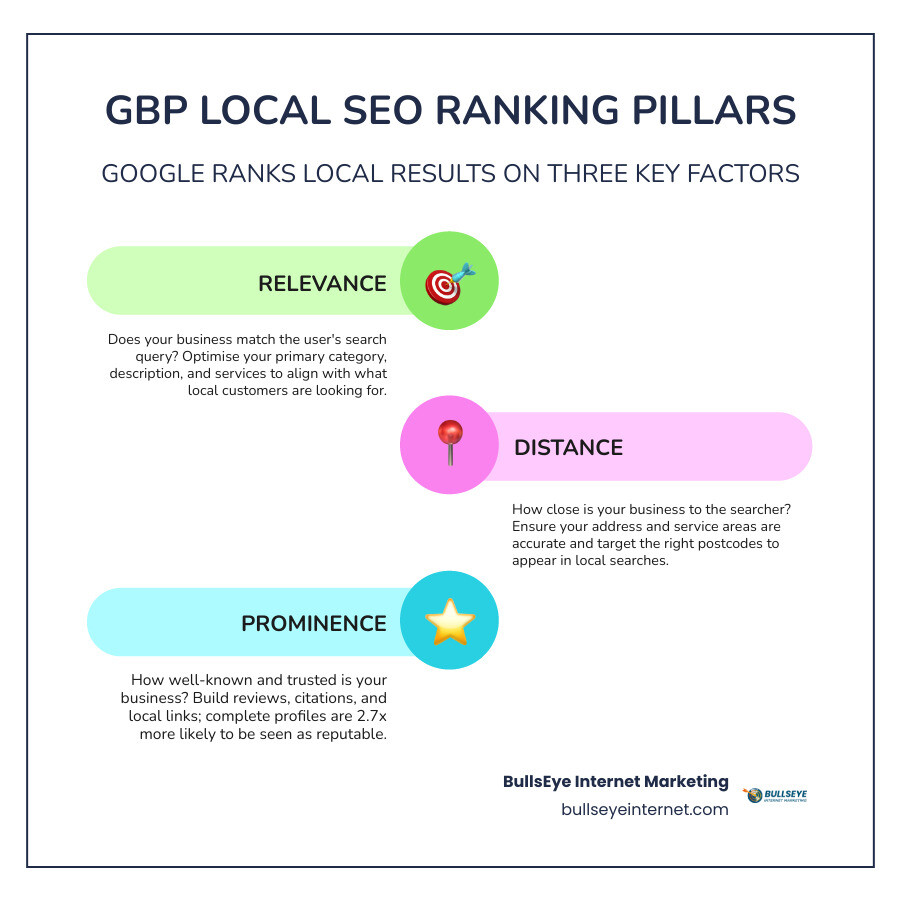
Google ranks local results on three factors: relevance (does your business match what was searched?), distance (how close are you to the searcher?), and prominence (how well-known and trusted is your business online?). Your GBP is the engine behind all three.
Nearly 80% of people search for local businesses every week. 76% of those mobile searches end in a store visit within 24 hours. If your profile is incomplete, unverified, or sitting idle — you are handing those customers to a competitor.
This is not a “nice to have.” It’s the highest-return marketing task available to any local business.
I’m Ronnie Katz, founder of BullsEye Internet Marketing, and since 2006 I’ve helped hundreds of businesses improve their GBP local SEO to generate more calls, more foot traffic, and more revenue — without wasting budget on tactics that don’t move the needle. In this guide, I’ll walk you through everything you need to go from invisible to undeniable in your local market.
Gbp local seo terminology:
What is a Google Business Profile and Why is it Critical for GBP Local SEO?
A Google Business Profile (GBP) is your business’s official identity card on Google Search and Google Maps. Formerly known as Google My Business, this free tool allows you to control how your business appears to users at the exact moment they are looking for your services.
To understand why it is so critical for gbp local seo, we have to look at the “Local 3-Pack” (or “Snack Pack”). When a user searches for a local service on a mobile device or desktop, Google displays a map accompanied by three prominent local business listings. These three spots receive the lion’s share of local clicks and phone calls.
According to official guidelines, Google’s local algorithm determines who gets into this coveted 3-pack based on three core pillars:
- Relevance: How well a local business profile matches what someone is searching for.
- Distance: How far each potential search result is from the location terms used in a query, or the user’s real-time geographic coordinates.
- Prominence: How well-known a business is. This is calculated using information Google has about a business from across the web (links, articles, directory citations) and your GBP review profile.
If you want to master Google Business SEO Complete Guide, you must treat your profile as a living, breathing asset rather than a “set-and-forget” directory listing. Understanding What Is Google My Business GMB is the first step, but optimizing it systematically is what drives real-world revenue.
By aligning your profile with the core ranking factors, you build a powerful marketing asset. This is especially true because Map Pack rankings operate on different signals from traditional organic results. You can actually rank in the top three of the local maps even if your main organic website ranking is still climbing.
Why GBP Local SEO is the Ultimate Entity Anchor for AI Search
As we navigate July 2026, the local search landscape has fundamentally shifted. Your Google Business Profile is no longer just a listing; it has evolved into the single most authoritative “entity anchor” Google holds about your local business.
With the rise of AI-driven search experiences, search engines do not just look for keyword matches. They seek “confidence” in a business’s real-world existence, capabilities, and location. When an AI search engine attempts to answer a natural-language query like “where is the most reliable emergency plumber near me?”, it queries Google’s Knowledge Graph directly.
As detailed in the comprehensive study on Google Business Profile as an Entity Anchor for Local AI Answers – Link Building Journal, AI search engines prioritize data consistency and confidence. If your business name, address, or service list is contradictory across different platforms, the AI layer will exclude you from curated answers to avoid recommending an unreliable entity.
Optimizing your profile is now a process of “entity engineering.” You are feeding the AI engine structured, verifiable data that proves your identity, freshness, and authority. This makes a highly optimized GBP the ultimate anchor for both traditional local searches and modern AI-driven conversational answers.
Setting Up Your Profile: Claiming, Verification, and Core Fields
The journey to the top of local search begins with claiming and verifying your business profile. An unclaimed or skeleton listing is the single most common reason local businesses remain invisible to their target audience.
To get started, visit google.com/business and sign in with your corporate Google account. Search for your business name to see if a listing already exists. If it does, you can request access; if it doesn’t, you can create a new profile from scratch.
Once you have entered your business details, Google will require verification to prove you are the legitimate owner or representative. Google uses several verification methods:
- Postcard Verification: Google mails a physical postcard containing a unique verification code to your business address. This usually arrives within 5 to 14 days.
- Video Verification: Often required for service-area businesses, this involves uploading a continuous video showing your business location, your tools of the trade, and proof of management (such as unlocking your business vehicle or office).
- Phone or Email Verification: Available to select businesses, allowing instant verification via a secure code.
If you run into issues during this process, our guide on How to Get Google Business Verification Help When You Need It Most provides a step-by-step troubleshooting path. Once verified, you gain full access to the GBP dashboard to complete your profile using proven strategies from our guide on How to Optimize Google Business Profile.
Optimizing Core Fields for the UK Local Pack
For businesses targeting specific local markets, optimizing core fields with extreme precision is non-negotiable. Whether you are aiming to dominate the local pack in the UK or in South Florida, the rules of field optimization remain identical.
- Business Name: Use your exact, real-world legal trading name. Resist the temptation to stuff keywords into your business name (e.g., writing “John’s Plumbing – Best Cheap Plumber Miami” instead of “John’s Plumbing”). Google actively suspends profiles for keyword stuffing, and it harms your entity trust.
- Primary Category: This is the single most powerful ranking signal on your profile. You must choose the most specific primary category available (such as “Solicitor” instead of “Lawyer,” or “Roofing Contractor” instead of “Contractor”). Use tools like GMB Everywhere to spy on competitor categories directly on Google Maps to ensure you are aligned with top performers.
- Address Formatting: Format your physical address exactly as it is recognized by official postal records. Consistency is key here; use the same abbreviations, spacing, and suite numbers everywhere online.
- Service Areas: If you serve customers at their locations, define your service areas clearly by postcodes, cities, or counties rather than selecting a massive, unrealistic radius.
For a deeper dive into maximizing your visibility, read our Local Pack Optimization Ultimate Guide and implement our strategies on How to Optimize Your Google Business Profile for Maximum Local Reach.
When to Hide Your Address and Use Service Area Listings
A common point of confusion for small businesses is whether to display their physical address. Google divides profiles into two main types: Brick-and-Mortar businesses (where customers visit you) and Service-Area Businesses (SABs, where you travel to your customers).
If you operate your business from a private residential home, a shared co-working space without dedicated signage, or a virtual office, you must hide your physical address and set your profile as a Service-Area Business.
Failing to hide a residential address violates Google’s terms of service and puts your listing at high risk of immediate suspension. Instead, clear your address from the dashboard and define your service area by entering specific cities, counties, or postcodes. This preserves your geographic relevance while keeping your profile fully compliant. For more details on managing this transition, see How to Optimize GBP.
Ongoing Profile Management: Posts, Reviews, and UK GDPR Compliance
An optimized profile is not a static monument; it requires ongoing active management. Google rewards active businesses that regularly engage with their audience and update their profiles with fresh signals.
Active management involves three core tasks: publishing regular updates via Google Posts, uploading high-quality visual content, and managing customer reviews. These actions are central to Google Maps Marketing and are highly effective for Managing Google Business Profile Reviews a Guide for Home Service Businesses.
Crafting High-Engagement Google Posts and Photos
Google Posts are short updates that appear directly on your Business Profile. Think of them as mini social media updates designed for high-intent searchers.
- Post Frequency: Aim to post at least once a week. Standard posts keep your profile active and signal to Google’s algorithm that your business is operating and engaged.
- Content Types: Share recent completed projects, seasonal offers, business updates, or helpful tips. Always include a clear call-to-action (CTA) button like “Call Now” or “Book Online.”
- Photos and Videos: Complete profiles with photos receive 42% more direction requests and 35% more website clicks. Upload real, high-resolution photos of your team, your office, and your completed work.
- Vision AI Optimization: Google uses advanced Vision AI to scan and analyze your uploaded images. If you upload a photo of a newly installed metal roof, Google’s AI recognizes the context, which directly corroborates your “roofing services” category. Avoid generic stock photos; real photos build trust with both users and search algorithms. Read about The Impact of Google Business Profile Photos on Conversion Rates to see how visual assets drive action.
Ethical Review Acquisition and UK GDPR-Compliant Responses
Customer reviews are the lifeblood of prominence. 98% of consumers read online reviews for local businesses, and 76% trust them as much as personal recommendations.
However, acquiring reviews can be challenging due to the “British reserve” or general customer inertia—people are statistically less likely to leave positive reviews spontaneously. To overcome this, build a proactive, low-pressure review request process. Send a direct link to your review form via SMS or email right after completing a job, using polite scripts like: “If you were happy with our service today, a quick mention on Google helps our local business enormously.”
When managing reviews, you must strictly adhere to ethical and legal guidelines:
- No Incentives: Never offer discounts, gifts, or entries into prize draws in exchange for reviews. This violates Google’s terms and can lead to profile suspension.
- GDPR-Compliant Responses: When responding to reviews, especially negative ones, you must comply with strict data privacy laws (like UK GDPR or state-level privacy rules). Never disclose personal details, invoice numbers, specific services discussed in private, or the reviewer’s full name in your public response.
- Professionalism First: Respond to all reviews within 24 hours. Keep negative review responses polite, objective, and brief. Take the discussion offline immediately by providing a direct customer service email or phone number.
For a complete blueprint on protecting your online reputation, refer to our Google My Business Reputation Management Guide.
Off-Page and On-Page Local SEO: Citations, Schema, and Link Building
While your Google Business Profile is the star of your local search strategy, it does not exist in a vacuum. Google’s algorithm validates the information on your GBP by comparing it with signals from across the open web.
Building High-Authority UK Citations and Local Links
A local citation is any online mention of your business’s Name, Address, and Phone number (NAP). Consistent citations build search engine confidence in your location and identity.
| UK Citation Directory | Domain Authority (DA) | Value to Local SEO |
|---|---|---|
| Yell | High | Strong authority, excellent trust signal |
| Thomson Local | Medium-High | Core UK business directory |
| 192.com | Medium-High | High trust, feeds local mapping data |
| Scoot | Medium | Network syndication across multiple sites |
| Cylex | Medium | Detailed business descriptions and services |
When building citations, character-for-character NAP consistency is non-negotiable. An address written as “Suite 4, 12 High Street” on your website but “4 High St.” on Yell creates minor entity conflicts that can erode search engine confidence.
To learn more about the power of structured directories, explore how listings build authority in our article on How Accurate Business Listings Can Improve Customer Trust and Boost Sales.
Beyond basic directories, local link building is the ultimate way to boost your prominence. High-value local links include:
- Sponsorships of local youth sports teams or local charities.
- Memberships in local Chambers of Commerce.
- Features in regional news outlets or local business blogs.
For a step-by-step roadmap on building local authority, study our guide on The SEO Power of Citations How Business Listings Build Authority.
On-Page Optimization and Syncing with Bing Places
Your website is the foundational support system for your GBP. To maximize your local relevance, optimize your website’s on-page elements:
- Location Pages: If you serve multiple areas (such as different neighborhoods in South Florida like Coral Gables, Hollywood, or West Palm Beach), create dedicated, content-rich location pages. Avoid duplicate doorway pages; each page should feature unique local content, real reviews from that area, and a customized embedded map.
- LocalBusiness Schema: Implement structured JSON-LD schema markup on your website. This code tells search engine spiders exactly what your business name, address, phone number, coordinates, and GBP URL are.
- Local Keyword Integration: Naturally integrate localized language (such as local landmarks, neighborhoods, and regional terminology) into your headings, meta titles, and body copy.
- Bing Places Integration: Do not ignore Bing. Bing holds a significant 20-25% desktop search market share in the UK because it is the default browser on corporate Windows PCs. You can easily sync your fully optimized Google Business Profile directly with Bing Places for Business in just a few clicks, instantly doubling your local search footprint.
Discover how to craft high-performance local content in our guide on How a Local SEO Agency Creates Location-Focused Content That Ranks.
Tracking Success and Measuring Performance
To ensure your local campaigns are delivering a positive return on investment, you must establish a reliable tracking and measurement routine.
By monitoring the right metrics, you can refine your strategy and focus on the actions that generate actual leads and phone calls. For a foundational overview, see our Local SEO Complete Guide.
How to Track and Measure Your GBP Local SEO Performance
When measuring the success of your gbp local seo efforts, focus on these primary metrics:
- Map Pack Rankings: Track where your business ranks for core keywords from various coordinates in your target area. Because rankings vary depending on searcher proximity, use advanced local grid tracking tools to see your visibility radius.
- GBP Insights: Monitor user actions directly in your Google dashboard. Look at the number of phone calls, direction requests, website clicks, and direct messages your profile generates.
- Review Velocity and Sentiment: Track the rate at which you acquire new reviews (velocity) and your average rating. A steady, consistent stream of positive reviews is far more valuable to search algorithms than a sudden burst followed by months of silence.
- Organic Local Traffic: Monitor the organic traffic arriving on your location pages using UTM tracking codes appended to your GBP website link.
For comprehensive support on measuring and scaling your campaigns, explore our Local SEO Services Complete Guide and utilize our Free GMB Rank Checker to audit your current standing.
Frequently Asked Questions about Local Search
Can I pay Google for a better local ranking?
No. Google’s local organic search results and Map Pack rankings are strictly algorithmic and cannot be influenced by payment. This maintains fairness and ensures searchers receive the most relevant, high-quality recommendations. While you can run paid Google Local Services Ads (LSAs) or Map Ads to appear above the organic results, organic Map Pack positioning is earned purely through optimization, relevance, and prominence.
How often should I post on my Google Business Profile?
You should aim to publish a new update on your Google Business Profile at least once a week. Regular posts serve as a strong freshness signal to Google’s algorithm, proving that your business is open, active, and engaged with customers. It also provides fresh, high-intent content for potential clients viewing your profile.
What should I do if my competitor is keyword-stuffing their business name?
Keyword stuffing violates Google’s guidelines and creates unfair competition. If you spot a competitor using an artificial, keyword-stuffed name on Google Maps, you can “Suggest an edit” directly on their public profile to change the name to their real-world legal trading name. If the edit is ignored, you can submit a formal complaint via Google’s Business Redressal Complaint Form.
Conclusion
Cracking the Google Business Profile SEO code is not about finding a magic trick; it is about executing the fundamentals with relentless consistency. By verifying your profile, optimizing core fields, maintaining NAP consistency, and building a steady stream of reviews, you signal to Google that your business is the most relevant and prominent choice in your area.
At BullsEye Internet Marketing, we specialize in translating local visibility into actual calls and sales. Our unique competitive advantage is simple: we do not lock you into long-term contracts, and we work with only one client per industry per geographic area. This means when you partner with us, we focus entirely on helping you dominate your local competitors.
Whether your business is located in Miami, Hollywood, West Palm Beach, or any of our other service areas across South Florida and the US, we are here to help you win. Ready to claim your spot at the top of the Map Pack? Partner with a leading Local SEO Agency today and let’s start driving more leads to your business.
