
AI Search Visibility Strategies from BullsEye Internet Marketing
AI search visibility — how often and how prominently your brand appears in AI-generated answers — is now one of the most important factors in whether customers find you or your competitors.
Here’s what you need to know right now:
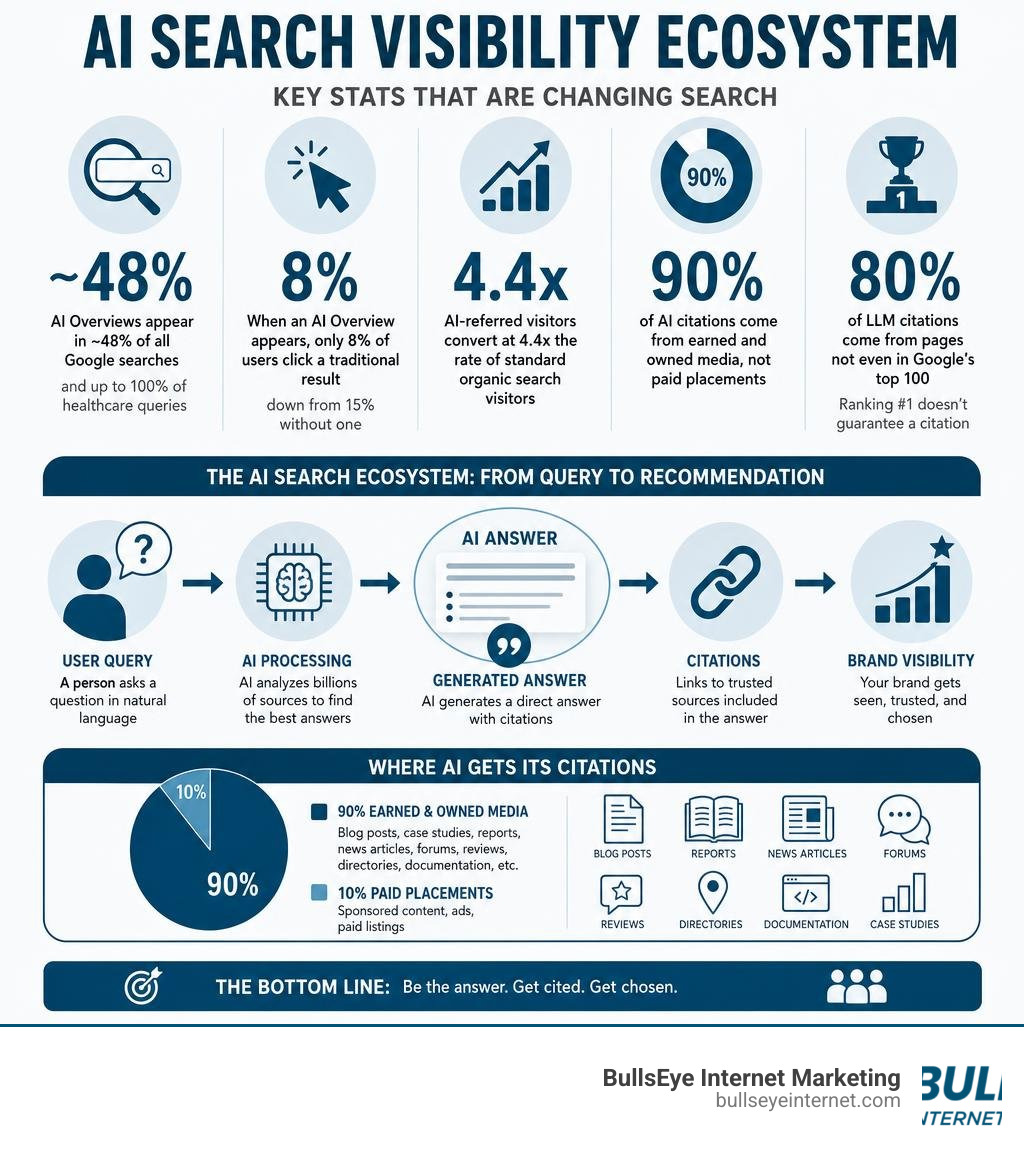
- AI Overviews appear in ~48% of all Google searches and up to 100% of healthcare queries
- When an AI Overview appears, only 8% of users click a traditional result — down from 15% without one
- AI-referred visitors convert at 4.4x the rate of standard organic search visitors
- 90% of AI citations come from earned and owned media, not paid placements
- Ranking #1 on Google does not guarantee an AI citation — 80% of LLM citations come from pages not even in Google’s top 100
The bottom line: if AI tools like ChatGPT, Gemini, Perplexity, and Claude aren’t recommending your brand, you’re losing high-intent buyers to competitors who figured this out first.
Something fundamental has shifted in how people search. Instead of scanning ten blue links, users are opening an AI assistant and getting a direct answer. That answer either includes your brand — or it doesn’t. There’s no second page.
Over 100 million people search with AI every day. The brands getting cited in those answers are seeing conversion rates that dwarf traditional organic traffic. The brands that aren’t? They’re watching their phone stop ringing and wondering why their traffic looks fine but leads have dried up.
This guide breaks down exactly how AI search works, why it matters, and what you can do about it — in plain language, with no fluff.
I’m Ronnie Katz, founder of BullsEye Internet Marketing, and with over 20 years in online marketing I’ve been helping businesses stay ahead of every major shift in search — from early SEO to local search to, now, AI search visibility optimization. Let’s get into what you actually need to know.
AI search visibility basics:
What is AI Search Visibility and Why It Matters in 2026
We have officially entered the era of the zero-click search. In June 2026, the traditional list of blue links is no longer the primary gateway for online discovery. Instead, AI search engines synthesize massive amounts of web data to answer user queries directly.
This behavioral shift has radically transformed click-through rates (CTRs). When Google displays an AI Overview, the likelihood of a user clicking on a traditional search result drops from 15% to just 8% — a nearly 50% decline in organic click share.

However, the traffic that does come through AI search is incredibly valuable. Data shows that while AI search visitors account for only about 0.5% of total website visitors across industries, they drive 12.1% of all signups. That is a staggering 23x conversion rate compared to traditional organic search visitors.
On average, AI-referred visitors convert at 4.4x the rate of standard organic search visitors. Why? Because these users are pre-qualified. They have already asked highly specific, long-tail questions, and the AI has recommended your brand as the precise solution.
If your business is located in Florida — whether you are a local service provider in West Palm Beach, a medical practice in Miami, or a business in Fort Lauderdale — appearing as the recommended answer in these conversational search results is the ultimate competitive advantage.
Traditional SEO vs. AI Search Visibility Optimization
To win in this new environment, we must understand that traditional SEO and Generative Engine Optimization (GEO) are two different sports.
Traditional SEO focuses on ranking a page for specific keywords to drive clicks to a website. It relies on backlinks, keyword density, and domain authority.
AI search visibility, or GEO, focuses on whether your content is extracted, cited, and synthesized by large language models (LLMs). LLMs use Retrieval-Augmented Generation (RAG) to ground their answers in real-time web results. They also perform “query fan-out,” where they generate concurrent, related queries behind the scenes to gather the most comprehensive answers possible.
| Feature | Traditional SEO | Generative Engine Optimization (GEO) |
|---|---|---|
| Primary Goal | Rank in the top 10 blue links | Become the cited “Footnote of Truth” in AI answers |
| Targeting | Keywords and search volume | Entity authority and conversational prompts |
| Algorithm | Google’s core search ranking systems | Retrieval-Augmented Generation (RAG) & LLMs |
| Citation Source | Strictly high Domain Authority sites | Authoritative sources, Reddit, Wikipedia, niche blogs |
| Click Behavior | User scans links and clicks to read | User reads synthesized answer; clicks only for verification |
Crucially, traditional organic ranking does not guarantee AI visibility. In fact, 80% of LLM citations do not come from pages ranking in Google’s top 100 results. This means a smaller business in Coral Gables or Delray Beach can easily out-cite a massive national brand if their content is optimized for AI extraction.
To dive deeper into this shift, explore our comprehensive guide on Answer Engine Optimization: AEO, GEO, LLM SEO.
How Search Engines and LLMs Decide What to Cite
Different AI engines use different criteria to decide which sources to trust and cite:
- Gemini (Google AI Overviews & AI Mode): Gemini relies heavily on Google’s core Search ranking and quality systems, including the Knowledge Graph. It has a high overlap with traditional search results, with 76.1% of its cited sources ranking in Google’s top 10.
- Perplexity: This research-focused engine is highly citation-heavy, citing an average of 8 to 15 sources per answer. It pulls heavily from real-time web indexing, user-generated platforms like Reddit (which accounts for 46.7% of its citations), and YouTube (13.9%). Perplexity is incredibly valuable for brands because it drives 6 to 10 times as many clicks as ChatGPT and delivers a 20% to 30% conversion rate on trial and demo pages.
- ChatGPT and Claude: These conversational engines carry brand knowledge from their training data but also use live web search (like ChatGPT’s search feature powered by Bing). ChatGPT relies heavily on Wikipedia (which makes up 7.8% of its citations) and authoritative, non-commodity earned media.
To learn more about Google’s official stance, you can read Google’s Guide to Optimizing for Generative AI Features on Google Search | Google Search Central | Documentation | Google for Developers , which confirms that standard SEO and high-quality content remain the bedrock of AI search.
The 5-Step AI Answer Optimization Framework
To systematically improve your brand’s presence in AI answers, we developed a repeatable, 5-step optimization framework. This framework focuses on structuring your content so AI crawlers can easily extract it, while building the off-site authority required to earn citations.
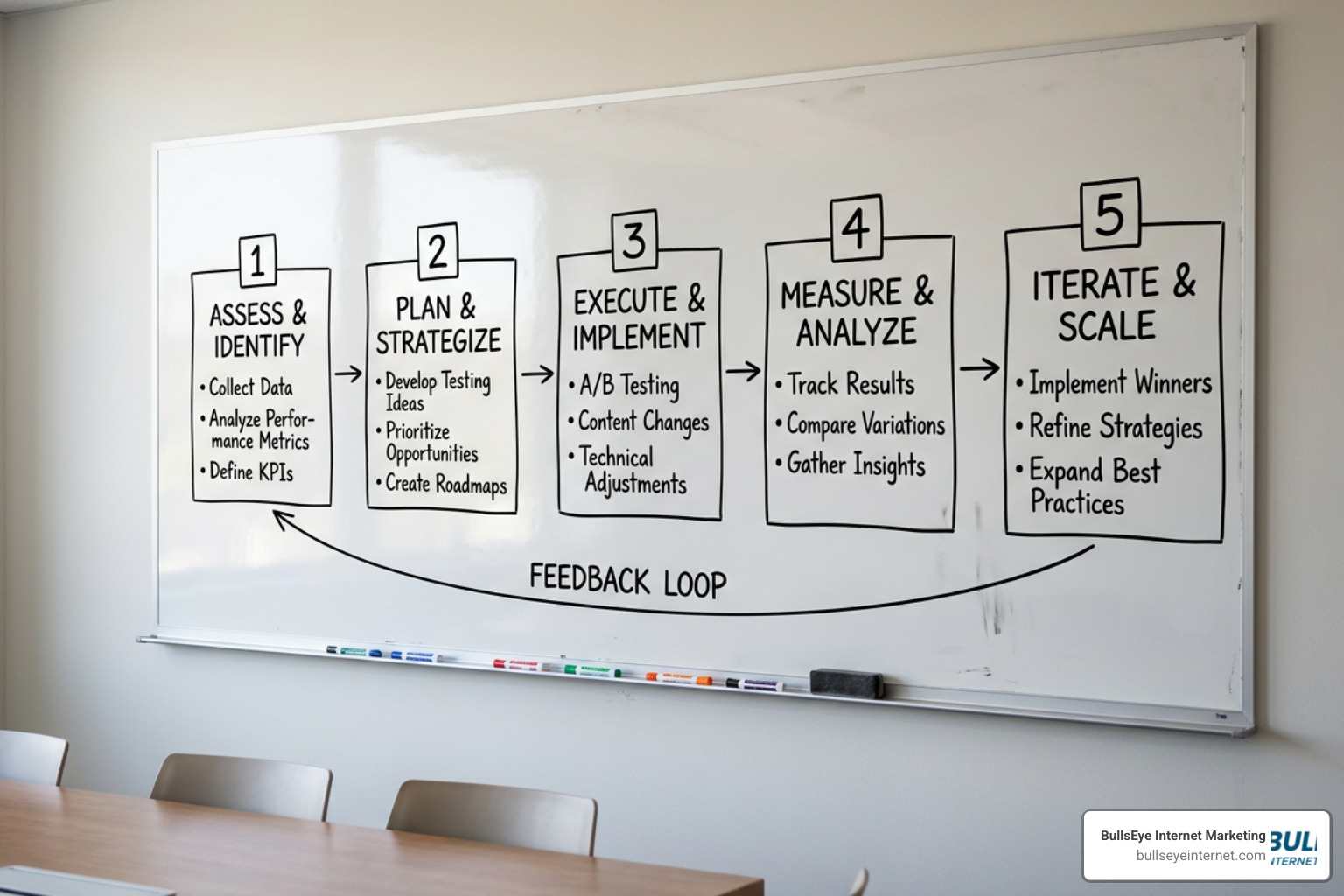
Step 1: Map Your Query Universe and Audit Your Baseline
Before optimizing anything, we must establish a baseline. You cannot improve what you do not measure. This starts with a manual citation audit.
We recommend selecting 20 to 30 of your highest-value target queries — the actual questions your customers ask when looking for your services in South Florida. Run these prompts through Gemini, ChatGPT, Perplexity, and Claude.
Document the following:
- Is your brand mentioned?
- Is your website cited?
- What is the sentiment of the response? Is the AI characterizing your brand positively, neutrally, or negatively?
- Which of your competitors are being recommended?
By mapping your query universe by AI intent, you can identify where you are already strong and where competitors are winning the “Share of Model.” For a detailed walkthrough on setting up this process, check out our guide on LLM SEO Audit Best Practices.
Step 2: Restructure Content for Maximum AI Search Visibility
AI engines do not read content the way humans do; they extract information. If your content is buried under paragraphs of fluff, the AI will ignore it.
To fix this, we use an answer-first structure. Every key page and section should lead with an “answer capsule” — a direct, 1-to-3 sentence answer to the primary question using plain, clear language. Pages that include these answer capsules experience a 40% higher citation rate.
- Use Question-Style Headings: Structure your H2 and H3 subheadings as natural language questions (e.g., “How do I improve my AI search visibility?”). Pages with well-organized headings are 2.8 times more likely to earn citations.
- Write Listicles and Tables: Listicles make up 32% of all AI citations, surpassing the next most-cited format by a wide margin. Use numbered processes, bulleted lists, and structured comparison tables.
- Keep Paragraphs Short: Keep paragraphs under four sentences. This makes it easier for LLMs to chunk and extract your text.
For more technical tips on formatting, read our guide on how to Speak the AI’s Language: Optimizing Content for Large Language Models.
Step 3: Build Entity Authority and Off-Site Trust
AI engines do not just look at your website; they look at the entire web to understand who you are. They treat your brand as an “entity” with specific relationships to other entities (like your location, your industry, and your founders).
To build strong entity authority:
- Maintain Entity Consistency: Ensure your business name, address, phone number, and description are identical across your website, Google Business Profile, LinkedIn, Crunchbase, and local directories.
- Build a Wikidata Entity: Wikidata is a primary source for the Google Knowledge Graph and various LLMs. Creating a Wikidata entry for your brand is a powerful way to establish authority.
- Focus on Earned Media: 90% of AI citations driving brand visibility originate from earned and owned media, not paid placements. Getting featured in local publications (like the Miami Herald or Sun-Sentinel), industry blogs, and podcasts builds the external footprint AI models trust. Brands in the top 25% for web mentions get 10 times more AI visibility than others.
Discover how to build this off-site trust in The Complete Guide to Large Language Model SEO.
Step 4: Leverage Structured Data and Schema Markup
Structured data acts as a direct translator for AI search engines. By using schema markup, you tell the AI exactly what your content means, making it highly machine-readable.
We recommend implementing server-rendered JSON-LD schema across your site:
- Organization Schema: On your homepage, defining your brand, logo, social profiles, and location.
- FAQPage Schema: For any FAQ sections, pairing your question-and-answer text with schema.
- Product & Local Business Schema: To feed real-time pricing, reviews, and service areas to local AI queries.
In the article Google publishes guide to optimizing for generative AI search , Google emphasizes that while you do not need special “AI-only” schema, maintaining standard, technically sound schema markup remains vital for appearing in rich, generative search features.
Step 5: Maintain Content Freshness and Recency
AI models value fresh data. In fact, pages updated within the last 2 months earn 28% more citations than older, stagnant content.
We recommend implementing a strict 90-day content refresh cycle for your core pages. During these refreshes, update old statistics, add new expert quotes, and include recent industry developments.
Furthermore, content containing specific statistics, citations, and quotations achieves a 30% to 40% higher visibility rate in AI responses. Instead of writing general statements, write: “According to a 2026 study, AI-referred traffic is growing roughly 1% month over month across all industries.” This gives the LLM a concrete data point to extract and cite.
Advanced Tactics and Common Optimization Mistakes
As businesses rush to optimize for AI search, we see many technical errors and strategic misconceptions. True technical LLM readiness requires clean crawler access, fast page speeds, and avoiding common optimization myths.
Technical LLM Readiness and Crawler Access
If AI crawlers cannot access your site, your brand will remain invisible in AI answers.
- Audit Your Robots.txt: Ensure you are not blocking retrieval bots. While you may want to block training bots (which use your data to train future models without citing you), you must allow retrieval bots (which fetch real-time data to cite you in active search queries).
- Bots to Allow:
OAI-SearchBot(ChatGPT’s search crawler)PerplexityBot(Perplexity’s crawler)Google-Extended(Google’s AI crawler)ClaudeBot(Anthropic’s crawler)
- Ensure Clean JavaScript Rendering: Many modern websites use heavy JavaScript that client-side renders. If an AI crawler cannot render your JavaScript in milliseconds, it will move on. Use server-side rendering (SSR) or static site generation (SSG).
- Optimize Page Speed: Aim for a Time to First Byte (TTFB) under 200ms and a Largest Contentful Paint (LCP) under 2.5 seconds.
For a complete checklist on preparing your site technically, read Supercharge Your AI: Essential LLM Optimization Techniques.
Common Pitfalls in Generative Engine Optimization
- Ignoring Gemini: Many marketers focus entirely on ChatGPT and Perplexity, ignoring Gemini. Because Gemini is embedded directly into Google Search — which still handles the vast majority of search volume — it must remain your top priority.
- Over-Chunking Content: A common myth is that you need to break your website into tiny, single-topic pages (content chunking) or create separate “AI-friendly” text files like
llms.txt. Google’s official documentation explicitly states that its systems can extract relevant passages from multi-topic pages, making over-chunking unnecessary and potentially harmful to your traditional SEO. - Assuming Organic Rank Guarantees Citations: Just because you rank #1 on Google for a term does not mean Gemini or Perplexity will cite you. AI engines prioritize structured data, direct answers, and verified entity authority over traditional ranking signals.
- Neglecting Sentiment: AI engines do not just list your brand; they write about you. If your online reviews are poor or your brand is mentioned negatively on forums, the AI may synthesize a response warning users away from your business. Sentiment management is now a core part of search visibility.
Frequently Asked Questions about Generative Search
How long does it take to see results from AI search optimization?
The timeline depends heavily on the platform:
- Perplexity: Because Perplexity indexes the web in real-time and heavily relies on active news and social platforms, well-structured, fresh content can start earning citations within 24 to 48 hours of publishing.
- Gemini: Gemini typically reflects content changes and structured data optimizations within a few days to two weeks, following Google’s standard recrawling patterns.
- ChatGPT and Claude: For queries relying on live web search, optimizations can show results in 2 to 4 weeks. For queries relying purely on offline training data, changes will not reflect until the models undergo their next training or fine-tuning cycle.
How do I track my brand’s citations in AI answers?
We recommend a three-pronged tracking methodology:
- Manual Audits: Track a core set of 10 to 20 high-value conversational queries weekly across Gemini, ChatGPT, and Perplexity. Note your citation frequency and sentiment.
- GA4 Referral Traffic: Monitor incoming referral traffic from domains like
chatgpt.com,perplexity.ai, andgemini.google.com. While AI referral traffic is currently small, it is growing roughly 1% month-over-month across all industries and converts at an incredibly high rate. - Share of Model Tracking: Use dedicated AI search visibility tools to track your brand’s share of voice across target topic categories compared to your main competitors.
Should I block AI crawlers in my robots.txt file?
In almost all cases, no. If you block AI retrieval crawlers (like OAI-SearchBot or PerplexityBot), your brand will be completely excluded from AI-generated answers and recommendations.
Publishers who blocked AI crawlers in 2025 lost an average of 7% of their weekly traffic within six weeks. The only exception is if your website hosts highly proprietary, paywalled data that you do not want used for model training. For standard businesses looking to generate leads, keeping these crawlers open is essential.
Conclusion
The shift toward AI search is not a temporary trend; it is a permanent evolution in how customers make buying decisions. In 2026, waiting to optimize your AI search visibility means letting your competitors claim the definitive “Footnotes of Truth” across Gemini, ChatGPT, and Perplexity.
At BullsEye Internet Marketing, we have spent over two decades helping businesses navigate the changing digital landscape. Based in South Florida, we provide cutting-edge SEO, Pay Per Lead, and Generative Engine Optimization services to clients in Miami, Fort Lauderdale, West Palm Beach, and across the entire United States.
We do things differently to give you a true competitive advantage:
- No Long-Term Contracts: We earn your business month after month based on actual performance and lead generation.
- Strict Exclusivity: We work with only one client per industry per geographic area. When you partner with us, we focus entirely on making your brand dominate the search landscape, ensuring we never optimize for your direct local competitors.
Let us help you turn AI search from a threat into your most powerful source of high-converting leads. Contact us today to audit your current AI search visibility and build a customized playbook for your business.
To learn more about our specialized search optimization services, visit our comprehensive guide on Answer Engine Optimization: AEO, GEO, LLM SEO.
