
Why Google SGE Optimization Matters for Your Visibility
Google SGE optimization helps your website earn visibility in Google’s AI-generated answers, now commonly called AI Overviews. Start by publishing direct, fact-checked answers to real customer questions, organizing pages with clear headings and lists, adding relevant schema markup, and proving real experience and expertise.
Traditional rankings still matter. But AI Overviews can take up much of the screen before people reach standard organic results. That means a page can rank well and still receive fewer clicks. The opportunity is to become one of the cited sources inside the overview, where searchers can discover your business before they compare options.
For business owners, the goal is not to chase an unproven trick. It is to build content Google can clearly understand, trust, and use to answer a searcher’s question. Strong technical SEO, helpful topic clusters, current information, and credible authorship all support that goal.
I am Ronnie Katz, founder and Principal CEO of BullsEye Internet Marketing, with more than 20 years of experience helping businesses improve search visibility, leads, and conversions. In this guide, I will break down practical Google SGE optimization strategies that build on sound SEO while preparing your site for AI-driven search.
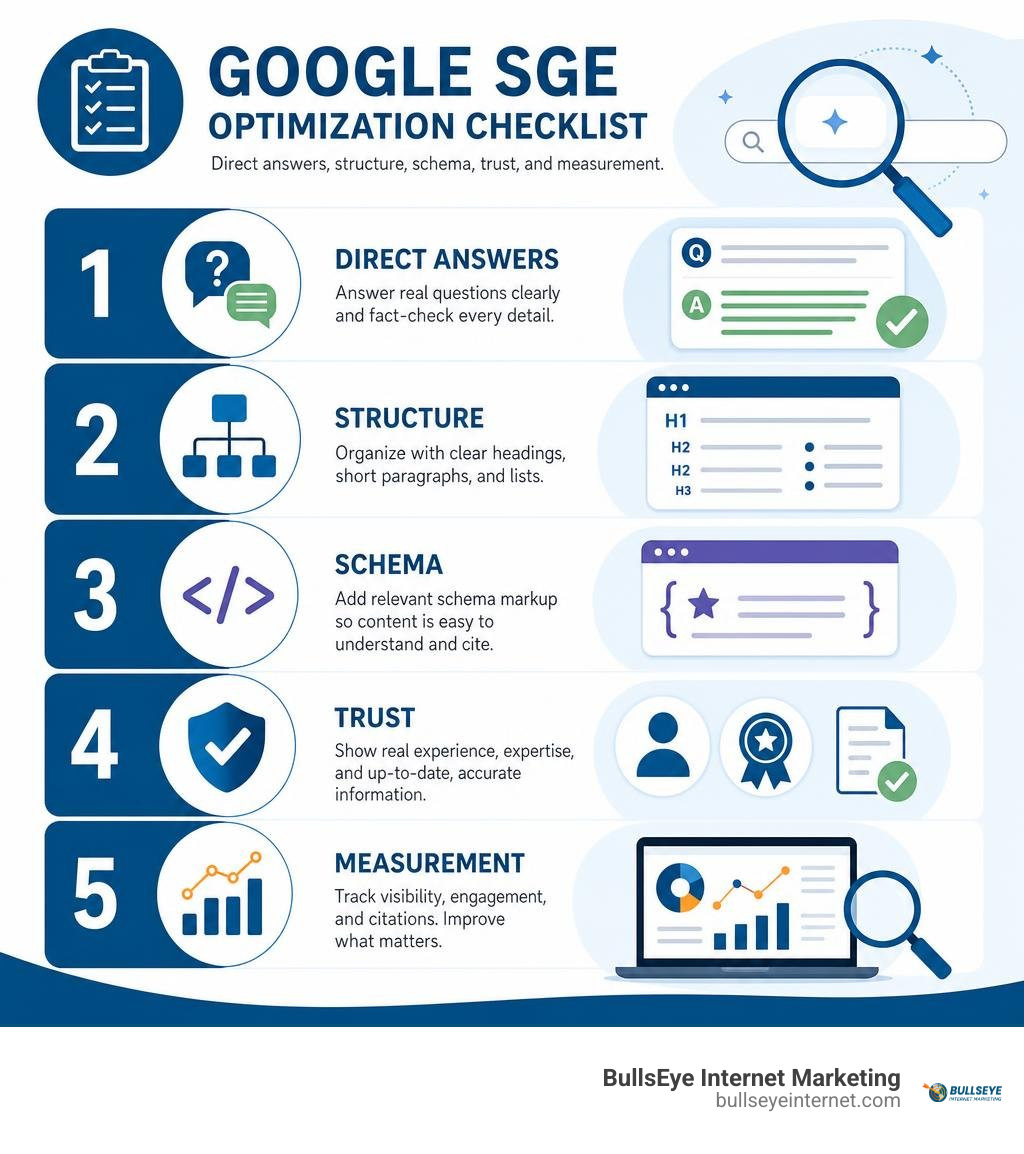
Key google sge optimization vocabulary:
Understanding Google SGE and AI Overviews in Modern Search
The search ecosystem has evolved dramatically. What began as the Search Generative Experience experiment has developed into integrated AI Overviews across search engine results pages (SERPs). Powered by advanced multimodal large language models like PaLM 2 and Gemini, these systems synthesize web content to generate cohesive, multi-perspective snapshots in under seven seconds.
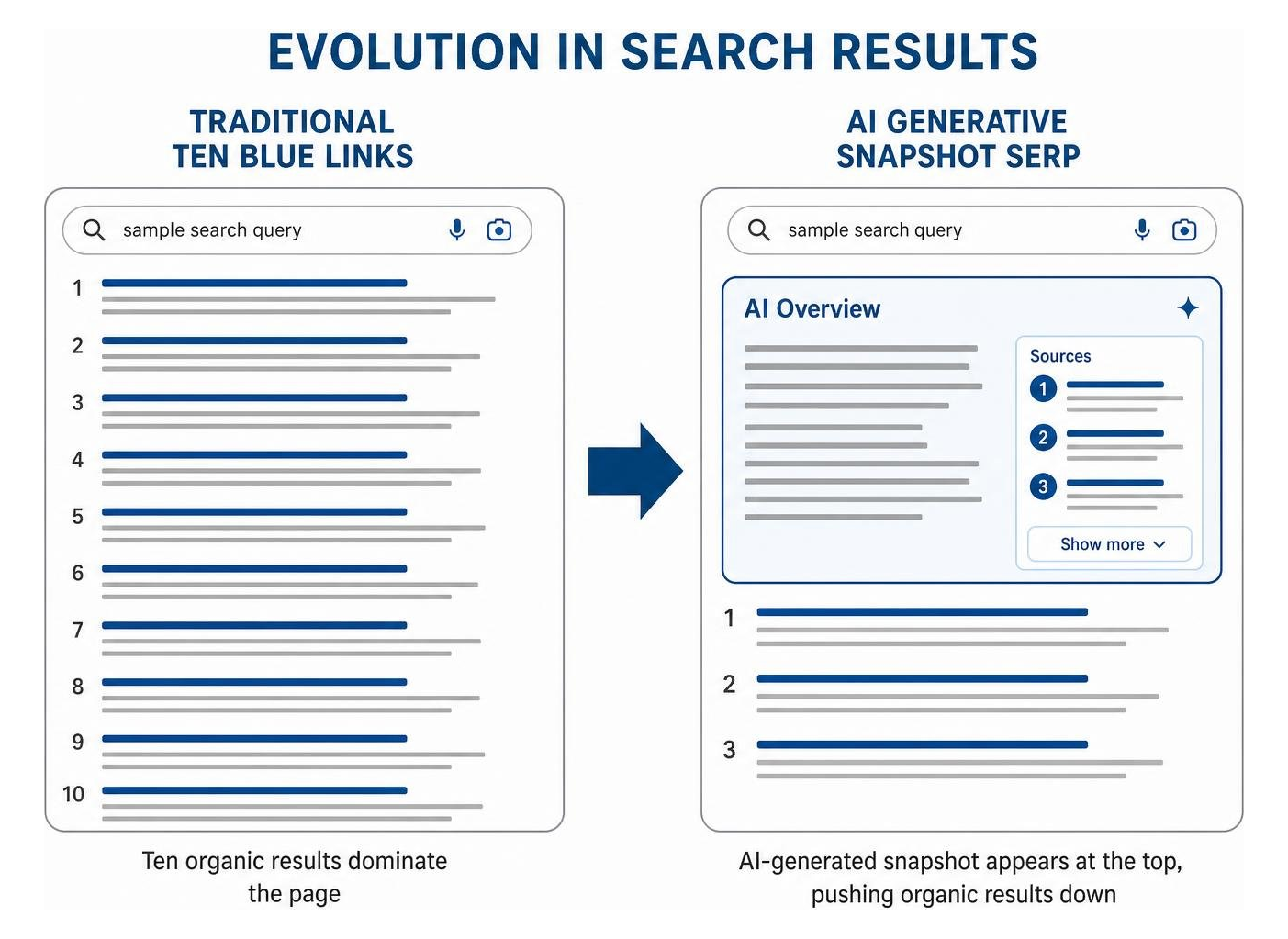
This evolution impacts SERP real estate. Studies reveal that 84% of the time, AI Overviews occupy more than half the screen, with 38% consuming the entire viewport on mobile devices. For queries where these snapshots appear, standard organic listings are pushed far down the page. Traditional high-ranking pages are facing estimated organic traffic declines of up to 25%, while generic informational sites see traffic drops between 30% and 40%. Conversely, pages cited within generative summaries capture prominent visibility and experience measurable click boosts.
Understanding how generative models evaluate sources is essential. According to foundational research on SGE and generative AI in Search, Google blends real-time web retrieval with core ranking systems to corroborate data and minimize hallucinations.
| Dimension | Traditional Organic Search | Google SGE / AI Overviews |
|---|---|---|
| Primary Output | Ranked list of standalone web links | Synthesized multi-source answer snapshot |
| Placement | Position 1 through 10 below ads | Position Zero / Above traditional organic listings |
| Screen Coverage | Fractional screen area per listing | Over 50% on desktop; up to 100% on mobile |
| Source Selection | Strong bias toward top 10 ranked domains | 93.8% of citations can come from outside the top organic ranks |
| User Interaction | Single click-and-visit model | Interactive follow-up queries and direct exploration |
| Optimization Focus | Keywords, metadata, and backlink volume | Entity depth, semantic clarity, direct answers, and schema |
How AI Overviews Differ from Traditional Search Results
Traditional SEO focused heavily on claiming a top spot on Page 1. If your page had solid backlinks, exact-match keywords, and decent domain metrics, you secured steady clicks.
Generative search changes that dynamic. Only 4.5% of URLs cited in AI Overviews mirror the exact traditional Page 1 organic results. Google’s AI snapshots synthesize information from a broader web index, favoring content that answers the core query concisely and clearly, regardless of whether the domain possesses massive backlink equity.
Unlike traditional featured snippets that lift a single paragraph from one page, AI snapshots assemble composite answers from multiple domains. They provide expandable citation carousels, allowing users to drill down into specific sub-points or ask natural language follow-up queries.
Query Types and Trigger Mechanics for AI Snapshots
Not every search produces an AI overview. Across global indexes, about 30% to 47% of queries actively display generative snapshots, depending on search intent and user context.
According to deep-dive research on SGE SERP formats, generative results appear in three distinct states: expanded snapshots, collapsed modules requiring user interaction, and opt-in prompts.
- Informational Queries: Informational searches trigger AI overviews most frequently. Generative snapshots organize broad topics into scannable sections, breaking down complex subjects into digestible takeaways.
- Commercial Exploration: For product research, Google integrates its Shopping Graph—indexing over 35 billion product listings updated at a rate of 1.8 billion per hour—to present dynamic carousels with pricing, specifications, and review summaries.
- Local Searches: Local business queries populate Places modules, highlighting reviews, location data, and hours sourced directly from Google Business Profiles.
- YMYL (Your Money or Your Life): For sensitive medical, legal, or financial topics, generative engines apply strict guardrails, frequently deferring to established authorities or suppressing AI summaries altogether.
Core Strategies for Google SGE Optimization
Succeeding in generative search requires adjusting your optimization workflow. Traditional keyword placement alone is not enough; AI models analyze semantic relevance, context, and structural clarity.

To build visibility across AI-driven environments, explore our AI search optimization complete guide to align your site architecture with natural language processing models.
On-Page Content Structuring for Google SGE Optimization
AI language models favor structured information that is easy to extract. To position your pages for inclusion:
- Adopt the 3A Content Framework: Structure your primary sections around Awareness (clear definition of the topic), Analysis (comparative insights, nuances, and real-world implications), and Action (actionable steps, checklists, or procedural guides).
- Implement Answer-First Headings: Place concise, direct 2-to-3 sentence answers immediately below your H2 and H3 headings. AI snapshot engines extract these direct summaries for inclusion in generative overviews.
- Use Scannable Formats and Breakout Lists: Replace dense paragraphs with bulleted lists, numbered sequences, and comparison tables. Generative engines frequently convert well-organized on-page lists into prominent SERP summary modules.
- Target Conversational Long-Tail Queries: Structure subheadings around natural questions that match how people speak into voice-search devices or type multi-part queries.
Integrating these generative SEO techniques ensures that search algorithms can quickly parse, synthesize, and cite your assets.
Technical Schema and Google SGE Optimization
Technical markup provides explicit context that helps AI models parse page intent without ambiguity. Implementing structured JSON-LD data serves as an essential semantic translation layer.
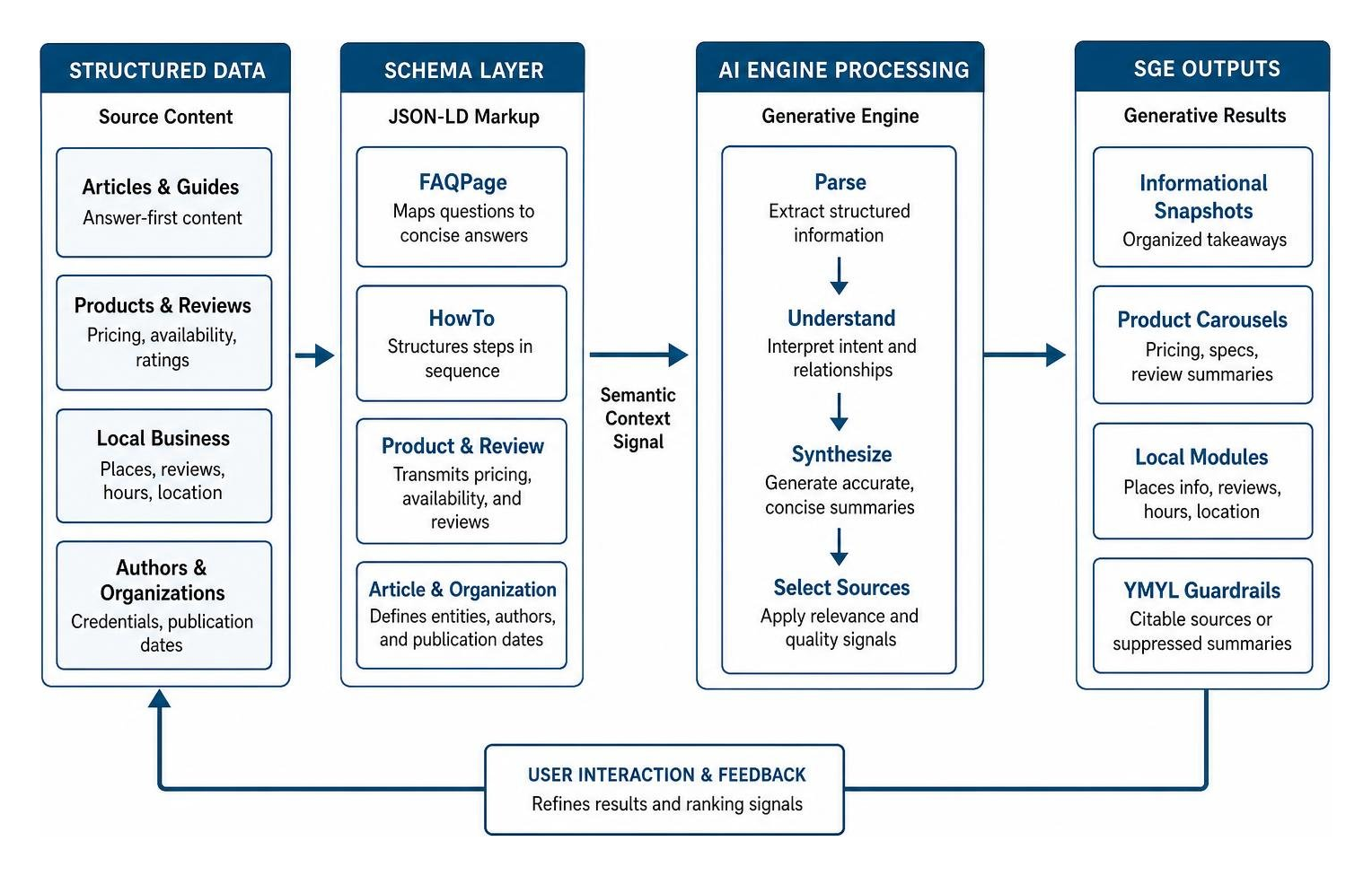
Key schema types to prioritize:
- FAQPage Schema: Clearly maps specific user questions to concise answers, making them directly readable for generative modules.
- HowTo Schema: Structures instructional and procedural guides into distinct sequential steps.
- Product and Review Schema: Transmits real-time data regarding pricing, availability, and customer feedback into Google’s Shopping Graph.
- Article and Organization Schema: Establishes unambiguous entity definitions, author attribution, and publication dates.
If you need hands-on technical support configuring advanced schema networks, our generative engine optimization service can help build a robust, machine-readable infrastructure for your business.
The Role of E-E-A-T and Topical Authority in Generative Results
AI Overviews are engineered to reduce hallucinations and ensure factual accuracy. Consequently, domain-level Experience, Expertise, Authoritativeness, and Trustworthiness (E-E-A-T) serve as critical filters for citation eligibility.

To explore these authority models in depth, read our guide on mastering Google SGE.
Building Resilient Topic Clusters and Entity Depth
Generative algorithms evaluate topical authority across your entire domain rather than looking at individual pages in isolation. A single high-performing article is rarely enough to sustain long-term citations if the rest of your domain lacks contextual depth.
To establish semantic authority:
- Build Comprehensive Pillar Pages: Develop centralized authority hubs that thoroughly cover broad industry topics.
- Publish Supporting Cluster Articles: Surround each pillar with 6 to 10 interlinked cluster articles covering specific sub-themes, comparison queries, and long-tail FAQs.
- Use Clear Internal Linking: Connect related topics using descriptive, keyword-rich anchor text to reinforce semantic relationships.
- Conduct Content Gap Analyses: Systematically identify and address unaddressed questions within your niche before competitors do.
Consistently demonstrating entity depth across targeted subjects improves your site’s overall AI visibility optimization.
Demonstrating First-Hand Experience and Trust Signals
Because generative AI can easily reproduce generic information, unique first-hand experience stands out to ranking algorithms:
- Showcase Verified Author Credentials: Include clear author biographies, professional qualifications, and links to external industry publications.
- Publish Original Data and Case Studies: Produce proprietary survey findings, unique operational benchmarks, and detailed client outcomes that AI models cannot synthesize from other sources.
- Maintain Entity Consistency Across the Web: Ensure your brand name, address, phone number (NAP), and business details remain consistent across your website, social channels, and third-party directories.
- Optimize Local Authority via Google Business Profile: For local visibility, keep your Google Business Profile updated with accurate operational hours, categorized service offerings, and authentic customer reviews.
Measuring Performance and Common SGE Mistakes to Avoid
Tracking generative search visibility requires shifting away from legacy rank-tracking methods. Because AI Overviews are dynamic and change based on context, standard rank-checking tools often fail to capture complete snapshot performance.
For a structured roadmap on monitoring AI search performance, review our SGE optimization services.
Key Metrics for Tracking Generative Search Visibility
To accurately measure AI search performance, monitor the following indicators:
- Share of Snapshot: Track the percentage of target keywords that generate an AI overview citing your domain.
- Google Search Console Impression Trends: A steady increase in impressions alongside stable or slightly reduced clicks often indicates that your content is appearing within AI Overviews.
- Direct Referral Traffic from Citations: Track user visits originating from generative snapshot links and interactive carousels.
- Query Diversity: Monitor your appearances across complex, conversational multi-word search queries.
Strategic Errors That Harm AI Inclusion
Avoid these common mistakes when optimizing for generative search:
- Keyword Stuffing: Overloading pages with repetitive phrases confuses semantic NLP models and degrades readability.
- Thin, Unoriginal Content: Paraphrasing existing articles without adding original data or expert insight gives AI models little reason to cite your site.
- Neglecting Content Freshness: Outdated statistics and stale timeframes reduce citation rates, as generative engines favor current information.
- Missing Structured Data: Omitting schema markup forces AI models to guess your content’s hierarchy, reducing your chances of winning rich snippet displays.
- Relying Solely on Backlinks: Backlinks build baseline organic authority, but clear content structure, topical depth, and direct answers are what secure generative snapshot citations.
Frequently Asked Questions about SGE Optimization
What is the difference between SGE and traditional featured snippets?
Traditional featured snippets pull a single text excerpt or table from one high-ranking webpage to answer a specific query. In contrast, Google SGE and AI Overviews use generative models to synthesize information across multiple sources simultaneously. They construct dynamic multi-paragraph explanations, present interactive comparison modules, and provide follow-up conversational capabilities that featured snippets cannot match.
How long does it take to see results from SGE optimization?
Websites that implement clear content structures, answer-first headings, and JSON-LD schema typically observe shifts in AI Overview citations within four to twelve weeks. The exact timeline depends on Google’s crawl frequency, the baseline topical authority of your domain, and the competitive density of your target queries.
Can new websites earn citations in Google SGE snapshots?
Yes. Because more than 90% of generative citations come from pages outside the traditional top-ranked organic results, newer websites with high topical relevance can earn citations quickly. Focus on long-tail, question-based queries, implement proper schema, and deliver clear direct answers to build early AI visibility.
Conclusion
The shift toward AI Overviews represents a major evolution in search. Businesses that adapt their content structures, lean into domain-level topical authority, and embrace structured schema will secure significant visibility advantages as search becomes increasingly conversational.
At BullsEye Internet Marketing, we help businesses build forward-looking search strategies that generate measurable calls and sales. With over two decades of digital marketing experience, our team specializes in search engine optimization, Google Business Profile management, Pay Per Lead, PPC, and conversion optimization. We operate without long-term contracts and work with only one client per industry per geographic area, giving our partners a true competitive edge.
To prepare your digital assets for the future of search, explore our advanced strategies in Answer Engine Optimization (AEO), Generative Engine Optimization (GEO) & LLM SEO and start building your generative search visibility today.
