
Home Services SEO Helps You Turn Local Searches Into Booked Jobs
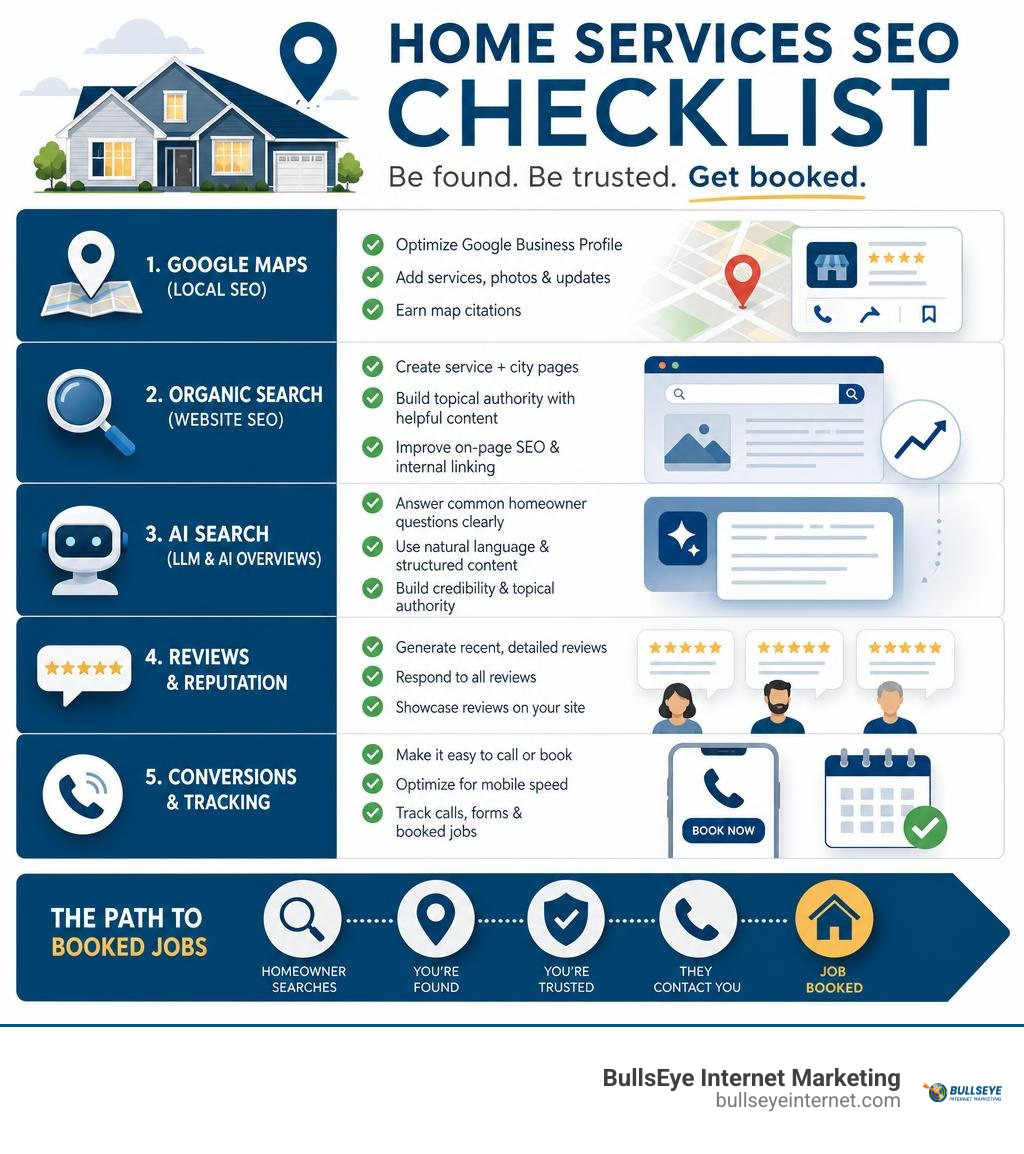
Home services SEO is the work of making your business easy to find, trust, and contact when homeowners need help. Start by fully optimizing your Google Business Profile, building clear service-and-city pages, earning recent detailed reviews, fixing mobile speed issues, and tracking calls and booked jobs instead of rankings alone.
In 2026, that visibility must extend beyond Google Search and Maps. Homeowners also ask AI tools such as ChatGPT, Gemini, Claude, and Perplexity which contractor to call. Meanwhile, Google’s AI Overviews can answer a search before a person clicks a traditional result. The goal is no longer just to rank – it is to become one of the few businesses a homeowner sees and trusts at the moment they need service.
For a plumber, HVAC company, roofer, electrician, or remodeler, this matters because local searches carry strong intent. Someone searching for an emergency repair, a replacement cost, or a contractor in their neighborhood is often close to making a call. Your competitors may not provide better work. They may simply be easier to find online.
I am Ronnie Katz, founder and Principal CEO of BullsEye Internet Marketing, with more than 20 years of experience helping businesses improve visibility, traffic, and conversions. In this guide, I will show how practical home services SEO can create a clearer path from local search to qualified phone calls and booked work.
Home services seo further reading:
Core Foundations of Modern Home Services SEO
Local search represents the lifeline of modern trade businesses. When a homeowner’s air conditioner fails or a roof begins leaking, they do not browse casually; they turn directly to their phones to find an immediate, trustworthy solution. Nearly half of all Google searches carry local intent, and most users who conduct a local query visit or contact a business within 24 hours.
To capture this demand, companies must adopt proven local SEO strategies for small business success. A strong campaign rests on three core pillars:
- Google Business Profile (GBP) optimization to anchor you in local map packs.
- Name, Address, and Phone (NAP) consistency across foundational business directories and citation networks.
- Hyper-local website content targeting the specific problems homeowners experience within your exact service zones.
Search algorithms evaluate relevance, distance, and prominence. To rank in the coveted Map Pack—the three prominent Google Maps listings at the top of local search results—your business must demonstrate clear geographic proximity to the searcher, consistent citation records, and authoritative on-page signals.
The 8-Step Homeowner Buyer Journey
Contractors often assume customers make instant decisions. In reality, modern property owners follow a structured progression before booking a technician.
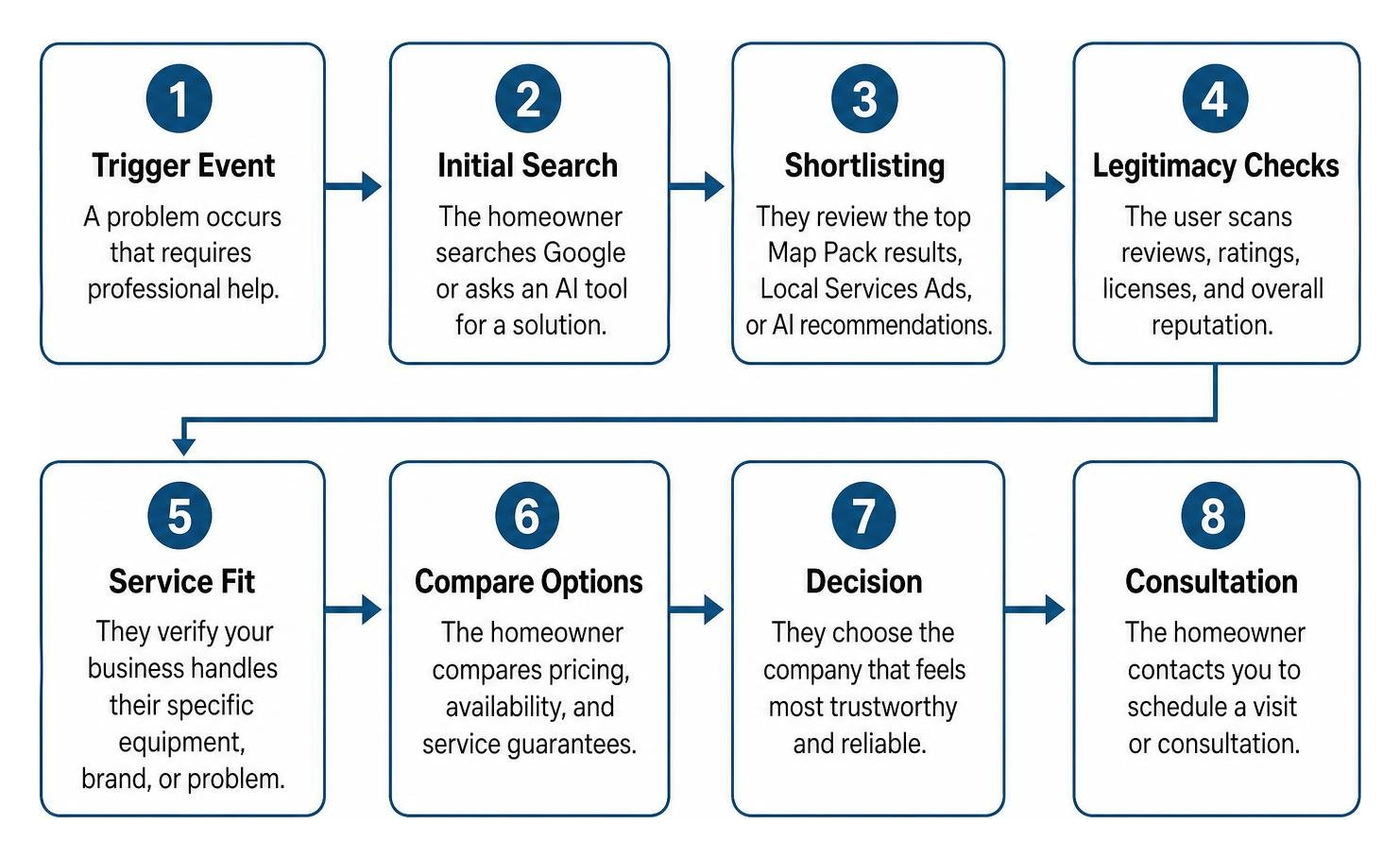
- Trigger Event: A water heater breaks, an electrical panel trips repeatedly, or a storm damages shingles.
- Initial Search: The homeowner searches Google or prompts an AI tool with phrases like “emergency roof repair near me” or “best AC repair in Miami.”
- Shortlisting: The searcher reviews the top three Map Pack entries, Google Local Services Ads, or AI recommendations.
- Legitimacy Checks: The user scans star ratings, licenses, review recency, and overall reputation.
- Service Fit: They verify whether your business handles their specific equipment, brand, or problem.
- Proof Points: The homeowner reviews before-and-after photos, neighborhood project case studies, and transparent pricing structures.
- Contact Step: They initiate contact via click-to-call, live chat, or an online booking form.
- Consultation: The homeowner discusses details with your dispatch team and schedules the service visit.
Search Intent Segmentation for Home Services
Understanding search intent allows you to craft pages that match the urgency and expectations of the user.
| Search Intent Type | Example Search Query | Primary User Goal | Optimal Conversion Asset |
|---|---|---|---|
| Emergency Repair | “burst pipe repair 24/7 Fort Lauderdale” | Immediate on-site help within 60–90 minutes | Prominent click-to-call button & dispatch guarantees |
| Planned Replacement | “heat pump installation cost Palm Beach” | Budgeting, options, and financing terms | Cost calculator, brand comparisons, and estimate forms |
| Maintenance & Upkeep | “annual electrical inspection checklist” | System preservation and warranty protection | Maintenance club signup and seasonal tune-up packages |
| Neighborhood-Specific | “licensed roofer Coral Gables” | Verifying local building code compliance & permits | Local neighborhood landing page with local permits proof |
Google Business Profile and Reputation Dominance
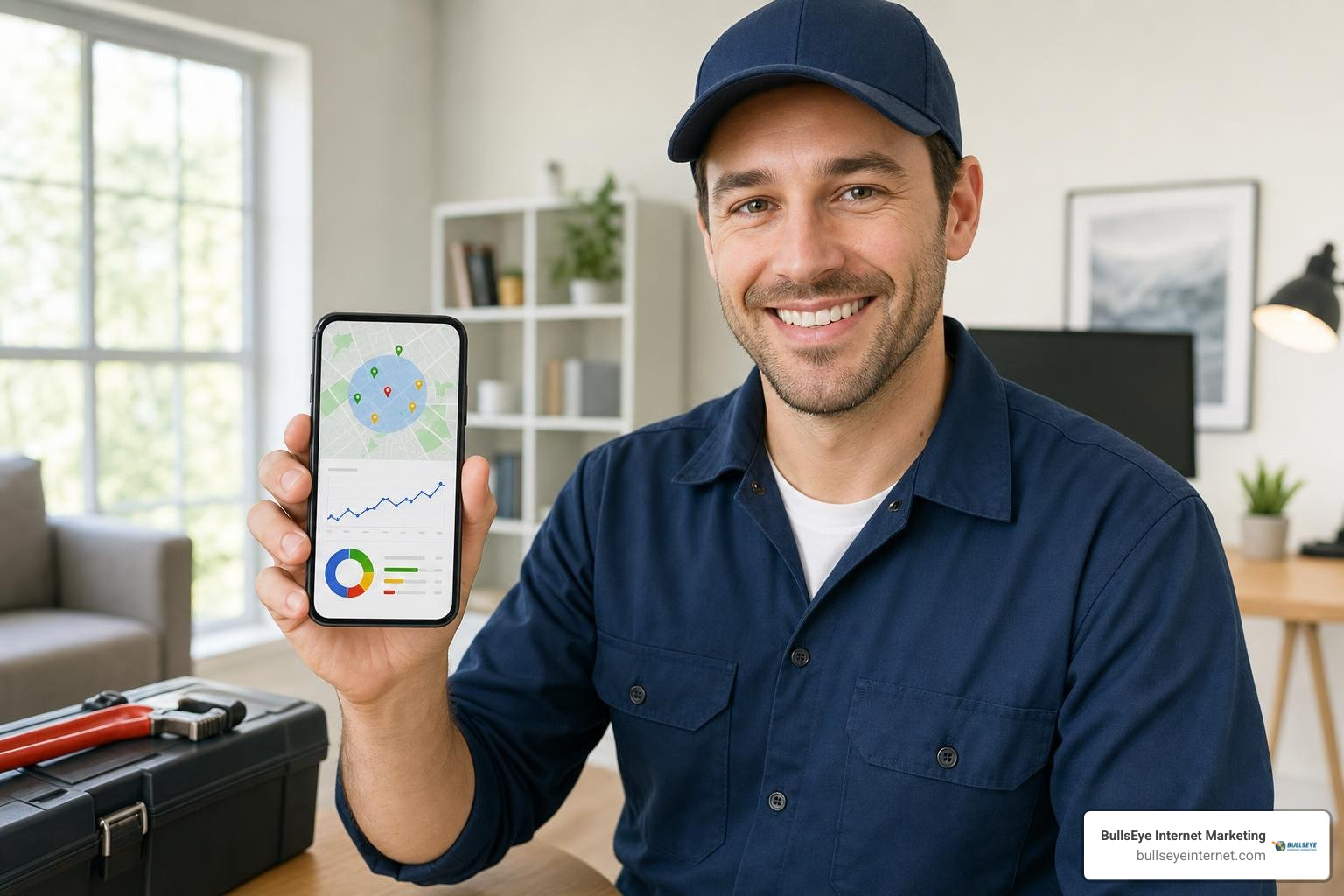
Your Google Business Profile functions as the virtual front door of your company. Claiming and fully completing every field establishes the core foundation of local map rankings.
To maximize profile strength:
- Primary & Secondary Categories: Choose the most precise primary classification (e.g., HVAC Contractor rather than Contractor), then assign relevant secondary categories like Air Conditioning Repair Service or Heating Contractor.
- Service Menus & Products: List each service individually with detailed descriptions, starting prices, and turnaround timelines.
- Geotagged Real Project Photos: Upload authentic, high-resolution images of your technicians, branded vehicles, and completed installations weekly.
- Google Posts: Publish weekly updates highlighting seasonal discounts, recent community projects, and maintenance advice.
- Q&A Management: Pre-populate the Q&A section with answers to common questions regarding response times, warranties, emergency fees, and service areas.
Review Generation and Reputation Velocity
Raw review volume is no longer enough. Modern search engines and AI systems prioritize review velocity (the frequency of new reviews) and semantic context (specific mentions of services, tools, and neighborhoods).
Implement an automated SMS and email system that requests feedback immediately after a technician completes a job. Providing a direct, one-tap link simplifies the process for homeowners.
Train your staff to request mentions of specific services:
“If you enjoyed our service today, please let us know in a quick review which neighborhood you’re in and how our drain cleaning team helped solve your issue!”
Always post professional responses to every review. Thank positive reviewers by mentioning the specific service performed, and address negative reviews constructively within 24 hours to demonstrate accountability to prospective clients.
Local Citation Management and NAP Data
Search algorithms cross-reference your Name, Address, and Phone Number across hundreds of directories. Even slight variations—such as “Street” versus “St.”—can dilute your local authority.
- Audit primary data aggregators (Data Axle, Localeze, Foursquare).
- Secure consistent listings on trade platforms (Angi, Houzz, HomeAdvisor).
- Maintain verified profiles on local chambers of commerce and municipal trade directories.
- Ensure your state contractor license registry lists the exact business name and physical address used on your website.
Winning AI Search Engines: AEO, GEO, and Entity Optimization
The search landscape is experiencing a massive evolution. Today, roughly 45% of U.S. consumers have utilized an AI platform to find local services. Homeowners increasingly use conversational assistants such as ChatGPT, Gemini, Claude, and Perplexity to source contractor recommendations.
To understand how to capture high-intent leads from these platforms, explore our local lead generation services complete guide.
AI search platforms rely on Answer Engine Optimization (AEO) and Generative Engine Optimization (GEO). Rather than simply scanning for keywords, these systems interpret semantic relationships between your business entity, services, geographical footprint, and customer sentiment.
The Six AI Recommendation Signals
AI models evaluate specific trust signals when selecting which three to five contractors to recommend to a user:

- Structured Data Precision: Comprehensive Schema.org markup outlining business types, service offerings, and licenses.
- Entity Footprint Consistency: Uniform business information across authoritative industry databases and local registries.
- Third-Party Review Velocity: Active, positive review trends across Google, the Better Business Bureau, and Yelp.
- Direct-Answer Content: Clear, concise explanations answering homeowner technical questions directly on your website.
- Authoritative Local Mentions: Citations and features in local news, community sponsorships, and supplier partner pages.
- Precise Service-Area Mapping: Detailed neighborhood service boundaries that match homeowner location queries.
Structured Data and Schema Implementation
Schema markup helps search engines and AI crawlers interpret your site’s data without ambiguity. Use specific business types (such as HVACBusiness, Plumber, RoofingContractor, or Electrician) rather than generic LocalBusiness tags.
Ensure your JSON-LD structured data includes:
- Exact business operating hours and emergency availability.
- Defined
serviceAreaboundaries by county, city, and zip code. - Specific
priceRangeindicators. - Embedded
FAQPageschema on all service hubs. - Direct links to state licensing directories and certifications via
hasCredentialproperties.
High-Converting Content Strategy and Website Structure
To systematically land more jobs, follow our comprehensive contractors blueprint how to generate leads and land more jobs. A high-converting website pairs targeted local landing pages with detailed service hubs.
Your digital site architecture should follow a logical hierarchy:
- Dedicated Service Pages: Separate pages for each core service (e.g., Drain Clearing, Tankless Water Heater Installation, Repiping).
- Service-Area Pages: Unique, non-duplicate pages for every key town, city, and neighborhood you serve.
- Emergency Action Hubs: Fast-loading emergency landing pages detailing on-call schedules and exact response windows.
- Maintenance Club Portals: Pages dedicated to annual service agreements, recurring discounts, and preventive upkeep plans.
Technical Home Services SEO and Website Architecture
A slow or broken website costs you conversions before a homeowner even reads your phone number. Mobile optimization is critical, as emergency home searches occur almost entirely on smartphones.
- Speed & Core Web Vitals: Ensure your Largest Contentful Paint (LCP) loads under 2.5 seconds. Optimize high-resolution job site images using WebP compression.
- Mobile-First Layout: Place persistent click-to-call buttons and short quote forms directly within the smartphone viewport.
- HTTPS & Security: Maintain valid SSL encryption to protect user data and reinforce trust.
- URL & XML Hierarchy: Maintain clean, descriptive URL paths (e.g.,
/services/air-conditioning-repair/and/locations/west-palm-beach/) linked inside updated XML sitemaps. - Crawlability: Eliminate 404 broken links, address redirect loops, and optimize your internal linking structure to distribute domain authority across all localized service hubs.
Content Types That Dominate AI Answers and Organic Search
To stand out in both organic search and AI Overviews, publish content that addresses practical homeowner questions with verified expertise:
- Detailed Cost Breakdowns: Provide honest pricing ranges for equipment installations, explaining labor variables and permit costs.
- Equipment Brand Comparisons: Compare major equipment brands, discussing seasonal efficiency, reliability ratings, and warranty coverage.
- Hiring & Inspection Checklists: Guide homeowners on evaluating contractor bids, checking state licenses, and verifying liability insurance.
- Neighborhood Project Spotlights: Document recent projects with photos, addressing specific regional issues like high humidity, salt-air corrosion, or local building codes.
- Trust Pages: Maintain clear pages dedicated to technician background checks, licensing credentials, and safety guarantees.
Multi-Channel Growth: Blending SEO with Paid Advertising
While organic SEO provides sustainable, long-term ROI, combining organic visibility with paid advertising builds predictable lead flow. Learn how we guarantee quality leads for home service contractors through multi-channel integration.
Integrating Local Services Ads with Organic Strategy
Google Local Services Ads (LSAs) appear at the absolute top of the search engine results page, above both traditional paid search ads and organic map packs.
Leveraging Google Local Services Ads for home services provides several distinct advantages:
- Pay-Per-Lead Model: You only pay for qualified phone calls and direct messages from prospective customers.
- Google Guaranteed / Screened Badge: Enhances user trust by verifying background checks, business licenses, and insurance coverage.
- Review Synchronization: Your Google Business Profile reviews automatically populate your LSA listings, increasing conversion rates.
Emerging AI Advertising Channels
As consumers shift research queries to conversational AI interfaces, conversational PPC and sponsored placements within AI platforms are becoming valuable conversion channels.
These tools place your brand directly inside AI-generated solutions when homeowners search for local service providers. Aligning conversational advertising with organic entity optimization ensures your brand maintains full coverage across traditional search, map packs, and AI platforms.
Measuring Home Services SEO ROI Beyond Keyword Rankings
Rankings alone do not pay the bills. True marketing success is measured by revenue, customer acquisition costs, and booked jobs.
Track these operational metrics:
- Booked Appointments: The number of scheduled on-site estimate visits generated via organic and map channels.
- Cost Per Acquisition (CPA): Total marketing investment divided by closed, paid service tickets.
- Google Business Profile Actions: Direction requests, website clicks, and phone calls logged inside your GBP performance dashboard.
- AI Citation Share of Voice: How frequently AI tools recommend your company when prompted with local service queries.
- Dynamic Call Tracking: Dedicated tracking phone numbers placed on service-area pages to measure lead quality and conversion rates accurately.
Frequently Asked Questions about Home Services SEO
How fast does home services SEO generate inbound leads?
Initial performance improvements—such as Google Business Profile updates, citation cleanup, and high-priority technical fixes—often produce measurable lifts in map impressions and calls within 30 to 60 days. Broader organic authority, neighborhood landing page rankings, and consistent AI citations typically compound over 3 to 6 months of active optimization.
Why is AI search optimization essential for contractors in 2026?
AI Overviews now appear in roughly 40% of local search queries, frequently answering homeowner questions directly at the top of the screen. Optimizing for AI discovery (AEO and GEO) ensures your business entity is cited as a trusted service provider across Google AI Overviews, ChatGPT, Gemini, Claude, and Perplexity.
What are the biggest local SEO mistakes contractors make?
The most common mistakes include:
- Stuffing keywords into the Google Business Profile title.
- Selecting incorrect or overly broad business categories.
- Copying and pasting identical text across multiple city landing pages.
- Failing to respond to negative reviews.
- Running a slow, non-responsive website that lacks prominent click-to-call buttons.
Conclusion
Building a dominant local presence requires more than basic directory submissions. By pairing a fast, mobile-friendly website with an optimized Google Business Profile, active review generation, and deep structured data, you establish a resilient brand that converts local search demand into booked revenue.
At BullsEye Internet Marketing, we operate with a clear competitive advantage: we do not require long-term contracts, and we partner with only one client per industry per geographic area. This guarantees our complete dedication to making your company the market leader in your service territory.
Claim your local market before your competitors adapt by implementing comprehensive answer engine optimization and AI search strategies today. Contact our team to build your tailored local growth plan.
