
Why Medical Aesthetic Marketing Is One of the Hardest — and Most Rewarding — Industries to Crack
Medical aesthetic marketing sits at the crossroads of healthcare, beauty, and high-stakes consumer decisions. And that makes it unlike almost any other industry you could market.
Here’s a quick answer if you just want the essentials:
What is medical aesthetic marketing?
Medical aesthetic marketing is the process of attracting, converting, and retaining clients for treatments like Botox, dermal fillers, laser procedures, and body contouring. It requires:
- Building clinical trust — patients treat these decisions like medical choices, not impulse buys
- Getting found locally — most clients search “Botox near me” or “best med spa in [city]” before booking
- Managing your reputation — 84% of patients check online reviews before choosing a provider
- Staying compliant — ad restrictions, before-and-after rules, and privacy laws all limit what you can say and show
- Nurturing long-term relationships — repeat clients and referrals drive the majority of sustainable revenue
The opportunity is real and growing fast. The global medical aesthetics market is projected to hit USD 40.60 billion by 2031, up from USD 22.59 billion in 2026 — a 12.4% annual growth rate. Consumer demand is surging too: 81% of consumers say they’re more accepting of noninvasive treatments than they were five years ago.
But here’s the hard part: most practices don’t have a marketing system. They try a few ads, post sporadically on Instagram, and wonder why their calendar isn’t full.
This guide gives you a clear, practical roadmap to fix that.
I’m Ronnie Katz, founder of BullsEye Internet Marketing, and I’ve spent over 20 years helping businesses cut through the noise online — including navigating the unique compliance and trust challenges that come with medical aesthetic marketing. Let’s get into what actually works.
Medical aesthetic marketing terms to learn:
- Advertising for plastic surgeons
- Hair transplant marketing
- cosmetic surgery lead generation
What is Medical Aesthetic Marketing and Why is it Unique?
While a local hair salon or makeup brand can rely on lifestyle imagery and quick impulse purchases, medical aesthetic practices operate in a completely different realm. We aren’t just selling skincare; we are selling medical procedures. Treatments like neuromodulators, dermal fillers, chemical peels, and body contouring require needles, lasers, and clinical expertise.
Because these treatments are medical in nature, patients approach them with a high degree of caution. You cannot discount your way to a packed calendar if patients do not trust your injectors. This is why Learn more about aesthetic clinic marketing must prioritize clinical trust, safety, and credentials over flashiness.
Furthermore, search engines and social media networks hold medical aesthetics to incredibly strict advertising standards. We must navigate HIPAA guidelines in the United States, FTC truth-in-advertising standards, and strict platform-level restrictions that ban or limit before-and-after imagery, specific cosmetic claims, and retargeting ads for medical procedures.
The Challenge of YMYL and E-E-A-T in Aesthetics
Google categorizes most medical and cosmetic procedure content as YMYL (Your Money or Your Life). This means search engines evaluate your website under the absolute strictest E-E-A-T (Experience, Expertise, Authoritativeness, and Trustworthiness) guidelines.
To rank well on Google, your content cannot be generic, ghostwritten fluff. It must show clear clinical authorship. Every treatment page should be attributed to a verified, licensed practitioner with visible credentials, registration numbers, and a professional bio.
When search engines crawl your site, they look for signals that prove you are a safe, authoritative voice. If your website lacks these trust markers, your search rankings will suffer. For a deep dive into navigating these rules, check out the Aesthetic & MedSpa Clinics Marketing Guide 2026.
The Considered Patient Journey
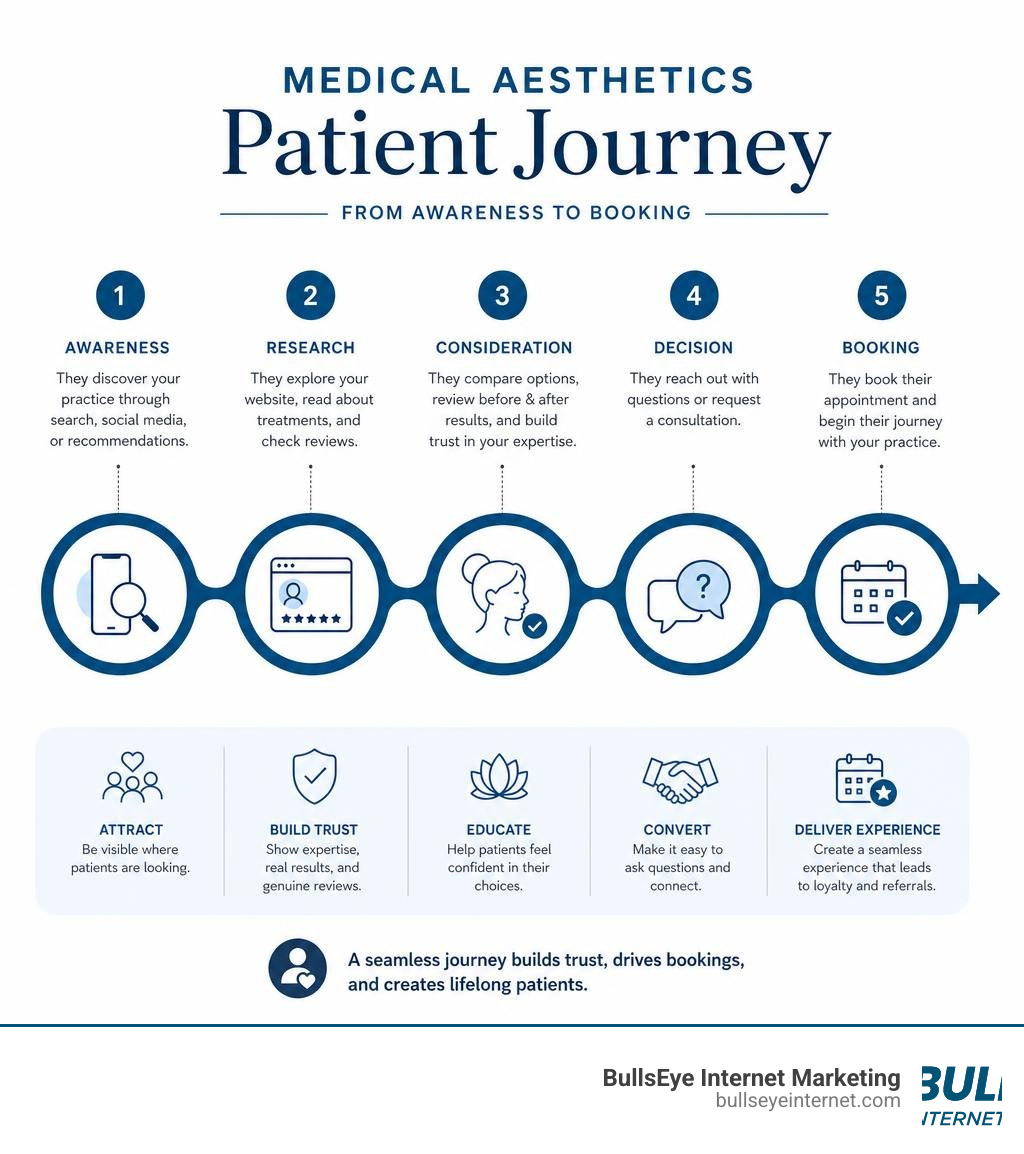
Aesthetic patients do not see an ad and book a $1,500 filler treatment five minutes later. They embark on a highly emotional, multi-session research journey. We map this journey across five distinct search moments:
- Curiosity: The patient notices a concern (e.g., “why do I look tired all the time?” or “how to reduce jowls”).
- Education: They research potential solutions (e.g., “Botox vs. dermal fillers”).
- Evaluation: They look into specific treatments, recovery times, and price ranges.
- Validation: They research specific local clinics, reading reviews and checking injector credentials.
- Conversion: They make the final decision and book a consultation.
To capture these patients, we must build a “Trust Stack” — a foundation of organic search presence, clinical website authority, and a stellar reputation that answers their questions at every single step of this journey.
| Feature | General Beauty Marketing | Medical Aesthetic Marketing |
|---|---|---|
| Primary Driver | Lifestyle, trends, and impulse | Clinical trust, safety, and results |
| Search Category | Standard consumer retail | YMYL (Your Money or Your Life) |
| Decision Cycle | Minutes to days | Weeks to months |
| Trust Factor | Influencer hype & aesthetics | Credentials, reviews, and clinical safety |
| Ad Restrictions | Low (standard retail guidelines) | Extremely high (HIPAA, FTC, platform bans) |
The 6 Types of Medical Aesthetic Consumers
To market effectively, we must understand who is walking through your doors. According to modern industry research, medical aesthetics consumers fall into six distinct personas:
- The Beauty Routiner: Highly loyal, consistent, and views treatments like Botox and facials as standard monthly maintenance.
- The Reluctant Ager: Primarily focused on turning back the clock; seeks natural-looking, preventative treatments.
- The Glam Extrovert: Loves high-impact, visible results and is highly influenced by social media trends.
- The Deal Hunter: Highly price-sensitive; constantly searches for bundles, Groupons, and promotional discounts.
- The One-Timer: Books a single treatment for a major life event (like a wedding) but requires education to convert into a lifetime client.
- The Growth Catalyst: A “fence-sitter” who is highly interested but held back by fear or lack of education. Once converted, they become highly loyal.
High-Impact Channels for Medical Aesthetic Marketing
To build a resilient practice in competitive markets — whether you are operating in Miami, West Palm Beach, or Fort Lauderdale — you cannot rely on a single marketing channel. You need an omnichannel strategy that captures high-intent searchers while simultaneously building brand demand.

Local SEO: The Foundation of Medical Aesthetic Marketing
If a potential patient in Fort Lauderdale searches “lip fillers near me,” and your practice doesn’t show up in Google’s local three-pack, you are losing out on the highest-intent leads available.
Local SEO is the ultimate foundation of your digital presence. To dominate your local area, you must:
- Claim and Optimize Your Google Business Profile (GBP): Ensure your Name, Address, and Phone number (NAP) are 100% consistent across the web. Fill out your services list with precise treatment names, and upload high-quality, clinical photos of your clinic.
- Build Treatment-Specific Landing Pages: Generic service pages like “Our Services” do not rank well. You need individual, depth-first pages for every treatment you offer (e.g., “Botox in West Palm Beach” or “CoolSculpting in Boca Raton”).
- Systematically Gather Reviews: 84% of patients check online reviews before choosing a healthcare provider. Over half read at least six reviews before making a decision. Even worse, 61% of patients say a personal recommendation wouldn’t sway them if they found negative reviews online.
To secure your local search dominance, explore our Discover our local SEO services.
Paid Advertising: Scaling Your Medical Aesthetic Marketing Campaigns
While SEO builds long-term equity, paid advertising delivers immediate traffic. The key is using the right platform for the right intent:
- Google Search Ads: Perfect for high-intent searches. When someone searches “dermal filler consultation Miami,” they are ready to book.
- Meta Ads (Facebook & Instagram): Excellent for visual storytelling, educating “fence-sitters,” and retargeting website visitors who didn’t book on their first visit.
- TikTok Ads: Ideal for reaching younger demographics with educational, short-form video content.
To succeed with paid ads without wasting your budget, you must maintain absolute compliance. Avoid using banned medical terms in your ad copy, and ensure your landing pages are fully optimized to convert clicks into consultations. Dive deeper with our Explore our Google Ads guide.
Social Media and Video Marketing: Building Visual Proof
In aesthetics, your results speak louder than any copy ever could. Social media platforms like Instagram and TikTok serve as your modern digital storefront.
Short-form video is the most powerful format for building trust. We recommend focusing on four content pillars:
- Before-and-afters with context: Explain the patient’s concerns, the treatment plan, and the realistic outcome.
- Procedure explainers: Demystify the treatment process to reduce anxiety.
- Safety and credentials: Showcase your injectors’ qualifications and clinical standards.
- FAQs and myth-busting: Address common fears directly.
Always obtain written, dated, and use-specific consent from patients before sharing their images or videos online. To master this medium, Read about video marketing strategies.
Email and SMS Marketing: Maximizing Client Lifetime Value
Acquiring a new client can cost 5 to 25 times more than retaining an existing one. Conversely, increasing your client retention rate by just 5% can boost your profits by 25% to 95%.
This is where email and SMS marketing shine. By segmenting your database based on past treatments, you can send highly personalized campaigns:
- Recall Cadences: Send automated friendly reminders when it’s time for a Botox touch-up (typically every 3 to 4 months).
- Membership Programs: Bundle recurring services into a monthly subscription model (e.g., a “Skin Health Club”) to secure predictable monthly recurring revenue.
- VIP Offers: Reward your most loyal patients with exclusive booking windows or complimentary add-on treatments.
To learn how to protect and build your clinic’s digital standing, Learn about reputation management online.
Building a Repeatable Medical Aesthetic Marketing Strategy
A successful marketing strategy isn’t built on luck; it’s built on a repeatable, data-driven system.
Step 1: Analyze Performance and Set SMART Goals
Before spending a single dollar on new campaigns, you must look at your historical data. Track your core metrics:
- Cost Per Lead (CPL) and Cost Per Booking: How much does it cost to get a phone call or booking request?
- Conversion Rate from Consultation to Treatment: Your team should aim for a 50% to 70% conversion rate.
- Client Lifetime Value (CLV): How much does a patient spend with you over their lifetime?
- Return on Ad Spend (ROAS): Aim for a minimum 5:1 ratio.
Once you know your baseline, set SMART (Specific, Measurable, Achievable, Relevant, Time-bound) goals. For example: “Increase dermal filler bookings by 20% in Broward County over the next 90 days.” To get your tracking right from the start, Analyze your data with web analytics services.
Step 2: Budget Allocation and Omnichannel Integration
According to industry benchmarks, successful medical practices allocate an average of 7.7% of their overall revenue to marketing.
During periods of economic shift, do not make the mistake of pausing your marketing. McKinsey consumer surveys show that during economic downturns, only 7% of aesthetic consumers plan to stop their treatments entirely. Instead, they look for cost-effective options, value-based pricing, or loyalty programs. Maintaining an active, multichannel marketing presence ensures your brand remains top-of-mind. Keep up with the latest industry shifts by reviewing the US Medical Aesthetics Market Report 2026-2031.
Step 3: Automate the Client Journey and Booking Flow
To maximize your marketing ROI, you must remove all friction from the booking process. If a lead has to fill out a complicated form and wait 24 hours for a callback, they will go to a competitor.
Use modern clinic management software to automate the repetitive tasks:
- Enable real-time, online booking directly from your website and social media profiles.
- Set up automated SMS and email confirmation tracks.
- Trigger post-treatment follow-up sequences to check on recovery and request a Google review.
To turn more website visitors into booked patients, Optimize your site with conversion rate optimization.
Frequently Asked Questions about Med Spa Growth
How does medical aesthetic marketing differ from general beauty marketing?
Medical aesthetic marketing requires a deep focus on clinical trust, safety, and credentials because the procedures are medical and invasive. It is subject to strict YMYL search standards and rigorous healthcare advertising regulations, whereas general beauty marketing relies heavily on lifestyle trends and low-friction impulse purchases.
What is the average marketing budget for a medical aesthetics practice?
On average, medical aesthetic practices allocate about 7.7% of their total company revenue to marketing. This budget is typically split between local SEO, paid search/social advertising, content creation, and automated client retention systems.
How can medical spas legally use before-and-after photos in advertising?
To use before-and-after photos legally and ethically, clinics must secure written, signed, and dated HIPAA-compliant consent forms from patients. Photos should be taken under consistent lighting and angles to show realistic, unedited outcomes, and they should be published in dedicated website galleries rather than as primary creative in paid ads to prevent platform compliance flags.
Conclusion
Building a thriving medical aesthetics practice requires a delicate balance of clinical authority, local search dominance, and seamless client retention. You cannot afford to waste your budget on generic campaigns that fail to build trust or get flagged by ad networks.
At BullsEye Internet Marketing, we do things differently. We specialize in generating high-quality calls and direct sales through Pay Per Lead campaigns, Google Business Profile optimization, SEO, and local PPC.
Our unique advantage? We do not lock you into long-term contracts, and we work with only one client per industry per geographic area. If you partner with us in Fort Lauderdale, West Palm Beach, or Miami, we will never work with your local competitors — giving you an exclusive, unfair advantage in your market.
Ready to fill your calendar with high-value aesthetic patients? Partner with us for plastic surgeon advertising.
