
Why PPC for Medical Practices Is One of the Fastest Ways to Fill Your Schedule
PPC for medical practices is a paid advertising model where your clinic appears at the top of Google search results when patients are actively looking for the exact services you offer — and you only pay when someone clicks.
Here’s what you need to know at a glance:
| What It Is | Pay-per-click advertising on Google and other platforms, targeting patients searching for specific treatments or providers |
|---|---|
| Who It’s For | Independent practices, specialty clinics, urgent care centers, dental offices, and multi-location groups |
| How It Works | You bid on keywords like “orthopedic surgeon near me,” your ad appears at the top of results, and you pay only when a patient clicks |
| Average Cost Per Click | ~$5.00 for physicians and surgeons; $15–$50+ for specialties like plastic surgery |
| Average Cost Per Lead | ~$57 for physicians and surgeons |
| Average Conversion Rate | 8.09% for appointment bookings; 11.6% for physicians on search ads |
| Biggest Challenges | HIPAA compliance, Google health certificates, tracking phone calls, and high competition from hospital systems |
| Biggest Advantage | Captures patients at the exact moment they are ready to book — not passive browsing |
Google processes roughly 70,000 health-related searches every single minute. Those aren’t casual browsers — many are patients deciding right now which clinic to call. If your practice isn’t visible at that moment, a competitor gets that appointment.
But healthcare PPC isn’t like running ads for a retail store. The rules are stricter. The stakes are higher. HIPAA applies to your tracking setup. Google requires special health certificates for many medical services. And a poorly built campaign can generate dozens of leads that never actually walk through your door.
This guide breaks all of it down — compliance, ad types, keyword strategy, landing pages, tracking, and budgeting — so you can run campaigns that bring in real patients, not just clicks.
My name is Ronnie Katz, and since 2006 I’ve helped medical practices and healthcare businesses grow their patient base through targeted digital advertising, including PPC for medical practices across competitive local markets. Over the past 20 years, I’ve seen what separates campaigns that fill appointment calendars from the ones that burn through budget with nothing to show for it.
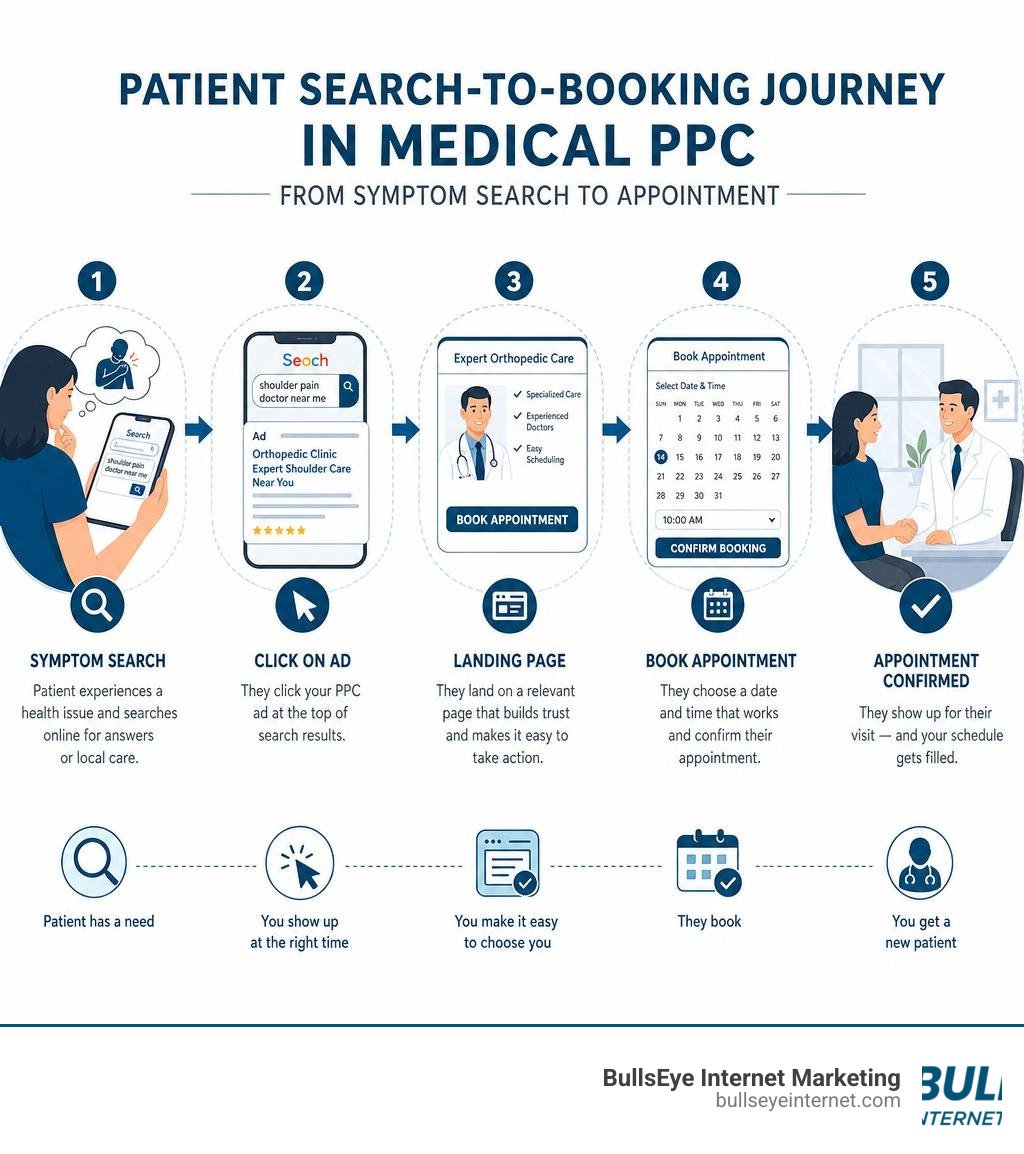
Quick look at PPC for medical practices:
The Unique Challenges of PPC for Medical Practices
Running a paid search campaign for a medical practice is fundamentally different from advertising retail products or software. When a patient searches for a doctor, they are making a deeply personal and often high-stakes decision. This dynamic shifts how we write ad copy, structure keywords, and handle data.
Furthermore, medical practices operate within a heavily regulated legal environment. Beyond standard federal guidelines, medical advertising is shaped by state-level regulations. For example, if you are looking to purchase or expand a clinic, you must navigate complex state laws, as detailed in The Corporate Practice of Medicine 50-State Guide. In Florida, state medical boards enforce strict rules regarding how licensed professionals present their credentials and services in public advertisements.
The digital landscape has shifted rapidly, with platform-side privacy enforcement tightening significantly. To succeed, we must design campaigns that balance aggressive patient acquisition with strict ethical and legal boundaries.
Ensuring HIPAA Compliance in PPC for Medical Practices
The biggest hurdle in healthcare advertising is maintaining HIPAA compliance. HIPAA regulations protect patient health information (PHI), and this protection extends directly to your digital marketing stack.
A common mistake is placing standard tracking pixels (like those from Meta or TikTok) directly on post-form-fill pages or appointment confirmation screens. Data shows that 71% of audited healthcare sites have client-side pixels firing on pages where PHI is collected, exposing them to massive regulatory fines. In fact, HHS OCR enforcement actions have resulted in over $137 million in penalties concentrated primarily on tracking technologies and telehealth pixel leakage.
To safely run PPC for medical practices, we must strip PHI from conversion tags and implement server-side tracking. Instead of sending data directly from the user’s browser to Google or Facebook, we route it through a secure cloud server that we control. This allows us to filter out any personal identifiers before the data reaches the advertising platform.
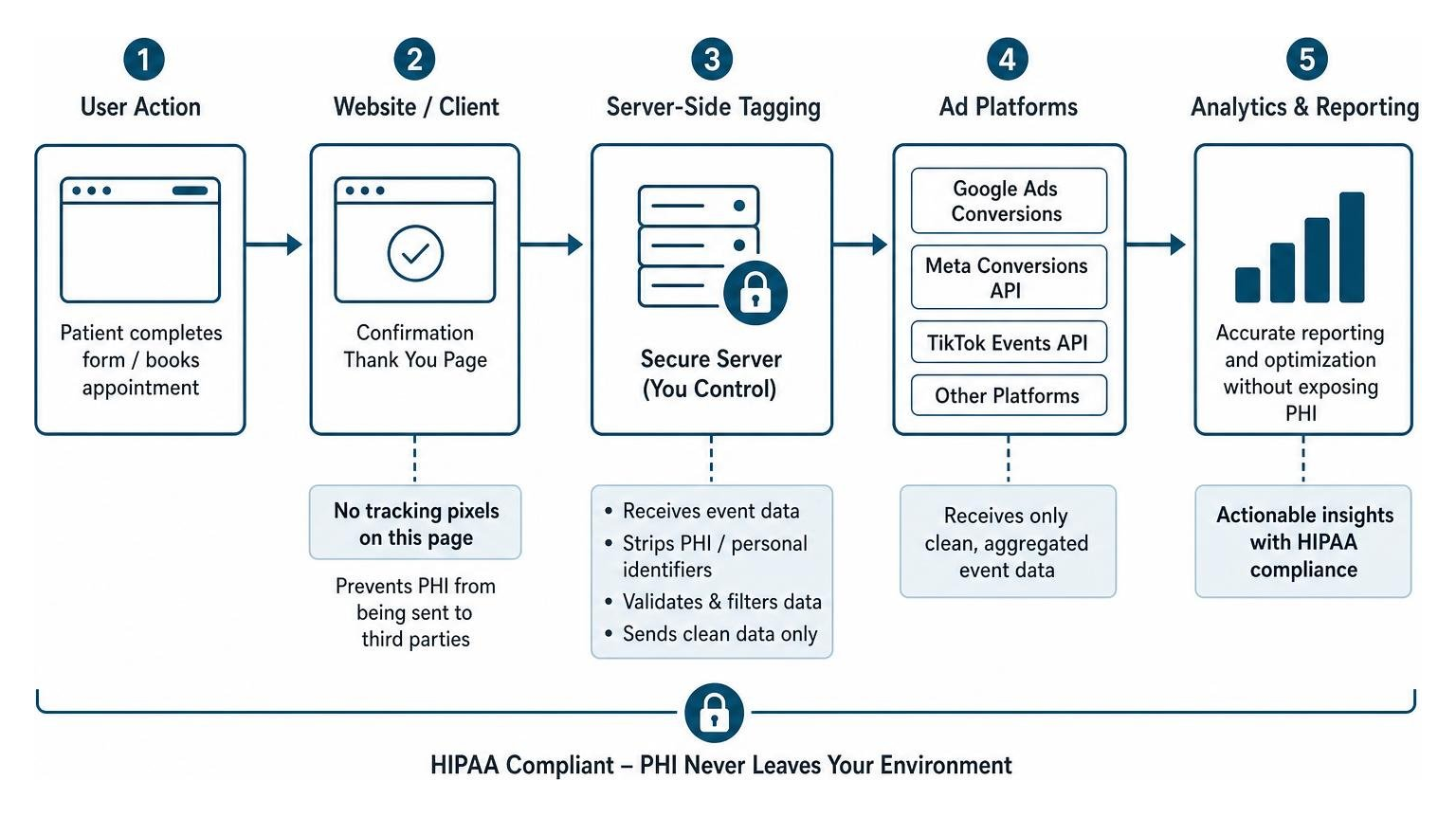
Structuring your campaigns safely is critical to avoiding costly compliance violations.
Navigating Google Health Certificates and Policy Restrictions
Google maintains incredibly strict rules regarding healthcare advertising. For many medical specialties, Google requires a Google health certificate before you can show ads. If your clinic offers services related to prescription drugs, clinical trials, or addiction treatment, you must also secure LegitScript certification.
The review process for these certificates can take anywhere from 5 to 30 business days, and the first-submission rejection rate is as high as 40%. Additionally, 62% of healthcare advertisers report compliance issues that can lead to sudden account suspension.
To avoid these pitfalls, we must ensure that all ad copy claims are factually accurate, supportable, and free of restricted terms. For instance, clinics operating in South Florida—such as those offering Clinical and Nutrition Services in Martin County—must align their digital copy directly with approved medical definitions to pass Google’s automated policy checks.
Choosing the Most Effective Ad Types for Healthcare Providers
Not all PPC ads are created equal. Depending on whether your practice focuses on routine family medicine, elective cosmetic procedures, or urgent care, certain ad formats will deliver a much higher return on investment.
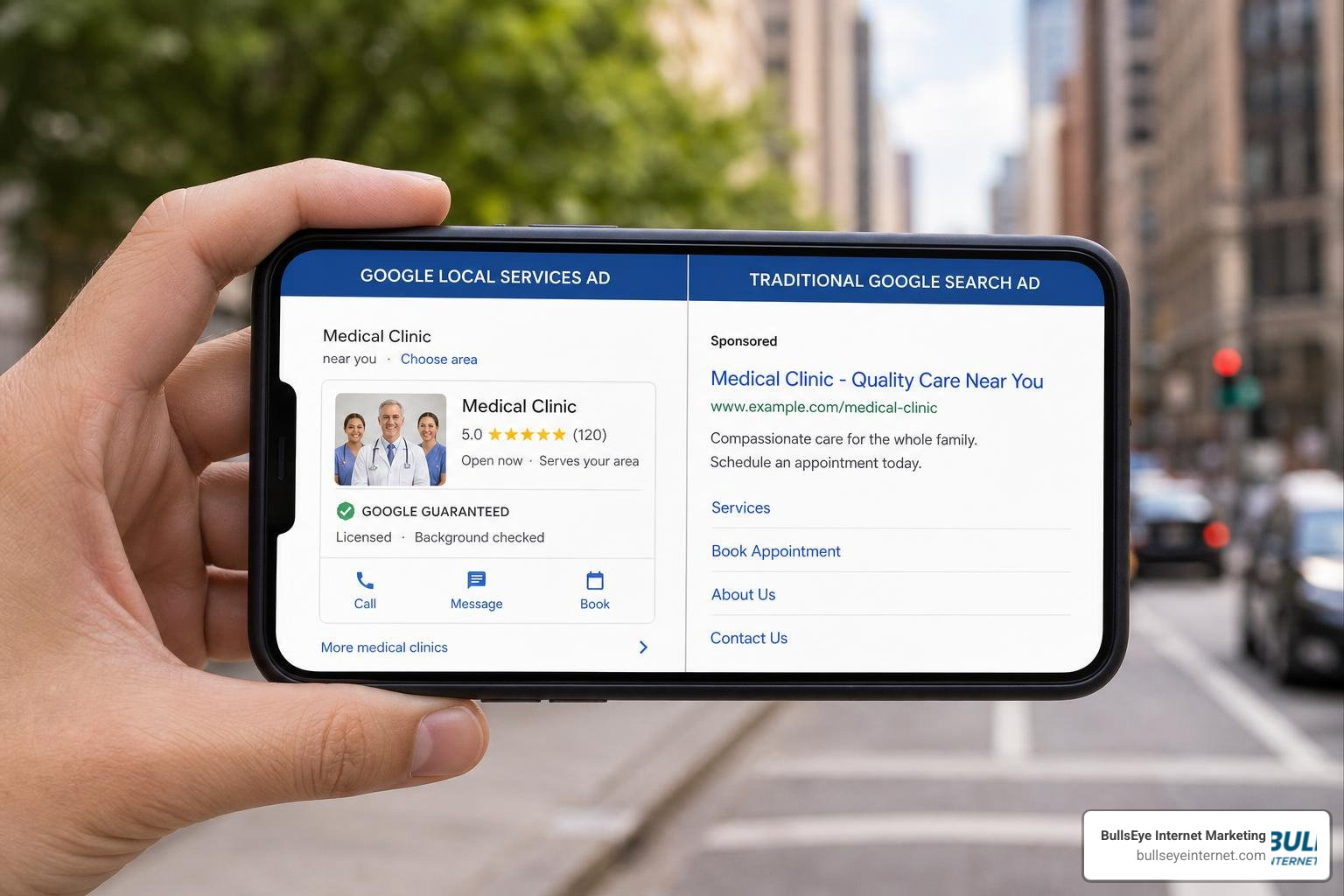
To learn more about local ad options, explore Why Healthcare Google Local Ads Are a Game Changer for Clinics.
| Ad Type | Best For | Payment Model | Key Advantage |
|---|---|---|---|
| Google Search Ads | High-intent specialty services, specific treatments | Pay-Per-Click (CPC) | Appears at the very top of Google; highly customizable copy |
| Local Services Ads (LSAs) | Local clinics, dentists, primary care | Pay-Per-Lead (CPL) | Features a “Google Screened” badge; higher trust |
| Call-Only Ads | Urgent care, emergency dentistry, immediate needs | Pay-Per-Click (CPC) | Direct dial from mobile; bypasses the landing page |
Google Local Services Ads (LSAs) vs. Traditional Search Ads
Local Services Ads (LSAs) appear at the absolute top of the search engine results page, even above traditional Google Search Ads. These ads feature the doctor’s name, ratings, hours, and a prominent “Google Screened” or “Google Guaranteed” badge.
The primary difference lies in the cost structure. Traditional search ads operate on a pay-per-click model, whereas LSAs operate on a pay-per-lead basis. This means you only pay when a patient actually calls your office or sends an inquiry through the ad.
For local providers, utilizing LSAs is an incredibly efficient way to build trust quickly. You can read more about how to set these up in our guides on Google Local Services Ads for Health Care Services and Google Local Services Ads for Wellness Services.
Call-Only Ads for Urgent and Immediate Care
If you run an urgent care clinic or a practice that handles immediate medical needs, Call-Only Ads are a game-changer. These ads are designed exclusively for mobile devices. When a patient clicks the ad, it doesn’t open a website; instead, it immediately prompts their phone to dial your front desk.
Because over 60% of healthcare conversions occur over the phone, Call-Only Ads reduce friction by removing the landing page step entirely. This is highly effective for practices like (PPC) Personal Physician Care or Physicians Primary Care: Primary Care Family Doctor … that need to capture patients experiencing acute symptoms who want to speak to a receptionist right away.
Structuring a High-Intent Keyword Strategy
The foundation of any successful campaign using PPC for medical practices is a tightly controlled keyword strategy. If you target keywords that are too broad, you will waste thousands of dollars on non-converting traffic.
For example, bidding on the broad keyword “knee pain” is incredibly risky. A user searching “knee pain” is likely looking for home remedies, stretching exercises, or symptom research. They are not ready to book an appointment.
Instead, you want to bid on provider-intent keywords like “orthopedic surgeon near me” or “knee replacement specialist in Boca Raton.” These searches represent patients who have already diagnosed their problem and are actively looking for a medical professional to treat it.
How to Structure High-Intent Keywords in PPC for Medical Practices
To maximize your budget, we recommend separating your campaigns by specific service lines rather than lumping all treatments into a single campaign.
If you operate a multi-specialty clinic, you should have separate campaigns for each department (e.g., primary care, dermatology, and physical therapy). This allows you to write highly specific ad copy and direct users to dedicated landing pages. For a deeper dive into specialty-specific keyword structures, check out our guide on Local Ads for Dermatologists: How to Attract More Patients with Google Ads.
Additionally, you must maintain a robust negative keyword list. Negative keywords prevent your ads from showing for irrelevant searches. For instance, you should add negative keywords like “free,” “jobs,” “salary,” and “how to become a” to ensure you aren’t paying for clicks from job seekers or students.
If you are a local provider in South Florida, you should also bid on your own brand terms (e.g., the names of your doctors and your clinic, such as Personal Physician Care | Multi-Specialty Doctors in Boca …). Bidding on your brand prevents competitors from placing ads on top of your organic search listings.
The Role of Local Targeting and Geo-Fencing
Patients are rarely willing to travel long distances for routine healthcare. For standard primary care, the typical patient driving radius is only 10 to 15 minutes. However, for highly specialized surgeries, patients may travel an hour or more.
Therefore, your geo-targeting must match the realistic service radius of your physical clinic. In densely populated areas like Broward County, you can target specific zip codes or use radius bidding around your office. If you are looking to acquire an existing practice, analyzing local traffic patterns is critical, as highlighted by listings for Medical Practices For Sale in Broward County, Florida.
By setting tighter geographic parameters, you prevent your ads from showing to users who are geographically unrealistic patients, ensuring every dollar of your ad spend is concentrated on warm, local leads.
Maximizing ROI: Landing Pages, Tracking, and Budgeting
Driving clicks to your website is only half the battle. To turn those clicks into paying patients, you must guide them through a seamless digital experience. If your ad links to a cluttered homepage, the user will likely leave and click on a competitor’s ad.
For a comprehensive look at how to evaluate healthcare marketing partners, read The Ultimate Guide to Choosing Dermatology Advertising Experts.
Designing High-Converting, Compliant Landing Pages
A landing page is a standalone web page designed specifically for a paid ad campaign. To maximize conversion rates, your landing page must achieve a perfect “message match” with your ad copy. If your ad promises “Same-Day Appointments for Back Pain,” your landing page headline must repeat that offer and provide an immediate booking button.
Here are the key elements of a high-converting medical landing page:
- Clear, Benefit-Driven Headline: Address the patient’s immediate need without medical jargon.
- Frictionless Booking Options: Include both a prominent click-to-call phone number and a simple online scheduling form.
- Immediate Trust Signals: Display board certifications, patient reviews, and accepted insurance plans.
- Mobile-First Design: Over 85% of patients use smartphones to research health info; your page must load in under two seconds on mobile.
For specialized clinics, tailoring the user experience is vital. You can find specific landing page strategies in our guides on Aesthetic Clinic Marketing and Advertising for Plastic Surgeons: Ultimate Guide.
Tracking Phone Calls and Appointment Bookings Safely
To accurately measure the ROI of your PPC for medical practices, you must track conversions beyond simple form submissions. Because the majority of medical bookings occur over the phone, implementing dynamic call tracking is essential.
Dynamic call tracking displays a unique phone number to each website visitor, allowing us to attribute phone calls back to the exact keyword and ad that triggered the click. However, this tracking must be fully integrated with a HIPAA-compliant CRM or practice management software.
Without proper tracking, you might see that a campaign generated 50 leads, but fail to realize that only 12 patients actually showed up for their appointments (a 24% show-up rate). Closing the loop between digital clicks and real, completed office visits is the only way to calculate your true patient acquisition cost.
Frequently Asked Questions about Medical PPC
What is the typical cost per click and cost per lead for healthcare PPC?
The cost of medical PPC varies widely depending on your specialty, geography, and level of local competition:
- Direct Primary Care (DPC): Median CPC is around $14; Cost Per Lead is typically under $40.
- General Physicians & Surgeons: Average CPC is $5.00, with an average Cost Per Lead near $57.
- Dermatology & Medspas: CPCs range from $8 to $22.
- Specialty Medical (Orthopedics, Cardiology): Median CPC is $32.
- High-Demand Elective Procedures (Plastic Surgery, GLP-1 Weight Loss): CPCs can range from $15 to over $50, with highly competitive search terms occasionally reaching up to $240+ per click.
How can small independent practices compete with large hospital systems?
Small, independent practices often feel overwhelmed by the massive marketing budgets of regional hospital networks. However, independent clinics have a major competitive advantage: agility.
While large hospital networks run broad, slow-moving corporate campaigns, a local clinic can target highly specific, long-tail search terms. For example, rather than bidding on “pediatrician,” a local clinic can target “same-day pediatric appointments in Homestead.”
Additionally, small practices can dominate local search by utilizing Local Services Ads and maintaining highly optimized Google Business Profiles. For more on how local dental and orthodontic practices can leverage this strategy, see Google Local Services Ads for Dentists & Orthodontists. Local community clinics, such as the Primary Care Physicians Community Center Miami Dade, excel by establishing deep-rooted local trust that large systems cannot easily replicate.
What common mistakes cause healthcare PPC campaigns to fail?
- Bidding on Symptom Searches: Wasting budget on broad informational terms like “why does my shoulder hurt” instead of provider-intent terms like “shoulder specialist near me.”
- Sending Traffic to the Homepage: Forcing users to search through a complex, slow-loading homepage to find a phone number or booking form.
- Treating Compliance as Optional: Failing to implement server-side tracking, leading to ad account suspension or massive HIPAA fines.
- Ignoring Call Tracking: Failing to track phone conversions, leaving the practice blind to which keywords are actually driving new patient appointments.
Accelerating Medical Practice Growth with BullsEye Internet Marketing
Running a successful campaign using PPC for medical practices requires a delicate balance of technical digital marketing expertise, strict regulatory compliance, and deep local market knowledge.
At BullsEye Internet Marketing, we specialize in generating high-quality calls and appointments for medical practices throughout the United States, with a deep focus on Florida and the South Florida area—including Broward, Miami-Dade, Palm Beach, Martin, St. Lucie, and Indian River Counties.
We do things differently to give your practice a distinct competitive advantage:
- No Long-Term Contracts: We earn your business month-over-month based on real, measurable results.
- Exclusive Geographic Partnerships: We only work with one client per industry per geographic area. When you partner with us, we focus 100% of our local advertising efforts on beating your competitors—not helping them.
Are you ready to stop losing high-intent patients to your competitors? Let’s discuss a compliant, high-performing Google Ads strategy tailored specifically to your clinic.
