
Why Most Businesses Generate Leads But Never Build a Real Pipeline
A strong lead acquisition strategy is the difference between a business that grows predictably and one that stays stuck chasing its tail.
Most businesses focus on getting more leads. But 91% of marketers say lead acquisition is their most important marketing goal — yet most pipelines stay empty. Why? Because generating leads and acquiring the right ones are two very different things.
Here is a quick answer to what a lead acquisition strategy actually involves:
| Step | What It Means |
|---|---|
| 1. Define your ideal customer | Who is worth targeting — and who is not |
| 2. Identify buying signals | Behavioral cues that show real purchase intent |
| 3. Capture leads across channels | SEO, LinkedIn, paid ads, email, referrals |
| 4. Qualify and score leads | Filter out poor fits before they waste sales time |
| 5. Act fast | Speed to contact directly impacts conversion rates |
| 6. Measure what matters | Pipeline created, not just leads counted |
This guide walks you through every layer — from fixing why your leads do not convert, to building a system that fills your pipeline consistently.
I am Ronnie Katz, founder of BullsEye Internet Marketing, and since 2006 I have helped businesses across competitive industries sharpen their lead acquisition strategy to drive real revenue, not just traffic. With over 20 years of hands-on experience across SEO, PPC, pay-per-lead, and conversion optimization, I have seen what separates a strategy that scales from one that stalls.
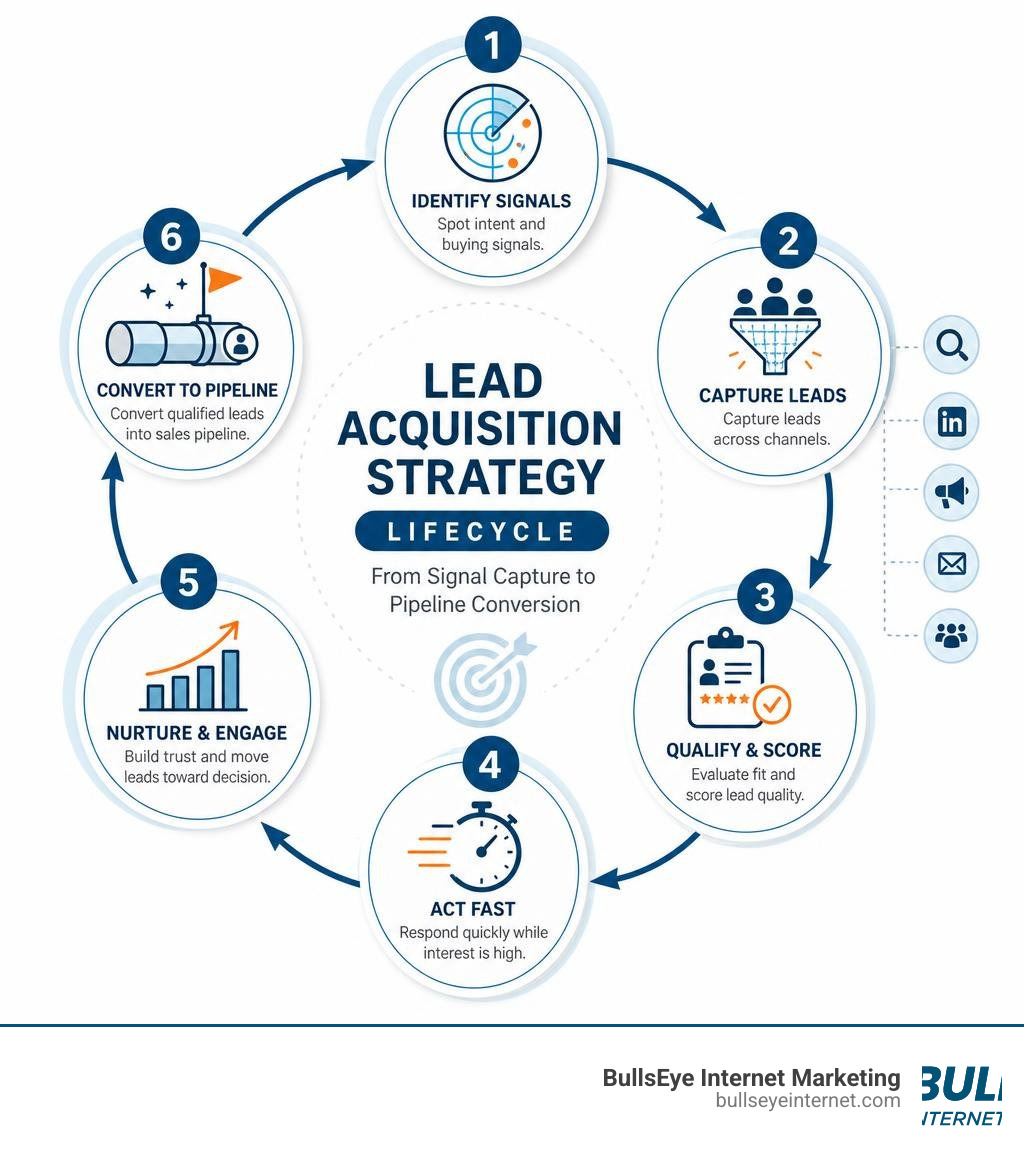
Lead acquisition strategy terms simplified:
Defining the Modern Lead Acquisition Strategy
To build an engine that consistently generates revenue, we must first clear up a massive point of confusion in the marketing world. Many professionals use “lead generation,” “lead acquisition,” and “customer acquisition” interchangeably. Doing so is a fast track to misallocated budgets and broken sales cycles.
Let’s break down how these terms actually differ:
| Term | Core Focus | Primary Metrics | Typical Stage |
|---|---|---|---|
| Lead Generation | Creating initial interest and gathering basic contact details. | Click-Through Rate (CTR), Cost Per Lead (CPL), Form Fills | Top of the Funnel (TOFU) |
| Lead Acquisition | Sourcing, validating, enriching, qualifying, and preparing high-intent leads for sales conversion. | Lead-to-Pipeline Rate, Pipeline Velocity, Marketing Qualified Leads (MQL) to Sales Qualified Leads (SQL) Conversion | Middle of the Funnel (MOFU) |
| Customer Acquisition | Converting those qualified, nurtured leads into paying, long-term clients. | Customer Acquisition Cost (CAC), Customer Lifetime Value (LTV), Close Rate | Bottom of the Funnel (BOFU) |
A modern lead acquisition strategy acts as the crucial bridge. It takes the raw, unrefined interest generated at the top of the funnel and transforms it into highly qualified, sales-ready conversations. According to Lead Acquisition Guide, focusing solely on top-of-funnel volume without a structured acquisition and qualification process is exactly why sales pipelines dry up.
When we consult as lead generation experts, we emphasize that lead acquisition is not just about gathering names. It is about building a repeatable, compliant system that filters out the noise. This involves real-time validation, lead enrichment, and instant routing so your sales team only spends time on prospects who have the budget, authority, and immediate need for your services.
Shifting from Static Leads to Dynamic Buyer Signals
If you are running a B2B SaaS company or a high-ticket service business in South Florida, you have likely noticed a frustrating trend: you are generating leads, but your pipeline remains stagnant.
The real reason for this failure is that traditional, linear funnels are obsolete. In June 2026, buyers do not follow a neat path from reading a blog post to filling out a contact form. Instead, they self-educate in “dark social” channels, read independent reviews, and form opinions long before they ever talk to a sales representative. In fact, roughly 95% of B2B website traffic never converts on a static form.

Relying on static forms to tell you when a prospect is ready to buy is a losing battle. Instead, winning teams are shifting their focus to reading dynamic buyer signals.
A buyer signal is an observable behavior that indicates active purchase intent. These signals can be:
- First-Party Signals: A prospect visits your pricing page multiple times, views your team’s LinkedIn profiles, or spends more than the average B2B engagement time (which benchmarks at 59 seconds) on your high-intent service pages.
- Third-Party Intent Data: An account searches for terms related to your software category on review platforms, or monitors your competitors.
By shifting from collecting static leads to tracking these dynamic, account-level signals, you can engage prospects exactly when they are in their active buying window. This signal-driven approach is a core focus of a modern B2B SaaS Lead Acquisition Strategy.
For businesses that want to skip the complexity of building these tracking systems from scratch, partnering with a professional pay-per-lead marketing agency allows you to pay only for qualified prospects who have already demonstrated these high-intent behaviors.
The Role of LinkedIn in a Modern Lead Acquisition Strategy
When it comes to B2B lead acquisition, LinkedIn is the undisputed heavyweight champion. The platform generates 80% of B2B social media leads. But the way successful teams use LinkedIn has changed dramatically. It is no longer just a place to broadcast corporate updates; it is a live intelligence layer and a primary channel for warm outreach.
To get the most out of LinkedIn:
- Monitor Competitor Engagement: Keep an eye on prospects who are actively engaging with your competitors’ content or complaining about their service limitations.
- Leverage Warm Outreach: Rather than sending cold, generic pitches, use LinkedIn Sales Navigator to identify key decision-makers. Warm them up by engaging with their posts before reaching out.
- Use High-Impact InMail: LinkedIn InMail messages achieve response rates up to three times higher than standard emails, averaging an impressive 18% to 25%.
By integrating these social selling tactics into your broader B2B Lead Generation Playbook, you turn cold outreach into highly personalized, high-converting conversations.
The 5-Layer Framework for High-Converting Lead Acquisition
To build a lead acquisition engine that scales predictably without wasting your marketing budget, we recommend implementing a structured, five-layer framework.
Layer 1: Know Exactly Who You Are After (ICP Definition)
You cannot acquire the right leads if you do not know who they are. Define your Ideal Customer Profile (ICP) with extreme precision. This includes firmographic data (company size, location, industry), behavioral data, and trigger-based criteria (such as a recent round of funding or a new leadership hire). Crucially, you must also define exclusion criteria — who is explicitly not a good fit — to keep unqualified leads out of your system.
Layer 2: Capture Signals Across Every Channel
Set up tracking mechanisms to capture intent signals wherever your audience spends time. Whether it is organic search traffic landing on your high-intent comparison pages, social engagement on LinkedIn, or targeted ad clicks, your system needs to aggregate these behaviors in real time. For many local service providers, running highly optimized PPC for lead generation is the fastest way to capture these high-intent search signals.
Layer 3: Think in Accounts, Not Individuals
In B2B and high-ticket sales, purchase decisions are rarely made by one person. Your lead acquisition strategy should aggregate signals at the account level. If three different managers from the same target company visit your website in one week, that is a massive account-level signal that your sales team needs to act on immediately.
Layer 4: Act Quickly (Speed-to-Lead)
The gap between lead capture and the first sales touch is where most pipelines bleed value. Speed-to-lead is a critical conversion driver. For example, in competitive local industries, prospects contacted within 5 minutes of submitting a inquiry are roughly 9 times more likely to convert than those contacted after 30 minutes.
Layer 5: Measure What Actually Matters
Stop obsessing over vanity metrics like raw lead volume or cost-per-click. Instead, focus on metrics that impact your bottom line: lead-to-pipeline conversion rate, pipeline velocity, Customer Acquisition Cost (CAC), and customer lifetime value.
Activating Multi-Channel Signals Within Your Lead Acquisition Strategy
Activating these signals across multiple channels requires a reliable marketing technology stack and smart automation. Modern sales engagement and marketing automation platforms can automatically score prospects based on their behaviors, routing the highest-scoring leads directly to your sales representatives.
When setting up these automated workflows, keep these Lead Acquisition Marketing Best Practices in mind:
- Implement Real-Time Validation: Use validation tools directly within your lead forms to block fake phone numbers, duplicate entries, and invalid email addresses before they enter your CRM.
- Maintain Compliance: Ensure you are documenting explicit consent at the moment of lead capture to comply with local privacy regulations.
- Balance Automation with Human Touch: Use automation to handle repetitive tasks like data enrichment and initial routing, but keep your actual outreach personalized and human. Generic, automated spam will quickly get your emails blacklisted.
Frequently Asked Questions about Lead Acquisition
What is the difference between lead generation and lead acquisition?
While they sound similar, lead generation is the initial process of attracting attention and collecting basic contact information at the top of the funnel (such as an email address in exchange for an ebook).
Lead acquisition is the deeper, more operational middle-funnel layer. It involves validating those contacts, qualifying them against your ICP, nurturing them with targeted content, and preparing them for sales conversion. According to the latest Lead Generation Trends, companies that invest in tightening the transition between lead generation and lead acquisition see significantly higher pipeline conversion rates and lower overall customer acquisition costs.
How do you calculate lead acquisition costs?
To calculate your basic Cost Per Lead (CPL), use this formula:
$$text{CPL} = frac{text{Total Marketing Spend on Channel}}{text{Number of Leads Acquired}}$$
For example, if you spend $5,000 on Google Search Ads and acquire 100 leads, your CPL is $50.
However, to understand the true efficiency of your marketing, you must look beyond CPL and calculate your Customer Acquisition Cost (CAC) by factoring in your conversion rates and sales expenses. If you want to eliminate the risk of unpredictable CPLs and wasted ad spend, utilizing pay-per-lead advertising allows you to pay a fixed, pre-negotiated price only for qualified, high-intent leads that meet your exact criteria.
What are the most common mistakes in lead acquisition?
Based on our years of experience optimizing campaigns across Florida, we see three mistakes ruin otherwise promising strategies:
- Prioritizing Volume Over Quality: Flooding your sales team with hundreds of low-intent leads wastes valuable sales hours and demoralizes your team. It is always better to acquire 20 highly qualified leads than 200 cold ones.
- Slow Follow-Up Times: If you let a high-intent lead sit in your inbox for hours or days, they will move on to a competitor who responds faster.
- Poor Sales-Marketing Alignment: If marketing defines a “lead” as anyone who downloads a PDF, but sales only wants to talk to ready-to-buy decision-makers, your pipeline will stall. Both teams must agree on qualification criteria.
To learn more about setting up a high-converting system, check out this comprehensive guide on Top Lead Acquisition Strategy.
Conclusion
Building a scalable, high-performing lead acquisition strategy is not about chasing the latest viral marketing trend. It is about setting up a disciplined, predictable system that targets the right audience, reads their intent signals, and converts that interest into real revenue.
At BullsEye Internet Marketing, we specialize in helping businesses in South Florida and across the United States build high-converting lead acquisition engines. Whether you are looking for localized campaigns in Miami, Fort Lauderdale, or West Palm Beach, we offer a massive competitive advantage: we work with only one client per industry per geographic area, and we never require long-term contracts.
We handle the heavy lifting across SEO, PPC, pay-per-lead, and conversion optimization to deliver exclusive calls and sales directly to your business.
Ready to stop paying for vanity metrics and start building a real pipeline? Explore BullsEye Internet Marketing’s SEO services or contact us today to build a lead acquisition engine that scales.
External Resources for Further Reading
- Lead Generation Guide: The Complete Playbook 2026
- Lead Generation in 2026: The Complete B2B Playbook
- Lead acquisition marketing: Best practices for high-quality leads – ActiveProspect
- Top Lead Acquisition Strategy: How to Build a good one – Trackier
- Lead Acquisition Strategy for Consultants (B2B Lead Gen) – YouTube
- Best Lead Generation Companies in Florida 2026 | Semrush
- Best Lead Generation Companies in West Palm Beach 2026
Explore Our Specialized Pay-Per-Lead Guides
- Local Lead Generation Services Complete Guide
- Pay Per Lead Marketing Agency
- How Pay Per Lead Marketing Drives Real Results
- Exclusive Attorney Leads That Actually Convert
- Step-by-Step Guide to Generating Family Law Leads
- Pay Per Lead for Lawyers
- Pay Per Lead Real Estate
- Real Estate Pay Per Lead
- Roofing Leads: The Secret to a Thriving Home Services Company
- How We Guarantee Quality Leads for Home Service Contractors
- Water Damage Pay Per Lead
- Pest Control Pay Per Lead
- HVAC Pay Per Lead Guide
- Electrician Pay Per Lead
- Cosmetic Surgery Lead Generation
- Pay Per Lead Agency Complete Guide
- Pay Per Lead Generation Companies
