
Why Aesthetic Clinics Are Losing Patients to Google — And How to Fix It
SEO for aesthetic clinics is the process of optimizing your website and online presence so that patients searching for treatments like Botox, lip fillers, or laser resurfacing can find your clinic first on Google.
Here’s what it covers at a glance:
- Local SEO — Rank in Google Maps when patients search “near me”
- Keyword targeting — Show up for high-intent searches like “Botox in [your city]”
- Google Business Profile — Get found, trusted, and booked faster
- Treatment pages — Convert visitors into consultations with optimized content
- Reviews — Build trust and improve rankings simultaneously
- Technical SEO — Fast, mobile-friendly site that Google rewards
The aesthetic industry has never been more competitive. Most patients no longer ask a friend for a referral — they open Google. In fact, 93% of consumers used online searches to find a local business in the past year, and 46% of all searches have local intent.
Yet most aesthetic clinics rely almost entirely on paid ads and social media to fill their schedules. The problem? Paid ads stop the moment you stop spending. Social media reaches people who aren’t actively looking to book.
Organic search is different. When someone types “lip fillers near me” or “best Botox clinic in [city],” they’re ready to act. Capturing that moment — consistently, without paying per click — is exactly what SEO does.
But aesthetic clinic SEO isn’t just standard SEO. Google classifies cosmetic and medical content as YMYL (Your Money or Your Life), meaning it holds your content to a higher standard of trust and expertise. Without the right approach, even a beautifully designed clinic website can be invisible on Google.
I’m Ronnie Katz, founder of BullsEye Internet Marketing, and I’ve spent over 20 years helping businesses grow through search — including developing targeted SEO for aesthetic clinics that drives real patient bookings, not just traffic. In this guide, I’ll walk you through every key strategy, from local SEO to content authority, so you can build a patient acquisition engine that works around the clock.
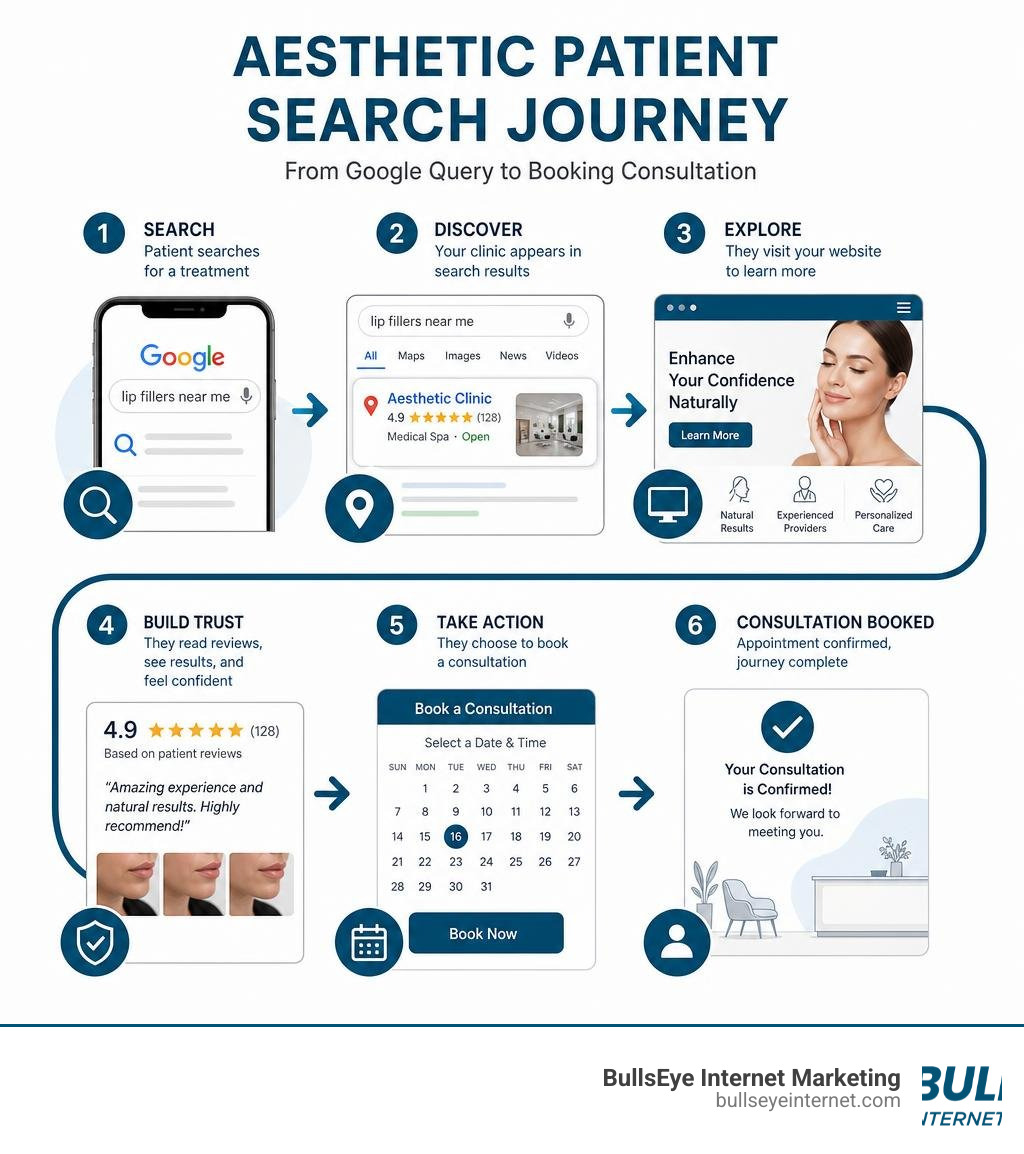
Know your SEO for aesthetic clinics terms:
Why SEO for Aesthetic Clinics is Essential in 2026
As we navigate through June 2026, the digital landscape for medical aesthetics is more sophisticated than ever. Relying purely on traditional marketing or basic social media posts is no longer enough to sustain a growing clinic. When patients consider altering their appearance or investing in anti-aging treatments, their first instinct is to research.
Because medical aesthetics directly impacts a patient’s physical appearance and physical health, Google categorizes aesthetic clinic websites under YMYL (Your Money or Your Life). This means search algorithms apply incredibly strict quality standards to your content. To rank well, we must align your website with Google’s E-E-A-T guidelines, which are reinforced by Google’s own guidance on creating helpful, reliable, people-first content:
- Experience (first-hand knowledge and real-world clinical experience)
- Expertise (credentials, medical licensing, and specialized training)
- Authoritativeness (reputation of the clinic and its medical directors)
- Trustworthiness (accurate, secure, transparent, and medically reviewed content)
When your website systematically proves these four elements, Google rewards you with higher organic traffic. Unlike social media platforms where algorithms shift overnight and organic reach continues to dwindle, organic search traffic captures patients at the exact millisecond they have active search intent. They aren’t passively scrolling; they are actively looking for a solution to a specific aesthetic concern.
By building a robust search presence, you establish deep patient trust before they even step foot into your consultation room. Discover how this fits into your broader growth strategy by exploring our comprehensive guide on Aesthetic Clinic Marketing.
Understanding the Value of SEO for Aesthetic Clinics
Unlike paid advertising—which acts like a rental model where your patient flow vanishes the moment your ad budget is turned off—SEO is an owned asset that delivers compounding growth. When we optimize a clinic’s website, the initial efforts build a foundation that continues to attract and convert patients month after month, year after year, without a corresponding increase in ad spend.
Consider the patient lifetime value (LTV) in the aesthetic industry. A patient who finds your clinic via Google for a primary Botox treatment often returns every three to four months. Over time, that single organic acquisition can transition into dermal fillers, chemical peels, or high-end laser resurfacing.
Furthermore, having a dominant search presence builds immense brand authority. In an era where zero-click searches are rising—meaning Google often answers informational queries directly on the search results page—occupying the top organic spots and local map positions ensures your clinic remains the undisputed local authority.
Local SEO vs. General SEO: Dominating Your Service Area
Many generalist marketing agencies treat aesthetic clinics like national e-commerce brands, focusing on broad keywords with high search volumes but zero local relevance. This is a costly mistake. If your clinic is located in Fort Lauderdale or Coral Gables, ranking for “what is Botox” nationally does nothing to fill your treatment chairs.
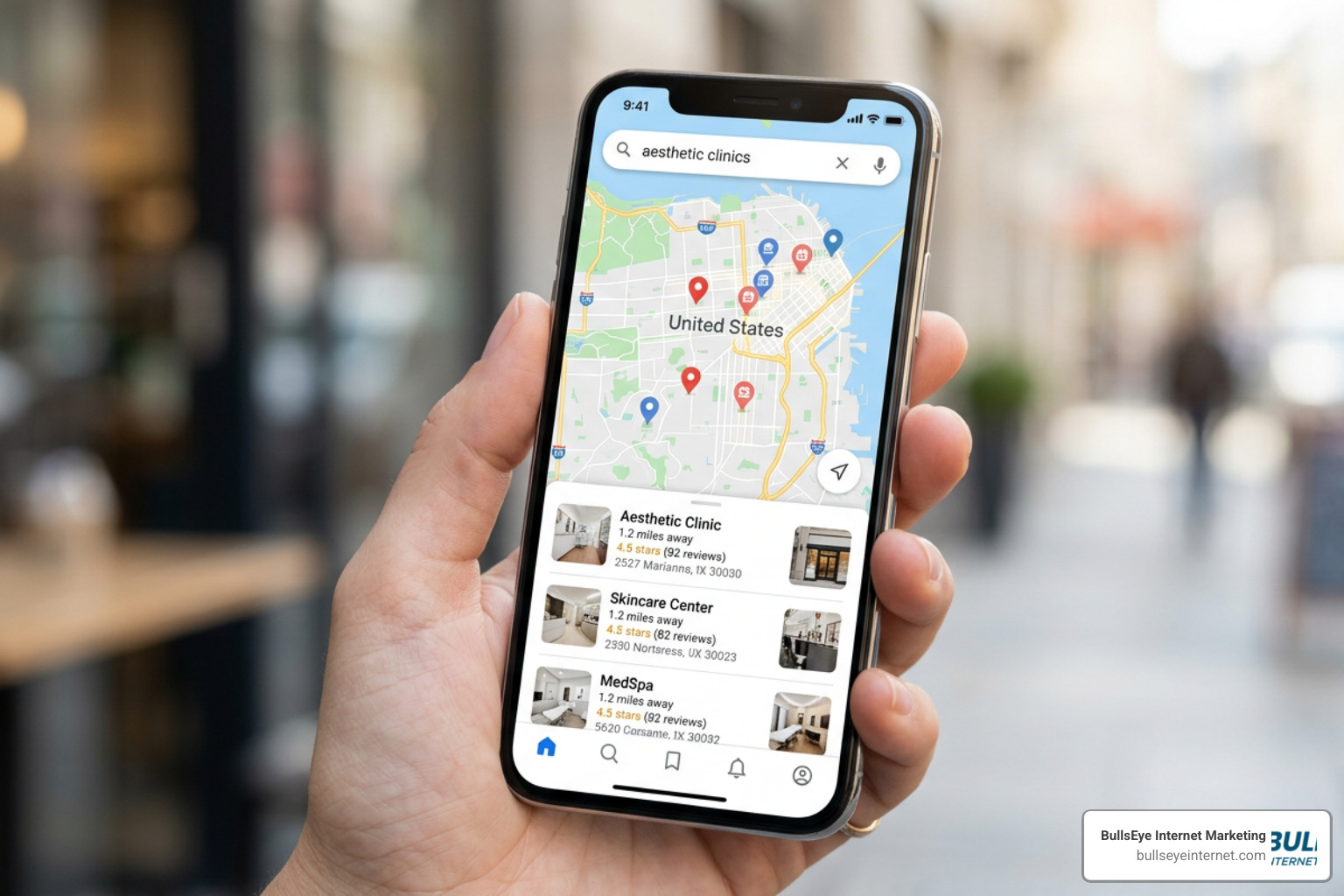
Local SEO focuses entirely on capturing high-intent patients within your specific geographic territory. Studies show that 88% of consumers who search for a local business on their smartphone visit or call that business within 24 hours. Furthermore, “near me” searches have skyrocketed by over 500% in recent years.
To win at local SEO, we must maintain absolute NAP (Name, Address, Phone) consistency across the web. Whether a patient finds you on Google, Yelp, Healthgrades, or local business directories, your contact details must be identical. In fact, businesses with consistent NAP data across all major platforms enjoy up to 20% higher local rankings than those with discrepancies. To master these local dynamics, check out our insights on Local SEO Strategies for Small Business Success.
Optimizing Your Google Business Profile
Your Google Business Profile (GBP) is the single most powerful tool for dominating the local map pack. When local patients search for “medical spa near me” or “coolsculpting Miami,” Google displays the Map Pack—the top three local listings—above the traditional organic search results.
To fully optimize your GBP, we focus on several critical steps:
- Choose the Most Accurate Primary Category: Select “Medical Spa,” “Aesthetic Clinic,” or “Skin Care Clinic” depending on your primary medical oversight. Selecting the correct primary category is vital, as it dictates which secondary categories and keyword queries your profile is eligible to rank for.
- Complete Every Section: Ensure your hours of operation, address, phone number, and booking links are fully updated. Clinics with a complete Google Business Profile are 70% more likely to attract location-based search traffic.
- Upload Geotagged, High-Resolution Photos: Regularly publish photos of your clinical interior, treatment rooms, staff, and state-of-the-art equipment. Avoid generic stock photography; Google and prospective patients want to see your real, physical space.
- Utilize the Services Menu: List every single treatment you offer (e.g., Microneedling, Juvederm, Hydrafacial) with detailed, keyword-rich descriptions and transparent pricing ranges where appropriate.
Building and Managing Patient Reviews
Online reviews are the digital lifeblood of local authority. Over 80% of consumers trust online reviews as much as personal recommendations. Google’s local algorithm heavily favors clinics with a steady stream of fresh, positive reviews. This concept, known as “review velocity,” signals to Google that your clinic is active, trusted, and highly relevant.
We advise our clients to implement a systematic review generation process. Train your front-desk staff or aesthetic injectors to request feedback immediately after a successful treatment, and follow up via automated SMS or email with a direct link to your GBP review page.
To maximize the SEO value of your reviews, encourage patients to mention the specific treatment they received and the name of their provider (e.g., “Dr. Katz was incredible for my lip fillers in Boca Raton!”). This natural, user-generated language helps Google associate your entity with highly valuable treatment keywords. Finally, always respond to every single review—both positive and negative—with professional, HIPAA-compliant messaging to show prospective patients that you care about their experience.
High-Intent Keyword Strategies and SEO for Aesthetic Clinics
The foundation of any successful campaign involving SEO for aesthetic clinics lies in targeting high-intent, transactional keywords. We categorize search terms into three distinct buckets:
- Informational Intent: “How long does lip filler last?” or “What is the difference between Botox and Dysport?” These searchers are researching and are earlier in the decision journey.
- Comparison Intent: “Morpheus8 vs Ultherapy” or “Xeomin vs Botox cost.” These users have identified their problem and are comparing potential solutions.
- Transactional Intent (Money Keywords): “Best Botox clinic in Miami,” “dermal fillers Fort Lauderdale,” or “laser hair removal deals Broward County.” These users are ready to book a consultation immediately.
While informational content is fantastic for building topical authority, your core service pages must be optimized for transactional, long-tail keywords. Long-tail keywords (e.g., “non-surgical nose job in West Palm Beach”) typically have lower search volume but convert at a dramatically higher rate because the searcher’s intent is highly specific. By targeting these highly focused search terms, you can capture motivated patients who are ready to book a treatment immediately.
Mapping Keywords to the Considered Patient Journey
The decision to undergo an aesthetic procedure is deeply personal and highly considered. Patients rarely search once and book immediately; instead, they move through a multi-step journey:
- The Curiosity/Awareness Stage: The patient notices a concern (e.g., “sagging jowls” or “acne scarring”) and searches for general solutions. We target these queries with educational blog posts and comprehensive treatment guides.
- The Evaluation/Comparison Stage: The patient compares different modalities (e.g., “microneedling vs. chemical peels for acne scars”). We address this stage with side-by-side comparison articles, highlighting candidacy, recovery times, and expected outcomes.
- The Decision Stage: The patient is ready to choose a provider. They search for specific brand names, pricing, and local clinics. We capture these ready-to-book patients by optimizing dedicated, high-converting treatment pages.
Implementing Localized Keywords in SEO for Aesthetic Clinics
If your clinic serves multiple areas across South Florida—such as Miami, Fort Lauderdale, Sunrise, or West Palm Beach—you cannot rely on a single homepage to rank for all of these locations. Instead, we build highly optimized, dedicated location landing pages.
Each location page must feature completely unique content tailored to that specific geographic area. Do not simply duplicate the page and swap out the city names; Google’s algorithms will flag this as duplicate content and devalue both pages. Instead, weave in local landmarks, neighborhood names, customized patient testimonials from that specific area, and localized schema markup.
For a deeper look into how to execute this successfully, refer to our expert guide on How a Local SEO Agency Creates Location-Focused Content That Ranks.
On-Page and Technical SEO Best Practices
Your website can have the most beautiful aesthetic design in the world, but if it is technically flawed, Google will not rank it. Technical SEO ensures that search engine crawlers can easily discover, index, and understand every page on your site.
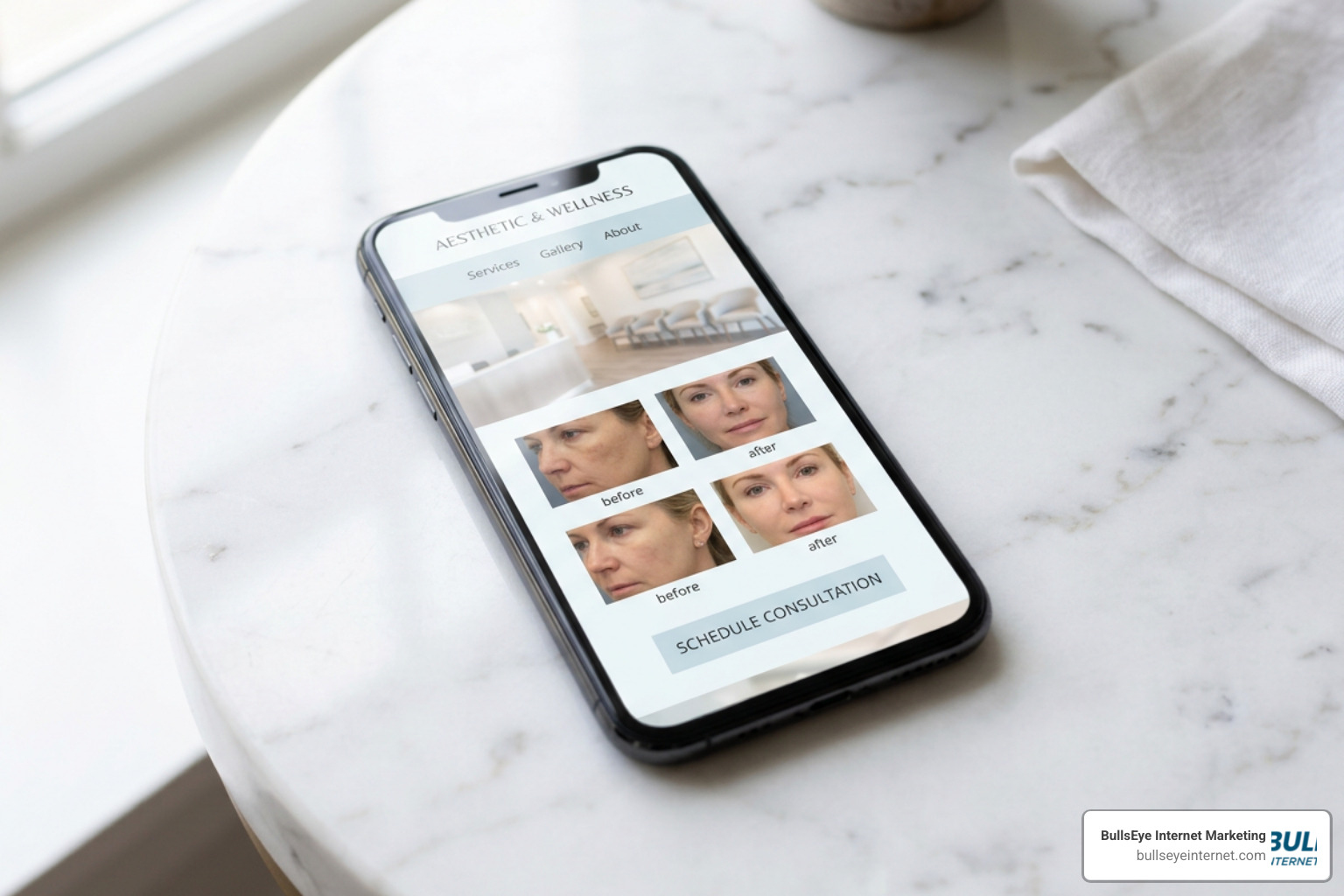
Because over 80% of aesthetic clinic inquiries occur on mobile devices, Google uses mobile-first indexing. This means the mobile version of your website is the primary baseline for how Google evaluates your rankings.
We prioritize Core Web Vitals, which measure your site’s loading speed, visual stability, and interactivity. If your high-resolution before-and-after galleries are not properly compressed and optimized, they will slow down your page speed, causing potential patients to bounce and Google to drop your rankings.
Additionally, implementing structured data, or schema markup (such as MedicalBusiness, Physician, and FAQPage schema), is critical. Schema provides search engines with explicit clues about the meaning of your page, helping you win rich snippets and prominent map placements.
Structuring High-Converting Treatment Pages
Every major treatment you offer—whether it is Botox, dermal fillers, laser resurfacing, or body contouring—needs its own dedicated, long-form service page. Grouping all your services onto a single page makes it impossible to rank for highly specific keyword queries.
To maximize both search rankings and patient conversions, structure your treatment pages using the following blueprint:
- Clean Header Hierarchy: Use a single, keyword-optimized H1 tag at the top, followed by logical H2 and H3 subheadings structured as questions that patients frequently ask.
- Compelling Meta Descriptions: Write unique, click-worthy meta descriptions for each page, including your primary keyword, location, and a clear call-to-action (e.g., “Looking for natural-looking lip fillers in Coral Gables? Schedule your consultation with our board-certified experts today!”).
- Descriptive Image Alt Text: Label all treatment photos and before-and-after images with descriptive, keyword-rich alt text to assist visually impaired users and rank in Google Image Search.
- Clinical Authorship: Clearly attribute your content to your lead medical director or nurse practitioner. Include a brief bio, medical license details, and links to their professional credentials to satisfy Google’s strict E-E-A-T requirements.
Structuring your service pages this way ensures that both search engines and prospective patients find exactly what they need, leading to higher rankings and increased consultation bookings.
Content Marketing and the Future of Search (AEO & GEO)
As search technology evolves in 2026, content marketing has expanded beyond simple blog writing. With the rise of AI-driven search engines, we must optimize for AEO (Answer Engine Optimization) and GEO (Generative Engine Optimization). Platforms like ChatGPT, Perplexity, Gemini, and Google’s own AI Overviews are increasingly answering patient queries directly.
To ensure your clinic is cited as the trusted source by these AI engines, your content strategy must shift toward building undeniable topical authority. Instead of writing short, generic 500-word posts, we create comprehensive, deeply researched content hubs that cover a topic from every conceivable angle. AI models prioritize medically accurate, highly structured data that aligns with established medical consensus.
Discover how authoritative content drives local conversions by reading our analysis on The Role of Content Marketing in SEO Services for Sunrise Florida Businesses.
Creating Authoritative Educational Content
To stand out in the age of generative search, your educational content must feel human, expert-led, and clinically sound. Here is how we build a high-performing content library for our aesthetic clients:
- Physician-Authored Pieces: Ensure all medical claims, treatment risks, and clinical advice are written or thoroughly reviewed by a licensed physician, complete with an author bio and medical review stamp.
- Compliant Before-and-After Galleries: High-quality, ethical before-and-after imagery is your most powerful conversion tool. Ensure all photos are HIPAA-compliant, feature consistent lighting and angles, and are accompanied by descriptive text explaining the patient’s specific treatment plan and timeline.
- In-Depth Treatment Comparisons: Create detailed comparison guides (e.g., “IPL vs. Fraxel Laser: Which is Right for Your Skin Type?”) to capture high-intent patients who are actively evaluating their clinical options.
- FAQ Schema Integration: Add structured FAQ schema to your treatment pages to answer common patient questions directly in search results, capturing valuable real estate on the SERP.
By focusing on these high-quality, expert-led content strategies, your clinic can establish itself as the go-to authority in your local market, driving consistent organic growth.
Combining SEO with PPC for Maximum Patient Acquisition
While SEO is the ultimate long-term, compounding growth engine, combining organic search with Pay-Per-Click (PPC) advertising creates a highly dominant search engine marketing (SEM) strategy. By targeting the same high-value keywords with both paid ads and organic rankings, you effectively double your search engine real estate and build immediate clinical trust.
| Feature / Metric | Organic SEO | Pay-Per-Click (PPC) |
|---|---|---|
| Time to Results | 3 to 6 months to build authority | Immediate traffic upon campaign launch |
| Cost Structure | Upfront investment with compounding, free organic clicks | Pay-per-click model; cost scales with traffic |
| Long-Term ROI | Extremely high; cost-per-lead drops over time | Consistent; stops immediately when ad spend stops |
| Search Intent | Captures research, comparison, and booking queries | Focuses primarily on immediate booking queries |
| Trust & Credibility | High; patients trust organic listings over ads | Moderate; clearly labeled as sponsored |
By running both channels in tandem, we can use PPC data to identify which high-converting keywords we should prioritize for our long-term SEO campaigns. Additionally, we can set up targeted retargeting campaigns on social media to stay top-of-mind for patients who initially discovered your clinic through an organic Google search.
To explore advanced paid strategies that complement your organic efforts, check out our guide on Dermatologist Google Local Ads Strategies to Outrank Competitors.
Frequently Asked Questions about Aesthetic Clinic SEO
How long does it typically take to see SEO results for an aesthetic clinic?
Generally, aesthetic clinics begin seeing noticeable improvements in local visibility and map rankings within 60 to 90 days. However, substantial organic ranking improvements and a significant increase in consultation bookings typically emerge between months three and six. Because SEO is a compounding marketing strategy, the traffic, trust, and patient bookings you generate in month six will continue to grow and deliver returns well into the future.
What are the most common SEO mistakes aesthetic clinics make?
The most common mistakes we see include:
- Duplicate Location Pages: Copying the exact same text across multiple city pages, which causes Google to filter out the pages.
- Inconsistent NAP Data: Having conflicting phone numbers or addresses across various online directories.
- Ignoring Mobile Optimization: Having a slow, poorly formatted mobile site that frustrates on-the-go searchers.
- Keyword Cannibalization: Writing multiple thin blog posts that target the exact same keyword, causing your own pages to compete against each other in search results.
Can a new aesthetic clinic compete with established local med spas?
Absolutely. While established med spas may have a head start on domain authority, a new clinic can successfully compete by dominating hyper-local search queries and targeting highly specialized, niche treatments. By focusing on long-tail keywords, building an immaculate Google Business Profile, securing ultra-specific patient reviews, and creating authoritative, physician-led content, a new practice can quickly carve out a dominant local market share.
Conclusion
Building a successful patient acquisition engine doesn’t have to feel like guesswork. While social media algorithms change and ad costs continue to rise, SEO for aesthetic clinics remains the single most reliable, cost-effective way to generate consistent, high-value patient bookings.
At BullsEye Internet Marketing, we do things differently. We specialize in generating direct phone calls and bookings through Pay Per Lead, Google Business Profile Optimization, advanced SEO, and high-converting PPC campaigns. Our unique value proposition is simple yet incredibly powerful: we offer no long-term contracts, and we work with only one client per industry per geographic area, giving you an exclusive, unmatched competitive advantage in your local market.
If you are ready to stop renting your traffic and start owning your local search market, we are here to help. Schedule a consultation to scale your clinic’s visibility with our team of digital experts today.
