
What Is Pay Per Lead SEO — and Why It Matters for Your Business
Pay per lead SEO is a performance-driven approach to organic search marketing where the goal isn’t just rankings or traffic — it’s generating qualified leads that turn into real customers.
Here’s the quick version:
- What it is: Using SEO (search engine optimization) to attract organic traffic, then converting that traffic into leads through optimized content, CTAs, and lead capture tools
- How it differs from PPC: You don’t pay per click or per ad impression — organic rankings drive traffic at no ongoing cost per visitor
- Who it’s for: Businesses that want a lower cost-per-lead over time without the budget drain of constant ad spend
- Why it works: Around 71% of people prefer clicking organic search results over ads, while only 15% click on paid listings
The frustrating reality for most businesses is this: traffic doesn’t pay the bills — leads do. You can rank on page one and still see your marketing budget disappear with nothing to show for it. That gap between “getting found” and “getting called” is exactly what Pay Per Lead SEO is designed to close.
And the numbers make the case. In WordStream’s analysis of $3 billion in annual PPC spend, the average click-through rate was just 2.35% — and more than 90% of those clicks bounced. Meanwhile, 54% of B2B marketers say their biggest challenge is improving lead quality, not just volume.
This guide breaks down how to build an organic lead engine that actually converts.
I’m Ronnie Katz, founder and Principal CEO of BullsEye Internet Marketing, with over 20 years of experience helping businesses grow through Pay Per Lead SEO and performance-based digital marketing strategies. I’ll walk you through exactly how to make this model work for your business.
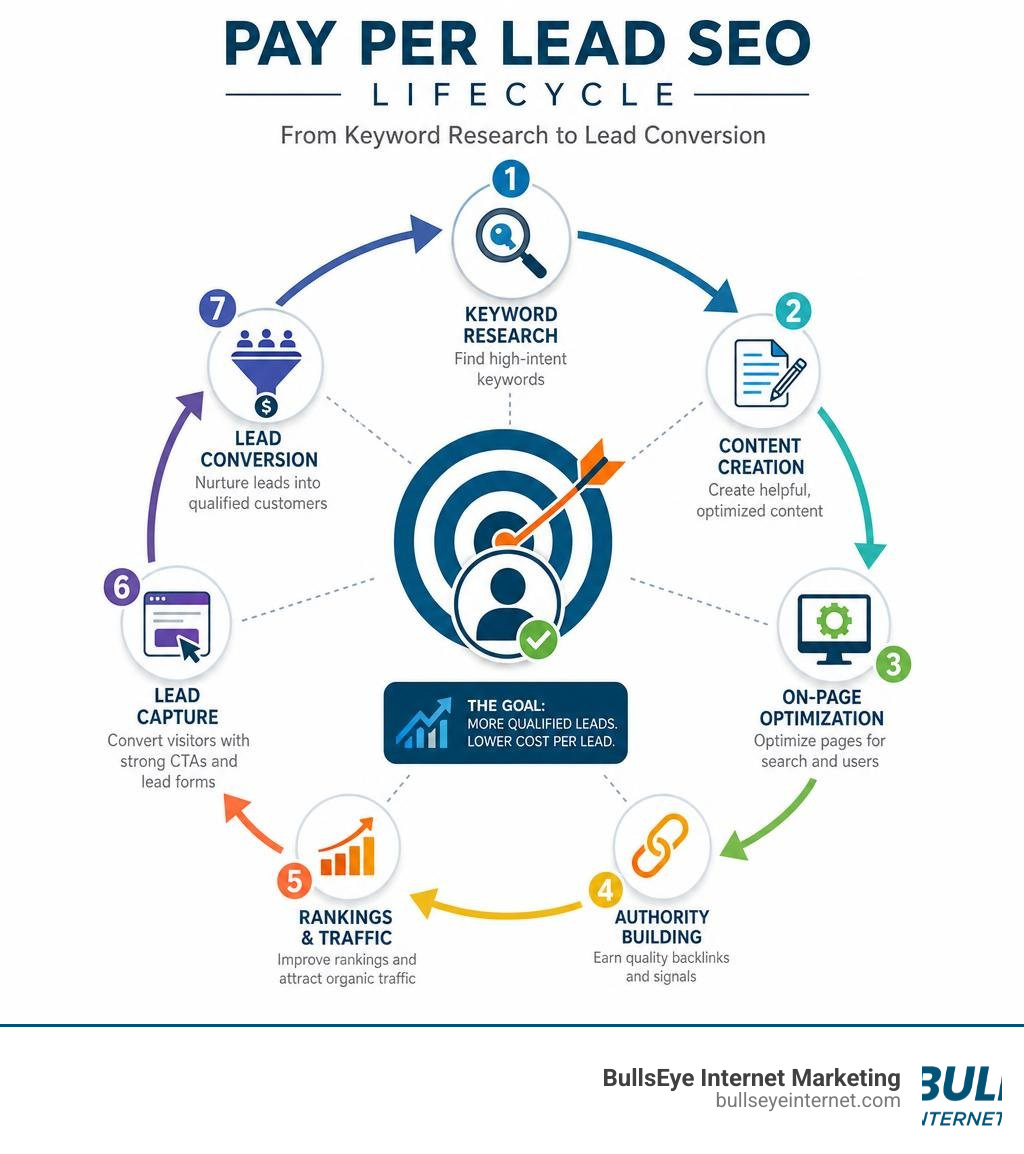
Key terms for Pay per lead SEO:
Demystifying Pay Per Lead SEO: How It Works
Many business owners are inherently skeptical when they hear the term “SEO.” They have likely been burned by agencies charging high monthly retainers while delivering nothing but vague reports about “increased visibility” and “impressions.”
Pay per lead SEO flips this traditional retainer model on its head. It is a performance-based marketing framework that combines the long-term, high-intent traffic power of organic search with the accountability of pay-for-performance lead generation.
At its core, the model works by identifying high-intent search queries, ranking content organically for those terms, and systematically capturing the resulting traffic using highly optimized landing pages, forms, and interactive tools.
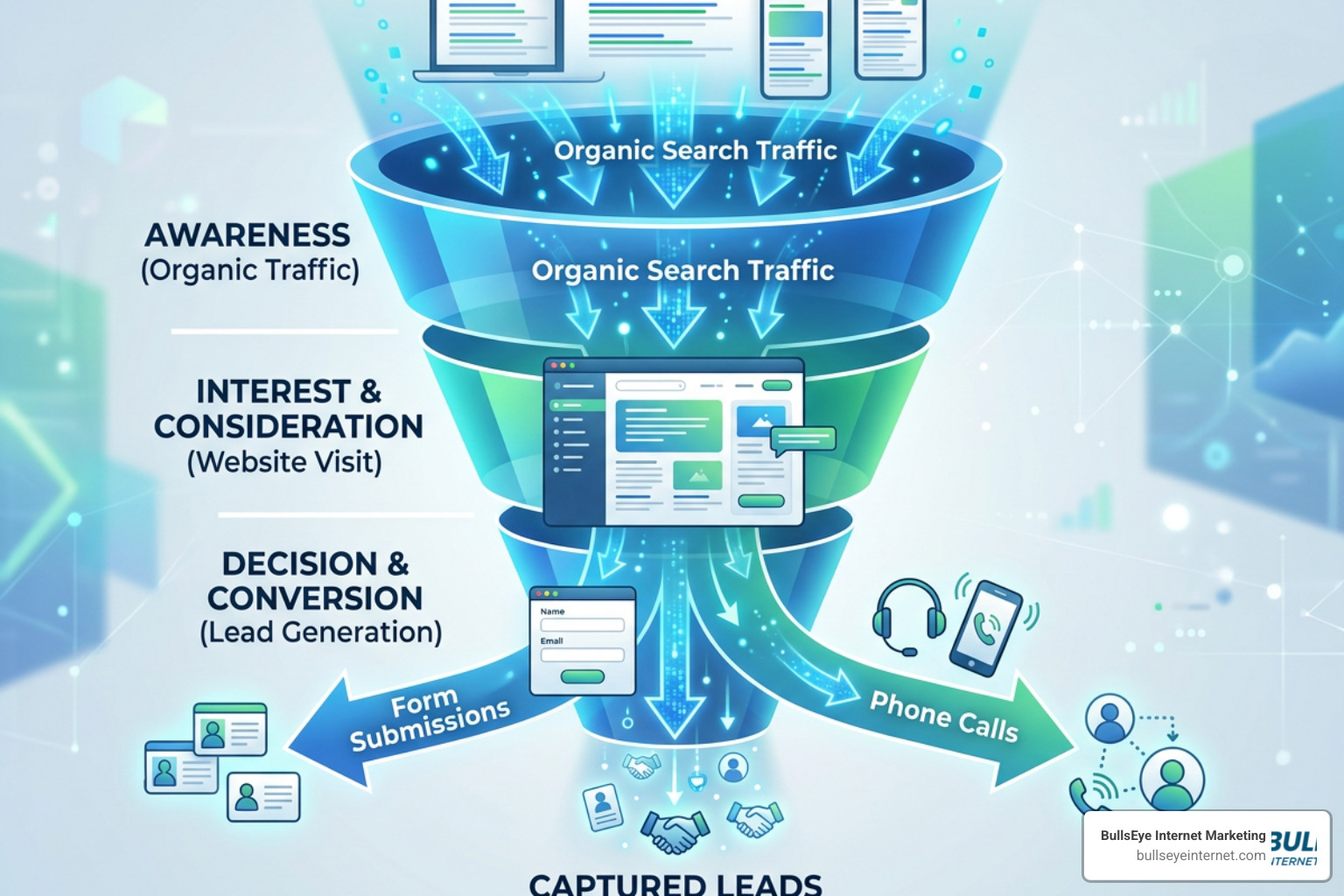
Instead of paying for clicks that may or may not convert, or paying a flat fee to maintain search rankings, the financial risk is realigned. For businesses partnering with a performance agency, you are paying for actual, verified inquiries—such as inbound phone calls or detailed form submissions. When you invest in a performance model like Pay Per Lead, you ensure that your marketing dollars are tied directly to potential revenue.
By utilizing organic search as the primary traffic driver, this strategy builds a compounding asset. Unlike Pay Per Lead Advertising which relies on paid channels, SEO continues to generate traffic and leads long after the initial optimization work is completed.
Pay Per Lead SEO vs. Traditional PPC Lead Generation
To truly understand the value of an organic lead engine, it helps to compare it to traditional pay-per-click (PPC) models.
In a standard PPC campaign, you pay for every single click on your ad, regardless of whether that user stays on your site for two seconds or fills out a form. This model places 100% of the conversion risk on your shoulders. If your landing page has a technical glitch, or if the traffic is slightly off-target, you still pay the ad platform for those clicks.
Additionally, PPC costs are rising. In highly competitive service and tech sectors, the cost per click (CPC) can easily reach double or triple digits. For instance, the average cost per lead (CPL) for tech-industry leads sits at a staggering $208 per lead. With more than 90% of PPC ad clicks bouncing, you are essentially paying a premium to rent temporary traffic.
Pay per lead SEO shifts the conversion risk. Because organic traffic does not carry a per-click fee, we can focus entirely on optimizing the user journey to convert visitors into inquiries. The search intent of organic users is also fundamentally different. Users who skip past the sponsored ads at the top of Google and click on organic results are actively looking for authoritative, trusted solutions—not just the highest bidder.
| Metric / Feature | Traditional PPC Lead Generation | Pay Per Lead SEO |
|---|---|---|
| Payment Trigger | Paid per click (CPC), regardless of conversion | Paid per qualified lead (phone call or form) |
| Traffic Source | Paid ad placements (Google Ads, Bing, etc.) | Organic search results (Google, GBP, Local Pack) |
| Long-Term Asset Value | Zero. Traffic stops the second you turn off budget | High. Compounding authority that generates leads over time |
| Conversion Risk | Borne entirely by the advertiser | Shared or absorbed by the performance strategy |
| Average User Trust | Low (only ~15% click on top ads) | High (~71% click on organic search results) |
| Cost Stability | Subject to ad auction inflation and competitor bidding | Highly stable; declining marginal cost per lead over time |
The Strategic Benefits of Organic Lead Generation
When you shift your perspective from renting traffic to owning your lead pipeline, the long-term ROI of your marketing efforts changes dramatically. Content marketing and organic optimization generate three times as many leads as traditional outbound marketing while costing up to 62% less.
The primary benefit of organic lead generation is the creation of permanent authority. When your website ranks at the top of Google for competitive, high-intent keywords in major Florida markets like West Palm Beach or Broward County, you aren’t just getting traffic; you are establishing your business as the default local authority. This organic prominence builds immediate trust with searchers.
Additionally, organic lead generation provides immense cost efficiency. In an era where B2B companies spend an average of 8.7% of their total revenue on advertising, finding ways to lower your customer acquisition cost (CAC) is vital. Because organic search does not require a media budget, the compounding traffic you build over time drives your average cost per lead down.
When you choose to Transform Your Lead Generation Strategy with Pay Per Lead Marketing, you create a self-sustaining system. The content you optimize today will still be capturing high-intent leads months and years down the road.
When to Invest in Pay Per Lead SEO
While the benefits are clear, Pay per lead SEO is not a one-size-fits-all magic bullet. It requires a specific set of characteristics to be highly effective.
First, this strategy is ideal for businesses that have a solid baseline of website authority but are struggling to convert their existing search traffic. If your site already gets decent traffic but your phone isn’t ringing, a conversion-focused SEO overhaul is exactly what you need.
Second, it is the right strategy if you are planning for long-term, sustainable growth. Because search engines take time to index content and build authority, this is not a quick-fix solution for a business that needs leads by tomorrow morning. It requires stamina and a long-term outlook.
Third, it works best in industries and geographic areas with established search volume. For instance, if you provide local services in South Florida—such as Broward County, Palm Beach County, or Miami-Dade County—there is already a massive, active audience searching for your services every day.
If you are a business owner trying to scale without taking on massive upfront financial risks, partnering with a performance-focused agency can help. You can learn more about how these partnerships work by reading our guide on how to Unlock Your Potential: Understanding Pay Per Lead Marketing Agencies.
Building a High-Converting Organic Lead Engine
To generate high-quality leads organically, you cannot rely on basic blog posts or generic “About Us” pages. You must build a dedicated, high-converting organic lead engine.
This engine relies on three core pillars: precise keyword targeting, exceptional user experience (UX), and conversion rate optimization (CRO).

UX is particularly critical. An average user will leave your website if a page takes more than 3 seconds to load. With 60% of all web traffic now coming from mobile devices, your site must be lightning-fast and fully responsive. If a potential customer in Fort Lauderdale or Boca Raton visits your site on their phone and encounters a slow, clunky page, they will instantly click back to Google and call your competitor.
For local businesses, this means optimizing both your website and your Google Business Profile (GBP) to capture local intent. To master this local landscape, refer to our Local SEO Complete Guide.
Step-by-Step Keyword Research for Pay Per Lead SEO
The foundation of any successful SEO campaign is keyword research. However, for a pay-per-lead campaign, we do not care about raw search volume; we care about commercial intent.
Here is how to find the right keywords:
- Identify Seed Keywords: Start with your core services. If you are an HVAC contractor in West Palm Beach, your seed keywords are “AC repair,” “air conditioning installation,” and “duct cleaning.”
- Analyze Search Intent: Search the terms on Google. Are the top results informational blog posts, or are they commercial service pages? We want keywords where Google displays local service providers, as this indicates a user ready to buy.
- Target Long-Tail Keywords: Long-tail keywords (e.g., “emergency AC repair West Palm Beach”) have lower search volume but incredibly high conversion rates. These searchers have a specific, urgent problem and are ready to call a provider immediately.
- Evaluate CPC Data: Look at what competitors are paying for these keywords in PPC auctions. If a keyword has a high CPC, it means the traffic is highly valuable and converts well. That makes it a prime target for our organic SEO efforts.
Content Formats That Turn Searchers Into Leads
Once you have your keywords, you need to map them to content formats designed specifically to capture leads:
- Local Service Pages: Highly optimized pages targeting specific services in specific geographic areas (e.g., “Residential Electrician in Delray Beach”). These pages should feature clear trust signals, local reviews, and a prominent click-to-call button.
- Long-Form Comparison Guides: Comprehensive resources that help users make a buying decision (e.g., “Metal Roofing vs. Shingle Roofing in South Florida”). These establish authority and capture users in the middle of the funnel.
- Case Studies and Proof Pages: Real-world examples of how you solved a problem for a local client. Showing before-and-after photos and actual performance data builds unmatched trust.
To understand how to structure these local pages for maximum visibility and lead generation, explore our Local SEO Services Complete Guide.
Optimizing On-Page Elements for Maximum Conversions
Getting a user to your page is only half the battle. Once they arrive, you have a matter of seconds to capture their attention and guide them toward taking action.
On-page conversion optimization requires making your content highly skimmable. Modern users do not read every word on a page—they scan. Use short paragraphs (2-3 sentences max), descriptive subheadings, bulleted lists, and bold text to highlight key points.
You must also prominently display trust signals. Include badges for licensing and insurance, local business awards, and real customer reviews from platforms like Google and Yelp. If you serve South Florida, showcasing that you are a locally owned business familiar with local building codes or weather conditions can be a major selling point.
Crafting High-Impact CTAs and Lead Capture Forms
Your call-to-action (CTA) is the bridge between a reader and a lead. A weak CTA like “Submit” or “Contact Us” does nothing to motivate a user.
Instead, use action-oriented, value-driven CTAs. For example:
- “Get My Free AC Repair Estimate”
- “Schedule My Same-Day Service”
- “Claim My Free Roof Inspection”
When designing lead capture forms, keep friction to an absolute minimum. Every extra field you add to a form decreases your conversion rate. For initial contact, only ask for the essentials: name, phone number, email, and a brief description of their need. You can gather deeper details once you have them on the phone.
Place your primary CTA and form “above the fold” (visible without scrolling) on mobile devices, and repeat the CTA naturally throughout the content. For a deeper dive into structuring your pages and forms, check out our Pay Per Lead Agency Complete Guide.
The Power of Interactive Quizzes and Tools
One of the most effective ways to skyrocket your conversion rates is by replacing static forms with interactive tools.
Quizzes, cost calculators, and diagnostic tools achieve incredible engagement. While a standard contact form might convert at 10%, an interactive quiz can achieve completion rates as high as 90%.
For example, a solar installer could feature a “Solar Savings Calculator” where users input their monthly electric bill to see their estimated savings. A roofing contractor in West Palm Beach could use a quick, 4-step “Roof Replacement Cost Estimator.”
These tools work because they provide immediate, personalized value to the user. By the time the user is asked to input their contact details to receive their final results, they are already highly engaged and invested in the process. This approach is highly favored by top Pay Per Lead Generation Companies because it pre-qualifies the lead before it ever reaches your sales team.
Off-Page Authority and Technical Foundations
You cannot generate leads if your website is buried on page three of Google. To rank for competitive, high-intent terms, your site needs a rock-solid technical foundation and strong off-page authority.
Technical SEO is the engine under the hood. Your site must load quickly, have clean code, and be easy for search engine crawlers to understand. This is especially true in local search, where Google’s algorithm heavily weighs proximity, relevance, and prominence.
The Role of Backlinks and Website Authority
Backlinks—links from other reputable websites to yours—act as votes of confidence in the eyes of search engines. The more high-quality, relevant websites that link to you, the higher your domain authority will be, and the easier it will be to rank for competitive keywords.
For local businesses, focus on local link building. Getting listed in local directories, sponsoring community events in Broward or Palm Beach counties, and getting mentioned in local news outlets are incredibly powerful ways to build local authority.
Building this authority takes time, which is why working with an experienced Local SEO Agency can help you navigate the complexities of link building and technical optimization safely and effectively.
Overcoming Challenges and Measuring ROI
Like any marketing strategy, Pay per lead SEO comes with its own set of challenges. The most common hurdle is tracking and attribution. When a lead comes in, you need to know exactly which organic keyword or page drove that inquiry.
Another challenge is search engine algorithm updates. Google frequently updates its ranking algorithms, which can cause traffic fluctuations.
To mitigate these risks, we focus on building a diversified organic footprint. This includes optimizing your Google Business Profile, targeting a wide range of long-tail keywords, and maintaining a clean, technical site structure that stands up to algorithm changes.
We also establish clear, upfront lead definitions. A qualified lead should be a real person, within your defined service area, looking for a service you actually offer. If a lead is spam, a duplicate, or out of your service area, there should be a clear dispute process in place so you only pay for genuine opportunities.
Key Metrics to Track Campaign Success
To measure the true ROI of your organic lead engine, look beyond simple ranking reports. Track these five essential metrics:
- Organic Traffic Growth: The volume of non-paid visitors coming to your site from search engines.
- Conversion Rate: The percentage of website visitors who turn into leads (calls or form submissions).
- Cost Per Lead (CPL): Total marketing investment divided by the number of qualified leads generated.
- Close Rate: The percentage of qualified leads that your sales team successfully turns into paying customers.
- Customer Acquisition Cost (CAC): The total cost to acquire a single paying customer.
Frequently Asked Questions About Pay Per Lead SEO
How long does it take to see results from a pay-per-lead SEO campaign?
SEO is a long-term investment. While technical optimizations and GBP updates can yield quick wins within the first few weeks, it typically takes 3 to 6 months for new content to rank consistently and build momentum. However, unlike paid ads, this momentum compounds over time, driving your average CPL down as your organic authority grows.
What is the average cost per lead in the tech and service industries?
Lead costs vary widely depending on your industry, location, and competition. In the highly competitive B2B tech space, the average CPL is around $208. In local home services (like plumbing, HVAC, or roofing in South Florida), exclusive, high-intent phone leads generally range from $50 to $150+, depending on the specific job type and market competitiveness.
How do you prevent and handle unqualified or spam leads?
We use advanced spam filters, CAPTCHAs, and phone verification systems to screen out bots and telemarketers before they ever reach your inbox or phone lines. Additionally, we establish clear, written guidelines defining what constitutes a qualified lead, backed by a transparent dispute policy for invalid inquiries.
Conclusion
If you are tired of paying for clicks that don’t convert, or feeling trapped by long-term agency retainers that produce vague reports instead of actual revenue, it is time to take a different approach.
At BullsEye Internet Marketing, we do things differently. We specialize in generating high-quality calls and sales through performance-driven digital marketing. Our unique approach gives you a distinct competitive advantage:
- No Long-Term Contracts: We earn your business month after month based on actual performance, not restrictive contracts.
- Exclusive Representation: We work with only one client per industry in any geographic area. If we are driving leads for you in West Palm Beach, we will never work with your local competitors.
- Complete Transparency: We track and verify every single inbound call and form submission, so you know exactly what your marketing dollars are producing.
Whether you want to dominate local search in Broward County, Palm Beach County, or across Florida, we can help you build an organic engine that keeps your calendar full.
Explore how we can scale your business by reading about the best Unlock Growth: The Best Florida SEO Marketing Services.
Ready to stop paying for empty promises and start paying for real results? Let’s talk. Get started with professional SEO services today for a free, no-obligation consultation.
