
Why SEO for a New Business Is the Smartest Investment You Can Make
SEO for a new business is one of the highest-return decisions you can make when launching — but most new owners don’t know where to start.
Here’s a quick answer to what it involves:
- Keyword research — Find the exact words your customers type into Google
- On-page optimization — Structure your pages so search engines understand them
- Technical SEO — Make your site fast, mobile-friendly, and crawlable
- Off-page authority — Earn links and mentions that build trust with Google
- Local SEO — Show up when nearby customers search for what you offer
- Track and improve — Use free tools like Google Search Console to measure results
The payoff is real. Organic search drives 53% of all online traffic and contributes to 44% of revenue — yet it costs nothing per click once you rank.
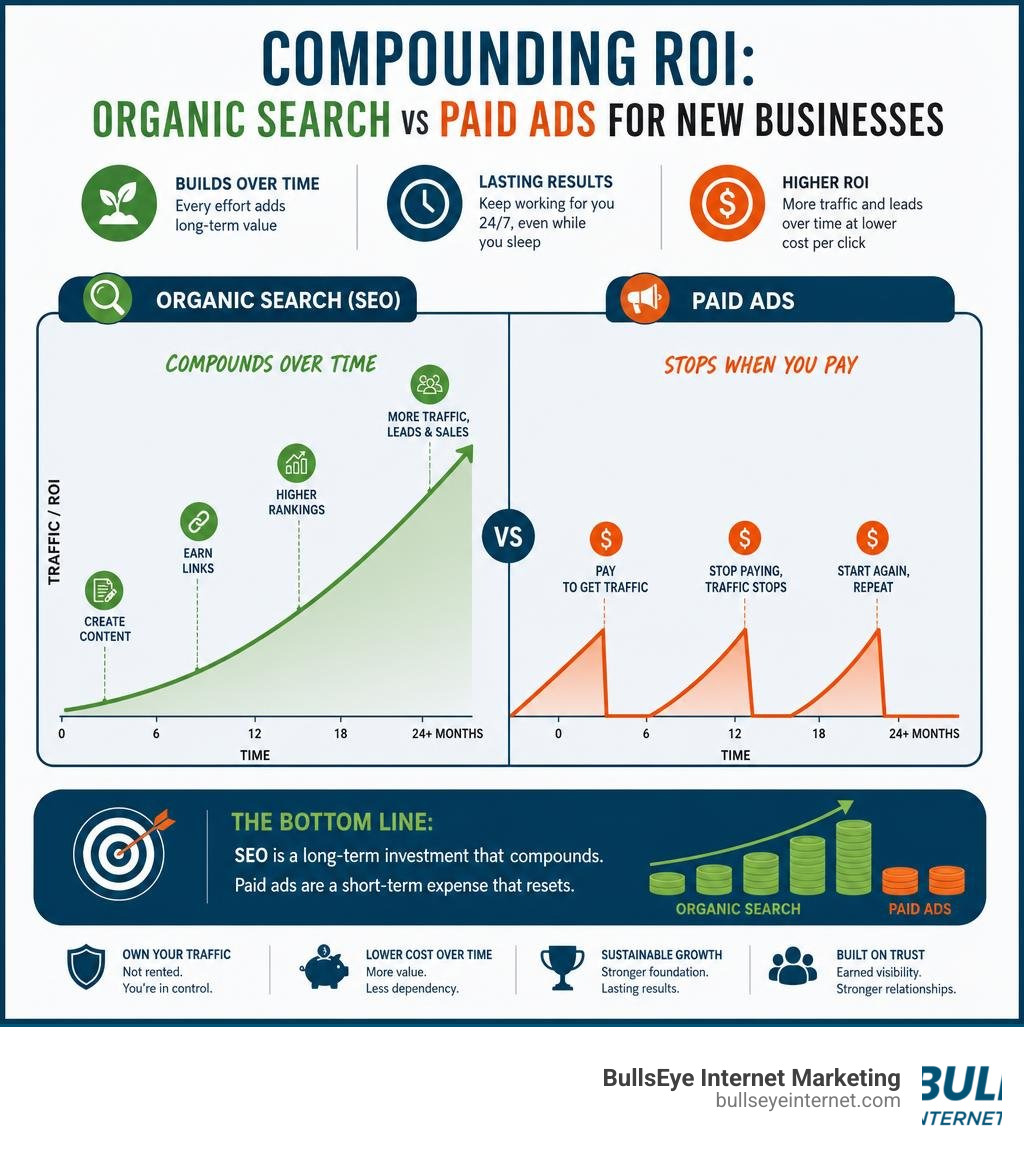
Compare that to paid ads, which stop the moment your budget runs out. SEO compounds. Every piece of content you publish, every backlink you earn, and every optimization you make keeps working for you long after the work is done.
And the stakes for getting found are high. The top result on Google earns a 27.6% click-through rate. The second page? Just 0.63% of searchers ever get there.
For a new business with a tight budget and no brand recognition yet, SEO is the great equalizer. It lets you compete with larger, more established companies — not by outspending them, but by out-answering your customers’ questions.
I’m Ronnie Katz, founder of BullsEye Internet Marketing, and I’ve spent over 20 years helping businesses grow through SEO for new business and beyond — from technical audits to local rankings to AI search visibility. In this guide, I’ll walk you through everything you need to build a strategy that actually drives calls and sales, not just traffic.
SEO for new business vocabulary:
Demystifying SEO for New Business: How Search Engines Work
To make SEO for new business work for you, it helps to understand what goes on behind the scenes when someone types a query into Google. Search engines are automated matchmakers. They use software programs called “crawlers” (or spiders) to scour the internet, read web pages, and follow links.
Once a crawler finds your site, it sends the information back to the search engine’s index—a massive digital library of the web. When a user searches for something, Google’s complex ranking algorithms analyze thousands of indexed pages in milliseconds. The search engine aims to serve up the most relevant, high-quality, and trustworthy answers that match the user’s exact search intent.
For a new business, trying to rank can feel overwhelming, but it is highly achievable when you focus on answering specific questions rather than trying to buy your way to the top. Many founders make the mistake of relying solely on paid ads early on. However, as we discuss in our guide on how to Stop Killing Your Startup with High Customer Acquisition Costs, relying exclusively on paid channels can drain your budget before you ever find your footing.
To help you decide where to focus your resources, here is a breakdown of how organic search (SEO) compares to paid search (SEM) based on the principles outlined in A Complete Guide to SEO for Your Small Business Website.
| Feature | Search Engine Optimization (SEO) | Paid Search (SEM / PPC) |
|---|---|---|
| Cost Per Click | Free ($0) | Variable (You pay for every single click) |
| Sustainability | Compounds over time; traffic continues if you pause work | Stops immediately when you stop paying |
| Timeline | Typically takes 3 to 6 months for initial traction | Instant (Ads appear as soon as the campaign is live) |
| Trust Level | High (94% of search clicks go to organic results) | Medium (Some users actively skip sponsored ads) |
| Effort Required | Continuous content creation and technical monitoring | Continuous budget monitoring and ad copy testing |
The Four Pillars of a Successful Search Strategy
If you want your new business website to rank well in July 2026, you cannot rely on a single trick. A successful organic strategy is built on four distinct pillars. When these four elements work in harmony, search engines recognize your site as a trusted authority.

On-Page Optimization and Content Creation
On-page SEO is everything you do directly on your website’s pages to help search engines understand your content. It is entirely under your control, making it the perfect place to start.
When optimizing your pages, pay close attention to these critical on-page elements:
- Title Tags: Keep them under 60 characters and place your primary keyword at the very beginning.
- Meta Descriptions: Write enticing summaries between 120 and 155 characters that encourage users to click.
- Header Tags (H1, H2, H3): Use only one H1 tag per page for your main title, and use H2 and H3 tags to break up sections logically.
- Image Alt Text: Write descriptive alternative text for every image so search crawlers (and visually impaired users) know what the image shows.
- Simple URLs: Keep your web addresses short, clean, and keyword-rich (for example, use
/services/garage-door-repairinstead of/page-id-9872).
Beyond these basic tags, Google relies heavily on a framework known as E-E-A-T (Experience, Expertise, Authoritativeness, and Trustworthiness) to evaluate content quality. To satisfy these guidelines, avoid publishing generic, thin content. Instead, focus on creating helpful, detailed guides that draw from real-world experience.
As detailed in How to Do SEO for a New Startup Website, a single comprehensive, well-researched article of 1,500 to 2,500 words will easily outperform a dozen short, shallow blog posts that do not offer real value to the reader.
Technical SEO and Site Architecture
Technical SEO focuses on what happens beneath the surface. If search engine crawlers cannot easily read, navigate, or load your website, your content will not rank—no matter how beautifully written it is.
First, your site must load quickly. Google uses a set of metrics called Core Web Vitals to measure page speed and user experience. Aim for a Largest Contentful Paint (LCP) of under 2.5 seconds, a First Input Delay (FID) under 100 milliseconds, and a Cumulative Layout Shift (CLS) under 0.1.
Second, your site must be fully responsive on mobile devices. Because more than 60% of searches now happen on smartphones, Google indexes the mobile version of your website first.
Finally, establish a clean site architecture. Use a “silo” structure where topically similar pages are grouped into logical directories, ensuring that every single page on your site can be reached in three clicks or fewer from the homepage. Don’t forget to generate and submit an XML sitemap to Google Search Console so crawlers can find your new content instantly.
Off-Page SEO and Building Authority
Off-page SEO is the process of building trust and credibility outside of your own website. Think of every external link pointing to your site as a digital vote of confidence. Search engines view these backlinks as proof that other people vouch for your expertise.
However, off-page authority is about quality, not quantity. A single backlink from a highly trusted, relevant local website—like your local Chamber of Commerce or an industry-specific association—carries far more weight than hundreds of low-quality links from spammy forums.
In July 2026, building authority also means monitoring your overall brand footprint. Unlinked brand mentions across reputable platforms, digital PR coverage, and positive customer reviews on third-party directories all act as strong trust signals that tell search algorithms your brand is a legitimate, respected player in your space.
Step-by-Step Implementation: Launching Your Organic Strategy
Building an organic strategy for a new website does not require a massive enterprise budget. By focusing on a lean, step-by-step roadmap, you can establish search visibility and capture qualified leads within your first few months.
Phase 1: Foundational Setup of SEO for New Business
Before you write a single word of content, you must set up your tracking and analytics foundation. This ensures that you can measure your progress and see exactly which search terms are driving traffic to your business.
- Verify Google Search Console (GSC): This free tool is your direct line of communication with Google. It tells you if your pages are indexed, flags technical errors, and shows you the exact queries people use to find your site.
- Install Google Analytics 4 (GA4): Set up GA4 to track user behavior on your site. Configure custom conversion events so you can see when organic traffic turns into phone calls, contact form submissions, or booked appointments.
- Conduct Bottom-Up Keyword Research: Do not try to target highly competitive, broad industry terms right away. If you are launching a new B2B company, for example, chasing a term like “software” is a waste of time. Instead, focus on low-competition, high-intent keywords. Look for long-tail search queries (often 5 to 8 words) that have lower monthly search volumes but carry clear buyer intent. For more on tailoring your early marketing efforts, check out our guide on B2B Startup Marketing.
Phase 2: Executing Content Clusters of SEO for New Business
Once your foundation is set, it is time to build out your content. The most effective way to rank a new website is to use a “content cluster” strategy rather than writing random, isolated blog posts.
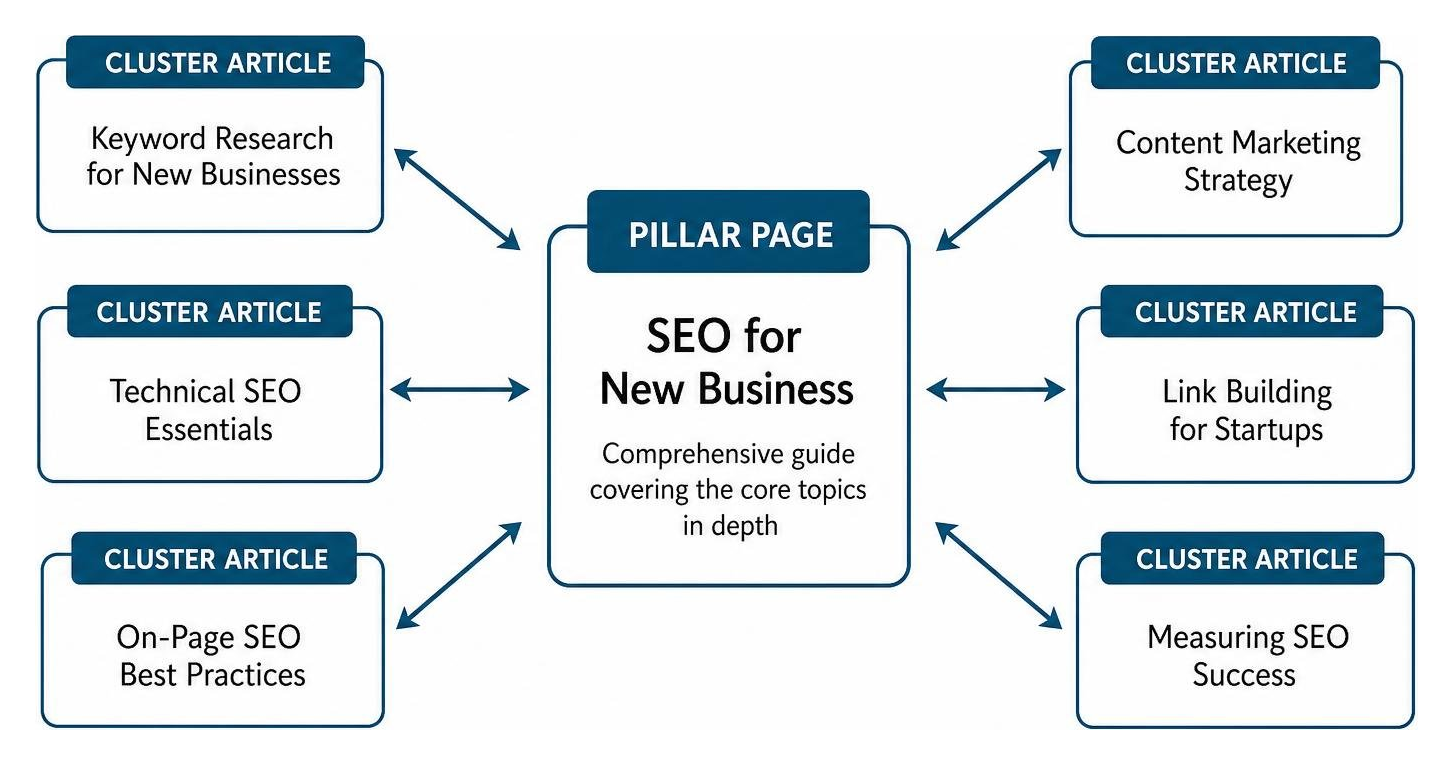
A content cluster consists of one central “pillar” page that covers a broad topic in depth, surrounded by several supporting “cluster” articles that target specific, long-tail questions. You then link all of these supporting articles back to the main pillar page, creating a tightly knit web of internal links that signals search engines you have deep topical authority.
As highlighted in Startup SEO: The Lean Execution Guide for Founders, this structured approach prevents content decay and ensures that every piece of writing serves a clear purpose in your marketing funnel. Keep your publishing schedule realistic: publishing 4 to 8 high-quality, highly optimized cluster pages per month is far better than churning out low-value content just to meet a daily quota.
Maximizing Local SEO for Brick-and-Mortar Success
If your new business serves a specific geographic area—whether you are a service-based business or a physical storefront—local search is your single most powerful marketing lever. Almost half of all Google searches have local intent, and 76% of people who search for something nearby on their smartphone visit a business within 24 hours.
To win in local search, your first step is to claim and fully optimize your free Google Business Profile (GBP). Ensure your business name, physical address, and phone number (NAP) are exactly identical across your website, your GBP, and every local directory. Even minor discrepancies—like writing “Suite 100” on one site and “#100” on another—can confuse search crawlers and damage your local rankings.
Building local authority takes consistent effort. You should actively build local citations on platforms like Yelp, Apple Maps, and Bing Places. If you are operating in Florida, make sure you register your entity properly through the official Start a Business – Florida Department of State portal to establish legal and digital legitimacy.
For local businesses throughout South Florida, targeting specific neighborhood search terms is crucial. We have outlined these exact blueprints in our guides on Local SEO Strategies for Small Business Success and How to Leverage Local SEO for Small Businesses.
If you are a business owner in Palm Beach County, for instance, you can learn why localized visibility is so critical by reading about Why Local SEO is Crucial for Businesses in South Palm Beach.
To understand the long-term financial benefits of this approach, explore Is Local SEO Worth It? Understanding the ROI and discover why many business owners consider it The ROI of Local SEO: Why It’s the Best Marketing Investment for 2025.
To get a sense of how competitive your local market is and find professional support, you can check out resources like:
- TOP Professional SEO Services for Small Business in Florida
- SEO Tips for Small Businesses for Miami-Dade County FL…
- West Palm Beach SEO PPC AI Agency Digital Marketing Florida
- Top-Rated Martin County, Florida Web Design & SEO Agency
- SEO for Startups: Why New Businesses in Sebastian Need Professional SEO Services
To further benchmark Florida’s robust commercial landscape, you can review the methodology behind 2026 America’s Top States for Business: How we rank all….
Navigating the AI Era: GEO, AEO, and Generative Search
As we navigate July 2026, the search landscape is undergoing a massive transformation. Traditional search engine results are now sitting alongside AI Overviews, ChatGPT Search, Perplexity, and Bing Copilot. This shift has introduced two new terms to the modern marketer’s vocabulary: Answer Engine Optimization (AEO) and Generative Engine Optimization (GEO).
According to SEO for Startups: The Complete 2026 Founder’s Guide, AI engines do not search the web the same way humans do; they synthesize information to present direct, conversational answers. This actually presents a massive opportunity for new businesses. AI engines frequently cite lower-ranking websites—up to 90% of the time—if those sites provide the clearest, most concise answer to a user’s question, regardless of their domain authority.
To optimize your new business website for generative search, implement these strategies:
- Write Clear, Direct Answers: Place a concise, 50-to-60-word answer directly below major headings before diving into deeper explanations.
- Use FAQ Schema: Implement structured data markup to help AI crawlers easily read and parse your question-and-answer formats.
- Build a Digital Brand Footprint: Ensure your brand name is mentioned in trusted industry directories, local news outlets, and forums like Reddit and Quora. AI models rely on these broad digital footprints to decide which brands to recommend.
Frequently Asked Questions about SEO for New Businesses
How long does it take to see results from SEO efforts?
For a brand-new website, SEO is a compounding process rather than an instant switch. You can expect to see search engine crawlers index your first posts within 24 to 72 hours. If you target highly specific, long-tail search terms with low competition, you can see your first page-one rankings within 7 to 30 days.
For broader, moderately competitive terms, meaningful organic traffic typically begins to build between months 3 and 6. The most significant, compounding growth—where organic search becomes a predictable lead-generation machine—usually occurs after 9 to 12 months of consistent optimization.
What are the most common SEO mistakes new businesses should avoid?
The most common mistake new business owners make is chasing broad, high-volume keywords (like “marketing” or “plumber”) before building up their topical authority. These competitive terms are dominated by massive, established brands.
Other critical mistakes include:
- Keyword Stuffing: Forcing search terms into your text unnaturally, which hurts readability and triggers Google’s spam filters.
- Publishing Thin or Duplicate Content: Copying text from other websites or publishing short, low-value pages that do not help the reader.
- Ignoring Mobile Users: Failing to optimize your site’s load speed and layout for smartphones.
- Buying Spammy Backlinks: Purchasing cheap link packages that promise instant rankings but ultimately lead to severe search engine penalties.
What free and paid tools are best for tracking SEO performance?
You do not need to spend a fortune on marketing software when launching. Start with free, essential tools:
- Google Search Console: To track indexing, organic impressions, and keyword rankings.
- Google Analytics 4: To monitor user behavior, traffic sources, and conversion rates.
- Google Keyword Planner: To find initial search term ideas and analyze search volumes.
As your business grows and your budget allows, you can invest in paid platforms like Ubersuggest (around $30/month) for straightforward keyword tracking, or industry-standard suites like Semrush or Ahrefs for advanced competitor analysis and technical site auditing.
Achieving Sustainable Growth with BullsEye Internet Marketing
Building a powerful online presence through SEO for new business is a marathon, but the long-term rewards are unmatched. By laying a clean technical foundation, targeting smart long-tail keywords, executing organized content clusters, and dominating your local search map, you can build a sustainable stream of inbound leads without relying on expensive, paid ad campaigns.
At BullsEye Internet Marketing, we specialize in helping businesses cut through the digital noise to generate real calls and sales. We do things differently: we offer no long-term contracts and work with only one client per industry per geographic area, giving you a distinct, exclusive competitive advantage in your local market.
Whether you need support with Google Business Profile optimization, technical SEO, Pay Per Lead campaigns, or conversion rate optimization, we are here to help your business hit its target. Ready to take the next step? Explore our full range of BullsEye Internet Marketing Services to see how we can grow your organic reach.
Other digital marketing services we offer:
- PPC Management for Small Business
- Digital Marketing Agency for Small Business
- Digital Marketing Agency for Small Business 2
