
Why an AI Visibility Platform Protects Organic Market Share
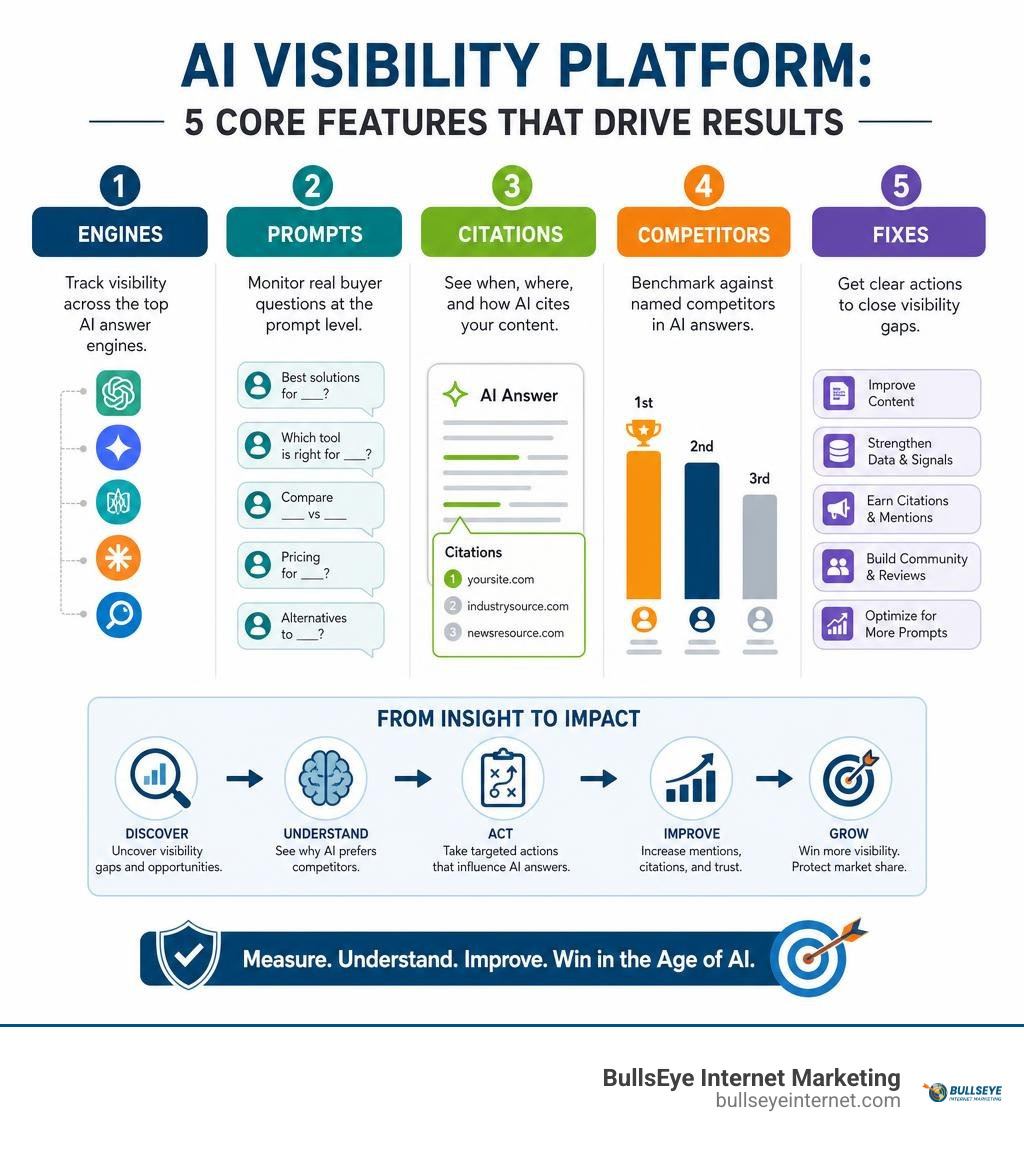
An AI visibility platform shows whether AI tools recommend, mention, or cite your business when people ask buying questions. For a useful comparison, choose a platform that tracks prompt-level results across ChatGPT, Gemini, Perplexity, Claude, and Google AI Overviews; benchmarks named competitors; identifies citation sources and sentiment; and gives your team a clear path to fix lost visibility.
Traditional rank trackers still matter, but they cannot show what happens inside an AI-generated answer. That gap is growing: 68% of Google searches ended without a click in early 2026, while AI tools increasingly become the place where buyers compare options and make decisions.
The best platforms do more than report a score. They help you find the questions where competitors win, understand why AI cites them, and turn those findings into better pages, product data, reviews, digital PR, and community signals.
I am Ronnie Katz, founder and Principal CEO of BullsEye Internet Marketing, with more than 20 years of experience helping businesses improve visibility, traffic, and conversions through SEO, local search, AEO, GEO, and paid media. In this guide, I will explain how to evaluate an AI visibility platform based on the data, workflow, and business results that matter most.
Why Traditional Search Tracking Fails in the Generative Era
Traditional position monitoring tracked static URLs across ten blue links on a Search Engine Results Page (SERP). However, generative engines synthesize information from dozens of unstructured datasets into a single cohesive response. When users query an LLM, the answer is generated on the fly, rendering traditional rank tracking obsolete for measuring actual digital market share.

This behavioral shift has fundamentally changed how prospects discover and evaluate solutions. According to The 5W AI Trust Map of America, consumer trust in AI-driven recommendations continues to surge, with 50% of users stating they trust AI recommendations and 52% of U.S. consumers planning to use generative AI directly for online shopping. If your brand is omitted from these synthesized answers, you forfeit customer acquisition before prospects ever visit a website. Adapting to this new paradigm requires an active generative engine optimization service to ensure your brand entities remain prominently cited.
Traditional SERP Rankings vs Generative Engine Citations
Traditional SEO focuses on earning top-ten organic rankings for high-volume keywords. In generative engines, ranking in position one on standard search does not guarantee you will be cited. In fact, industry data shows that only 16.7% of sources cited in Google AI Overviews rank in the organic top 10.
Generative models rely on entity association, semantic context, and cross-web authority rather than raw backlink volume or exact-match keywords. Understanding what is aeo (Answer Engine Optimization) is critical: LLMs extract facts, verify brand co-occurrences across third-party databases, and synthesize direct recommendations to resolve conversational queries.
The Multi-Engine Landscape: ChatGPT, Gemini, Perplexity, and Claude
Modern buyer discovery is distributed across multiple distinct AI ecosystems, each operating on unique retrieval architectures, training corpora, and citation mechanisms:
- ChatGPT: Surpassed 900 million weekly active users in early 2026, serving as an conversational shopping assistant and primary discovery hub.
- Google Gemini & AI Overviews: Gemini has scaled past 750 million monthly active users, while Gemini-powered AI Overviews reach an estimated 2 billion-plus global users every month.
- Perplexity: Operates as an answer engine focused on real-time web indexing, citation transparency, and academic-grade source attribution.
- Claude: Anthropic’s flagship assistant excels at nuanced conversational synthesis, document evaluation, and technical comparisons.
Because these engines pull from different training windows, web indices, and weighting algorithms, a brand dominating ChatGPT might be invisible in Perplexity or Gemini. Capturing high-intent buyers requires multi-engine visibility tracking to fuel sustained generative ai lead generation.
Core Capabilities of a Modern AI Visibility Platform
Evaluating generative search tools requires auditing how software collects, processes, and structures LLM outputs into operational intelligence. Teams need structured frameworks outlined in a practical guide to llm seo strategies to separate diagnostic signal from noise.

Evaluating AI Visibility Platform Data: Multi-Engine Tracking vs Single LLM Scans
A robust monitoring system must ingest prompts across diverse models, query types, and geographic locations. Leading platforms incorporate:
- Prompt-Level Intelligence: Tracking complex, multi-turn buying queries that reflect real human conversational behavior rather than isolated keyword phrases.
- Query Drift & Cadence Tracking: Running automated prompt sweeps every 6 to 24 hours to capture non-deterministic changes in LLM outputs.
- Locale-Aware Engine Scanning: Simulating regional queries across specific markets to measure localized answer variance.
- Crawler Bot Analytics: Monitoring visits from GPTBot, ClaudeBot, PerplexityBot, and Google-Extended to ensure enterprise assets are indexed rather than blocked. Integrating these checks aligns directly with llm seo audit best practices.
Sentiment Analysis, Hallucination Detection, and Share of Voice
Appearance within an AI response is only half the battle; the context of that mention dictates customer action. Modern platforms evaluate:
- AI Sentiment Decoding: Gauging whether models frame your brand as an industry leader, a budget alternative, or an outdated option.
- Hallucination Detection: Flagging instances where an LLM invents false pricing, non-existent features, or incorrect company leadership details.
- Competitive Share of Voice (SoV): Measuring your brand’s presence rate against named competitors across targeted buyer prompts.
- Cross-Model Consistency: Calculating how reliably your brand appears across ChatGPT, Claude, Gemini, and Perplexity to identify isolated visibility blind spots, addressing core ai search ranking factors.
Comparing AI Visibility Tool Architectures and Workflows
AI visibility platforms vary widely in their architectural focus. Some solutions function as passive reporting dashboards, while others offer closed-loop remediation workflows or deep e-commerce catalog integrations.
| Platform Type | Primary Use Case | Key Strengths | Core Limitations | Typical Tech Integrations |
|---|---|---|---|---|
| Passive Monitoring Trackers | Brand presence auditing & Share of Voice reporting | Multi-model prompt monitoring, sentiment scoring, historical trend lines | Diagnostic only; no content creation or remediation tools | REST API, Looker Studio, CSV / BI Exports |
| Monitor-and-Fix Workflow Platforms | End-to-end GEO remediation for content teams | Automated gap briefs, content optimization, on-page remediation workflows | Higher complexity, requiring cross-team execution | CMS webhooks, API, Content Optimization Suites |
| Commerce-Specialized AI Platforms | DTC & retail SKU recommendation tracking | SKU-level feed optimization, review synthesis, crawler bot verification | Narrower focus on product feeds vs complex B2B queries | Shopify, BigCommerce, Product Information Systems (PIM) |
Deploying these architectures requires aligning software with semantic seo services complete guide principles to ensure structured data matches LLM extraction formats.
Passive Monitoring Tools vs Closed-Loop Monitor-and-Fix Platforms
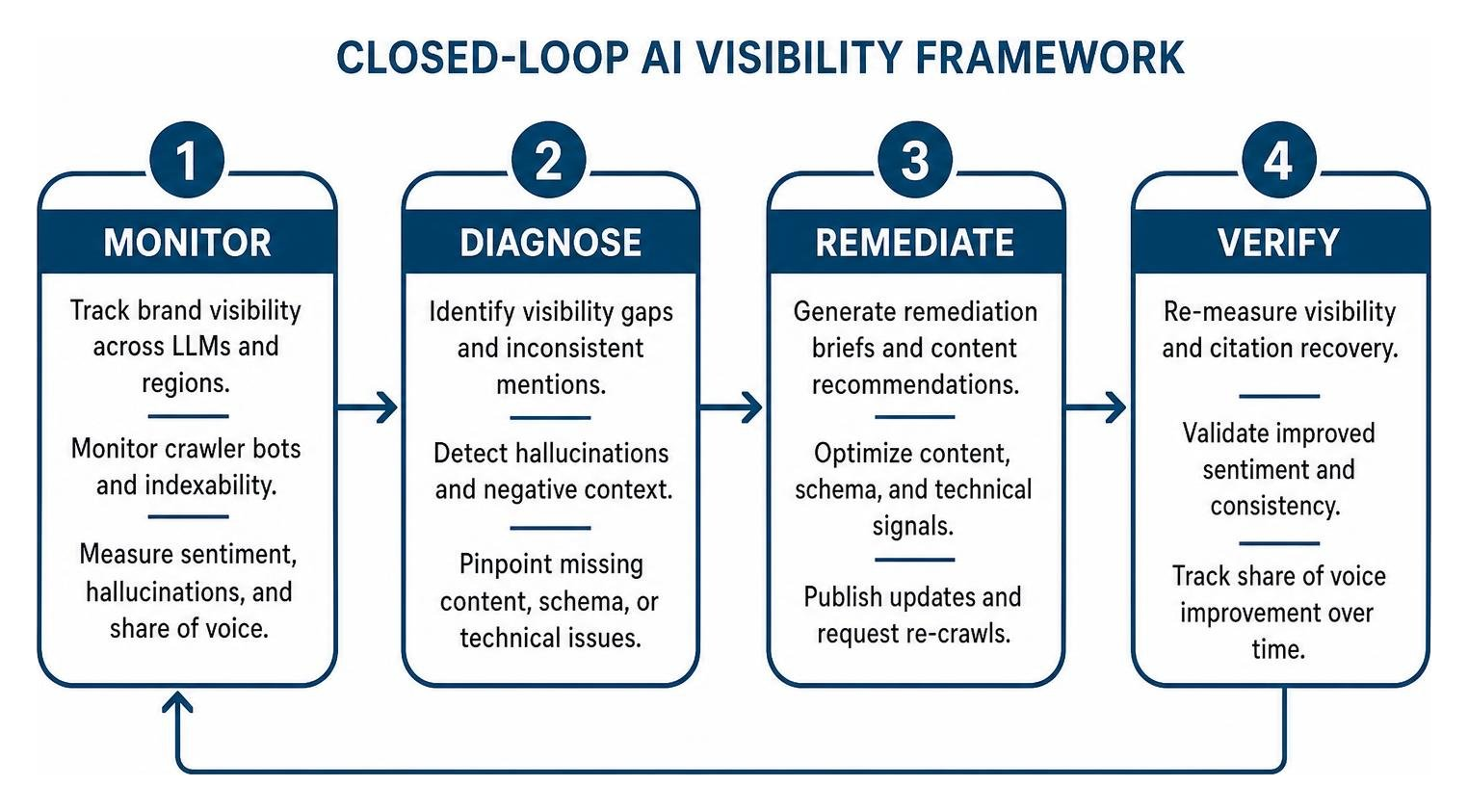
Passive monitoring tools generate visibility scores and citation alerts. While useful for high-level reporting, they leave teams stranded when answering the operational question: “What do we publish or update to fix this missing citation?”
Closed-loop platforms connect detection directly to execution. When the system identifies that a competitor is consistently cited for a commercial prompt, it generates a remediation brief highlighting the exact citation sources, missing technical schema, and conceptual gaps. Following structured ai search best practices allows marketing teams to publish remediated pages, request LLM re-crawls, and measure citation recovery. Over time, closing these citation gaps produces compounding gains in generative market share.
Selecting an AI Visibility Platform: Enterprise Depth vs Lightweight Monitoring
Choosing the right platform depends on your operational maturity, resource allocation, and team structure:
- Enterprise-Depth Tools: Solutions designed for large organizations emphasize SOC2 compliance, role-based access control (RBAC), multi-language tracking across 200+ regions, and Looker Studio/BI database connectors. They often carry enterprise seat licensing and higher prompt allocations.
- Lightweight & Entry-Level Trackers: Ideal for SMBs and lean teams requiring rapid setup without heavy onboarding. These platforms focus on tracking 15 to 100 core commercial prompts across top models at accessible monthly tiers.
- Agency Management Suites: Multi-tenant architectures that allow agencies to run segregated client workspaces, white-label reporting dashboards, and bulk prompt intelligence. Teams scaling these efforts should follow a proven llm seo best practices guide to structure cross-client workflows.
E-Commerce SKU-Level Tracking vs B2B Brand Entity Monitoring
The optimization signals required to win AI recommendations diverge sharply between business models:
For e-commerce brands, platforms must ingest entire SKU catalogs, auditing whether product feeds, pricing, inventory statuses, and JSON-LD schema are machine-readable. With 52% of consumers leveraging generative AI for shopping, missing structured product attributes means AI shopping assistants will recommend a competitor’s product instead.
For B2B and SaaS brands, tracking centers on brand entity authority, software feature parity, compliance validation, and executive leadership positioning. Content teams must learn how to speak the ais language optimizing content for large language models so algorithms associate their solutions with core enterprise use cases.
Measuring ROI and Connecting Generative Visibility to Conversions
Investing in generative visibility requires connecting engine citations to bottom-line pipeline growth and closed revenue.
Because 38% of users become customers from AI traffic and 50% of Gen Z discover brands via generative tools, measuring upstream visibility serves as a leading indicator of pipeline health. Implementing an ai search optimization complete guide strategy ensures every citation contributes to measurable pipeline performance.
Tracking AI Citations to Pipeline and Revenue
Connecting generative visibility to ROI involves multi-touch attribution modeling:
- Referral Traffic Verification: Tracking direct session attribution from domains like
chatgpt.com,perplexity.ai, andclaude.aiinside Google Analytics 4. - AI-Sourced Customer Signups: Deploying post-conversion “How did you hear about us?” friction-free attribution fields to capture untracked zero-click AI recommendations.
- Brand Search Volume Lift: Measuring the correlated rise in direct and branded organic search queries following significant gains in AI share of voice.
- Pipeline Acceleration: Monitoring lead velocity improvements when prospects interact with AI assistants before scheduling sales calls, a process detailed in our answer engine marketing complete guide.
Off-Site Signals: Customer Reviews, Community Discussions, and Digital PR
Generative models rely on off-site verification to validate whether a brand is trustworthy. LLMs frequently crawl and synthesize sentiment from:
- Third-Party Review Aggregators: G2, Capterra, Trustpilot, and Better Business Bureau profiles provide structured customer sentiment that feeds AI recommendations.
- Community Discussions: Unfiltered Reddit, Quora, and industry-specific forum threads carry high authority in model synthesis.
- Digital PR & Editorial Citations: Unlinked brand mentions in major news outlets, industry whitepapers, and reputable publications reinforce entity authority, helping businesses dominate generative engine answers with ai visibility optimization.
Frequently Asked Questions About AI Search Visibility
How do AI visibility platforms track non-deterministic LLM responses?
Because large language models generate text based on probabilistic token prediction, running the exact same prompt multiple times can produce slight answer variations. AI visibility tools account for this non-deterministic behavior by executing multi-run prompt sampling across scheduled 6-to-24-hour intervals. Platforms calculate a statistical confidence score and presence rate (e.g., brand mentioned in 9 out of 10 runs) rather than relying on a single snapshot.
Why are traditional SEO rank trackers insufficient for generative engines?
Traditional rank trackers scrape fixed URLs on static SERP pages. Generative engines do not present a single list of ten URLs; they synthesize natural-language summaries pulled from multiple disparate sources. Furthermore, studies show that only 16.7% of sources cited in AI Overviews rank within the top 10 organic positions. Measuring your digital market share through large language model seo requires monitoring synthesized brand mentions, sentiment, and direct citations inside the answer itself.
What is the difference between AEO and traditional SEO tools?
Traditional SEO tools evaluate keyword volume, backlink counts, and metadata tags to help pages rank higher on classic search engines. Answer Engine Optimization (AEO) tools monitor how conversational models extract, synthesize, and cite brand entities within chat responses. AEO platforms focus on knowledge graph presence, third-party sentiment verification, and machine-readable schema, as detailed in our aeo best practices ultimate guide.
Conclusion
The transition from keyword-based SERPs to generative answer engines represents the most significant shift in search architecture in decades. Brands that rely solely on legacy rank tracking risk losing their market share to competitors who actively optimize for LLM citation algorithms.
At BullsEye Internet Marketing, we help businesses dominate this evolving landscape through comprehensive ai visibility optimization. We provide a decisive competitive edge by offering no long-term contracts and working exclusively with only one client per industry per geographic area across Florida and all 50 U.S. states. Contact our team today to audit your generative search performance and protect your market share across ChatGPT, Gemini, Perplexity, and Claude.
