
Why Your Small Business Website Needs to Be More Than Just “Pretty”
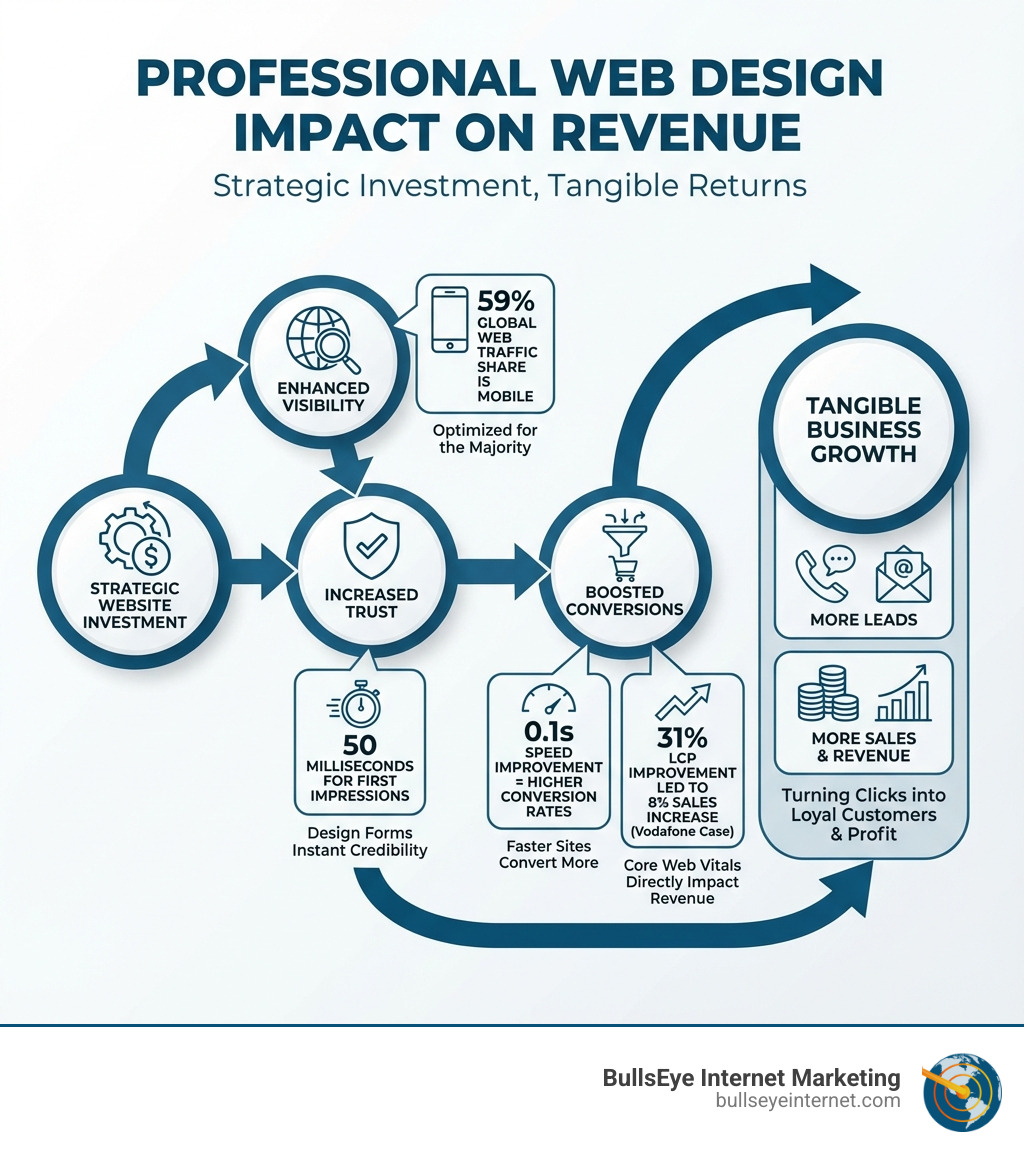
Web design services for small business come in many forms—from DIY platforms to full-service agencies—and choosing the right one directly impacts your bottom line. Your website is your digital storefront, and first impressions form in about 50 milliseconds. A website that doesn’t generate leads or sales isn’t just neutral—it’s actively costing you money in lost opportunities.
Here’s what you need to know:
- Professional web design improves visibility, trust, and conversions through strategic layout, fast load times, and mobile optimization
- Mobile accounts for ~59% of global web traffic—your site must work flawlessly on phones
- A 0.1-second improvement in mobile site speed correlates with measurably better conversion rates
- DIY templates often hit a ceiling with slow load times, poor navigation, and generic branding that doesn’t convert visitors into customers
- The right web design partner aligns design decisions with your real business goals: more calls, more leads, more sales
As someone who’s been frustrated by ineffective marketing and high acquisition costs, you need a website that works as hard as you do. Not a digital brochure—a lead generation machine that pays for itself.
This guide compares 10 different web design service approaches for small businesses, from DIY builders to professional agencies. You’ll learn the pros, cons, real costs, and which option matches your budget and growth goals. By the end, you’ll know exactly which path will get your phone ringing without locking you into long-term commitments that don’t deliver results.
I’m Ronnie Katz, founder of BullsEye Internet Marketing, and since 2006 I’ve helped hundreds of small businesses transform their websites from expenses into profit centers. I’ve seen how the right web design services for small business can turn a struggling company into a thriving one—and how the wrong choice can drain your budget for months with nothing to show for it.
Web design services for small business vocab explained:
What a Professional Website Must Have to Drive Growth
A professional small business website is more than just an online presence; it’s a powerful tool that actively contributes to your growth and success. It should be working for you, generating leads and increasing sales, not just existing.
Here are the essential elements of a professional small business website and how they contribute to your bottom line:
- User Experience (UX): Your website must be intuitive and easy to steer. Visitors should find what they need quickly and effortlessly. A good UX ensures people enjoy their experience, remember your website, and return. 38% of people will leave a website if they find the layout unattractive or difficult to steer.
- Conversion-Focused Design: A beautiful website alone won’t pay the bills; conversions are the key. Every element, from layout to content, should guide visitors towards a desired action, whether it’s making a purchase, filling out a form, or calling your business.
- Lead Generation: Your website should be a lead generation powerhouse. This means integrating clear calls-to-action (CTAs), user-friendly contact forms, and strategic content that captures visitor information and nurtures them into customers. We believe a website that isn’t making you money is costing you money.
- Mobile-First Responsive Layout: With mobile traffic now at roughly ~59% of global web traffic (as of July 2025), your website must look and function perfectly on all devices. A mobile-first approach ensures an optimal experience for the majority of your visitors.
- Fast Loading Speed: This isn’t just about convenience; it’s a critical factor for user retention and search engine rankings. A 0.1s improvement in mobile site speed correlates with better conversion funnel progression. 53% of mobile users abandon sites that take over 3 seconds to load. Vodafone saw an 8% increase in sales with a 31% improvement in Largest Contentful Paint (LCP), a key speed metric.
- Clear Calls-to-Action (CTAs): Tell your visitors what you want them to do next. “Call Us Today,” “Request a Quote,” “Book an Appointment”—these direct prompts are vital for guiding user actions and generating leads.
- Consistent Branding: Your website should reflect your brand’s personality, values, and visual identity. This includes consistent color schemes, typography, and tone of voice, building trust and recognition.
- Search Engine Optimization (SEO): A stunning website is only effective if people can find it. Professional web design integrates SEO best practices from the ground up, ensuring your site ranks high in search results for relevant keywords. When your design, content, and technical SEO are built as one system, you rank better and sell more.
- Security (SSL): An SSL certificate is non-negotiable. It encrypts data, protects user information, and signals to visitors (and search engines) that your site is trustworthy.
A well-built small business website also helps your Google Business Profile, reviews, and local landing pages work together. This holistic approach ensures your online presence is cohesive and effective. For more insights into how these elements drive results, explore How a Web Design Company Can Improve Your User Experience and Conversion Rates.
Essential Pages for a Small Business Website
Every small business website needs a foundational set of pages to inform, engage, and convert visitors. These include:
- Home: The digital storefront, providing an overview of your business, value proposition, and key services/products.
- About Us: Tells your story, builds trust, and introduces your team, helping visitors connect with the human side of your brand.
- Services/Products: Detailed descriptions of what you offer, with clear benefits and pricing where applicable.
- Contact: All the ways customers can reach you—phone, email, address, and a contact form.
- Blog: A platform for sharing expertise, answering common questions, and improving SEO by regularly publishing fresh, relevant content.
- Testimonials/Reviews: Social proof that builds credibility and reassures potential customers about the quality of your work.
Examples of High-Converting Small Business Websites
We’ve seen countless examples of small businesses leveraging professional web design to achieve remarkable success. What makes them effective is their focus on user experience, clear calls-to-action, and a strong brand message.

- The Cultured Cup: This tea and coffee retailer features a stunning homepage with a slider bar and clean navigation. A strategic pop-up guides users to choose between tea or coffee, personalizing the experience and moving them deeper into the site. This demonstrates excellent visual appeal and a clear user journey.
- Tamara Knight Photography: This local Orlando photographer showcases her portfolio with ample white space, making her images pop. Her site effectively highlights her packages and includes an immediate contact form, making lead generation a priority. It’s a great example of a creative professional’s site designed for conversion.
- The Joinery: This small business making handmade furniture uses a unique feature: when you hover over a product image, a text description with details, options, and usage suggestions appears. This interactive element helps customers visualize items and overcome purchasing hesitations.
These examples illustrate that effective web design services for small business are about more than just aesthetics; they’re about strategic design that guides users, builds trust, and ultimately, drives business growth.
Comparing the Top 10 Web Design Service Approaches for Small Business
Choosing the right approach for your small business website is a crucial decision that impacts your budget, timeline, and ultimately, your online success. There’s no one-size-fits-all solution, so let’s compare the most common options available to you.
1. DIY Website Builders
These platforms empower you to build a website yourself with drag-and-drop interfaces.
- Pros: Low initial cost (often under $50/month), high control over content, and fast to launch. Platforms like Wix and Squarespace are known for their ease of use.
- Cons: DIY templates often hit a ceiling with slow load times, clunky navigation, and generic branding that make it hard to stand out. Limited SEO capabilities, potential hidden fees for advanced features, and scalability issues can arise as your business grows.
- Best for: Hobbyists, very new businesses testing an idea, or those with extremely limited budgets who don’t rely heavily on their website for lead generation.
2. E-commerce-Focused Website Solutions
These platforms are specifically designed for online stores, providing tools to sell products directly.
- Pros: Built-in payment processing, inventory management, secure checkout, and often a wide range of e-commerce specific features. Shopify, WooCommerce (for WordPress), and Volusion are popular choices.
- Cons: Transaction fees can eat into profits, reliance on apps for additional features can increase costs and complexity, and design customization might be limited compared to custom solutions.
- Best for: Businesses primarily selling products online, from small boutiques to larger retailers. If you’re looking to sell, we can help with Ecommerce Website Design.
3. Working with a Professional Web Design Company
This involves partnering with an agency that handles the entire web design process for you.
- Pros: Personalized service, a dedicated team of experts (designers, developers, SEO specialists), creative and custom designs custom to your brand, and an integrated strategy that focuses on ROI and lead generation. You get one point of contact and a website built to achieve your specific business goals. Professional web design services for small business provide a measurable edge by improving visibility, trust, and conversions.
- Cons: This is typically the highest cost option, with projects often starting from $5,000 and going upwards, depending on complexity. However, we believe it’s an investment that yields significant returns.
- Best for: Businesses needing a unique, high-quality custom site and a growth-focused, integrated strategy for lead generation and sales. For B2B businesses, this is often the most effective route, as discussed in B2B Web Design Agency.
4. Subscription-Based Web Design Services
These services offer a website for a recurring monthly fee, often including maintenance and support.
- Pros: Low upfront investment, includes ongoing maintenance and support, and a predictable monthly cost. Some services offer a modern business website in 4 weeks for around $1,500 one-time + $199/month for optional support.
- Cons: You typically don’t own the website outright, costs can add up significantly over time, and customization options may be less flexible than a traditional agency.
- Best for: Businesses that want a completely hands-off approach to website management and prefer a subscription model.
5. WordPress Specialists
These designers and developers focus specifically on building and maintaining websites using the WordPress platform.
- Pros: WordPress is highly customizable, scalable for future growth, and boasts a massive library of plugins for almost any functionality. You own your data and have full control.
- Cons: Requires regular maintenance and security updates, which can be complex for beginners. If not managed properly, performance can suffer.
- Best for: Content-heavy sites, blogs, and businesses wanting long-term flexibility and control over their online presence.
6. Industry-Specific Web Design Solutions
Some agencies specialize in designing websites for particular industries.
- Pros: Deep understanding of your market, familiarity with what features your customers need (e.g., menus for restaurants, case pages for law firms, schedules for fitness studios). They can speak your language!
- Cons: Their portfolio may lack design variety, and choosing a local specialist might mean they serve your competitors in the same geographic area. However, at BullsEye, we offer a unique competitive advantage: we only work with one client per industry per geographic area.
- Best for: Niche industries like law, healthcare, real estate, or restaurants that have very specific functional and aesthetic requirements.
7. Low-Code/No-Code Web Design Approaches
These methods use visual development tools to build applications and websites with minimal manual coding.
- Pros: Extremely fast development time, often leading to a lower cost than traditional coding. Some teams can work 10x faster than traditional agencies using this approach.
- Cons: Can lead to platform dependency, and there might be limitations on highly complex or unique customization requests.
- Best for: Startups needing a minimum viable product (MVP) quickly, small businesses with straightforward needs, or internal tools where speed is paramount.
8. Local Web Design Service Providers
This option involves working with a web design company based in your local area, such as Florida, Miami-Dade, or Broward County.
- Pros: Opportunity for in-person meetings, a better understanding of the local market and customer base, and the satisfaction of supporting your local economy.
- Cons: May have a smaller portfolio or less access to cutting-edge skills compared to larger national agencies.
- Best for: Local service businesses targeting a specific geographic area who value face-to-face interaction. If you’re looking for Web Design Companies Near Me, we understand the unique needs of businesses in our local Florida communities.
9. Custom Web Development Solutions
This is a bespoke approach where your website is built from scratch to meet your exact specifications.
- Pros: Fully custom to your business needs, highly scalable for future growth, and allows for unique features and integrations that perfectly align with your operations.
- Cons: This is usually the highest cost option and involves the longest development time due to the custom nature of the work.
- Best for: Businesses with complex requirements, unique processes, or custom integrations that cannot be achieved with off-the-shelf solutions.
10. Template-Based Web Design Packages
This approach uses pre-designed templates as a starting point, which are then customized with your content and branding.
- Pros: Faster turnaround compared to fully custom, lower cost, and still provides a professional look. A typical website homepage might be quoted at $250, with additional pages at $100 each.
- Cons: Limited customization options means your site may not stand out as much as a fully custom design. It can feel generic if not executed well.
- Best for: Businesses needing a quick, budget-friendly solution with a professional appearance without the need for extensive unique features.
How to Choose the Right Web Design Partner
Choosing the right partner for your web design services for small business is a critical decision that impacts your online presence for years to come. It’s like choosing a business partner – you want someone who understands your vision and can help you achieve your goals.

Here’s what to consider when making your choice:
- Your Budget: Be realistic about what you can afford. While DIY is cheapest upfront, remember a website that isn’t making you money is costing you money. Professional services offer a higher ROI in the long run.
- Business Goals (Leads, Sales, Branding): What do you want your website to achieve? Is it primarily for branding, generating leads, or driving e-commerce sales? Your goals will dictate the complexity and features required.
- Technical Requirements: Do you need complex integrations, custom functionalities, or a simple online brochure? This will influence whether you need a custom developer or a template-based solution.
- Your Desired Level of Involvement: Do you want to be hands-on with content and updates, or do you prefer a completely managed service?
- Scalability for the Future: Will your website need to grow with your business? Choose a solution that can adapt to new products, services, or increased traffic without needing a complete overhaul every few years.
- Reviewing Portfolios and Testimonials: Look at their past work. Does it align with your aesthetic and industry? What do other clients say about their experience? We’re proud of our work and the results we’ve achieved for businesses like yours.
Key Factors for Choosing a Web Design Service
To simplify your decision, here’s a comparison of key factors across different types of web design services for small business:
| Factor | DIY Builders | Template-Based Packages | Professional Web Design Companies |
|---|---|---|---|
| Average Cost | <$50/month (platform fees) | $500 – $3,000 (one-time) | $5,000 – $25,000+ (one-time, project-based) |
| Time to Launch | Days to a few weeks | 2-6 weeks | 4-12+ weeks |
| Level of Customization | Limited (template-dependent) | Moderate (content/branding within template) | High to fully custom |
| SEO & Marketing Integration | Basic tools, often requires manual effort | Basic to moderate, can be limiting | Comprehensive, built-in strategy (SEO, lead gen, conversion optimization) |
| Ongoing Maintenance | Your responsibility | Often extra, or basic included | Can be bundled, or offered as ongoing support for optimal performance |
The Professional Web Design Process Explained
Understanding the process behind professional web design services for small business can explain the investment and help you appreciate the strategic thinking involved. A professional process ensures your website is a strategic asset, not just a digital brochure.
Step 1: Findy and Strategy
This is where we get to know you and your business. We define your goals (e.g., “generate 20 leads per month”), conduct target audience research, analyze your competitors, and perform keyword research to understand how potential customers are searching for your services. This foundational step ensures your website is built with purpose.
Step 2: Design and Branding
Based on the strategy, we move to visual conceptualization. This includes:
- Wireframing: Creating a basic structural blueprint of each page.
- Mockups: Developing static visual representations of your website’s design.
- User Interface (UI) Design: Focusing on the aesthetics and interactivity of your site.
- Creating a Brand Style Guide: Ensuring consistent use of colors, fonts, and imagery across your site and other marketing materials.
Step 3: Development and SEO Implementation
This is where the magic happens, turning designs into a functional website. We focus on:
- Coding the Design: Building the website with clean, efficient code.
- Mobile-First Development: Ensuring your site is optimized for mobile devices first, then scaled up for larger screens. With ~59% of global web traffic on mobile, this is non-negotiable.
- On-Page SEO: Implementing titles, meta descriptions, headings (H1, H2, etc.), and keyword-rich content to help search engines understand your pages.
- Technical SEO: Optimizing site speed (remember that 0.1s improvement!), schema markup, and site structure for better search engine crawling and indexing. Learn more about how we approach Mobile Website Design for optimal performance.
Step 4: Content Creation and Integration
Content is king! We work with you to:
- Write Persuasive, SEO-Optimized Copy: Crafting messages that resonate with your audience and include relevant keywords.
- Source High-Quality Images and Videos: Visuals are crucial for making a strong first impression and keeping visitors engaged.
- Populating the Website Pages: Carefully placing all content, ensuring it flows logically and supports your conversion goals.
Step 5: Testing and Quality Assurance
Before launch, we rigorously test every aspect of your website:
- Cross-Browser Testing: Ensuring your site looks and functions correctly across different web browsers (Chrome, Firefox, Safari, Edge).
- Checking for Broken Links: Eliminating dead ends that frustrate users and hurt SEO.
- Testing Forms and CTAs: Confirming all contact forms, quote requests, and calls-to-action work flawlessly.
- Ensuring Responsiveness on All Devices: Verifying that the layout adapts perfectly to desktops, tablets, and mobile phones.
Step 6: Launch and Training
The exciting part!
- Migrating the Site to the Live Server: Carefully transferring your completed website to its permanent online home.
- Final Checks: A last-minute review of everything to ensure a smooth launch.
- Training You on How to Use Your New Website’s CMS: We empower you with the knowledge to make basic updates and manage your content, giving you control without the headaches.
Small Business Web Design Costs & FAQs – BullsEye Internet Marketing
How much do web design services for small business typically cost?
The cost of web design services for small business varies widely based on the approach and complexity.
- DIY builders can cost under $50 per month for platform fees, but require your time and effort.
- Template-based packages and subscription services typically range from a few hundred dollars to a few thousand dollars upfront, with potential monthly fees. For example, a basic website might be quoted at $250 for the homepage and $100 for each additional page, while a subscription service could be $1,500 one-time plus $199/month.
- Professional web design companies generally start at $5,000 for a foundational site and can go up to $25,000+ for complex projects with custom features, e-commerce, or extensive content.
When considering cost, focus on the value and potential return on investment (ROI), not just the initial price tag. An effective website is an asset that generates revenue.
How do I choose between different web design services for small business?
To choose the right web design services for small business, evaluate your:
- Budget: How much can you realistically invest?
- Business Goals: What do you need the website to do for your business (e.g., generate leads, sell products, build brand awareness)?
- Technical Needs: Do you require complex integrations, unique features, or a simple informational site?
- Time Commitment: How much time and effort are you willing to put into the process?
Review portfolios and case studies of potential providers. If you need a simple online presence, a template-based solution might suffice. However, for a growth-focused, integrated strategy that includes strong SEO and lead generation, partnering with a professional web design company is usually the best investment. We pride ourselves on offering an integrated approach, and we don’t lock our clients into long-term contracts because we believe our results speak for themselves.
How long does it take to build a professional small business website?
The timeline for building a professional small business website depends significantly on the scope and complexity of the project.
- A basic professional website with a few pages and standard functionalities typically takes about 4-6 weeks from findy to launch. We’ve even seen modern business websites built in just 4 weeks.
- A more complex site with custom features, extensive content, e-commerce functionality, or specific integrations can take 8-12 weeks or even longer. For instance, a website with over 40 pages can be built in under 2 months with an efficient team.
A clear process, timely feedback from your end, and efficient communication with your web design partner are key to staying on schedule and launching your new site effectively.
Your Website Should Be Your Best Salesperson
Choosing the right web design services for small business is one of the most critical business decisions you’ll make in today’s digital landscape. Your website isn’t just an expense; it’s a strategic investment that, when done right, generates leads and sales 24/7.
We’ve explored the diverse approaches, from the hands-on DIY route to the comprehensive accept of professional agencies. While each has its place, the most effective strategy integrates thoughtful design with robust technical SEO and an unwavering focus on conversions. This synergy ensures your website doesn’t just look good, but actively works to achieve your business goals.
For a website designed not just to look good, but to be your #1 lead generation tool—a website that truly pays for itself—a full-service agency approach delivers the highest ROI. Our commitment is to provide you with a website that is a profit center, not a money pit. We offer no long-term contracts and work with only one client per industry per geographic area, ensuring you have a competitive edge in your market, whether you’re in Miami-Dade, Broward County, or anywhere else in Florida or the United States.
Find out how our Web Design Company can build a website that grows your business and turns browsers into buyers.
