
Why Website Visitor Conversion Matters More Than Traffic
Website visitor conversion is the moment a casual browser becomes a lead or customer—and it’s the most critical metric for measuring your online success. You can have thousands of visitors, but if they’re not converting, you’re not making money.
Quick Answer: How to Improve Website Visitor Conversion
- Understand your baseline – Calculate your current rate (conversions ÷ visitors × 100)
- Optimize user experience – Fast load times, mobile-friendly design, simple navigation
- Build trust – Display testimonials, security badges, and clear contact information
- Personalize the journey – Tailor content and offers based on visitor behavior
- Test everything – Use A/B testing to identify what drives conversions
- Recover lost sales – Implement abandoned cart emails and exit-intent offers
- Focus on high-converting channels – Prioritize traffic sources that actually convert
Here’s the reality: 84% of lead conversions happen during the first website visit. If your site isn’t optimized to convert visitors immediately, you’re losing money every single day. The average conversion rate across industries ranges from 2% to 5%, but top-performing sites consistently convert at 11% or higher. That gap represents real revenue you’re leaving on the table.
This isn’t about getting more traffic—it’s about getting more value from the traffic you already have. Every percentage point improvement in your conversion rate directly impacts your bottom line without spending another dollar on advertising.
As Ronnie Katz, founder of BullsEye Internet Marketing with over 20 years of experience, I’ve helped hundreds of businesses transform their website visitor conversion rates through data-driven strategies and cutting-edge optimization techniques. My mission is to get your phone ringing by turning more of your website visitors into paying customers.
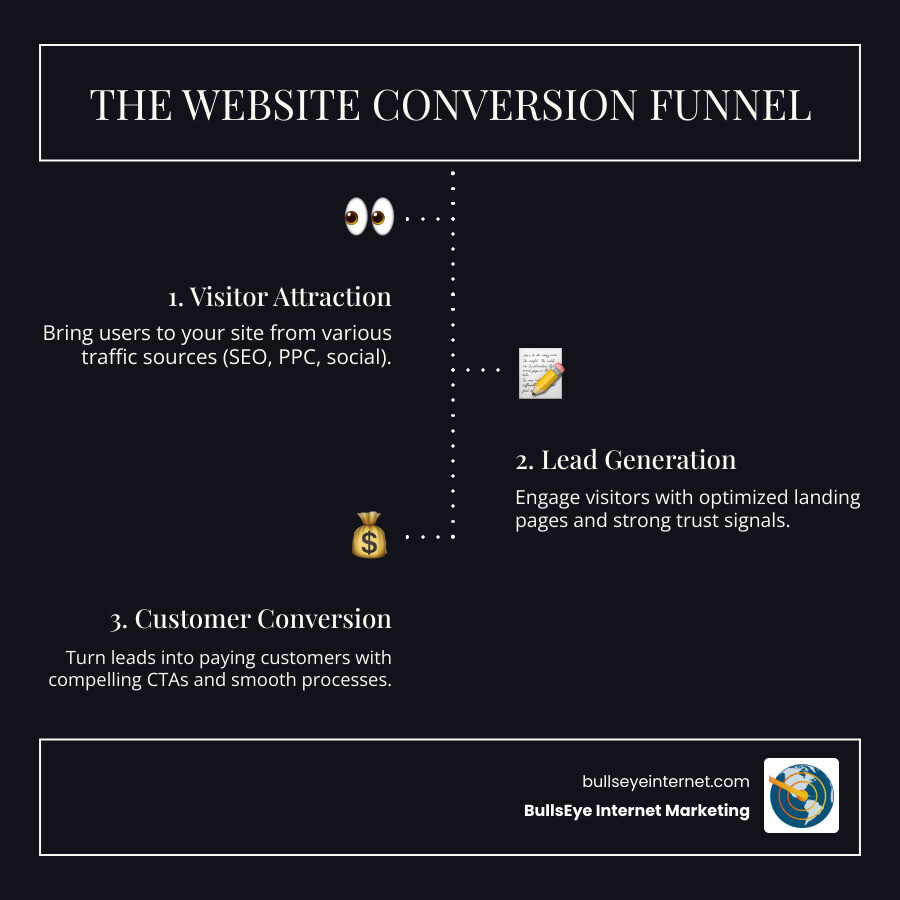
Decoding Conversions: From Metrics to Meaning
Before we dive into the nitty-gritty of boosting your rates, let’s make sure we’re all on the same page about what website visitor conversion truly means. It’s more than just a number; it’s a window into your audience’s needs and how effectively your website meets them.
Understanding Website Visitor Conversion: The Core Metrics
At its heart, a website visitor conversion happens when a user completes a desired action on your website. This could be anything from making a purchase to downloading an e-book. Every business website is built to generate conversions, because without them, even the most beautiful site is just an online brochure. Why is this so important? Because a higher conversion rate means more leads, more sales, and ultimately, more growth for your business.
We categorize conversions into two main types:
- Macro Conversions: These are the big kahunas, the primary goals of your website. For an e-commerce store, it’s a completed purchase. For a service-based business, it might be a demo request or a contact form submission. These actions directly contribute to your bottom line.
- Micro Conversions: These are smaller, often preliminary, actions that indicate a user’s engagement and move them closer to a macro conversion. Think signing up for a newsletter, downloading a resource, watching a product video, or adding an item to a cart. Tracking these helps us understand the user journey and identify potential roadblocks before they reach the main goal.
By defining what a “conversion” means for your specific business goals—whether it’s a purchase, a trial sign-up, or a booking—we can then track the entire user journey and optimize every step.
Calculating and Benchmarking Your Conversion Rate
Calculating your website visitor conversion rate is straightforward. We simply divide the number of conversions by the total number of website sessions (or unique visitors, depending on your tracking method) and multiply by 100 to get a percentage.

For example, if your website had 1,000 sessions last month and you achieved 40 conversions, your conversion rate would be (40 / 1000) * 100 = 4%. Simple, right?
But what constitutes a “good” conversion rate? This is where things get a little nuanced. A good conversion rate can range from 2% to 5%, but this number varies significantly depending on your industry, business model, and even the type of conversion you’re tracking.
Let’s look at some benchmarks to give you a clearer picture:
| Industry | Average Conversion Rate |
|---|---|
| E-commerce | 1.84% – 3.71% |
| B2B Services | ~2.23% |
| Travel & Hospitality | ~3.6% |
| Financial Services | ~4.3% |
| Overall Across Industries | 2.35% – 5.31% |
It’s clear that what’s “good” varies. A multi-billion-dollar company once aimed for more even with 41% conversion rates for first-time visitors! For us, the goal isn’t just to hit an average, but to understand our unique audience and continuously improve their experience.
Foundational Pillars for Higher Conversion Rates
Before we implement advanced tactics, we need to ensure your website stands on solid ground. These foundational elements are non-negotiable for a high-converting website.
The Critical Role of User Experience (UX) and Usability
Imagine walking into a physical store that’s messy, hard to steer, and has slow-moving lines. You’d probably walk out, right? Your website is no different. A seamless user experience (UX) and excellent usability are paramount for website visitor conversion.

- Mobile-First Design: With mobile accounting for a significant portion of web traffic, your site must be responsive and perform flawlessly on all devices. According to Criteo, mobile-optimized sites convert more than 100% higher than non-optimized sites. Our team in South Florida, serving areas like Miami-Dade County and Broward County, knows that local customers are often browsing on their phones.
- Simple Navigation: Users should never have to think about where to go next. Clear menus, intuitive paths, and a logical hierarchy guide visitors effortlessly toward their goals.
- Fast Page Load Speed: We live in an instant gratification society. A slow website kills conversions. The chance of a bounce increases by 32% when a page load time goes from one to three seconds. Optimizing images, streamlining code, and using a fast hosting service are crucial. We prioritize speed for all our clients, whether they’re in Orlando, Tampa, or anywhere across Florida.
Improving website visitor conversion starts by improving the user experience, making it easy and enjoyable for your visitors to interact with your site.
Building Unshakable Trust and Credibility
In today’s digital landscape, trust is everything. Visitors won’t convert if they don’t trust your brand or your website. We help you build that trust through various signals:
- Social Proof: Showcase customer testimonials, star ratings, and case studies. People are influenced by what others say. If you’re a service provider in Fort Lauderdale, highlighting positive reviews from local businesses can be a game-changer.
- Security Badges and SSL Certificates: These visual cues, especially on checkout or sensitive data pages, reassure visitors that their information is safe.
- Transparent Contact Information: Clearly displaying your phone number (especially important for our clients in areas like Boynton Beach or Delray Beach who rely on calls), email, and physical address makes your business feel more legitimate and accessible.
Demonstrating credibility isn’t just about flashy badges; it’s about being transparent, reliable, and showcasing that real people stand behind your brand.
Crafting High-Impact Content and Calls-to-Action (CTAs)
Your content and calls-to-action are the persuasive elements that guide visitors towards conversion.
- Valuable Content: High-quality content addresses your audience’s pain points, answers their questions, and clearly communicates your unique value proposition. Whether it’s a blog post, a product description, or a service page, the content should resonate with the reader and make them feel understood.
- Clear Value Proposition: What makes you different? Why should they choose you? This needs to be crystal clear and compelling.
- CTA Design: A well-designed CTA stands out. We use contrasting colors, action-oriented verbs (e.g., “Get a Free Quote,” “Download Now,” “Start Your Project”), and ensure they are appropriately sized and easy to click.
- CTA Placement: Place CTAs where they are most likely to be seen and clicked. Common spots include above the fold on a webpage, within the body of relevant content, and at the end of blog posts or articles.
Crafting compelling CTAs is an art form that balances psychology, design, and strategic positioning to maximize your website visitor conversion.
10+ Proven Strategies for Boosting Website Visitor Conversion
Now that we’ve covered the essentials, let’s dive into actionable strategies we use to significantly improve your website visitor conversion rates.
Strategy 1: Personalize the Visitor Journey
Generic experiences are a thing of the past. Today’s visitors expect brands to understand their needs and deliver custom interactions. Personalization is no longer a bonus; it’s an expectation.
By using the data you collect about your visitors—demographics, browsing history, past purchases, and even real-time behavior—we can craft a unique and compelling journey for each individual.
- Dynamic Content: Show personalized product recommendations, recently viewed items, or relevant promotions. Imagine a returning visitor from Coconut Creek being greeted with personalized recommendations based on their past purchases.
- Geolocation Targeting: Tailor content, offers, and products based on a visitor’s geographic location. A client in Miami-Dade County could see different offers than one in Broward County.
- Custom Offers Based on Behavior: Offer a discount to a visitor who has viewed a product multiple times but hasn’t purchased, or provide a free resource to someone browsing your services.
Personalization makes visitors feel understood and valued, significantly increasing the likelihood of website visitor conversion.
Strategy 2: Engage in Real-Time with Live Chat
Sometimes, all a visitor needs is a quick answer to a pressing question to move forward. Live chat provides that instant gratification and direct support, significantly reducing friction in the customer journey.
Forrester found that 44% of online consumers say having questions answered by a live person while in the middle of an online purchase is one of the most important features a website can offer. Live chat can transform your website from a static brochure into an interactive and supportive experience.
- Proactive Chat: Instead of waiting for users to initiate, we can strategically trigger chat invitations based on behavior (e.g., time spent on a page, multiple page views).
- Knowledgeable Agents: Ensure your live chat agents are well-trained, knowledgeable, and equipped to handle inquiries quickly and efficiently.
Live chat is a powerful tool for boosting website visitor conversion by offering immediate assistance and building trust.
Strategy 3: Simplify Checkout and Forms
One of the biggest culprits for abandoned carts and incomplete lead forms is unnecessary complexity. We make the conversion process as smooth as possible.
- Reducing Form Fields: Only ask for essential information. Every extra field is a potential point of friction.
- Multi-Step Forms: Break longer forms into smaller, manageable steps to reduce perceived effort.
- Guest Checkout Option: For e-commerce, don’t force users to create an account immediately. Offer a guest checkout to streamline the purchase.
- Clear Error Messages: If a user makes a mistake, provide clear, helpful feedback on how to correct it.
- Autofill Options: Leverage browser autofill capabilities to save users time.
A streamlined path to conversion means fewer drop-offs and more completed actions.
Strategy 4: Recover Abandoned Carts
It’s a fact of online life: people abandon carts. But it doesn’t mean they’re lost forever! Abandoned cart recovery is crucial for maximizing revenue and turning “almost” customers into loyal buyers.
- Automated Email Reminders: Send timely, automated emails reminding users of items left in their cart. The global click-to-open rate (CTOR) for abandoned cart emails is an impressive 14%.
- Offering Incentives: Sometimes, a small nudge is all it takes. Consider offering free shipping, a small discount, or a limited-time bonus to encourage completion.
- Personalized Recommendations: Include personalized product recommendations in recovery emails to entice them back to the site.
These strategies can significantly boost your website visitor conversion by recapturing lost sales.
Strategy 5: Optimize for High-Converting Marketing Channels
Not all traffic is created equal. Some marketing channels naturally bring in more qualified, ready-to-convert visitors. Understanding this helps us allocate your budget wisely.
Here’s a look at average conversion rates by channel:
- SEO Conversion Rate: 2.3%
- PPC Conversion Rate: 1.5%
- Email Conversion Rate: 2.8%
Direct Traffic Conversion Rate: 3.3%
Tailoring Landing Pages to Traffic Source: A visitor from a Google search for “HVAC repair Miami” should land on a page specifically about HVAC repair services in Miami, not a generic homepage.
- Focusing Budget on Top Channels: If email marketing consistently brings in high-quality leads for your business in Palm Beach, we’ll invest more heavily there. Email marketing offers an average ROI of $36-$40 for every $1 spent, with 30% of CMOs citing email as their businesses’ top channel for ROI.
By focusing on channels that deliver high-intent traffic and tailoring the experience accordingly, we maximize your website visitor conversion potential.
Strategy 6: Leverage A/B Testing and Data Analysis
Guesswork is out; data-driven decisions are in. A/B testing and continuous data analysis are at the core of effective website visitor conversion optimization.
- A/B Testing Definition: A/B testing (or split testing) involves comparing two versions of a webpage or element (A and B) to see which one performs better in terms of desired outcomes. We test one variable at a time to isolate its impact.
- What to Test: We can test almost anything: headlines, CTA button colors or text, page layouts, images, form lengths, and even the overall flow of your checkout process.
- Using Analytics Tools: Tools like Google Analytics, Kissmetrics, and CrazyEgg allow us to track user behavior, identify trends, and understand the “what” and “why” behind their actions.
By continuously testing and analyzing, we turn assumptions into strategic science, ensuring every change we make is backed by data and drives higher conversions.
Strategy 7: Use Strategic Popovers and Overlays
Popovers can be a marketer’s best friend or a visitor’s worst nightmare. The key to using them effectively lies in strategic implementation and a focus on providing genuine value. When done right, onsite popovers can be a powerful tool for capturing leads, offering discounts, or highlighting specific promotions.
- Exit-Intent Popups: These appear when a user is about to leave your site, offering a last-chance incentive (e.g., a discount code, a free resource) to capture their attention.
- First-Time Visitor Offers: Greet new visitors with a special offer or a sign-up for your newsletter to encourage immediate engagement.
- Lead Capture Forms: Use popovers to offer valuable content (e.g., a guide for home renovation in Plantation, FL) in exchange for an email address.
The goal is to be helpful and relevant, not intrusive. When popovers provide genuine value, they significantly contribute to website visitor conversion.
The Continuous Process of Conversion Rate Optimization (CRO)
Website visitor conversion optimization isn’t a one-and-done project; it’s an ongoing, iterative process. The most successful businesses understand that continuous improvement is the engine of sustainable growth.
What is CRO and Why is it a Game-Changer?
Conversion Rate Optimization (CRO) is the systematic process of increasing the percentage of website visitors who take a desired action. It’s about ensuring that the user experience and website processes are fully optimized to generate more leads and sales from your existing traffic.
The benefits of CRO are immense:
- Increased ROI: By getting more out of your current traffic, you significantly boost the return on your marketing investment without increasing ad spend.
- Better Customer Understanding: CRO forces us to deeply understand our audience—their motivations, pain points, and behavior—leading to better products, services, and marketing.
- Competitive Advantage: While competitors are busy chasing more traffic, we’ll be busy turning your existing traffic into loyal customers, giving you an edge in markets like Orlando, Jacksonville, or even across the UK.
CRO is a fundamental component of successful digital marketing strategies, ensuring your website works smarter, not just harder.
The Role of Data Analysis in Improving Website Visitor Conversion
Data analysis is the compass that guides our CRO efforts. It helps us move beyond assumptions and understand exactly how users interact with your site.
- Heatmaps: These visual tools show us where users click, move their mouse, and how far they scroll on a page. They highlight areas of interest and neglect, like an unclicked CTA or overlooked content.
- Session Recordings: We can literally watch anonymous recordings of user sessions to see their entire journey, from entry to exit. This helps us identify points of confusion, frustration, or abandonment.
- Scroll Maps: These show us how far down a page users scroll, revealing whether important content or CTAs are being missed.
By combining traditional analytics with these behavioral insights, we get a holistic view of user behavior, allowing us to identify friction points and understand the “why” behind their actions. This data is invaluable for improving website visitor conversion.
A Framework for Continuous Improvement
Our approach to CRO is built on a cycle of continuous improvement:
- Hypothesize: Based on data analysis, we form a hypothesis about why a specific element isn’t converting well and how a change might improve it.
- Test: We implement the change (often through A/B testing) and run it for a statistically significant period.
- Measure: We carefully track the results, comparing the performance of the original version against the new one.
- Iterate: Based on the results, we either implement the winning variation, refine our hypothesis, or move on to the next test.
This framework allows for compounding gains. Small, steady improvements add up to big wins over time, creating a culture of optimization that drives sustainable growth for your business.
Frequently Asked Questions about Website Conversion
We hear a lot of questions about website visitor conversion. Here are some of the most common ones we address for our clients in Florida, Canada, and the UK.
How long does it take to see an improvement in conversion rates?
The timeline for seeing improvements in website visitor conversion rates can vary. Quick wins from obvious fixes (like a broken form) can be seen almost immediately. More significant, strategic changes that involve A/B testing require sufficient traffic volume to reach statistical significance, which could take weeks or even months for lower-traffic sites. We focus on both quick, impactful changes and a long-term, iterative strategy.
Can I improve conversions without a big budget?
Absolutely! Many effective website visitor conversion strategies don’t require a huge budget. Focusing on low-cost tactics like improving your copywriting, refining your CTAs, simplifying your forms, and performing basic UX tweaks can yield significant results. Free tools like Google Analytics can provide a wealth of data to guide your efforts. The key is to identify high-impact changes and systematically test them.
What’s the difference between a landing page and a homepage conversion?
This is a great question! Your homepage typically serves multiple purposes: introducing your brand, showcasing various products/services, and acting as a navigation hub. As such, its conversion goals are often broader (e.g., encourage exploration, newsletter sign-ups).
A landing page, on the other hand, is usually designed with a single, highly specific goal in mind. It’s often campaign-specific (e.g., for a PPC ad about a specific service in West Palm Beach) and is stripped of distractions to focus the user on one desired action. This focused approach is why landing pages typically exhibit higher conversion rates, with an impressive average of 23% for signup forms.
Conclusion: Master Your Conversions and Drive Growth
Mastering website visitor conversion is about understanding your audience, building trust, and relentlessly testing and optimizing every aspect of your online presence. It’s not just about getting more traffic; it’s about making that traffic work harder for your business. By implementing these proven strategies, you can transform your website into a powerful lead and sales generation machine.
At BullsEye Internet Marketing, we specialize in helping businesses across the United States, Canada, and the UK, including our local communities in Florida like Miami, Orlando, and Tampa, to maximize their marketing ROI through expert SEO, PPC, and conversion optimization. We believe in providing a competitive advantage, working with only one client per industry per geographic area, and offering no long-term contracts.
Ready to stop leaving money on the table and start turning more visitors into paying customers? Let’s talk about how we can craft a winning strategy for your business.
