
Understanding AI Visibility and the Shift in Digital Discovery
Running an AI visibility check on competitors reveals exactly why AI engines recommend rival brands instead of your own. By systematically auditing prompt responses across platforms like ChatGPT, Perplexity, and Google AI Overviews, a competitor visibility check uncovers critical citation gaps, edge-level crawler blocks, recommendation sentiment, and the third-party authority sources driving generative answers.
The way buyers find businesses has fundamentally transformed. We have moved from an era of static blue links to interactive conversational discovery. Users no longer just type short keywords into traditional search bars; they engage with generative engines, typing complex multi-part questions to research solutions, compare vendors, and receive instant summaries.
This massive disruption is backed by real behavioral shifts. Industry research shows a 527% year-over-year growth in AI search traffic, with 66% of users expecting AI to eventually replace traditional search entirely. More than 800 million people use ChatGPT weekly, and 50% of U.S. consumers now intentionally turn to AI-powered search tools.
The impact is even more pronounced in the business world: 94% of B2B buyers use conversational AI tools while evaluating purchases. Because generative search engines synthesize answers on the fly, analysts project a 15% to 25% drop in organic web traffic due to zero-click answers. If an AI assistant provides a comprehensive summary that leaves your business out, prospective buyers will never even know your website exists.

What an AI Visibility Check Measures Across Answer Engines
An AI visibility check tests whether AI answer engines can crawl, understand, cite, and recommend your business when prospective customers ask relevant buying questions. Unlike a traditional keyword audit, evaluating visibility across answer engines requires testing real-time discovery layers and prompt-based retrievals across platforms like ChatGPT, Google AI Overviews, Perplexity, and Claude.
To learn more about the mechanics of conversational discovery, explore our AI Search Optimization Complete Guide. For institutional frameworks on algorithmic governance, municipal guidelines such as the AI Resources and Reports – Artificial Intelligence illustrate how structured public data impacts modern AI systems.
When you audit your brand against competitors, an effective visibility check evaluates three foundational pillars:
- Crawler Accessibility: Verifying that AI user-agents can access raw HTML without edge-level firewall blocks.
- Syntactic and Semantic Readability: Ensuring content contains clean heading hierarchies, schema markup, and high signal-to-noise ratios.
- Citeability and Share of Voice: Testing whether the model references your domain, mentions your brand name, and paints your services in a positive light.
AI Search Visibility vs Traditional Search Engine Optimization
Traditional search engine optimization and AI answer visibility operate under completely different retrieval dynamics. Traditional SEO focuses on optimizing individual pages to capture high rankings, impressions, and clicks on Search Engine Results Pages (SERPs). AI search visibility focuses on training models, retrieval-augmented generation (RAG), and generating brand recommendations inside direct answers.
| Dimension | Traditional SEO | AI Answer Visibility |
|---|---|---|
| Primary Goal | Page 1 organic ranking & link clicks | Direct brand recommendation & authoritative citation |
| User Interaction | Query to Click list of URLs to Browse site | Conversational prompt to Synthesized answer to Direct action |
| Content Evaluation | Keyword placement, page speed, backlinks | Semantic entities, quotable answers, cross-web consensus |
| Conversion Dynamics | Standard transactional click conversion | Higher-intent buyer action; ChatGPT visitors convert better than traditional Google search |
| Discovery Mechanism | Classic web indexing bots | Hybrid real-time web retrieval & LLM knowledge bases |
Transitioning to this modern framework requires a shift toward Next-Gen SEO. Understanding What is AEO (Answer Engine Optimization) helps explain why optimizing for direct answers captures high-converting buyers long before they ever browse a classic search page.
How to Conduct a Competitor AI Visibility Check Step-by-Step
Auditing competitors across AI platforms requires a structured, repeatable methodology. By running standardized prompt sets and evaluating the responses, we can uncover exactly where rival brands hold a competitive advantage and how to claim that ground for our clients.
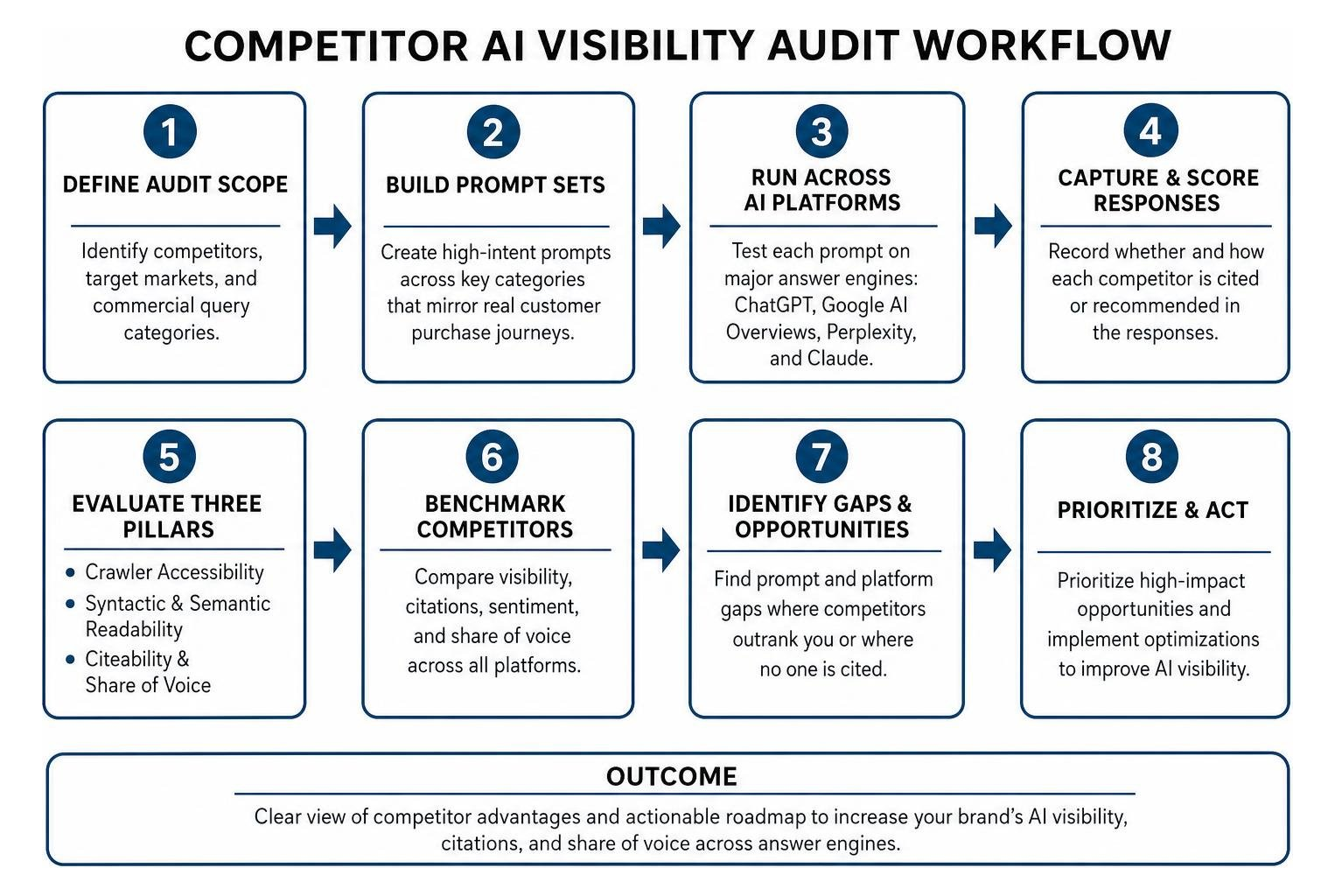
Running an AI Visibility Check to Spot Competitor Citation Gaps
To expose gaps in your AI presence, simulate high-intent queries that mimic real customer purchase journeys. Group your audit queries into distinct commercial categories:
- Category Leader Prompts: “Who are the top commercial HVAC contractors in South Florida?”
- Feature Comparison Prompts: “What is the difference between [Competitor A] and [Your Company] for dental implants in Palm Beach County?”
- Problem-Solution Prompts: “What is the best legal software for automated trust accounting in Florida?”
- Validation Prompts: “Is [Competitor B] reliable, and what are their primary strengths and weaknesses?”
Log every response across multiple platforms. Note whether your competitor is cited as a live source, if their brand name appears in bulleted lists, and what web URLs the answer engine references. When you find queries where competitors appear but your site is completely absent, you have identified a citation gap. Reviewing LLM SEO Audit Best Practices and mastering How to GEO provides the exact blueprint needed to close these competitive voids.
Decoding Technical Crawler Access and Edge Firewall Blocks
A frequent finding during competitor audits is that an invisible site is simply blocked at the server or edge layer. Webmasters often configure aggressive bot protection rules via Cloudflare, AWS WAF, or generic security plugins that treat AI search fetchers like malicious scrapers.
To diagnose these accessibility barriers, test your domain against major AI crawlers:
- OpenAI:
GPTBot(model training) andOAI-SearchBot/ChatGPT-User(live web search and browsing). - Anthropic:
ClaudeBot(training) andClaude-SearchBot/Claude-User(live citations). - Perplexity:
PerplexityBot(search indexing and real-time citation retrieval). - Google:
Googlebotand specialized Gemini retrieval crawlers.
Ensure your robots.txt file does not contain blanket disallow rules that inadvertently shut out search-tier AI crawlers. For deeper technical insights, consult our breakdown of AI Search Ranking Factors.
Key Insights Uncovered from Competitor LLM Citations and Sentiment
Running a competitor audit reveals qualitative data about how language models perceive brand value, customer service, and market authority.
Analyzing Share of Voice and Recommendation Sentiment
Generative models do not just count links; they synthesize sentiment and brand reputation across multiple web references. When ChatGPT or Gemini generates a business recommendation, it attaches descriptive attributes to each company.
During your audit, evaluate:
- Contextual Sentiment: Is the competitor described as “affordable,” “premium,” “industry-leading,” or “outdated”?
- Attribute Accuracy: Is the AI hallucinating old pricing, retired services, or incorrect office locations?
- Competitive Positioning: In head-to-head comparison prompts, does the AI recommend the competitor due to a higher volume of third-party reviews?
Leveraging Generative Engine Optimization Services 101 allows businesses to systematically improve negative or neutral sentiment. When managing interactive systems or municipal portals, clear notices like the AI Chatbot Disclaimer | Martin County Florida demonstrate how public entities document automated boundaries and data reliability.
The Power of Listicle Citations and Third-Party Authority Signals

One of the most eye-opening findings from competitive AI audits is where language models source their facts. AI engines rarely rely solely on a company’s homepage; instead, they lean heavily on consensus across the broader web.
Consider these critical research insights:
- 43.8% of ChatGPT citations come from “best X” style listicles. Recommendation and comparison roundups carry massive weight during live synthesis.
- There is a 0.737 correlation between YouTube mentions and AI brand visibility. This correlation is stronger than traditional backlinks or Domain Rating in the same research dataset. Video transcripts serve as high-trust, structured conversational data for AI training and live grounding.
To discover how to harness multi-channel authority, study The Ultimate Guide to Generative Engine Optimization and AI Search Visibility.
Technical and Content Fixes to Outperform Competitors in AI Engines

Once you understand why competitors outrank you in AI responses, you can implement technical and editorial enhancements to claim top visibility.
Implementing Machine-Readable Schema and llms.txt Files
AI search engines thrive on predictable structure. If your site structure is messy or ambiguous, an LLM will struggle to extract clear answers.
- Deploy JSON-LD Structured Data: Add comprehensive schema markup across your site, including
Organization,Service,Product,FAQPage, andHowTotypes. IncludesameAsattributes linking directly to authoritative entity profiles such as Crunchbase, LinkedIn, Google Business Profile, and industry directories. - Publish an
llms.txtFile: Place a plain-text markdown file at the root of your domain (yourdomain.com/llms.txt). This emerging web standard provides LLM crawlers with a curated, lightweight guide summarizing your core services, brand value proposition, and key documentation.
To align your site architecture with LLM standards, review our guides on how to Speak the AI’s Language Optimizing Content for Large Language Models and apply actionable Generative SEO Techniques.
Eliminating JavaScript Rendering Traps with Server-Side HTML
A major cause of AI invisibility is client-side rendering. While Google’s web indexer can render complex JavaScript, many AI search fetchers fetch only raw HTML to save compute power and reduce latency during live queries. If your pricing tables, core service descriptions, or business details require client-side execution to appear on the screen, AI answer engines will see a blank page.
To guarantee maximum visibility:
- Serve critical business content in clean, server-rendered HTML.
- Organize text using a single logical
H1tag followed by sequentialH2andH3subheaders. - Write direct, definitive answer paragraphs (40 to 60 words) immediately beneath question-based subheadings to facilitate easy extraction by answer engines.
- Maintain regular content freshness signals by displaying visible “Last Updated” timestamps.
For deep technical execution, see our guide on Large Language Model SEO.
Frequently Asked Questions About AI Visibility
How is an AI visibility score calculated?
An AI visibility score evaluates your website across multiple technical and contextual readiness dimensions on a 0 to 100 scale:
- Access and Crawlability (30–35%): Unrestricted access for search-tier AI crawlers in
robots.txtand edge firewalls. - Machine Readability and HTML Quality (20–30%): Clean server-rendered HTML, proper semantic tag hierarchies, language attributes, and high content-to-code ratios.
- Structured Data and Identity Signals (15–25%): Valid JSON-LD schema markup, active
llms.txtfiles, and consistentsameAsentity mappings. - Citeability and Recommendability (15–20%): Direct inclusion in third-party listicles, high review sentiment, and natural answers that match common conversational prompts.
A score of 85 or above represents strong AI readiness, while scores below 70 indicate critical technical or authority gaps that prevent consistent citations.
What is the difference between GEO, AEO, and LLM optimization?
While these three disciplines work together to build modern digital authority, each addresses a unique layer of search technology:
- AEO (Answer Engine Optimization): Optimizing factual, structured content so answer engines can extract immediate answers for direct queries and voice search.
- GEO (Generative Engine Optimization): Structuring content, comparisons, and third-party authority so multi-modal generative engines (like Google AI Overviews and Perplexity) recommend your brand inside synthesized solutions.
- LLM Optimization: Establishing long-term digital entity authority, cross-web consensus, and contextual training data presence across foundational AI models.
To dive deeper into how these strategies integrate, read our breakdown of Answer Engine Optimization AEO GEO LLM SEO.
Why does my competitor appear in ChatGPT answers when they have lower Google rankings?
AI assistants do not rely exclusively on traditional Google SERP algorithms. Research demonstrates that 28% of the pages cited most frequently by ChatGPT hold zero organic search visibility in Google. AI answer engines prioritize:
- Clear, quotable answers that directly address complex conversational prompts.
- Frequent mentions across third-party listicles, Reddit threads, industry forums, and YouTube video transcripts.
- Server-side text delivery that can be parsed rapidly without client-side JavaScript execution.
- High semantic entity consensus across multiple independent web directories.
If a competitor excels in these areas, conversational AI models will cite and recommend them regardless of their traditional organic rank.
Conclusion
As digital search evolves, monitoring your competitors through regular AI visibility audits is no longer optional. It is a vital strategy for protecting your market share. When prospective clients turn to conversational assistants to decide which company to hire, you must ensure your brand is cited clearly, positively, and consistently.
At BullsEye Internet Marketing, we help businesses dominate search results and capture high-intent buyers across all 50 states—including local markets throughout Florida such as Miami, Fort Lauderdale, West Palm Beach, Boca Raton, Hollywood, Coral Gables, and Boynton Beach. We provide a unique competitive advantage: we operate without long-term contracts and work with only one client per industry per geographic territory.
Ready to discover how AI assistants view your company compared to your competitors? Contact us today to launch your tailored AI Visibility Optimization strategy and secure exclusive market dominance in your region.
