
Why Google Rich Results Matter for Your Business
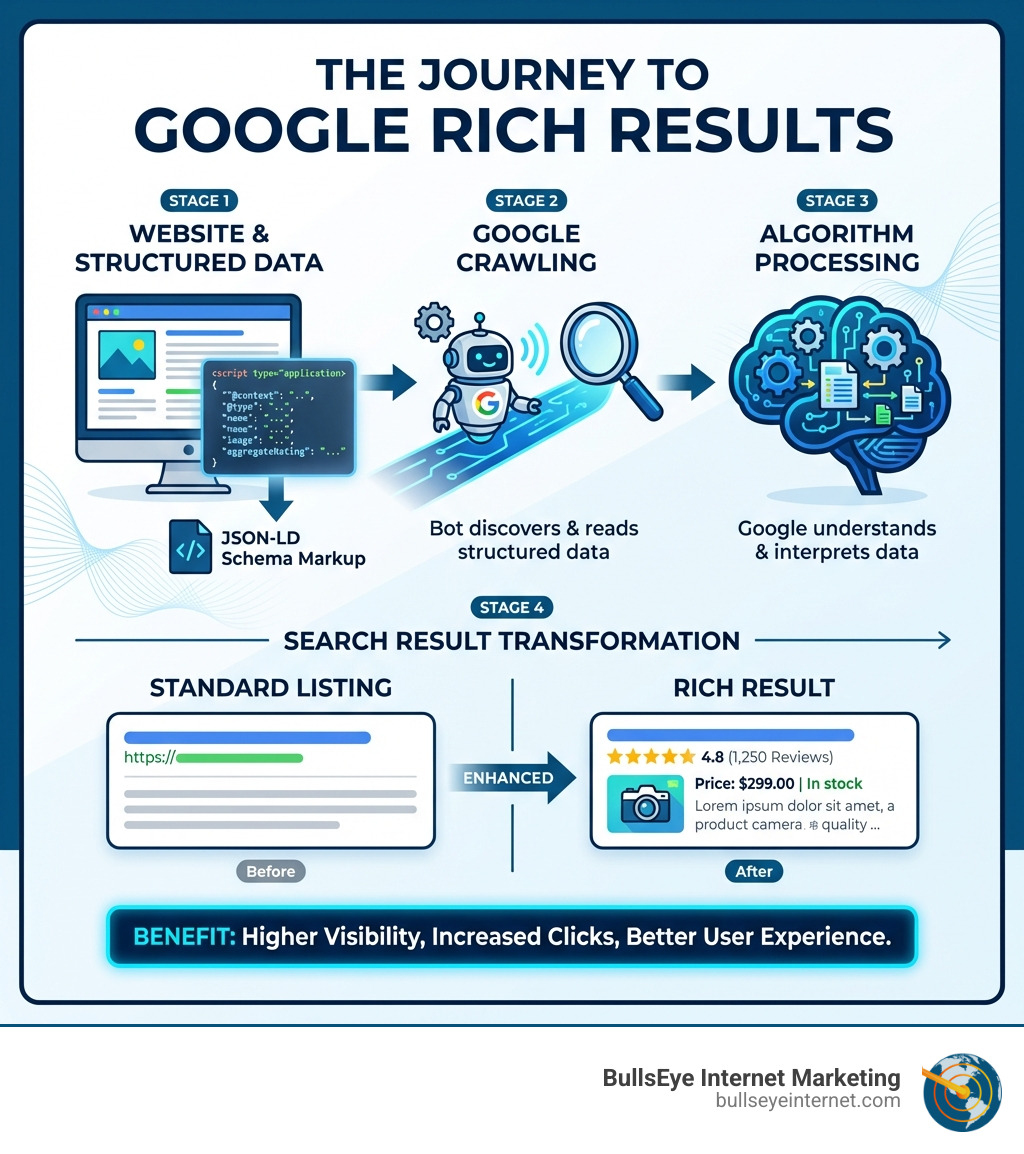
Google rich results are search listings with extra visual information beyond the standard blue link, title, and description. They can include images, star ratings, prices, and FAQs to make your listing stand out on the search results page.
Here’s what you need to know:
- What they are: Improved search results with extra visual or interactive features.
- How they work: Google reads structured data (Schema markup) on your website to create these improved displays.
- Key benefit: Businesses have seen CTR increases ranging from 491% to 1194% when rich results appear.
- Common types: Product snippets, reviews, recipes, FAQs, local business info, events, and articles.
- Implementation: Add JSON-LD structured data to your website’s code.
- No ranking boost: Rich results don’t directly improve rankings, but they significantly increase clicks.
Why does this matter? When competitors are plain blue links, your listing with star ratings or images gets the click—even if you’re not ranked #1. More clicks mean more customers and better ROI.
I’m Ronnie Katz, founder of BullsEye Internet Marketing. Since 2006, I’ve helped businesses use structured data to get rich results. With over 20 years of experience, I’ve seen how they transform search visibility and generate qualified leads for companies across South Florida and the rest of the United States.
Let’s explore how rich results work and how you can use them to stand out.
What Are Rich Results and How Do They Work?
Imagine searching for a seafood restaurant in Miami. Would you click a plain blue link or one showing a 4.5-star rating and a photo of a great dish? You’d pick the latter. That’s the power of Google rich results.
Google rich results are search listings that go beyond the basic title, URL, and meta description. They are visually improved with images, review stars, prices, and other details from your website. These “extra details” on the search engine results page (SERP) make your listing more appealing.
Google generates these results when it finds structured data (Schema Markup) on your pages. This code helps search engines understand your content, not just crawl text. Once Google understands, it may display the information prominently. As Google explains, rich results “display additional information about a page, making them more visually appealing and informative to users.” You can learn more about Google’s explanation of rich results here.
Rich Results vs. Rich Snippets vs. SERP Features
SEO has many terms like “rich results,” “rich snippets,” and “SERP features.” Let’s clarify them.
- Rich Snippets: This is an older term Google used for search results with extra data like star ratings or prices. Today, Google uses “rich results” and “rich snippets” interchangeably.
- Rich Results: This is Google’s current preferred term. A rich result is an improved search result on Google’s SERP achieved by implementing structured data (Schema Markup). They are visually appealing and help users make informed decisions before clicking.
- SERP Features: This is the broadest category, encompassing any non-standard search result on Google. This includes rich results, but also Knowledge Panels, Featured Snippets, People Also Ask boxes, and more. While Google rich results are a type of SERP feature, not all SERP features are rich results.
Here’s a quick comparison:
| Feature | Definition | How it’s Generated | Example Visual Improvement |
|---|---|---|---|
| Rich Results | Improved search listings with extra details derived from structured data. | From structured data (Schema Markup) on your page. | Star ratings, prices, images, event dates, FAQ dropdowns. |
| Rich Snippets | Older term, now used interchangeably with Rich Results. | Same as Rich Results. | Same as Rich Results. |
| SERP Features | Any non-standard search result on Google. | Can be from structured data, algorithmic determination, or other Google data sources. | Rich Results, Featured Snippets, Knowledge Panels, PAA boxes. |
The Role of Structured Data (Schema Markup)
Structured data (Schema Markup) is the foundation of every Google rich result. It’s a language that helps search engines understand your content’s context, like whether a number is a price or a rating.
Schema.org is a collaborative project that provides a vocabulary of tags (microdata) to add to your HTML. This improves how search engines represent your page in SERPs. It offers over 1,300 properties for various content types, from products to local businesses.
Google recommends the JSON-LD format for structured data. It’s easy to implement as a script in your HTML’s or , separate from visible content. The code provides context to search engines about your page’s information.
For example, for a key lime pie from a Palm Beach County bakery, structured data can tell Google: “This is a product named ‘Key Lime Pie,’ priced at $25, with a 4.8-star rating from 150 reviews, and it’s in stock.” Without it, Google sees the data but doesn’t understand its relationship to the product.
Google states it “uses structured data… to understand the content of the page, as well as to gather information about the web and the world in general.” This understanding allows Google to display your content as a Google rich result, giving you an edge.
The SEO Impact: Why Rich Results Are a Game-Changer
In South Florida’s competitive market, from Miami to St. Lucie County, every advantage counts. Google rich results are a powerful SEO tool that can boost your online visibility and success.
Understanding the Benefits of Google Rich Results
The benefits of implementing Google rich results are numerous and directly contribute to a stronger online presence:
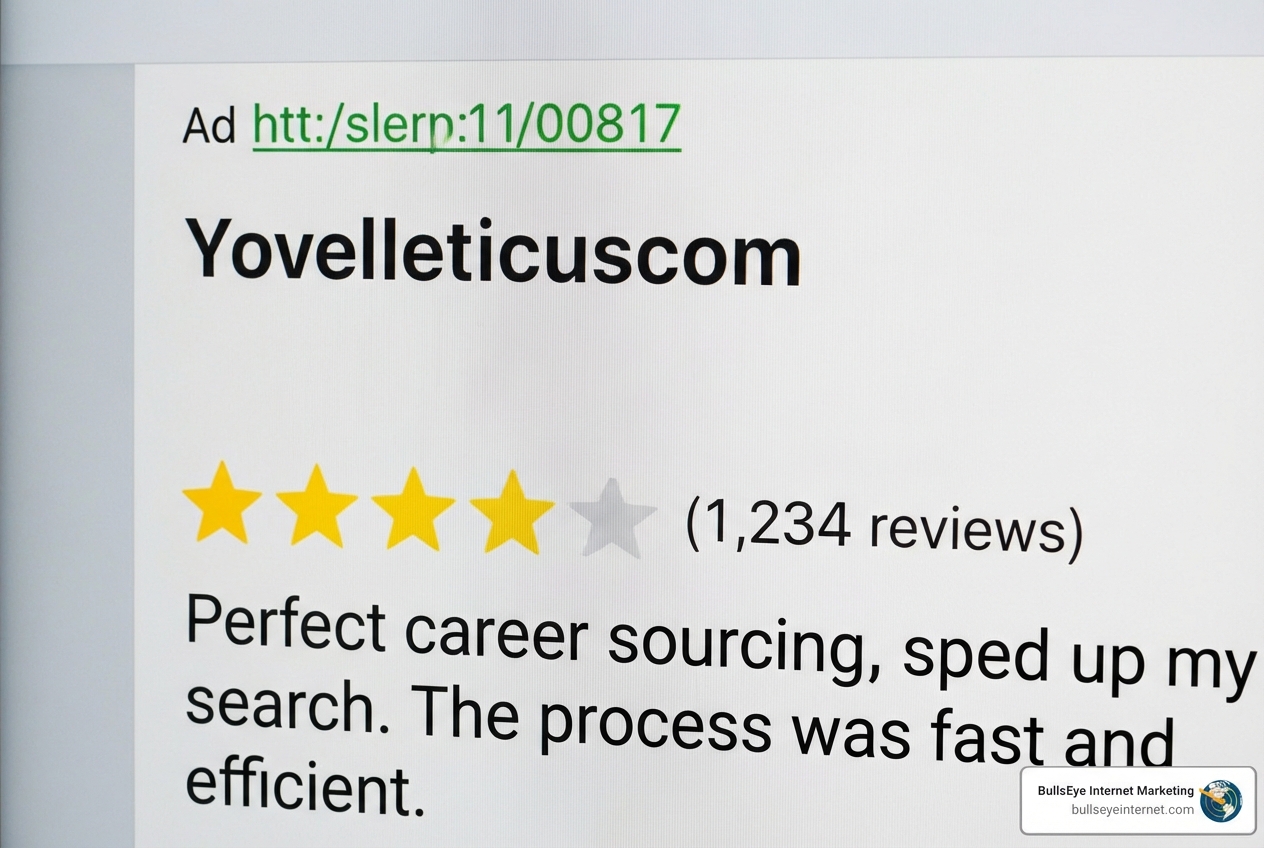
- Increased Visibility and Click-Through Rate (CTR): This is the most immediate benefit. Listings with images or ratings draw the eye. For example, Baptist Health saw a 491% CTR increase on physician pages with review snippets. Another client’s JobPosting rich results increased CTR by 1194%. Visually distinct results make users “35% more likely” to click, driving more traffic to your site.
- Standing Out on the SERP: In a sea of blue links, a rich result stands out. Features like star ratings, prices, or expandable FAQs make your listing more prominent.
- Building Trust and Authority (E-E-A-T): Review snippets with star ratings and review counts build credibility and instill confidence. This supports Google’s E-E-A-T (Experience, Expertise, Authoritativeness, and Trustworthiness) guidelines, signaling that your business is reputable.
- Driving Qualified Traffic: Rich results provide key information upfront, like product price and availability. This pre-qualifies visitors, leading to higher engagement and conversion rates on your site.
- Improved User Experience: By providing key information on the SERP, rich results improve the user experience. Users find what they need faster, making their search more efficient.
- Competitive Advantage: Fewer businesses use structured data effectively. Implementing it gives you an edge over competitors with standard listings, especially in local markets like Broward or Palm Beach County.
Do Rich Results Directly Affect Rankings?
A common question is whether rich results directly affect rankings. The answer is no. Google has stated that adding structured data won’t automatically boost your ranking.
However, the indirect benefits are strong and can improve search performance over time:
- Indirect Ranking Signals: Rich results often lead to higher CTRs. Many SEO professionals believe Google uses click data as one of many signals. More clicks can indicate higher relevance, which may help your position over time. It can become a virtuous cycle: rich results get more clicks, which can lead to better rankings and more visibility.
- Improved Understanding for Google: Google uses structured data to better understand your content. This allows Google to match your page to relevant queries more effectively, which can indirectly improve your visibility for the right searches.
- Quality Score in Paid Ads: In Google Ads, CTR is part of the Quality Score. A higher Quality Score can lead to a lower cost per click (CPC). This highlights the importance of optimizing for clicks through rich results or ad extensions.
So, while structured data won’t directly boost your rankings, it significantly improves your presence, drives more qualified traffic, and improves user engagement, all of which are positive signals that can indirectly contribute to better SEO performance.
A Practical Guide to Implementing Google Rich Results
Implementing Google rich results may sound technical, but it’s a straightforward process once you break it into clear steps. Here’s a practical guide you can follow or hand off to your developer.
Step 1: Identify and Prepare Your Content
First, identify and prepare eligible content on your website.
- Match Content to a Supported Rich Result Type: Match your content to one of Google’s 32+ rich result types. Consider your content’s intent and choose the best Schema type. For example, a local business in Doral would use LocalBusiness schema for its contact page.
- Review Your Pages: Review your site and identify pages with information that could be improved, such as:
- Product pages: Do they clearly display price, availability, images, and customer reviews?
- Article pages: Do they have a clear author, publication date, and headline?
- Recipe pages: Do they include ingredients, cooking time, and nutritional information?
- FAQ pages: Are the questions and answers clearly laid out?
- Ensure All Required Information is Visible on the Page: Ensure all marked-up information is visible on the page. Google’s guidelines require that content in your rich result must also appear on your page. For example, a marked-up price must be visible to users. This prevents “schema drift” and ensures honesty.
Step 2: Create and Add Your Schema Markup
Once you’ve identified what to mark up, create the structured data. Google recommends using JSON-LD.
Here are popular methods for creating and adding your Schema Markup:
- Manual Coding (JSON-LD): Manually write JSON-LD into your page’s HTML for the most control. The script is usually placed in the
or.
<script type="application/ld+json">
{
  "@context": "https://schema.org",
  "@type": "Product",
  "name": "Luxury Boat Rental",
  "image": "https://your-website.com/boat.jpg",
  "description": "Experience the beautiful waters of Miami-Dade County with our luxury boat rental service.",
  "offers": {
 "@type": "Offer",
 "priceCurrency": "USD",
 "price": "1500.00",
 "availability": "https://schema.org/InStock"
  },
  "aggregateRating": {
 "@type": "AggregateRating",
 "ratingValue": "4.9",
 "reviewCount": "125"
  }
}
</script>
- Using Plugins for CMS (like WordPress): For CMS platforms like WordPress, plugins can simplify adding structured data, often automatically or through simple interfaces.
- Google’s Structured Data Markup Helper: Google’s free Structured Data Markup Helper is useful for beginners. Paste your URL, visually tag elements like price or name, and the tool generates the JSON-LD code for you to copy and paste.
Step 3: Test and Validate Your Code
After adding structured data, you must test and validate it to ensure it’s correct and eligible for rich results.
- Importance of Validation: Validation is vital. A single error can invalidate your markup. Tools check your syntax and required properties for your chosen Schema type.
- Using the Rich Results Test: We recommend Google’s Rich Results Test. Paste a URL or code snippet, and the tool will:
- Tell you if your page is eligible for any Google rich results.
- Identify any errors or warnings in your structured data.
- Show you which rich result types were detected.
- Provide a preview of how your rich result might look in Google Search.

- Using the Schema.org Validator: The Schema.org Validator is another useful tool. It doesn’t check for Google eligibility but is great for validating the technical correctness of your Schema.org markup.
- Fixing Errors and Warnings: If the Rich Results Test finds errors, the tool will highlight them and provide links to documentation. Fix critical errors first, as they prevent rich results from appearing. Warnings are less severe but should still be addressed.
Exploring the Most Valuable Rich Result Types
With over 32 types of rich results, prioritization can be overwhelming. Match the rich result type to your business goals and content. We recommend exploring Google’s complete gallery of rich results.
Common Types of Google Rich Results
Here are some of the most impactful rich results for businesses, especially service-based ones in Florida:
- Product Snippet: Essential for e-commerce, a Product rich result displays price, ratings, and availability on the SERP, helping customers make faster decisions. This is a game-changer for a business selling fishing gear in Fort Lauderdale.
- Review Snippet: Crucial for building trust, Review snippets show star ratings for products, services, and local businesses. They significantly impact reputation and CTR, making them powerful for any service business, from AC repair in Hialeah to legal services in Miami.
- FAQ (Frequently Asked Questions): The FAQ rich result displays questions and answers in an expandable section on the SERP. This adds immediate value and makes your listing larger, which is great for informational or support pages.
- Recipe: For food-related content, the Recipe rich result can show images, ratings, prep times, and nutritional info.
- Article: For blogs and news sites, the Article rich result can show a larger image, headline, and date to make your content stand out.
- Local Business: Crucial for local businesses in areas like West Palm Beach, the Local Business rich result provides key info like address, hours, and ratings in search and Maps, driving foot traffic and calls.
Improved Results That Are NOT Rich Results
It’s important to distinguish rich results (from your site’s structured data) from other SERP features that Google generates algorithmically.
- Featured Snippets: These visible boxes at the top of the SERP (“position zero”) give a direct answer to a query. They are determined by Google’s algorithms, not specific structured data. You can optimize for them by clearly answering questions, but they can sometimes reduce clicks to your site.
- Knowledge Panels: These info boxes on the side of the SERP provide details about an entity (like a person or business). A knowledge panel is generated from Google’s Knowledge Graph, using data from sources like Wikipedia and your own site. A Google Business Profile is key for a local business to get one.
- People Also Ask (PAA) boxes: These boxes show related questions that expand with answers pulled from web pages. They are determined by Google’s algorithms, though Q&A schema can help. They are also a great source for keyword research.
These improved results are incredibly valuable for visibility, but they differ from Google rich results because their appearance is less directly controlled by the structured data you implement on your site.
Monitoring and Troubleshooting Your Rich Results
Implementing structured data is just the first step. Like any SEO effort, you must monitor and troubleshoot your Google rich results to ensure they appear correctly and continue to perform.
Using the Rich Results Report in Google Search Console
Google Search Console (GSC) is the best tool for monitoring your rich results. Its reports show the status of your structured data and any issues.
- Locating the Report: To find the reports, open Google Search Console and go to the “Improvements” section in the left-hand menu. Product-related reports are under “Shopping.”
- Understanding the Summary Chart: The summary chart breaks down your structured data into three categories:
- Valid: These items don’t have any critical errors and are eligible to appear as Google rich results.
- Valid with warnings: These items are eligible but have non-critical issues you should address.
- Invalid: These items have critical errors that prevent them from appearing as Google rich results. These are your top priority to fix.
- Drilling Down into Specific Issues: The reports list specific errors and warnings. Click an issue to see details and affected URLs, allowing you to pinpoint pages needing attention. Reports show items (structured data pieces), not just pages. Find an overview of GSC rich result reports for more detail.
How to Troubleshoot Common Issues
Finding errors in your reports is normal. The key is knowing how to fix them.
- Using the URL Inspection Tool: The URL Inspection tool in GSC is invaluable for troubleshooting. Enter an affected URL, and Google will provide details on how it sees the page, including:
- Whether the page was successfully crawled and indexed.
- The rendered HTML that Google’s bot sees.
- Any structured data detected and its validation status.
- Specific error messages related to structured data.
- Understanding Error Messages: Common errors include:
- “Missing field ‘name'”: A required property is missing.
- “Invalid value for field ‘price'”: The data doesn’t match the expected format (for example, text instead of a number).
- “The value specified for a field was of the wrong type”: Check the structured data documentation for the required value type.
- Checking for Schema Drift: This happens when your structured data contains information not visible on the page. Google requires marked-up content to be visible. For example, if your schema price doesn’t match the visible price, Google may invalidate your rich result.
- Ensuring Content is Crawlable: Google must be able to crawl your page to process structured data. Ensure your
robots.txtfile doesn’t block Google’s crawlers from your pages or critical resources like CSS and JavaScript. Ifrobots.txtis unreachable, Google won’t crawl the site. Check its availability in GSC’s Crawl Stats report.
Regularly checking your GSC reports and promptly addressing any issues will help maintain your eligibility for Google rich results, ensuring your business continues to stand out.
Harness Google Rich Results to Boost CTR | BullsEye Internet Marketing
We’ve explored the rewarding world of Google rich results, from what they are to the technical details of structured data. You should now see the immense potential they hold for your business.
While rich results don’t directly boost rankings, they increase visibility, CTR, and trust, delivering more qualified traffic. Statistics show CTR increases of hundreds or even thousands of percent. This can mean more leads and sales for businesses in Florida and across the United States, from Biscayne Gardens to Wellington.
Implementing structured data might seem technical, but with tools like Google’s Structured Data Markup Helper and the Rich Results Test, it’s more accessible than ever. The key is to:
- Identify the rich result types that best suit your content and business objectives.
- Create accurate JSON-LD Schema Markup that reflects the content visible on your pages.
- Validate your code carefully using Google’s tools.
- Monitor your performance and troubleshoot any issues proactively in Google Search Console.
At BullsEye Internet Marketing, we help businesses steer complex SEO, including using Google rich results for a competitive advantage. We help you take control of your search appearance and turn queries into opportunities.
Don’t let competitors steal the spotlight. It’s time to improve your online presence and shine on the SERP.
Learn more about our comprehensive SEO services to see how we can help you generate more calls, leads, and sales.
